Evidence from brain science suggests that far from being “babyish,” the technique is essential for mathematical achievement.
A few weeks ago I (Jo Boaler) was working in my Stanford office when the silence of the room was interrupted by a phone call. A mother called me to report that her 5-year-old daughter had come home from school crying because her teacher had not allowed her to count on her fingers. This is not an isolated event—schools across the country regularly ban finger use in classrooms or communicate to students that they are babyish. This is despite a compelling and rather surprising branch of neuroscience that shows the importance of an area of our brain that “sees” fingers, well beyond the time and age that people use their fingers to count.
In a study published last year, the researchers Ilaria Berteletti and James R. Booth analyzed a specific region of our brain that is dedicated to the perception and representation of fingers known as the somatosensory finger area.
 |
Philippe Lissac / Godong / Corbis |
Remarkably, brain researchers know that we “see” a representation of our fingers in our brains, even when we do not use fingers in a calculation. The researchers found that when 8-to-13-year-olds were given complex subtraction problems, the somatosensory finger area lit up, even though the students did not use their fingers. This finger-representation area was, according to their study, also engaged to a greater extent with more complex problems that involved higher numbers and more manipulation. Other researchers have found that the better students’ knowledge of their fingers was in the first grade, the higher they scored on number comparison and estimation in the second grade. Even university students’ finger perception predicted their calculation scores. (Researchers assess whether children have a good awareness of their fingers by touching the finger of a student—without the student seeing which finger is touched—and asking them to identify which finger it is.)
Evidence from both behavioral and neuroscience studies shows that when people receive training on ways to perceive and represent their own fingers, they get better at doing so, which leads to higher mathematics achievement. The tasks we have developed for use in schools and homes (see below) are based on the training programs researchers use to improve finger-perception quality. Researchers found that when 6-year-olds improved the quality of their finger representation, they improved in arithmetic knowledge, particularly skills such as counting and number ordering. In fact, the quality of the 6-year-old’s finger representation was a better predictor of future performance on math tests than their scores on tests of cognitive processing.
Many teachers have been led to believe that finger use is useless and something to be abandoned as quickly as possible.
Neuroscientists often debate why finger knowledge predicts math achievement, but they clearly agree on one thing: That knowledge is critical. As Brian Butterworth, a leading researcher in this area, has written, if students aren’t learning about numbers through thinking about their fingers, numbers “will never have a normal representation in the brain.”
One of the recommendations of the neuroscientists conducting these important studies is that schools focus on finger discrimination—not only on number counting via their fingers but also on helping students distinguish between those fingers. Still, schools typically pay little if any attention to finger discrimination, and to our knowledge, no published curriculum encourages this kind of mathematical work. Instead, thanks largely to school districts and the media, many teachers have been led to believe that finger use is useless and something to be abandoned as quickly as possible. Kumon, for example, an after-school tutoring program used by thousands of families in dozens of countries, tells parents that finger-counting is a “no no” and that those who see their children doing so should report them to the instructor.
Stopping students from using their fingers when they count could, according to the new brain research, be akin to halting their mathematical development. Fingers are probably one of our most useful visual aids, and the finger area of our brain is used well into adulthood. The need for and importance of finger perception could even be the reason that pianists, and other musicians, often display higher mathematical understanding than people who don’t learn a musical instrument.
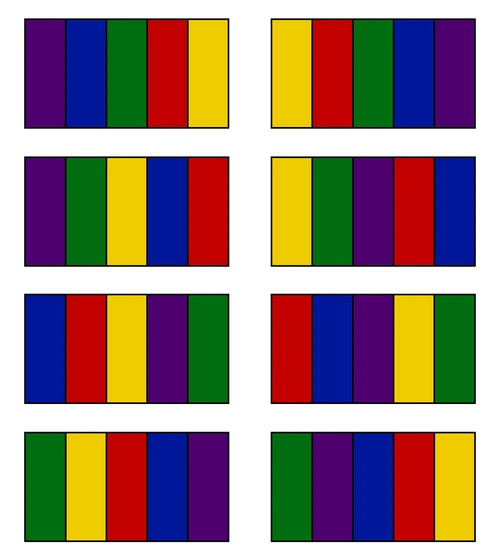
Teachers should celebrate and encourage finger use among younger learners and enable learners of any age to strengthen this brain capacity through finger counting and use. They can do so by engaging students in a range of classroom and home activities, such as:
Give the students colored dots on their fingers and ask them to touch the corresponding piano keys:
 |
youcubed.org |
 |
youcubed.org |
Give the students colored dots on their fingers and ask them to follow the lines on increasingly difficult mazes:
(The full set of activities is given here.)
The finger research is part of a larger group of studies on cognition and the brain showing the importance of visual engagement with math. Our brains are made up of “distributed networks,” and when we handle knowledge, different areas of the brain communicate with each other. When we work on math, in particular, brain activity is distributed among many different networks, which include areas within the ventral and dorsal pathways, both of which are visual. Neuroimaging has shown that even when people work on a number calculation, such as 12 x 25, with symbolic digits (12 and 25) our mathematical thinking is grounded in visual processing.
A striking example of the importance of visual mathematics comes from a study showing that after four 15-minute sessions of playing a game with a number line, differences in knowledge between students from low-income backgrounds and those from middle-income backgrounds were eliminated.
Number-line representation of number quantity has been shown to be particularly important for the development of numerical knowledge, and students’ learning of number lines is believed to be a precursor of children’s academic success.
Visual math is powerful for all learners. A few years ago Howard Gardner proposed a theory of multiple intelligences, suggesting that people have different approaches to learning, such as those that are visual, kinesthetic, or logical. This idea helpfully expanded people’s thinking about intelligence and competence, but was often used in unfortunate ways in schools, leading to the labeling of students as particular type of learners who were then taught in different ways. But people who are not strong visual thinkers probably need visual thinking more than anyone. Everyone uses visual pathways when we work on math. The problem is it has been presented, for decades, as a subject of numbers and symbols, ignoring the potential of visual math for transforming students’ math experiences and developing important brain pathways.
It is hardly surprising that students so often feel that math is inaccessible and uninteresting when they are plunged into a world of abstraction and numbers in classrooms. Students are made to memorize math facts, and plough through worksheets of numbers, with few visual or creative representations of math, often because of policy directives and faulty curriculum guides. The Common Core standards for kindergarten through eighth grade pay more attention to visual work than many previous sets of learning benchmarks, but their high-school content commits teachers to numerical and abstract thinking. And where the Common Core does encourage visual work, it’s usually encouraged as a prelude to the development of abstract ideas rather than a tool for seeing and extending mathematical ideas and strengthening important brain networks.
To engage students in productive visual thinking, they should be asked, at regular intervals, how they see mathematical ideas, and to draw what they see. They can be given activities with visual questions and they can be asked to provide visual solutions to questions. When the youcubed team (a center at Stanford) created a free set of visual and open mathematics lessons for grades three through nine last summer, which invited students to appreciate the beauty in mathematics, they were downloaded 250,000 times by teachers and used in every state across the U.S. Ninety-eight percent of teachers said they would like more of the activities, and 89 percent of students reported that the visual activities enhanced their learning of mathematics. Meanwhile, 94 percent of students said they had learned to “keep going even when work is hard and I make mistakes.” Such activities not only offer deep engagement, new understandings, and visual-brain activity, but they show students that mathematics can be an open and beautiful subject, rather than a fixed, closed, and impenetrable subject.
Some scholars note that it will be those who have developed visual thinking who will be “at the top of the class” in the world’s new high-tech workplace that increasingly draws upon visualization technologies and techniques, in business, technology, art, and science. Work on mathematics draws from different areas of the brain and students need to be strong with visuals, numbers, symbols and words—but schools are not encouraging this broad development in mathematics now. This is not because of a lack of research knowledge on the best ways to teach and learn mathematics, it is because that knowledge has not been communicated in accessible forms to teachers. Research on the brain is often among the most impenetrable for a lay audience but the knowledge that is being produced by neuroscientists, if communicated well, may be the spark that finally ignites productive change in mathematics classrooms and homes across the country.
(Source: The Atlantic)


