Showing posts with label French. Show all posts

Monday, 19 July 2021

How Gorky’s adopted son became a French diplomat

 Zinovy Peshkov came from a poor provincial Jewish family, but thanks to his natural talents, he had a brilliant career and even became friends with Charles de Gaulle.

Zinovy Peshkov was a son of a Nizhny Novgorod craftsman, who became a French military commander and diplomat. He was a brother of the famous revolutionary Yakov Sverdlov, but an ardent anti-Bolshevik. A graduate of a provincial parish school, he spoke on equal terms with great writers, military leaders and politicians. Zinovy Peshkov had an amazing life story, full of unexpected twists and turns.  


Adopted by Maxim Gorky 

A future French legionnaire and friend of Charles de Gaulle, Zinovy Sverdlov was born in 1884 to the family of a Jewish craftsman in Nizhny Novgorod. The world famous Russian writer Maxim Gorky (his real name was Alexey Peshkov) came from the same city. Gorky knew the Sverdlov family and was particularly fond of Zinovy, an inquisitive and enthusiastic kid.


The young man soon joined the writer’s circle, where he met many rebellious intellectuals and developed an enthusiasm for revolutionary ideas, which even landed him in trouble with the police. They say that after Zinovy converted to the Russian Orthodox Church, his Jewish family renounced him and Gorky adopted him, giving the young man his name. 


Zinovy was very gifted artistically. He had a beautiful voice and a great ear for music and even considered becoming a professional musician. However, his life took a different turn. At the age of 20, Zinovy left Russia in search of adventure and interesting work. Another motive was to escape the watchful eye of the police...  


A friend of de Gaulle 

Canada, the U.S., New Zealand... Abroad, Peshkov worked as a loader at a brick factory, at a fur factory and in a printing house. He tried his hand at business, but went bankrupt. He had relative success working in a Russian publishing house in the U.S., before travelling to France, where he found himself caught in the outbreak of World War I. 

Unlike the revolutionaries he used to know back in Russia, Zinovy did not want Russia and its allies to suffer a defeat in the war. Without a second thought, he signed up as a volunteer. Since foreigners were not allowed to join the French army, he ended up in the Foreign Legion.


In 1915, in an attack near Arras, Peshkov was badly wounded in the arm. The orderlies thought there was no hope for him and wanted to leave him on the battlefield. However, Zinovy’s life was saved by a lieutenant named Charles de Gaulle, who insisted that the wounded soldier be evacuated from the field. Zinovy was then sent to an American hospital in Neuilly.


The arm had to be amputated, but the patient showed great perseverance and learned to manage perfectly well with one arm. That same year, under an order from Marshal Joffre, the Russian legionnaire was awarded the Croix de Guerre with palm at a ceremony in Les Invalides. As for his savior de Gaulle, the two men would become friends. And there was a new war awaiting them... 


An enemy with his brother 

At first, both Zinovy and his brother Yakov were quite taken with revolutionary ideas. However, in the end, different life paths led them to opposite sides of the barricades, turning them into ideological enemies. Zinovy did not accept the Bolshevik Revolution, with its violence and desire to seize and divide everything.


“With him, it was more about some romantic notions of revolutions, which were typical of the young generation at the time. It is for a reason that, after 1917, he never returned to Russia, although, without a doubt, he could have, had he wanted to. Peshkov had long developed different values and ideals. That is why in the Civil War he found himself on the side of the White Army,” says writer and journalist Armen Gasparyan, a member of the Russian Military Historical Society and author of numerous books on Russian military history. 


In the meantime, Zinovy’s brother Yakov became one of the leaders of the Red Terror, a mastermind of repressions against the Cossacks and one of the officials behind the decision to execute the royal family.Yakov publicly disowned his brother, who had become an “agent of the Entente”. In early 1919, Zinovy sent a telegram to Yakov: “Yashka, when we take Moscow, we will hang Lenin first and you second, for what you did to Russia!” But Yashka did not have long to live: in March 1919, he died of the Spanish flu, which was raging in Russia at the time. At least, that was the official version...


It was known that Lenin was not too fond of dangerous rivals.  


Russian-French agent 

His shrewdness and cunning, the ease with which he established contacts, his rhetorical talent and ability to win people over did not go unnoticed in certain circles in France. That was how Peshkov began his diplomatic career. He hit the ground running: very soon Zinovy was sent on very serious and sometimes secret missions to different countries. 


During the Russian Civil War, Peshkov was a member of the French diplomatic mission in the country. He took an active part in the famine relief effort, arranging deliveries of goods from Le Havre and Marseille. He also helped many compatriots to evacuate from war-ravaged Russia.


His next mission was a military one. Peshkov travelled to Morocco, where he was assigned command of a company. The writer André Maurois described him as follows: “…One of those commanders who know how to boost the morale of the humiliated and the insulted, inspiring them to join in the task that the Foreign Legion inherited from the legions of the Roman Empire - the task of serving civilization. When Zinovy Peshkov talks about the Legion, his eyes glint with emotion. He is an apostle of this religion.” 


Despite Peshkov’s anti-Bolshevik views, the French security services kept a close eye on him: After all, his brother was a prominent Bolshevik in Russia and his father was a writer favored by the Soviet regime. That aroused a lot of suspicion. However, today historians are convinced that those suspicions were totally unfounded. “Peshkov certainly did not work for the 7th Directorate of the NKVD of the USSR. Moscow had other sources of information in France. 

But the suspicions that arose are understandable. The papers at the time were full of articles exposing Bolshevik gangsters in Paris. Many emigrants were under suspicion, so it is not surprising that a striking character like Peshkov was, too. But, as far as I know, the Sûreté did not find a single fact indicating his possible ties with Moscow,” Armen Gasparyan said. 


Loyal to France to the last 

In 1940, Zinovy refused to recognize the power of the Nazi occupiers and to serve under the Germans’ command. He was arrested and sentenced to death by a military tribunal. But here, too, he was, once again, saved by his talent of a diplomat and his combat experience in hot spots: he managed to turn his guard, exchange the gold watch that Maxim Gorky had gifted him for a grenade, take the commander hostage, seize a plane and fly it to join de Gaulle’s forces. 


His old friend knew Peshkov’s talents well and entrusted him with serious assignments. Zinovy worked in South Africa to persuade the local authorities to side with the allies. Then, he became the head of the French mission in China and, later, in Japan. Finally, he was elevated to the rank of ambassador. 


During World War II, Zinovy Peshkov received numerous decorations and distinctions, becoming a brigadier general of the French army. He retired in 1950, a highly decorated officer, including with a Grand Cross of the Legion of Honor, and lived in Paris, on rue Lauriston. 


Zinovy died at the age of 82 in Paris and was buried in the cemetery in Sainte-Genevieve-des-Bois. The ceremony was attended by prominent French military figures and politicians. In line with his will, his tombstone carries a simple inscription: “Zinovy Peshkov, a legionnaire.”


(Source: Russia Beyond)

Saturday, 17 April 2021

Hidden women of history: Hélisenne de Crenne, the first French novelist to tell her own story

 In 1538, a new author burst on to the literary scene in Paris. Published by Denys Janot, four new works appeared within five years by a writer known as Hélisenne de Crenne.

The first was Les Angoysses douloureuses qui procedent d'amours (The Torments of Love), a novel that depicted the disastrous consequences of an adulterous affair.


In 1539 came a collection of letters that explored women’s speech, education, friendship and legal rights among its topics.

Vittore Carpaccio’s portrait of a woman reading (1510). Wikiart


In 1540 she published Le Songe (The Dream), a moral and didactic work in which a woman and her lover reflected upon the perils of lust.


Her last known work was a translation into French prose of the first four books of Virgil’s Aeneid (1541), dedicated to the king, Francis I.


Hélisenne de Crenne was the pen name of Marguerite Briet, the daughter of a legal family from Abbeville. Few details of her life are certain, but we know that she obtained a legal separation from her husband, Philippe Fournel, Lord of Crenne, and moved to Paris, the centre of French literary activities and publishing. There she owned several properties. It appears that her son, Pierre, was a student there in 1548.


Hélisenne was the first living woman of the century to be printed in France and hers was the first autobiographical novel to be published in French. The publication of her works was remarkable in several ways.


Speaking out

Women represented less than 1% of all identifiable published authors in 16th-century France. Female literacy and broader education was not as high as for men at the same social levels.


Women at court were producing sophisticated intellectual and creative works that circulated in manuscript. Print publication provided a more open and visible expression than manuscript circulation, but was limited to a more select few. Even women in powerful social positions acknowledged expectations that women should restrict their speech to the domestic sphere.


An illustration from the translation of Virgil’s verse depicts Hélisenne presenting it to the king. Bibliothèque nationale de France


Most women writers provided lengthy justifications or apologies for their venture into print. Hélisenne claimed to hesitate to make “mention of immodest love, which according to the opinion of some shy women could be judged more worthy to be conserved in profound silence than to be published for a widespread audience”. Nevertheless, she pressed on.


Rather than locate herself in a line of female authors, Hélisenne identified herself in a tradition of the male canon for her authority to write. The opening phrase of her Le Songe recalled none other than Cicero as her model:


…in imitation of him, the desire arose in me to relate in detail to you a dream worthy of recording.


Small books to carry

Print publication offered a woman without elite networks access to a large pool of readers, and perhaps a way to reach potential patrons at court.


The dedication of her translation to Francis I and her praise of his sister, Marguerite de Navarre (another prolific author whose works appears in print over the course of the century), in her Letters suggests that Hélisenne may have hoped for their patronage.


Le Songe de madame Helisenne Crenne (1541) Bibliothèque nationale de France


The staggered release of her writings seems to have been planned to heighten their impact. Her publisher, Denys Janot, mainly published works in French, targetting a popular market and using on-trend Roman typeface rather than the heavy, old-fashioned Gothic script.


Most of Hélisenne’s works, like those of other female writers, were in small sizes such as octavo, duodecimo and sextodecimo. These were portable and cheap, unlike the larger-sized folio and quarto scholarly and religious works intended to be consulted in libraries as part of a long-lasting record, though her translation of Virgil’s Aeneid was produced as a folio, with extensive woodcut illustrations.


A female perspective

Hélisenne was one of the first women writers who sought publication of her work seemingly as a conscious contribution to contemporary popular literature.


Her novel, The Torments of Love, involves an unusual structure, retelling the same events from the perspective of three different narrators: Hélisenne, her lover Guénélic, and Guénélic’s best friend, Quézinstra. Each section offers new insights to the overarching narrative, and each has its own distinctive tone and style.


The work’s balancing of elements from chivalric literature and a new emotional sensibility culminates in its conclusion as a battle between Athena and Venus over the book itself.


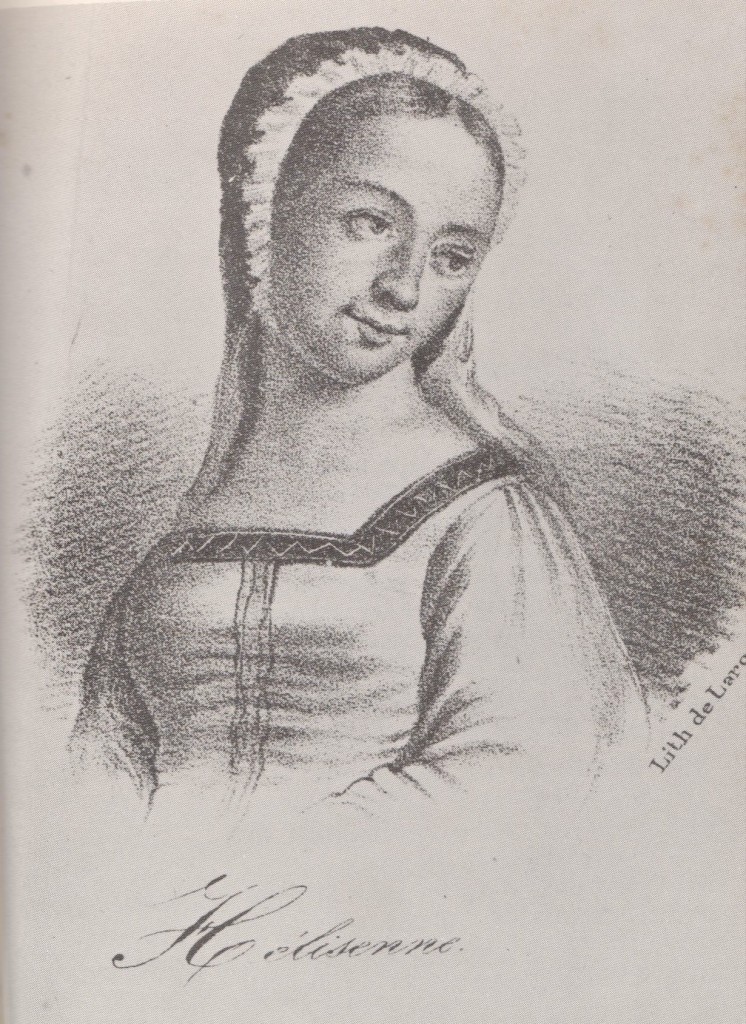
A nineteenth-century artist’s imagined Helisenne. Wikipedia


Her translation of Aeneid was equally radical, creatively embellishing the original from a female perspective with a highly sympathetic presentation of Dido’s plight and women’s loyalty in love.


She was very proud of her publication in the city that was the intellectual and publishing centre of France, saying:


… it is an inestimable pleasure to me to think that my books are on sale in this noble Parisian city, which is inhabited by an innumerable multitude of wonderfully learned people.


A commercial success

Hélisenne’s work were a commercial success, going through nine editions in a short, intense period to 1560.


Torments of Love is Hélisenne’s only work to be dedicated to female readers who she called “all honest ladies”. Elsewhere, she assumed her works would be of interest to everyone, including the king.


A later editor did not agree. Claude Colet explained in the introduction to the 1550 edition of her works that his extensive simplification of her Latinate style for young ladies was “to render the obscure words or those too much like Latin into our own familiar language, so that they will be more intelligible to you”.

The last known evidence of this groundbreaking author is in 1552 but, in her lifetime, she had achieved a remarkable series of literary firsts.


(Source: The Conversation)

Thursday, 25 February 2021

The adopted patriot of Pondicherry

 What makes Pondicherry special? The quaint French quarter? The nice beach? The well stocked bars? Yes, it has all of these. But it also has a special place in Indian history. Did you know that it was a refuge for Indian freedom fighters in the early 20th century? Pondicherry was French territory at that time, and patriots fighting for independence evaded the British police by quietly slipping into Pondicherry. The French and the British were never the greatest of friends. So, Pondicherry welcomed them in the spirit of “my enemy’s enemy is definitely  my friend”!

These patriots were mavericks, each one more amazing than the other. Perhaps the most interesting of those was a poet named Subramania Bharati. He was popularly known as ‘Mahakavi’ or ‘The Great Poet’. He was ‘Great’ alright, but much more than just a poet.


India map showing Puducherry


Born in a village in Tamilnadu in1882, language, poetry and music excited him from a young age. He soon mastered English, Hindi, Sanskrit, Bengali, Telugu and Malayalam.  Some say he knew 14 languages; but it was in his mother tongue of  Tamil, that poetry flowed! He was briefly the court poet of a princely state, but a palace was no place for a free spirit. A chance meeting got him a job as sub-editor of the popular journal ‘Swadesamitran’ at Madras (Chennai). Journalism became his true calling ever after.


Around this same time, he almost single-handedly ran another weekly called the ‘India’. Its publisher trusted Bharati and gave him complete literary  freedom. Bharati wrote about reformist ideas close to his heart: gender equality, democracy, individual liberties, inter-religious harmony, halting caste oppression and a whole lot more. These were avante-garde ideas in the conservative India of that time, and Bharati’s pen became an instrument of change. But one idea got him into serious trouble.


India was then a British colony, and Indians were second class citizens in their own land. Bharati wrote powerful articles inciting Indians to overthrow the British. The British were naturally furious.  British Intelligence watched him closely, waiting for an opportunity to imprison him. Bharti outwitted them by escaping to Pondicherry, which was out-of-limits for the British police. Even today, it is a mystery how he evaded them – some say he escaped by boat.


The year was 1908, and Bharti was barely 27. Ever the optimist, Bharti soon made himself at home in French Pondicherry. He learnt to speak French, could sing  the French national anthem as well as a Frenchman, and studied the works of French intellectuals like Voltaire, Proudhon and Rousseau. He found wonderful friends – fellow revolutionaries-in-hiding like Aurobindo, VVS Iyer and others. Together they were constantly making plans for a new India. His 10 years in Pondicherry were the most productive in terms of his writing. Bharti wrote on diverse topics like nature and environment, love and romance, philosophy and spiritualism.


It was no  holiday, though. His revolutionary work continued. He secretly wrote revolutionary articles and printed his magazine,  ‘India’, from Pondicherry. He knew he was still being tailed by British spies. So he arranged to smuggle copies of the magazine to Madras, hidden under haystacks in  bullock carts.


Subramanya Bharathi


The spies continued to shadow him. One account says that there was one inspector, 9 sub-inspectors, 45 constables, and dozens of paid informants, all keeping a close eye on Bharati and his friends. Bharati lived in and around Easwaran Dharmaraja Koil Street. For various reasons, including security, Bharati kept shifting houses in that area. 


There are many lighter stories around this. On November 22, 1916 a violent storm hit Pondicherry. Bharati had just shifted his family from one house to another. The next morning, he found that his old house had collapsed in the storm. The ever-positive Bharati took it as God’s blessing for leading a principled life. One evening Mrs. Bharati was disturbed because she thought she saw a prowler in the vicinity. Bharati easily allayed her fears: which thief would dare burgle a house watched by so many policemen?


But patriotism alone cannot feed empty stomachs. The British identified Bharati’s secret sponsors in Madras, one by one, and threatened them. Funding for the magazine dried up. Bharati tried to make ends meet by selling articles and poems, but that fetched very little in small Pondicherry. Sometimes, when the landlord demanded rent, Bharati paid up  by composing and delivering a beautiful impromptu poem. Once, when he had no money to pay the doctor who made a house call to treat his daughter, he sang one of his melodious songs as payment! But debts kept mounting. Mrs. Bharati woke up every morning to the abuses of the unpaid milkman. Soon, even Bharati’s charisma was no answer for sheer lack of money.


Bharati resolved to return to Madras. His loving wife and two daughters had always stoically supported him; they did not deserve this suffering!  He would quit politics and direct his journalism to happier themes. An unwritten deal was reached with the British bosses. They would leave him in peace if he quit politics. So, in 1918, he crossed into British Indian territory.  He was arrested by the British immediately. But now, prominent members of the society pressured the government into releasing him.


Bharati’s old employer, the Swadesamitran, welcomed him back. He returned to the life of a normal householder. Unfortunately, it didn’t last long. In 1921, the temple elephant that he loved, attacked him unexpectedly, when he was trying to feed it. Weakened by years of struggle – financial, emotional and physical,  Bharati died soon after. It was a tragic irony that 10 years of poverty in Pondicherry charged him, but 3 years of peace in Madras killed him.


At Pondicherry you can visit Bharati’s last house, lovingly restored by a grateful nation. What was Bharati’s greatest contribution? He had evolved a simple style of prose and poetry that was aesthetically pleasing but rich in meaning. It aroused a liberal outlook and patriotic fervour in an entire generation of Indians and galvanised them into positive action!


Even 200 years after his death, Bharati continues to capture Indian minds. Streets, colonies, Universities and educational institutions all over India are named after him. Tamil movie songs keep borrowing phrases from his poetry. The Govt of India annually awards the Subramania Bharti Award to authors of outstanding works of Hindi literature. To the millions of youngsters today, he is a kind of a poster boy representing freedom. His signature moustache and turban lend themselves easily to poster art.


Detour: Pondicherry’s rich history 

Pondicherry’s heritage dates back to prehistoric times. According to tradition, this place was called Vedapuri and was the centre of Siva worship. That is why even today the deity in the main temple of Pondicherry is called Vedapureeswarar.


There is evidence of Greek and Roman trade in this port during the 1st and 2nd  Cent. CE.


Between the 4th and 13th Cent. CE it was consecutively under the Pallava, Chola and Pandyan empires. In the 15th century it was part of the Vijayanagara empire. In the 17th century it was part of Gingee province. The Gingee province was under Bijapur, Mahratta, and Mughal kings at different points during this time.


The first modern Europeans to come here were the Portuguese, in 1554. It was briefly an unsuccessful Danish colony between 1624 and 1654 (Read the story of the Dutch fort of Sadras here ) . The French colonised it in 1664 and took it to great commercial heights in the next 100 years. Pondicherry was a vibrant port rivalling the nearby British colony of Madras. But successive wars with the British reduced it to a weak state by the late 18th century and early 19th century.


Yet it retained its independence and was an attractive place for Indian patriots fleeing British India. It became a part of India in 1954.]


When in Pondicherry 

If you’re visiting Pondicherry, here are a few recommendations: Walk through the French Quarter of Pondicherry and explore the quaint boulevards on the ‘French Connections trail’. You’ll find incredible stories behind every charming façade.


Enjoy a ‘Fishy’ meal at the Rendezvous restaurant. 


Go tipsy at the Storytellers’ bar.  


And when it comes to the stay, if you’re one who wants nothing but the best, look no further than Palais De Mahe. 


(Source: Storytrails)

Saturday, 31 October 2020

French engineer designs minimalist shelters that retain heat during winter for the homeless

Warmth in the cold should never be underappreciated.


It’s sad how the things we take for granted are the same things others would give everything to have. When winter approaches every year, most people are often concerned with buying decorations, gift shopping, and sending out dinner invitations to friends and family. 


In the same energy, some people would only be bothered about finding a safe, warm place to lay their heads on the cold, dangerous nights. Since they cannot afford the luxury of gifts and parties, all they want is a place of warmth from the biting cold. While feeling sorry for them and occasionally handing out blankets might help, this forward-thinking French engineer was tired of seeing his fellow humans freezing out on the streets. 


Geoffrey De Reynal, an M.Eng holder in Energy Engineering spent several months creating a heat-retaining dome called the iglou. [1] These small, portable shelters are big enough to house one or two persons and offer real protection from the dangerously cold weather sweeping into France from the Siberian Alps. When his project was completed, he tested them and began handing out the first set of domes to homeless persons in the streets of Bordeaux and Paris, where the temperatures would occasionally drop to life-threatening levels.


A better option

When Reynal was drawing up the plans for his project, the major factor was warmth and heat retention. While the iglous are incredibly small and would only accommodate a maximum of two people at once, usually an adult and a child, they offered a small measure of protection from the violent nights out in the streets.


The iglous are made of layered polyethylene on the outside and aluminum foil on the inside. These materials are synthetic insulators that keep the temperature within the iglou about 15% higher (or 60oF more) than the outside temperature. This means the domes are only ideal during the winter or on very cold nights throughout the year. 


The domes were smartly designed with a small window to provide solar lighting so the occupants can control their own light and privacy. The aluminum foil interior absorbs heat from the solar panels and the occupants’ bodies to increase the temperature within the dome. 


After he’d created the first ten iglous, Reynal took them out into the streets of Bordeaux, France to be tested. He singlehandedly sponsored the design of the first batch and when they turned out to be a success, people from all over the world were eager to contribute to his cause. The domes were provided at no cost to the occupants and people were instantly in love with them. Everyone who tested one refused to leave and those who couldn’t get a dome pleaded with Reynal to come back with more.


Reynal set up a crowdfunding account for his charity and in short a while, he amassed over $20,000 to continue his work.

Speaking on his motivation for the project, Reynal said to ABC News, “I was living abroad in Montenegro for a year, and there are not many people living outside there. When I came back to France, I was surprised by the number of homeless in the streets, so I decided to come up with an idea to help them.”


A 2012 survey conducted by the French National Institute of Statistics and Economic Studies revealed that over 141,000 people were homeless across the country. [2] Compared to the survey from 2001, this is a 50% increase in the number of people without homes in France.


Reynal explains that while his iglou may offer a measure of warmth and protection, they are not permanent solutions, especially as they can only be used properly in the winter.


“I am not trying to replace emergency accommodations,” he argued. “I am just trying to make life a bit less difficult for homeless people. Having one of these igloos does not mean that you are not homeless anymore.”


Reynal hopes the French authorities will support his vision with funds as he plans to build thousands of iglous and make some modifications to the design. He also hopes they’d eventually be available in other countries as cold as France, such as Poland, Canada, Norway, and even Chicago in the U.S.


 According to one of the beneficiaries, Océane, who lives with her boyfriend on the streets, her iglou has provided the best shelter they’ve had in months. “It’s much easier to fall asleep at night, to wake up in the morning,” Océane said. “We have much better nights inside the igloo shelter. It’s very precious.”


References

  • “FRENCH ENGINEER INVENTS SHELTERS FOR THE HOMELESS THAT RETAIN HEAT DURING WINTER.” Truth Theory. Mayukh Saha. Retrieved September 16, 2020.
  • “GLOBAL HOMELESSNESS STATISTICS.” Homeless World Cup. Retrieved September 15, 2020.
  • “Igloos provide shelter for homeless population in France.” ABC News. Paul Pradier. Retrieved September 15, 2020.


(Source: Family Life Goals)

Saturday, 24 October 2020

Qatar’s Al Meera removes French products amid growing boycott movement

 Recent tensions between France and the Muslim world has sparked a boycott movement, prompting Qatar’s Al Meera to remove all French products from its stores.

Qatar’s flagship Al Meera supermarket has removed all French products from its shelves after calls for boycott grew louder across the Arab and Muslim world, the corporation announced on Friday.


“We affirm that as a national company, we work according to a vision that is consistent with our faithful religion, our established customs and traditions, in a way that serves our country and our faith, and meets the aspirations of our customers,” Al Meera said in a statement.

 The move comes amid rising tension between France and the Muslim world after the killing of a teacher who showed his class caricatures of the Prophet Muhammad, leading to global uproar.

French authorities responded with a large-scale crackdown on Islamic entities in the country, raiding more than 50 mosques and associations.

France’s President Emmanuel Macron triggered backlash after suggesting Islam is a religion “in crisis” worldwide.


The French magazine at the centre of the cartoon controversy, Charlie Hebdo republished the offensive caricatures of Islam’s Prophet Muhammad and Macron affirmed his country would “not give up cartoons.” He has also refused to condemn the magazine’s decision, vowing measures against what he called “Islamic separatism.”


The decision to republish the images was seen by many as a renewed provocation after several similar incidents. One of the cartoons, which was first published by a Danish newspaper in 2005 and then by Charlie Hebdo a year later, showed Prophet Muhammad wearing a bomb-shaped turban.


As a response, Muslims around the world launched a virtual campaign to condemn France’s Islamophobia, calling for a boycott of French products. 


Qatar-based social media users shared a list of prominent French brands and called on residents to avoid purchasing their goods. 


Qatar University also took part in the movement by postponing the French Cultural Week event, saying “any violation of Islamic belief and sacred symbols is completely unacceptable, as these offences harm universal human values and the highest moral principles that all contemporary societies affirm.” 

Similar action has been seen in Kuwait where supermarkets removed French products from their shelves. 

The Organisation of Islamic Cooperation (OIC), the second-largest inter-governmental body after the United Nations, slammed France’s anti-Muslim rhetoric.

“We condemn the constant systematic attack on the feelings of Muslims by insulting the religious symbols represented by the person of the Prophet Muhammad,” an OIC statement read.

The global Muslim body also called the French government to review its discriminatory policies targeting Islam and its disrespect of Muslims around the world. 

(Source: Doha News) 

Tuesday, 24 March 2020

A tale of two cities: What made Calcutta’s sex workers escape to a French colony in 19th century

A British law meant to protect its soldiers from venereal diseases inadvertently changed the landscape of Chandannagar for a while.

In the town of Chandannagar, famed for its colonial French architecture and inventive LED arrangements, lies Laxmiganj Bazar, a 500-metre stretch on the Grand Trunk Road with nothing to set it apart. The bazar has some small or mid-sized stores, a few residential buildings and a shopping complex, but nothing that bears a sign of its vivid past, when it sheltered sex workers being persecuted by a cruel British law in Bengal.
Calcutta sex workers escape to Chandannagar in the dead of the night in 1868. | Sambaran Das for Bodmaish Jobdo (2017).

Time has not been kind to Chandannagar’s heritage. Most of its French architecture has been razed for real estate, save for the road across the famed Chandannagar Strand, the promenade built along the Ganga in 1921. “The Chandannagar administration, since the time of the Communists, has suffered from a lack of understanding of both history and the need to preserve heritage,” said Bhabani Chandra Das, 85, a statistician and long-time resident. “Today, nobody under 35 probably knows what Laxmiganj Bazar was. The story of this town starts and stops at Strand, unfortunately.”

Chandannagar was established as a French settlement in the late 17th century. For the next hundred years or so, the French and the British kept fighting over it, alternately winning control. But through it all, sex trade in Chandannagar survived and the town gained a sizable population of sex workers.

A great influx to Laxmiganj Bazar came later. In 1868, the British enacted the Indian Contagious Diseases Act, or Act 14, which required all sex workers to register with the government and undergo tests for venereal diseases. The law had hoped to keep British soldiers from sex workers. But it did so by unleashing a wave of oppression on the sex workers, causing their exodus to Chandannagar.

Numerous farces were published in pamphlets to critique the Contagious Diseases Act or CDA (called Chouddo Ain, meaning Act 14, by the Bengalis). Among them was Bodmaish Jabdo (Evil Vanquished), writer Prankrishna Dutta’s tragic account of sex workers’ lives in 19th century Bengal.
The Laxmiganj Bazar. Photo: Devarsi Ghosh.

“Act 14 was a case of bad implementation of a thoughtless law, causing torture, end of livelihoods, and eventual displacement of the weakest sections of the society at the time, something that keeps happening to this day,” said researcher Surojit Sen. A longtime Chandannagar resident, Sen and illustrator Sambaran Das published a commentary on Bodmaish Jabdo in 2017.

Crisis of ‘Chouddo Ain’
According to historian Sumanta Banerjee’s Dangerous Outcast: The Prostitute in Nineteenth-Century Bengal, commercial sex work flourished in Calcutta and its outskirts in the 1800s. This was markedly different from the work of tawaifs in pre-colonial India, who would receive royal patronage, be engaged in the arts, and take part in social and cultural festivities.

Under the British rule, courtesans and concubines began to fade out, making way for the commercial sex worker, whose occupation was solely to provide pleasures of the flesh, Banerjee wrote. As he pointed out, only the most “rootless and displaced women” across the state would travel to Calcutta and its nearby urban pockets to join the profession.

British attitudes towards sex workers stood in sharp contrast to the inclusive manner in they which were acknowledged earlier in society. On the one hand, pricked by “Victorian morality”, the government attached a stigma to the profession and codified it as crime. But on the other, it turned sex work into an organised business for the sake of its soldiers – which is where the Contagious Diseases Act comes in.

Under the East India Company, British soldiers could not be stopped from visiting public brothels, many of whom got infected with venereal diseases. This caused loss of man hours and added to the healthcare burden of the administration. The British state tried to put a stop to to this after taking over the Indian administration from the Company. In 1864, it introduced the Cantonment Act, ordering the creation of official brothels within “regimental bazars” in a bid to control the spread of venereal diseases.

The policy failed spectacularly. The troops frequently travelled out of cantonments or escaped their barracks to have sex elsewhere, continuing the spread of sexually-transmitted diseases, Banerjee wrote. So, on April 1, 1869, the British introduced the Contagious Diseases Act in India, near-replicating a law passed in the United Kingdom in 1864.
A British soldier escapes Kolkata's Fort William after dark to visit the brothels. Illustration: Sambaran Das for Bodmaish Jobdo (2017).
The Contagious Diseases Act made it compulsory for sex workers in India to get registered with the government and undergo a checkup for venereal diseases. If found infected, the sex workers had to be quarantined and treated until they were fit to return to work.

Calcutta’s sex workers were stridently critical of the law for the humiliating manner in which they – and sometimes even other women – would be rounded up and registered, Banerjee wrote. If they refused to register – or were deemed unregistered prostitutes under the law – they were thrown into prisons. The sex workers also reasoned that the law was bad for business since it kept them in hospitals for long periods.

The sex workers with financial means bribed their way out, but the policeman on the street, under pressure to show results, ended up oppressing poor women. This led to an exodus of Calcutta’s sex workers. According to a government memo of 1887, quoted by Banerjee in his book, “more than half the native public women had left the city and sojourned in the suburbs and further away”.

Tale of two cities
The Laxmiganj Bazar red-light district was older than the brothels of Calcutta. According to Chandannagar historian Biswanath Bandyopadhyay, it came into being “because...of travelling businessmen who would come here in the late 1700s”, but it “flourished because of the” Contagious Diseases Act.
A handbill issued by the Ladies’ National Association prior to a by-election in the historic English town of Pontefract in 1872. Courtesy Wikimedia Commons.
Scores of sex workers escaping Calcutta took refuge in Laxmiganj Bazar. 

“With the huge influx of prostitutes, the French government began taxing them, and the market became their official working space,” Bandyopadhyay continued. Some centuries later, “the Left Front government drove them out in the 1980s to help promoters create real estate. The prostitutes escaped to nearby towns of Chinsura and Kalna.”

Growing numbers drove down the prices of the sex workers in the 19th century. As Prankrishna Dutta’s contemporary Aghor Chandra Ghosh wrote in the farce Panchali Kamalkali (The Poem of the Lotus Bud), “Aat poisar mojur jara khejur chatay thakey/khatpolonkey khasha bichanaye succhey lakhey lakhey” (Labourers worth eight paisa who would earlier sleep on coarse mats made of palm leaves now got a chance to be comfortable on lavish beds of the best prostitutes).

Meanwhile, in Calcutta and the rest of British Bengal, the tyranny of the Contagious Diseases Act continued. “At least 12 women” were jailed every day for failing to comply with the rules, Banerjee wrote, while in prisons and hospitals, police discriminated between Indian prostitutes and those of European and Eurasian descent.

This turned bhadralok sentiment in favour of the sex workers. Where earlier, Calcutta’s middle class supported the law – they thought it would “vanquish” the “evil” of prostitution (hence the title of Dutta’s farce) – they now realised that it had become a tool to oppress the disenfranchised. They wanted it repealed.

There was a similar movement afoot in the United Kingdom. Women’s groups – including Josephine Butler-led Ladies’ National Association – found the regular examinations of women under the British law degrading. They demanded that it be repealed and got their victory in April 1886.

Ladies’ National Association next turned its attention to the Indian Contagious Diseases Act. The bhadralok politicians lent unflinching support, and the British army in India noticed that the tides were changing. Besides, only a few arrests had ever turned into convictions, and few sex workers actually got treated at hospitals. With a large part of the workforce somehow escaping the law, the government realised that the presence of venereal diseases had increased among the British troops.

The British army finally caved in. In September 1888, after more than 20 years, the Contagious Diseases Act was revoked in India.

Prejudices persist
Over the next century, prostitution dwindled in Chandannagar, owing to the rise of “educated middle class with moral values instilled by the Communists,” said Bandyopadhyay. Meanwhile, with the British gone, Calcutta regained its sex trade industry in the form of Sonagachi, said to be Asia’s largest red-light district.

“The business that all of Sonagachi brings, because of not just the sex trade, but the adjoining restaurants, bars and shops is unimaginable,” Sen said. “Of course, it is allowed to exist.”

Do the problems that came to light because of the 1868 law – be it sexually-transmitted diseases among sex workers or government oppression – still exist in 2019? Yes and no, said Bharati Dey, mentor at the Durbar Mahila Samanwaya Committee, a collective of over 65,000 sex workers in West Bengal.

Formed in 1995, the organisation works as an advocacy group for sex workers, making their working conditions safe. In association with the National AIDS Control Organisation, the committee runs 49 clinics for routine health checkups of sex workers. “The organisation has empowered sex workers and given them the power to say no to a customer who does not want to wear a condom,” Dey said. According to a 2018 study by the Joint United Nations Programme on HIV/AIDS, 1.6% of female Indian sex workers were HIV-positive or had AIDS in 2017, and 91% of sex workers used condoms in 2018.

Operating from North Kolkata’s Sonagachi, the organisation protects and stands up for sex workers against legal and extra-legal oppression, as documented in Shohini Ghosh’s 2008 documentary Tales of the Night Fairies. Not everything is rosy, of course.

“Why should sex workers register themselves in any government list?” Dey said. “Even today, often the police or the government approaches us with such requests. All sex workers have their identity proofs required to live as Indian citizens, so why can’t they go by their business independently?”

While Kolkata’s sex workers have organised themselves as a force, they have often faced societal prejudice and harassment. Locals protested against their requests to celebrate Durga Puja in Sonagachi in the early 2010s. The matter went to the Calcutta High Court. The sex workers won the case and have been celebrating Durga Puja since 2013, Dey said.

“There are so many issues that we are still fighting for,” Dey continued. “We want the removal of the Immoral Traffic Prevention Act and the even more dangerous anti-trafficking bill. Our rights are not recognised as we are still not covered under labour laws. The profession is yet to be made legal. There’s a lot of work that still needs to be done.”


(Source: Scroll)