Showing posts with label Padmavati. Show all posts

Thursday, 8 February 2018

Who was Dilli’s Khilji?

Ranveer Singh's portrayal of Alauddin Khilji has made the Delhi Sultanate ruler one of the most talked-about villains. It has also sparked off conflicting opinions about the ruler. ToI took a group of historians and explorers to Khilji's Tomb for a conversation on the Delhi-Khilji connect. Read on: 

"Who was Alauddin Khilji?" a child, who had come to visit the Qutub Complex recently, asked his parents. They quickly replied, "He was a ruler and someone you will watch in Padmaavat." This brief conversation made historian Archana Ojha smile.

The professor at Kamala Nehru College gave us a tour of the Khilji Tomb and talked about the ruler's influence on Delhi, his contribution to the city's architecture, as well as some interesting facts about the places in Delhi with a Khilji connection.

Joining her on the tour were Ajeet Kumar, a history professor at Kirori Mal College, and explorers Shrawan Chinchwadkar and Soumi Roy from the Delhi-based tour agency India City Walks. Soumi curates walks at various monuments and told us that the buzz around Sanjay Leela Bhansali's latest release has led to an increase in the number of tourists visiting his tomb, which was earlier neglected by tourists visiting the Qutub Minar.

"Only a few know about Khilji and the history of this place. So earlier, most tourists would just ignore it as it wasn't the most 'beautiful' monument around," Soumi said.
(L-R) Ajeet Kumar, history professor, Kirori Mal College, Archana Ojha, history professor, Kamala Nehru College, Soumi Roy, explorers, India City Walks and Shrawan Chinchwadkar, explorers, India City Walks (BCCL/ Ranjit Kumar)
'Khilji wasn't a barbarian, stubborn ruler. He was a strategic administrator'
While Bhansali's Khilji might remind you of Khal Drogo from Game Of Thrones - a barbaric ruler who wears furry overcoats and gets an ostrich when asked for just a feather - historians insist that's how the ruler is described by popular culture, but that isn't who Khilji was. He was a ruler who used to spend 16-18 hours discussing ways to expand his kingdom to bring economic stability and devise strategies to strengthen his army.

Ajeet said, "If true history is shown in any movie, it will turn out to be a flop. I think we need to keep movies separate from history, so if Ranveer Singh looks like a Khilji who was a barbaric ruler, then that's not surprising."

Archana added, "In movies, they show that the lives of the rulers were grand, but the reality is that most of their time was spent in fighting wars and working long hours."
Qutub Minar
'Khilji is also called a medieval economist'
Delhi is known for its street markets, but what Delhiites do not know is that it was Khilji who introduced segregated markets.

"People go to Chandni Chowk when they want to buy clothes and a different market when they want to buy electronics. This is exactly how markets were segregated in the medieval times," said Soumi.
Hauz-i- Khas
'Bhansali's Khilji wears furs, Allauddin used to wear cottons'
While Bhansali's Khilji wears furs, the real Khilji used to wear cotton clothes.

Ojha told us, "At the beginning of the Turkish invasion, particularly from the period of Qutub-ud-din Aibak, at the beginning of the Delhi Sultanate, new dressing styles were introduced. Rulers would wear long coats and pyajamas with leather boots. But after some time, they realised that wearing those kinds of clothes wasn't conducive to the Delhi weather or anywhere in the northern part of India. Then they started wearing cottons rather than woollens. Ranveer's look in movie is not what Khilji was. The film looks too exotic and grand."
Alai Minar
'If it wouldn't have been for Khilji, Delhi would have been a different city'
No matter how much people denounce Khilji in popular culture, Archana says that Khilji's contribution to medieval history is immense.

"What Delhi's architecture is today is because of him. South Delhi, which is a prime location where everyone wants to own a house, is where the Sultanate also decided to establish their empire," she said.

Ajeet added, "Delhi would have been very different without Khilji."
Khalji's Tomb
'Khilji built the extended area of the qutub complex. The Alai Darwaza is an example of his architectural brilliance'
Can you imagine exploring Delhi without going to Siri Fort or Hauz Khas? Well, hadn't it been for Khilji, Delhi would not have had any of these sites.

Soumi said, "Delhi's architecture wouldn't have been what it is if it wouldn't have been for Khilji. The tourists and the locals love these places and the footfall at all these places, especially the Khilji Tomb, has increased significantly, thanks to the Padmaavat buzz."

"The Qutub complex was the first complex of Delhi - built by Qutub-ud-din Aibak, sultan of Delhi - and the complex that we see today is an extended area built by Khilji. One of the examples of Khilji's architectural brilliance is the Alai Darwaza. There were four darwazas initially, but all of them are broken now," said Ajeet.

"We need to understand that the site where Khilji's Tomb is, was not discovered by Sultanate rulers. It was the provincial city of the Chauhan dynasty. There was Lal Kot in Mehruali, which is very close to this place, with a six-feet-high fortification wall. So, this site was considered to be geologically, geographically and strategically important, because from here, one could also control Rajasthan," added Archana.

Siri Fort remains
'Padmaavat has created curiosity about Alauddin Khilji among people'
Apart from those who conduct history walks, nobody, not even guides talk in detail about Khilji's Tomb, but after Padmaavat, the curiosity about Khilji has led to a jump in the number of tourists visiting the Qutub complex.

"Whenever a Bollywood or a Hollywood movie is made on a specific topic, it generates an interest among people. For example, PK brought Agrasen Ki Baoli into the limelight," said Soumi, while Shrawan gave the example of Jodhaa Akbar making the Agra Fort popular.

"When Jodhaa Akbar released, there was an increased interest in Agra Fort and Akbar's personality. Movies - Hollywood or Bollywood - have acted as a tool in piquing the curiosity of the locals about the landmarks of the place where the movie is based. The Harry Potter series made a village in Edinburgh a major tourist spot. So, at present, we have Padmaavat which has made people curious about Alauddin Khilji's dynasty and how he was as a person. Delhi also has its own connection with Khilji," said Shrawan.

Talking about the connection, Archana said that Khilji will always be of interest to Delhiites because of "his association with Delhi, what he did for it, and the kind of architectural features that he added to the city."

Wednesday, 7 February 2018

I went to see Padmaavat at Sanjay Leela Bhansali's bungalow. This is what all Hindus should know

His film is actually an ode to the real queen in his life... Unlike our dusty modern matchbox rooms, these cavernous rooms are spotless, ancient and have shady depth, writes Palash Krishna Mehrotra in Daily O. Read on: 

Sanjay Leela Bhansali’s bungalow is one of the better-known landmarks in Versova. Every time I’m on my way to someone’s house in the suburb, the auto-rickshaw driver, who is a fellow "bhaiya", will turn to me and say: "Now you can phone your friend and tell him we’ve reached Bhansali’s bungalow. Where do we go from here?"

And so, many a time, I’ve found myself parked outside Bhansali’s corner bungalow, with some time to kill. One cannot see anything inside. One can only imagine. In Padmaavat, as I would soon discover, Bhansali takes us inside his bungalow. (Man, what a bungalow. Unlike our dusty modern matchbox rooms, these cavernous rooms are spotless, ancient and have shady depth.)

Once I’ve reached the multiplex, I call my friend and say: "Hey, I’ve reached Bhansali’s bungalow. Where do I go from here?"

He says: "Get past the guards and take the elevator to the top floor." There is much checking before one enters the mall. Normally, one doesn’t have to stand on a low plastic stool when getting oneself patted down at the entrance. A queue extends in front of me.

Old men and women topple off the stool and have to be helped back on their feet by the apologetic security guard. The toddlers, on the other hand, think this is a game and begin tap-dancing on the stool. The hapless security guards have a tough time convincing the kids to step off. "This is not a game, beta. This is dead serious. The stool forms an extra layer of added security to prevent the Karni Sena from creating mayhem inside."

Once we enter Bhansali’s inner lair - Auditorium 2 - we are handed black goggles. Since this is yet another garish Bhansali film, I’m already carrying a pair, but I’m told that they won’t work. I have to wear the special goggles because the house is built in 3D.

A disclaimer precedes the film: "This is a work of the imagination and has nothing to do with facts." As if on cue, a girl in the audience says out loud, to one of her three girlfriends: "Pata hai aisi movie banni chaiye taaki logo ko pata chale itihaas mein kya hua, kaise hua, kyun hua."

The film begins. It’s dedicated to Lady Popo, a pet dog, presumably Papa Bhansali’s late canine offspring. Now I’m beginning to wonder if this is the twist in the tale, that Bhansali’s film is an ode to the real queen in his life. Pet parents nowadays can go to absurd lengths, especially wealthy ones. What’s to prevent a Bollywood director from mounting a multi-million dollar ode to a pet disguised as a mythical figure?

I’m waiting for Hiraman, the bird who is supposed to be Rani Padmaavat’s best friend. But Hiraman has been excised from the script. Instead, we get to see a rakish Alauddin Khilji, walking past flares, holding an ostrich on a leash. The "shuturmurg" is a surprise. I was expecting a parrot. What will be served for dinner at the Bhansali bungalow? I’m not salivating. The ostrich is bony. And certainly not free-range.


Ranveer Singh chomps meat and paws women right through the film. He is the evil back-stabbing Muslim, who cannot control his desires and impulses. If anything, Muslims should have had a problem with this film which is a giant washing machine, tumble drying clichés then hanging them out to dry. It looks like the ploy backfired. Bhansali makes a 3D tribute to Hindutva, but ultra-right fringe groups take it the wrong way, turning against him.

But here’s the thing: I like Ranveer Singh. I’ve liked him ever since he lip-synced to "Ladies, O ladies, main hoon aadat se majboor" in Ladies Vs Ricky Bahl. I liked him in Befikre too, though I must admit I liked Vaani Kapoor better.

Ranveer hams his way through Khilji’s role, but that’s what he’s been asked to do by the architect of the bungalow. The over-lean Shahid Kapoor, who is good as always and has no point left to prove acting-wise, is more statesmanlike. But Ranveer has always had this swag - part Brad Pitt, part Travolta, which works well on the big screen.

I’m also very happy because in a film that upholds the moral purity and unwaveringness of upper caste Hindus, we witness a stunning case of Hindu karmic reincarnation: Prince, the singer, is alive.

Prince, who had died tragically of a painkiller overdose in his hometown of Minneapolis, Minnesota, comes back to life in Padmaavat as Malik Kafur, Khilji’s effeminate general. It looks like Prince’s death was a gigantic hoax. Rock stars are known to do this kind of thing.

If there ever was any doubt, Prince Malik (not be confused with ex-MTV Roadie and Splitsvilla reality star Prince Narula) gets an entire yearning song sequence to himself. He even sings like the Prince of yore. "Folks", as Trump would say, "Prince is alive and he’s making India great again. We will leave no stone unturned to bring him back to our great land."

As I would later discover, Trump had indeed tweeted to Sushmaji, asking for Prince’s release. My sources tell me that Prince was kidnapped at the behest of Kim Jong-un, who then sold Prince to Bhansali for a hefty price.

The film ends. There is no dinner with Bhansali, as I had hoped. The ostrich, I was told, stuck its head in the sand and refused to pull it out. The blood-thirsty Muslim butcher was rebuffed. The guests went hungry.

On the way out, I tried to sneak out the plastic stool and the 3D goggles with me. I thought they were parting presents. I protested to the guards: "Bhai, Bhansali ke bangle aye hai, khali haath thodi hi ghar jayenge. Can’t return empty-handed." But to no avail.

The show was over and it was time to go home.

Sunday, 4 February 2018

Padmaavat is a horrifying film and it should never have been made

In these times of strife, intolerance and extremism, in the name of religion and caste, I wish Padmaavat had never been made, writes Ishmeet Nagpal in Feminism in India. Read on: 

I have grappled long and hard with the intention of writing a review for Padmaavat. The overwhelming voice in my head throughout the movie kept repeating: this movie should not have been made at all. I’m all for freedom of expression and creative licence but the discomfort that comes with supporting a movie like Padmaavat just doesn’t seem worth it.

I remember reading about Allaudin Khilji in school. His huge eyes from a black and white portrait conveyed determination and a hint of cruelty. Bhansali’s Khilji is portrayed in a very sharp spectrum as well, leaving no room for complexity. He’s demonic, savage and outright evil – which the film stereotypically attributes as Muslim characteristics. He has no hint of sensitivity even when he regales Khusrau with his mediocre poetry.

He goes after every ‘Naayab cheez’ with animal ferocity. With ‘cheez’ here often referring to a woman.

This brings us to the woman in question, Padmavati, a Buddhist princess who likes to hunt in semi-practical clothing and flowing hair that never seems to impede her pyrotechnics. Romance (post the mandatory stalking) ensues with a wooden Rawal Ratan Singh who never once mentions being already married. His flirting is cringeworthy and would trigger any woman who’s ever been cheated on by the quintessential ‘nice guy’.

Padmavati is extremely intelligent and also quite impressionable by the looks of it. She abandons her Buddhist heritage, spews flawless Shri Ram vs Raavan idioms, and magically masters Ghoomar choreography in a jiffy because she’s ‘Sarv gun sampann’.

It’s tragic that the 13th century male egos denied women their voices. Oh, wait, that happens in the 21st century too. But as I digress, a random thought hits me – if there were no men allowed except the King in Ghoomar, where did the male chorus voices in the song come from? Were they hiding in a cave somewhere? We’ll never know.


The glorification of Rajputs seems out of place in modern cinema and especially insensitive in these turbulent times. As if that was not problematic enough, the film indulges in caste-based invisibilisation as well. While the kingdom belonged to Rajputs, other castes must surely have been living in the kingdom.

What happened to the Dalit women in the kingdom? Did they commit mass suicide too? In the same pyre as Rajput women? If they did, did they have any say in the matter? Does history forget them, yet again?

I have struggled to be understanding of Jauhar in the context of the 13th century. That was probably the only option they thought they had. The conditioning of a male-dominated society from the context of the 13th century has continued well into the 1980’s and 1990’s, even in our films.

So many movie plots involve the sexual assault of the hero’s sister as an insult to the hero’s ‘honour; and her inevitable suicide. Even Ek Duje Ke Liye, a film that highlighted regional and cultural conflicts, ended with suicide as an aftermath of sexual assault.

THE GLORIFICATION OF RAJPUTS SEEMS OUT OF PLACE IN MODERN CINEMA AND ESPECIALLY INSENSITIVE IN THESE TURBULENT TIMES.

But there’s a difference between the above portrayals and Padmaavat. The Bollywood films preceding Padmaavat depicted the suicides as a tragedy, with heartbreaking music and tearjerking dialogue. It made you angry about the unjust society that conditions women into believing that their lives are over because of sexual assault.

This is where Padmaavat grossly gets it wrong. Padmavati delivers a motivational speech urging fellow Rajput women to commit Jauhar as a ‘dharm‘ to honour their men who are equal to ‘God’ for them. The women then proceed to the pyre in carefully choreographed geometric formations to rousing ‘this is heroic’ music and a voiceover which declares this as a Rajput victory.

As I watched children and pregnant women walking towards the fire, all I wanted to do was sob uncontrollably, but the ‘heroic’ music and cheers of the audience around me just left me frozen. How can you turn an unspeakable tragedy into a celebration, Mr Bhansali? The door closing scene lifted from your Devdas climax just leaves Khilji looking like a lovelorn little boy, not the villain you carefully crafted in the previous 120 minutes.

The disclaimers that this movie carried are worthless. Words are meaningless when actions refute them. In the end, I squirmed in my seat, because the only thing worse than a movie giving out wrong messages is the one that gives out ambiguous ones.

Please don’t tell us art can exist without giving out a message. All art speaks, whether you want it to or not. And Padmaavat leaves itself dangerously open to misinterpretation. In these times of strife, intolerance and extremism, in the name of religion and caste, I wish Padmaavat had never been made.

Wednesday, 31 January 2018

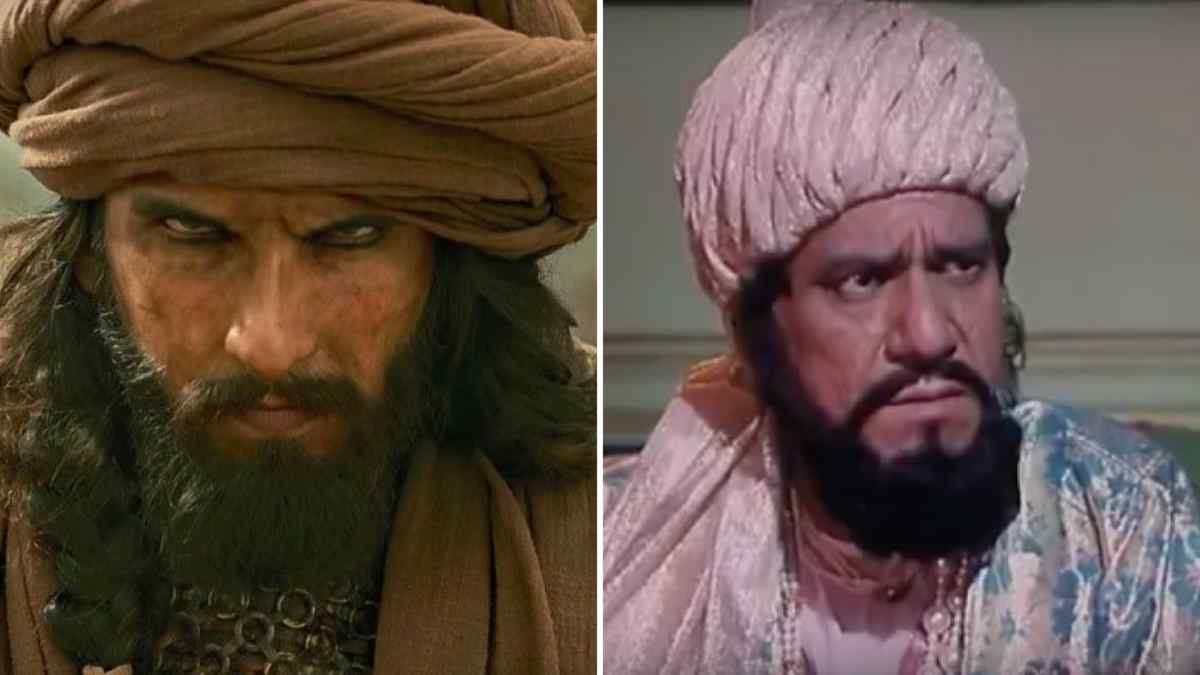
‘Padmaavat’: Ranveer Singh’s Khilji vs Om Puri’s Khilji

Long before Ranveer Singh played the Delhi Sultanate leader Alauddin Khilji in Sanjay Leela Bhansali’s Padmaavat as the mercurial monster, late veteran actor Om Puri essayed his role in Shyam Benegal’s Bharat Ek Khoj, the 53-episode Indian historical drama based on the book The Discovery of India (1946) by Jawaharlal Nehru. Both the works of art are based on Malik Muhammad Jayasi’s sixteenth-century epic poem Padmavat.

While we should give credit to Bhansali for the depiction of a strong Rani Padmini unlike the docile queen in Bharat Ek Khoj, the fault lines are evident in the depiction of the tyrant Khliji. Puri’s Khilji and Singh’s Khilji are like chalk and cheese.


The Khilji in Padmaavat comes across as a vile, snarling, meat-eating savage sans table manners driven by lust - a personification of depravity. His kohl rimmed eyes and towering, brawny physique, seems to be modelled on Khal Drogo from The Game of Thrones. His world, including his wardrobe is enveloped in a dark palette reflecting his primeval universe and his murky intentions. The Khilji in Bharat Ek Khoj dressed in vibrant royal garb looks like he bathes every day unlike Ranveer’s Khilji, a leader whose face is speckled with grime throughout the film. If Ranveer wears furry coats, Puri wears pearls. Puri may have nurtured the desire to covet Rani Padmini after hearing about her legendary beauty but his greed for the Chittorgarh jewels supersedes his desire for the queen. Unlike Ranveer’s Khilji, he is not a repulsive portrait of menace and lechery but a ruthless and authoritarian aristocrat.


A Machiavellian character, Ranveer’s Khilji steers clear of integrity, while Puri’s Khilji does stop and think before he indulges in the unscrupulous act of incarcerating and betraying Ratan Singh. He is polite and cultivated in his mannerisms.

The bisexual insinuations in Khilji’s track from Padmaavat count as firsts in mainstream Bollywood but they are missing in Benegals’ Bharat Ek Khoj. The latter does not even depict jauhar.

(Source: The Quint)

Tuesday, 30 January 2018

Dear Swara Bhasker, your letter on ‘Padmaavat’ got me thinking

The points that you put forward seem baseless if you think of it from the perspective of a viewer, writes Soumyani Ghoshal in the Quint in response to Swara Bhasker's oppen letter on Padmaavat. Read on:

Dear Swara Bhasker,

I have immense respect for you as an actor. But unfortunately, this particular open-letter has forced me to put forth some ideas regarding this film, Padmaavat(i) and the allegations that you have made against the director and the cast.

The points that you put forward seem baseless if you think of it from the perspective of a viewer. The film is merely a picturisation of 13th century 'Hindustan’, and the director has tried his best to portray that through his film. It would seem extremely unrealistic to portray these women in an emancipated light.


While having these women fight against the Khilji dynasty and safeguard themselves would indeed have been an empowering and inspiring sight, it wouldn't have made any sense to the time the movie has been set.

Needless to say, I am sure the director has made use of his creative liberty to add some glam to the film.

No one is trying to romanticise or glorify the idea of Jauhar through this film. That’s like saying that the practices of adultery and polygamy were justified, glorified and romanticised through ‘Bajirao Mastani’ (not to mention Tanu Weds Manu Returns, a film you were a vital part of).

I hope you don't believe that.

Warm regards,
A woman, and not just a vagina,

Monday, 29 January 2018

‘Padmaavat’: ‘Ram-Leela’ co-writers respond to Swara’s open letter

Swara Bhaskar wrote a no-holds-barred letter to Bhansali lamenting his depiction of ‘jauhar’ in Padmaavat but at the same time, upholding the right to freedom of speech and expression. Not denying that she is a fan of his operatic storytelling, she pointed out the possibly damaging effects of glorifying the medieval practice of self-immolation.

Read her letter here.

The co-writers of Goliyon Ki Rasleela Ram-Leela and lyricists of one of the songs from Padmaavat, Siddharth-Garima responded to her letter by writing another open letter titled, An open letter to all Vaginas. The letter begins with the dictionary definition of feminism and then goes on decry the concept.


Here are some of the excerpts from the letter. After citing all the incidents in the film that depict Rani Padmini’s agency in the film as a strong queen, they continue to question ‘equality of the sexes’ and Swara’s statement about feeling like being reduced to a vagina after watching the film.
But how can anyone advocate about ‘equality of the sexes’? A woman has a vagina, the door to life. It has the power to procure ‘life’, which no man, however hard he tries, can ever do. The question of equality is settled there, once and for all.

They must have felt like a ‘vagina’ when she chose ‘fire’ over ‘rape’? It was her ‘call’, her ‘decision’ as a vagina. Right, wrong, strong, weak is up to you to interpret as a ‘penis’ or as a ‘vagina’.

What perhaps was a victory for the filmmaker was the blinding of khilji as he entered the fort precincts, by burning embers thrown at him by the women. Such was the power of their fire within that they didn’t let the enemy lay their hands upon themselves. Why make them small and guilty of an act that they chose to protect themselves in the face of lynching and a life of slavery? Why judge that day from 700 years ago with ‘what would I do today’? It’s a film based in the 13th century when women preferred and chose death to rape.


Then don’t watch historicals, here or abroad. A ‘gladiator’ would perhaps shake your sensibilities of a slave in today’s context! Or a Troy might again make you feel like some other body part… A squishy liver perhaps. Since we cant appreciate art, lets violate it. With Karni Sena on one side and the vaginas on the other.

Padmavati was not a ‘rape victim’ who was so shamed that she didn’t have a right to live, as you make it out to be in your letter. Amazing what you all make it into. Was your open letter about Padmaavat or the regressive ‘Bhoomi’?

(Source: The Quint)

Sunday, 28 January 2018

The worst (and best) thing about Sanjay Leela Bhansali's Padmaavat

Sanjay Leela Bhansali's glorified treatment of the archaic practice of jauhar - mass suicide by fire - is a disconcerting watch. On a lighter note, if there's any lesson to take from this tragedy, it's to never send your husband shopping for jewels, writes Suhani Singh, the Senior Associate Editor, India Today, in Daily O. Read on: 

After a title change, a sartorial makeover and with two disclaimers - one elaborately long and one too short and ineffective - Sanjay Leela Bhansali's film finally releases. The only shade of grey in this film is Alauddin Khilji's kohl-lined eyes. Padmaavat is essentially a simplistic take on the good versus evil duel, in which the antagonist's crazy antics not only overshadow the righteous protagonists but also expose the flaws of their ethical code.


Padmaavat is not just a tribute to Rajput courage and in hindsight their obsession with principles of war as it is to Bhansali's filmography. Scenes from Bajirao Mastani and Devdas and a song from Saawariya will come to mind while watching the epic. Like Bajirao Mastani, here too is a married king, Rawal Ratan Singh (Shahid Kapoor), who finds a second wife while away from home. He has gone to the Singhalese kingdom to procure its famed pearls for his miffed wife. If there's any lesson to take from this tragedy, it's to never send your husband shopping for jewels.

Padmavati (Deepika Padukone) comes across as more pitiable than an inspiring figure. She is a spirited Singhalese warrior princess until she runs into Ratan Singh and soon becomes Chittor's queen. The bow and arrow and forest life is discarded for one stuck in a palace adorned with embellished ghaghras and big naths. And so begins a life of domesticity, in which Padmavati endlessly stares into her husband's eyes, exchanges amorous looks, smiles coyly and dresses him up.

This leisurely choreographed and luxurious take on romance is trademark Bhansali and also now too familiar. In this case it even makes you question the Rajput ruler's leadership skills while his kingdom is under threat.

It's all too familiar and jaded for once again Deepika plays another of Bhansali's virtuous heroines with little purpose other than to showcase the purity of her love. But her character isn't the problem here. In fact right until the #NotWithoutMyHusband climax, the queen is questioning her husband's decisions and his lack of action.

But then if history has taught us anything, it's that men rarely listen to women for the male ego is paramount. And so the weakest here is Rawal Ratan Singh who believes in making history by doing the right thing. It's hard to root for a character whose valour is misguided, is easily susceptible and thanks to Bhansali's love for craft preoccupied with his wardrobe. Sadly for him centuries later his persistence with his community's obedience to "usool" and "guroor" makes him seem an imprudent king. "Rajput kabhi peeth peeche nahi jaate." Sadly the words that ring true belong to Alauddin Khilji (Ranveer Singh) - "Jug ka ek hi usool hai, jeet".


(There is only one rule in war - victory). After all one remembers the winners, not the losers, and everything is fair in love and war.

But in Padmaavat its greed and not love which gets the plot going.

Raghav Chetan (Aayam Mehta), banished from Chittor for being a sleazy baba (the one rare occasion the film has contemporary significance), tells Khilji that he can be as celebrated a world conqueror as Alexander if he gets hold of Padmavati. Obsessed with making and rewriting history Khilji is enthralled at the prospect. Khilji attacks, struggles and then comes up with a stroke of genius. Chittor retaliates with one of its own courtesy Padmavati. Male chauvinism is at its peak when Padmavati arrives in Delhi only to be reprimanded by her husband for her daredevilry. Gradually Malik Muhammad Jayasi's 1520 poem, Padmavat, plays out.

Ranveer Singh shines as the megalomaniacal, lustful, narcissistic and ruthless Sultan. Compared to the indecisive Rajputs, the Afghan-origin Sultan of Delhi is the life of the proceedings. Women to him are objects to be mistreated and territories to be conquered. Padmavati is his Kiran, a woman to be had at all costs. Singh uses the kohl-lined eyes and muscular body effectively to put on a showy act, one which with a few jarring notes, is full of engaging moments. There is fun in the terror here. In one memorable scene, he makes his irritation of seeing Ratan Singh clear with a well-timed grimace. In another, he swaps his thali with the Rajput in fear of being poisoned. This is an actor savouring each and every moment, fully aware that deranged and debauched characters like this don't come your way every day.

Giving Khilji good company in the crazy department is his devoted aide Malik Kafur (Jim Sarbh), rewarded with the best entry sequence in the film. Labelled by the enemies as his wife, Kafur's own unconditional love for the king here is juxtaposed well against Khilji's insatiable want for Padmavati. This, and not Ratan Singh, Padmavati and Khilji, is the most fascinating love triangle in the film. The relationship only reiterates the differences between love and desire. Bhansali keeps the homoerotic tension between the two minimal but it's effective in getting the point across. Sarbh's measured performance ensures this character doesn't become a caricature and its sentiments are considered.


Apart from celebrating the Rajput spirit on the battlefield, the film inadvertently also highlights the royalty's ability to change clothes at a swift pace. The creative liberties here come at the cost of continuity. Padmaavat like any another Bhansali film excels in the craft department, with Sudeep Chatterjee's gorgeous lenswork and Rimple and Harpreet Narula's costumes playing big role in adding to the visual splendour. The grand scale is tasteful and impressive, even visible in the battle sequences.

But Padmaavat is also one of Bhansali's weakest musical efforts. Barring the censored ghoomar song, none register. The picturisation of the unreleased songs lacks the Bhansali magic. The Malhari-like track on Khilji is present only to further degrade the character.

Politics is why Padmaavat suffered and it's the film's politics which is hugely problematic. Bhansali's glorified treatment of the archaic practice of jauhar - mass suicide by fire - is a disconcerting watch. All along the Karni Sena, self-appointed custodians of Rajput honour, have been worried about the repercussions the film will have on how their community is perceived and judged.

The vilification here is entirely of Khilji and his Muslim army. Boorish they may be but at least they are not dull, a feature that the power couple does have. And that's the real failure of Padmaavat. It's inability to evoke a sense of loss and empathy for its Romeo and Juliet. Khilji may not have got what he wanted but he ensures that history remembers him. By the end of Padmaavat, it's Khilji that you are thinking about. Because really in this day and age who thinks mass immolation is a victory.

Tuesday, 2 January 2018

Using mythology to vindicate violence against women is horrifyingly medieval

Instances of individual and collective violence represented in the narratives; be it fratricide, murder, molestation, war, kidnapping – can be deliberately misinterpreted and morphed as terrorizations rather than moral reminders, emerging incorrectly as the swivels on which the epics hinge, classifying them as exemplary tales spawning more violence and viciousness, writes author Kavita Kane in She the People.TV. Read on: 

Our mythology is everywhere. Every day you run across instances of words, names, even city names (did you know Jabalpur is named after Jabaali the great seer?) and names of companies, literary allusions, art, music – and of course the planets and constellations – that take their name or borrow their theme from our mythology.

Even our daily conversations recall tales of metamorphoses and draw analogies between athletic and martyrial feats – ‘as strong as Hanuman’ or as ‘big as ‘Bheem’ or ‘as hungry as a Bakasura!’ are common comments. We are literally surrounded by mythology, whether we realize it or not, unknowingly peppering our language with colourful mythological similes like ‘sleeping like a Kumbhakarna!’ or ‘her nails are as long as Surpanakhas!’

But recently, it was Surpanakha’s chopped nose came brutally into focus, and not her hard talons, when the Karni Sena picked up a reference from the Ramayana and equated actor, Deepika Padukone with Surpanakha, threatening to cut off her nose, intimidating her that she would meet the same fate as Ravan’s sister if she persisted on the demand of releasing the film Padmavati.

Using mythological references to illustrate an argument is inventive but employing them to vindicate violence against women is horrifyingly medieval in its sheer barbarity and a matter of urgent concern.
How ironic is it that a group of men while fighting to protect the honour of the memory of a woman, are brutally vilifying a living woman in the name of that same honour.

Such violent interpretation of Hindu mythology is not just problematic but dangerous, manifestly taking opportune lessons from them to chastise women for transgressing norms.

If Surpanakha brings us a quick image of the leering, darkly wicked demon with long nails, (an image I have tried to humanize in my book on her – Lanka’s Princess); she was also the woman who was punished for her transgressions by having her nose cut off. When Lakshman did it, he did it to save a helpless Sita –  whom the enraged Surpanakha -after being scorned by Rama –  was going to attack and kill. Lakshman would have willingly killed her as he would any adversary who dared attack Sita, but for Rama’s orders and Sita’s pleadings, he was told to spare her life. He sliced off her nose instead and that remained her cruel punishment.


This episode – one of the most violent ones in the Ramayana, probably much more than the war itself between Ram and Ravan itself – has underlying subtexts of gender roles and women sexuality besides violence especially on women as leitmotif. Mythology is much more complex and subtle when it comes to such topics.

Using such a reference so brazenly as a weapon that is identified by members of a culture as representative and deemed to be a ‘punishment’ is outrageous, irrespective of the argument that the process of identification is subjective, and is judged by the extent to which they can be seen as an authentic proxy of that culture.

Some of the popular (mis)interpretations of mythology, conditioned severely by patriarchy, have very narrow interpretations on how women should behave; resulting in expedient archetypes like the good, obedient wife or the doting mother and extolling the virtues of womanhood and their role in society. It puts women on a worshipping pedestal, while ironically relating Nature and Earth as a goddess – the Shakti and Bhumi Mata, equating even the nation as Bharat Mata. In the Ramayan, Ram is the ‘purshottam’ for how men should act and Sita is the model for women and the viciousness of the ‘dhobhi’ is rarely recognized in its myopic understanding.

Unfortunately, these texts in the wrong hands and wrong intent, play a part in perpetuating chauvinism and violence against women. These representations get inappropriately twisted to validate an endemic violence of today’s times.
When such misinterpreted references take violent overtones, such blatant public display of ferocity are disturbing in their comprehensibility. Firstly, both the epics continue to be ideas of reference for moral, spiritual and philosophical instruction for the society as a larger culture, right down to the level of family. Also, instances of individual and collective violence represented in the narratives; be it fratricide, murder, molestation, war, kidnapping – can be deliberately misinterpreted and morphed as terrorizations rather than moral reminders, emerging incorrectly as the swivels on which the epics hinge, classifying them as exemplary tales spawning more violence and viciousness. These depictions of violence through the narrative of the epics get manipulated as exaggerated images amplifying the impact of the situation in question.

The Padmavati-Surpanakha controversy is a case in point. But, unlike in the epics, the violence is dissonantly real, without owning up to the moral valences of that focus.

Thursday, 23 November 2017

Padmavati has been a part of Indian theatre & cinema for 111 years, and nobody protested

Since 1906, the Rani Padmini-Alauddin Khalji story has been told and retold multiple times in various forms, without people going up in arms, writes Mahrukh Inayet in The Print. Read on: 

Former Central Board of Film Certification chairman Pahlaj Nihalani, not known for a reasonable approach till recently, has perhaps made the most pertinent comment on the controversy over Sanjay Leela Bhansali’s film Padmavati. He asked: “Why is it that earlier versions of Rani Padmini’s life invited no wrath from any Rajput groups?”

Indeed, many versions of Rani Padmini’s epic story have been part of Indian theatre, film and television for about 111 years, and none invited strictures.

Literature
Bengali poet and playwright Kshirode Prasad Vidyavinode’s play Padmini in 1906 revolved around the same story – Alauddin Khalji capturing the Rana of Chittor using deceit, Rani Padmini managing to rescue her husband, and later, as the battle ensued, all Rajput women including Padmini self-immolated.

Three years later, in 1909, Abanindranath Tagore’s Raj Kahini was published. This children’s literature collection told a similar tale of Padmini-Ratan Singh-Khalji, adding a part where the Rajput king offered to surrender his wife to Alauddin to protect Chittor, but his fellow Rajputs refused the offer.

Cinema
Cinema history is also littered with retellings of the Padmini story. In 1963, Tamil film Chittoor Rani Padmini had actor Vyjayanthimala playing the lead role. Tamil superstar Sivaji Ganesan played Rana Ratan Singh and M.N. Nambiar played Khalji. The film didn’t create any protest before release, nor any buzz at the box office.

A year later came the Hindi version Maharani Padmini, starring Anita Guha as the queen, Jairaj as her husband, and Sajjan as Khalji. The film was a damp squib at the box office, but the songs, featuring Mohammad Rafi, Asha Bhosle, Suman Kalyanpur, and Usha Mangeshkar were hits. This film saw no protests either.


Television
Apart from these two 70 mm versions, the story of Rani Padmini also found its way to the smaller screen. Shyam Benegal’s epic show Bharat Ek Khoj had one episode on Padmini, with Om Puri playing Khilji, Seema Kelkar playing Padmini, and Rajendra Gupta playing Ratan Singh.


In 2009, Sony Entertainment Televsion began broadcasting Chittod ki Rani Padmini Ka Johur, a show directed by National Award-winning art director Nitin Chandrakant Desai, featuring Tejaswani Lonari as Padmini.

The show didn’t complete its six-month run due to low TRPs and high costs. And while it was in the news for its opulent sets and costumes, it never witnessed protests for its historical content or context.


Bhansali’s Padmavati is clearly not the first time the story of Rani Padmini has been the inspiration for a creative piece. Khalji’s infatuation with her has also been used as a significant part of the narrative.

So is the film just an easy target for fringe groups and right-wing elements to force their beliefs on one man’s freedom of expression? History certainly seems to show that.

Monday, 20 November 2017

The many Padmavatis

There is no historical record that she existed — and her story has been reshaped in diverse ways over time, writes Divya Cherian in the Hindu. Read on: 

As the release of Bollywood film Padmavati  draws near, protests against it are reaching a fever pitch. Claiming to speak on behalf of all Rajputs, several political figures have objected to the portrayal of the title character of the film for two reasons — that it is a distortion of history and that it is disrespectful to Queen Padmini (appearing in some texts as Padmavati), who is deeply revered by the Rajput community.

Recent scholarly work on the Padmavat, such as that of Thomas de Bruijn, Shantanu Phukan and especially Ramya Sreenivasan, makes possible an informed engagement with these claims.


The earliest tale
The earliest known composition of the Padmini tale is Sufi poet Malik Muhammad Jayasi’s Padmavat, dating to 1540. This tale is part of a new genre, the Sufi premakhyan (‘love story’), that flowered from the 14th to 16th centuries in North India. Most of these tales feature a hero-king’s quest for union with supreme truth and transcendent beauty — embodied in the texts by a woman of unparalleled physical beauty — and the difficulty of navigating the contradictory pulls of the spiritual and worldly domains.

The Padmavat is perhaps the only one of these texts to be grafted upon a historical event, Delhi Sultan Alauddin Khilji’s siege of Chittor in 1303. Writing more than 200 years after the event, Jayasi’s tale bears little resemblance to surviving historical accounts of the siege and instead appears to draw in details from contemporaneous events and places.

In Jayasi’s composition, a parrot, Hiraman, tells the king of Chittor, Ratansen, of the unequalled beauty of the princess of Sinhal, Padmavati. Hiraman’s description is enough to trigger in Ratansen a desire to attain Padmavati. He leaves behind his wife, Nagmati, becomes a yogi, and heads out, along with his men who also become yogis, on the arduous quest to the faraway Sinhal.

With great difficulty, and only after he is ready to give up his life for the quest, Ratansen is united with Padmavati and marries her. Due to the pulls of his natal home and the suffering of his first wife, he returns to Chittor, bringing Padmavati along with him. While Ratansen works on building peace between Padmavati and Nagmati, a deceitful brahman, expelled from Ratansen’s court, seeks revenge by going to Delhi and informing Khilji of Padmavati’s stunning beauty. Piqued, Khilji decides to march upon Chittor to demand Padmavati. Ratansen refuses to part with her.

With the Sultan’s forces closing in, Ratansen dies of injuries sustained in a fight with a Rajput rival. Padmavati and Nagmati commit sati on Ratansen’s funeral pyre while the remaining Rajput men go into the battlefield to be martyred. When Khilji manages to finally conquer the fortress, all that remains of Padmavati are her ashes. His victory is thus rendered hollow.

Some manuscript copies explain the Sufi import of the tale by referring to Chittor as the body, Ratansen the spirit, Padmini the mind, Hiraman the spiritual guide, and Khilji as illusion (‘maya’). Literary representations of Khilji in a polyvalent text such as the Padmavat and in future iterations of the tale then should not be taken as historical.

The historical Sultan Alauddin Khilji, as we know him from accounts of his time, was a gifted statesman who strengthened the fisc of the Delhi Sultanate, expanded the frontiers of his kingdom, and capably protected North India from the expanding Mongol domain, a feat that many of his contemporaries could not accomplish.

As for Padmavati, there is no historical evidence that there was such a figure in Chittor when it was besieged, or that desire for a woman played any role in Khilji’s interest in conquering the fortress. Padmavati/Padmini, then, is a literary artefact, as is the entire story of love and sacrifice at whose heart she is placed. Any depiction of Padmavati thus cannot be a distortion of history since, in our current state of knowledge, she never existed. Born as a figment of poetic imagination, she is free to be reshaped in the hands of a different creator.


Padmini, recast
And indeed, the Padmavat was told and retold over the centuries and across the land. As historian Ramya Sreenivasan has carefully shown in her book, The Many Lives of a Rajput Queen, in each retelling, the contours of the story and the key characters within it, including Padmini, changed. Starting a few decades after the original composition, the Padmavat was adapted into Persian forms in North India and Gujarat, and Jain literati and bardic groups composed versions of it for Rajasthani courtly elites.

In the 17th century, professional genealogists wove the Guhila house of Ratansen into the genealogy of their patrons, the Sisodia rulers of Mewar. By the 18th century, after the decline of the Mughal empire but before colonial conquest, the tale of Padmini was refashioned in Mewar to demonise Alauddin Khilji, also emphasising his Muslim identity and presenting the clash between the Rajputs of Chittor and the Sultan of Delhi as the resistance of Hindus against an encroaching, ‘impure’ Islam.

In the 19th century, Colonel James Tod, Political Agent in Rajputana of the English East India Company, was guided in his attempt to write the first authoritative history (by contemporary European standards) of the region by the philological, historiographical, and intellectual frameworks of his age, as well as by the political goal of stabilising the region by strengthening the hands of kings against rebellious chiefs.

He selectively chose information from the range of pre-colonial sources at his disposal. He incorporated the courtly Rajasthani Padmini narrative into his early 19th century history of Rajasthan, using it, along with other material, to cast Rajputs as a valiant, pure fighting race of Hindus that resisted Islamic conquest, just as Christians had done in the West.

Bengali intellectuals of the nascent bhadralok were deeply impressed with the figure of the Rajput as presented in his account, not just for his selfless bravery but also for his resistance against a Muslim conqueror. As the earliest imaginings of an Indian nation — and a Hindu nation — began to take shape, Padmini became a token of the self-sacrificing, virtuous, and chaste Hindu woman that was to be at its heart. In this idealised form, her decision to annihilate her own body was celebrated for the preservation of her ‘honour’ (read ‘chastity’) through which was indexed the honour of her husband, her family, her community, and now, her nation.

In her journey from the 16th to the 21st century, Padmavati appears to have become increasingly shackled in the confines of patriarchy. In Rajasthani versions, Padmavati lost her autonomous voice, reduced to a prop on the edges of a scene largely occupied by the king and his courtiers. It was this Rajasthani Padmavati who was celebrated in 19th century bhadralok plays beginning to imagine a Hindu nation and who is today deified as the apotheosis of Rajput, and even Hindu, valour, purity, and sovereignty.

Padmavati has been recast as adhering strictly to codes of conduct applied to elite Rajput women. Allegations of disrespect and inaccuracy being levelled against the film are thus rooted in the expectation, by those familiar only with the Rajput or early Hindu nationalist adaptations, of a silver-screen Padmavati who observes the purdah and does not display any trace of sexuality. The current row over Padmini’s portrayal only underscores that in the long arc of its history, the imagined Hindu nation holds in its heart the dutiful, chaste Hindu woman, who acquiesces to patriarchal controls and only exercises her agency within their bounds.

No exclusive legacy
It is important to bear in mind, as Ms. Sreenivasan has shown, that at the same time that the Rajputs were articulating a new claim upon the Padmavat in the 17th century, other Padmini tales continued to be composed. A Sufi migrant from Bengal to the Arakan court (in today’s Myanmar) composed his own version of the text in Bengali. In the 19th century, there were multiple Urdu adaptations of the tale printed in North India and an opera performed in 1923 in Paris.

There have then been many Padmavats, just as there were many Ramayanas. The tale, and its heroine, are then not the exclusive legacy of any single community. The effort of spokespersons of a single community, one that continues to exercise tremendous sociopolitical power, to freeze the text into a single, authorised version, will rob it of the vitality that has allowed it to thrive over the ages.


Padmavati row: Why Rajput pride could excuse Gowariker but not Bhansali

Padmavati is not the first film to face hurdles for supposedly hurting Rajput sentiments.

The anti-Padmavati movement across the country, spearheaded by the Shri Rajput Karni Sena, has gone out of hand, with members of the organisation issuing death threats to the film's director Sanjay Leela Bhansali. Leading lady Deepika Padukone has not been spared either, with the Shri Rajput Karni Sena branding her as "naachnewali" and threatening to chop off her nose. Deepika has just been provided a special security cover after these threats.

The bone of contention is the alleged demeaning of the honour of Rani Padmini by incorporating a romantic dream sequence between her and Alauddin Khilji. Sanjay Leela Bhansali and the team of Padmavati have been shouting from the rooftops that no such scene was ever a part of the film's script, but it has fallen on deaf ears.

Padmavati is not the first historical film to face roadblocks. In fact, it is not even the first film with uncertainty looming over its release for hurting Rajput sentiments. Before this, there was Ashutosh Gowariker's Jodhaa Akbar.


The Hrithik Roshan and Aishwarya Rai Bachchan-starrer was under fire for supposedly distorting history. Incidentally, it was the Shri Rajput Karni Sena, who took it upon themselves to be the guardians of Rajput culture and honour there as well.

According to the founder of the organisation, Lokendra Singh Kalvi, Akbar had no wife named Jodhaa. He claimed that Jodhaa Bai was actually the wife of Akbar's son Salim, and thus, the Ashutosh Gowariker film was objectionable. Eventually, Jodhaa Akbar did not see the light of day in Rajasthan.

But Padmavati is no Jodhaa Akbar. The protests against Sanjay Leela Bhansali's period drama are not limited to Rajasthan, they have spread across the nation.

So why does Padmavati matter more to the Rajputs than Jodhaa?


Rani Padmini is deified in Rajput culture and her valour has attained legend status, because of her placing 'honour' above life. To the Rajputs, she proved that, as Deepika Padukone says in the trailer of Padmavati, "Rajputi kangan mein utni hi taqat hai, jitni Rajputi talwar mein."

The Padmini Mahal, where Rani Padmini supposedly lived, is regarded as sacrosanct, and temples and shrines have been built in her memory in Rajasthan. Jodhaa Bai, while revered as a historical figure, has no such cultural significance.

The Rajputs' intense emotion for Rani Padmini comes from anger and hurt. To put it from their perspective, she was a dutiful wife to a brave Rajput king. All was well, till she unwittingly became the object of the uncontrolled lust of a barbaric Muslim plunderer.

The Rajput hero of our story (Maharawal Ratan Singh) fights valiantly till his last breath, but is vanquished by the villain (Alauddin Khilji). The heroine refuses to be 'defiled' and instead, goes beyond her call of duty and embraces death by jumping into a burning pyre.

Needless to say, this is a sore point for the Rajputs. Rani Padmini's pride and honour has been further aggrandised to whitewash the defeat at the hands of Alauddin Khilji. Anyone who dares differ from this narrative will not be spared.

Jodhaa Akbar weaves together a tale of romance between a Hindu princess, Jodhaa Bai, and a Muslim emperor, Akbar, and how they achieve communal harmony. It is not a subject that evokes such strong sentiments as Padmavati does.


There, of course, is the divide along religious lines too. With Padmavati, emotions have been spilling over because how dare a filmmaker show the quintessential Rajput woman dancing in front of men in 'less clothing' and a Muslim barbarian dreaming about romancing her?

Jodhaa Bai, on the other hand, might probably have served as one of the first examples of 'love jihad', a concept that saffron fanatics have been trying to peddle for a few years now. In fact, one can't help but wonder if Jodhaa Akbar would have been allowed to release, had it been made today. Because, how dare a filmmaker show a Hindu princess and a Muslim emperor living in marital bliss?

(Source: India Today)

Padmavati row: An open letter from Shurpanakha to men sharpening knives

As noses go Deepika's is a nice nose, don’t you think? Not that it matters to you, you’d cut off any woman’s nose and then promptly get to writing that she looked kakka anyway, what loss her nose? asks Nisha Susan in the Ladies Finger. Read on: 

Can’t a girl get some sleep around here? No? Because every time I get a little shut-eye I hear that metallic grind of you lot sharpening something. And then I know it’s not my nose, but there is some woman’s nose you are after.

This time, I hear it’s Deepika Padukone’s nose. Because she is in that movie about Padmavati, a long-dead woman who a long-dead man may have seen in a mirror. Over the millennia I’ve seen lots of gents running around cutting women’s noses. As you know. For stupid reasons. As also you know. I mean, you got worked up when Padukone said she is appalled that you brothers did things like destroy shops and vandalise a cinema hall in Kota. “Rajputs never raise a hand on women but if need be, we will do to Deepika what Lakshman did to Shurpanakha,” said Karni Sena leader Mahipal Singh Makrana.

Having lived as long as I have, I can never crank up feelings to properly appalled. But attacking that rangoli artist in Surat was quite random, if you don’t mind my saying so. Abhi kya hai ki, I don’t mind if you mind also. The beauty of my post naak-katva scene is that men in battle formation or sulk formation cease to bother you. Now, if only I didn’t wake up each time I hear that grinding I’d be truly zen. But there is that Phantom Nose Syndrome, what to do.

Karni Sena leader threatened to cut off Deepika Padukone’s nose. Photo courtesy: Padmavati Facebook Page
As noses go Padukone’s is a nice nose, don’t you think? Not that it matters to you, you’d cut off any woman’s nose and then promptly get to writing that she looked kakka anyway, what loss her nose? I wasn’t bad-looking, you know. I looked a lot like my mother Kaikesi. But you men were in some post-truth funk, prepared to swear up and down that since I made a move first, I must be desperate with my ugly face, pot-belly and those sharp nails of mine.

My friends called me Meenakshi, if you really want to know. I did have eyes like a fish and I needed those sharp nails in my life. First they married me to someone literally called Dushtabuddhi (I mean, literally) and then Ravana was like: Surprise, sis! He’s no good, I will just kill him. So there I was, a widow, not what you call conventionally beautiful, and stuck in the court of an extra ambitious, too many brains brother.

Back in that moment when I was making my famously #fail move on one brother and the other, I kept wondering which way to go. Soft sell or hard sell. Little bit smoochie and then ask them whether they’d teach my brother a lesson, or pick one of the above. Anyway, it all fell apart and instantly appeared you boys ki famous proclivity. Either you are saying ki you didn’t fight your kidnapper hard enough, naak katva di. Or it is that you came on too hard so I will kaato your naak for you. Basically roaming around grinding your knife ready to cut a nose, any lady’s nose.

What is with men and wanting to cut off women’s noses? Photo courtesy: Women India Blog
Now you gents are after Deepika Padukone’s. Sanjay Leela Bhansali has sworn up and down the country that there is no dream sequence in which Alauddin Khilji and Padmavati will be in the same frame and that it’s all a rumour, but you are like no, no, no. Because you have dreamed that there is a dream, is that it? Over hundreds and hundreds of years, ever since the 13th century, the frisson of the Muslim man glimpsing the Rajput queen is still giving you the shivers, is it? (Achha chalo, I don’t blame you on this front. The Other is Hot, this is the universal truth. Hence my misadventures in the forest and hence, also, that incredible Muharram scene in Raees. Whip me.)

Maybe what you are really afraid of is that this new movie will somehow remind people how daft our textbooks are to continuously claim that Khilji attacked Chittor for Padmavati. That people will start wondering why Chittor collapsed, queen or not. Books written by men, I notice, are not so hot on facts and are really hot on blame.

Now I have lots of books I could quarrel about, especially one written by a man whose name starts with a V and ends with an I, but I’m too old for this. Places to go, things to do, y’know. But I’m going to make an exception for Padmavati, seeing as she is my fellow countrywoman from Sri Lanka, at least in that poet dude Malik Muhamed Jayas’ version. According to Jayas, a talking parrot told Chittor’s king Ratan Sen about Padmavati and so he brought her away from her nice, leafy island happiness to be among folk who were constantly worried about noses. And then Khilji, the mirror, the war, and the end. Now, Jayas probably dreamt up a fictional heroine for whom a hardened invader would change his plans to make the story more relatable, or he just liked writing about beautiful women whose lives end badly, or he liked the adolescent pathos of the it-was-all-for nothing-feeling when Khilji walks into an empty fortress after everyone dies. Who knows.

The existence of my nose is no matter and neither is your point, Mr Makrana.
Photo courtesy: Mahipal Singh Makrana Facebook page
I just want to tell you that back in Lanka, no poet would write about women jumping into fire to kill themselves just in case the men lost a battle. We girls from Lanka like to ensure we don’t lose battles (and if you are murmuring something about Hanuman and fire right now, please don’t, that’s another story). Poor Padmavati, so much peer pressure, she must have been wishing that parrot dead and all mirrors shattered. Instead, into the centuries the parrot talked and the mirror gleamed and she became that simpering inflammable miss.

So no, Padmavati wasn’t real but does it matter? And Jodha Bai of Jodhaa Akbar was not really Akbar’s wife, and that doesn’t matter also. I mean, my nose isn’t real and it doesn’t matter and the dream sequence you brothers are burning things in several states for apparently isn’t real and that doesn’t matter either.

Sanjay Leela Bhansali was attacked on set. Photo courtesy: Sanjay Leela Bhansali Twitter handle
Here you are again, fellows, prepared to go to war for a film you haven’t watched. I hear you are saying that Sanjay Leela Bhansali can’t be trusted because you feel he gave haath last time with his Ram-Leela screening, showing you one version and releasing another. Betrayal makes your knife hand itch and everything your mother told you about filmi types is coming back, isn’t it?

I understand the sab kuch jala do feeling (or to quote you precisely, “jauhar ki jwala hai, bahut kuch jalega. Rok sako to rok lo”), so I won’t give you a laundry list of shattered promises that you might want to be angry about instead. Rationality is so overrated. Instead, Karni Sena brothers, I give you one of those strange English sayings: Don’t cut off your nose to spite your face. Why not meditate on that? Breathe in. Breathe out.


Padmavati row: Karni Sena calls Deepika a 'bazaaru' woman

Shri Rajput Karni Sena founder Lokendra Singh Kalvi called Padmavati actress Deepika Padukone nasty names.

The raging protest over the release of director Sanjay Leela Bhansali's upcoming period film Padmavati reached a new low today with the founder of the Shri Rajput Karni Sena, Lokendra Singh Kalvi going on an abusive rant against the film's leading lady Deepika Padukone calling her a 'bazaaru' woman who dances for money.

Speaking to India Today in Patna, Kalvi said that the Sena has called for a Bharat bandh on December 1, the date on which the controversial film is slated to release.

"Padmavati will not release at any cost. Who is Deepika Padukone? Is she the Prime Minister or President that she is challenging us? Will a 'bazaaru' woman like Deepika tell us now what the Rajputs should do? On 1st we have called for Bharat bandh to protest the film," said Lokendra Singh Kalvi.


He further defended the threat given by a member of the Shri Rajput Karni Sena, Mahipal Singh Makarana, to Deepika Padukone to chop off her nose if the release of the film is not stopped. He said that it was the sentiment which should be looked at rather than the words.

"We should go by the sentiments and not the words being used by a protester against Padmavati. What is the status of Deepika? She is just a woman who dances for money," the Shri Rajput Karni Sena founder said.

Kalvi argued that Ranveer Singh, who plays the role of Alauddin Khilji in Padmavati, chose to do this film in order to do couple of intimate scenes with Deepika Padukone.

"Almost one and a half year back, Ranveer Singh himself said that he would play even a role of a villain to do a few intimate scenes with Deepika Padukone," he said.


(Source: India Today)

Friday, 27 January 2017

Filling in the Silences: Kamala Das's Short Stories

Kamala Das has published several short stories in Malayalam, under the
pen name Madhavikutty. Some of these are now available in translation. A Doll
for the Child Prostitute, 1977 and Padmavati, the Harlot, 1992 are two
collections of short stories published in English. Though Kamala Das is a wellknown
poet in English her short stories deserve equal attention as her poetry
because they are poignant tales of feminine suffering, dilemma., resistance and
rectitude. In the blurb of one of her short story collections it is mentioned,
"Kamala Das's stories are a re-affinnation of woman, woman reclaimed of body
and spirit. But it is woman, above all, always on the side of life, never betraying it
by antagonising man through mean acts of getting even, or scoring points."

Women are the protagonists of all the stories which offer a myriad of
different female characters. The stories present all variations on the feminine
stereotypes in radically subverted [onn. Like in her poems and her autobiography
in most of the stories there is a serious questioning of the existing basis of malefemale
relations and a more or less sustained refusal to the values of a maledominated
society get expressed.

In this chapter, we have analysed some of her short stories from the
women-centred perspective. In "The Princess of A vanti," Kamala Das focuses on
the theme of sexual perversion in men. This is a pathetic story of an old woman being taped by three young men. The old woman was under the delusion that
she was the princess of A vanti, so when in the park she encountered three young
men who flattered her, she lost her sensibility and fell a victim to their sexual
perversion. The three megalomaniac men declared themselves as king of
Vangarajya, Kalinga and Kerala. Together they lured the old woman with false
promises of her nuptial celebration in the park by saying, "We have come to ask
of you a favour. This evening you must not go home.

Remain hidden behind a bush. After the park is locked we shall celebrate your
wedding quietly inside this beautiful park." Being a myopic person she
disregarded her age, physical frailty and the time factor and failed to
comprehend the unctuousness in the proposal of the pseudo rajas. They are sclfproclaimed
monarchs and their cowardice is revealed in their intention to act
surreptitiously in the dark. Yet, the old lady waited for them without any fear,
hesitation and suspicion. When darkness engulfed the place her hope of
celebrating her marriage was shattered with the three bully men physically overpowering
her making her gasp and pant for her last breaths. "The young men
removed her dress. She had no undergannents. One took a long look at the
sagging breasts and guffawed.~'

The story may appear contrived when we think of the reference to
historical names, but such references help to hint at self-asserted male
superiority, the inherent megalomaniac attitude of most men and the perpetual physical enslavement of women throughout history and across diverse cultures.
Here through the age difference between the victim and the victimizers and the
clever juxtaposition of contrastive qualities like ignorance as against deceit,
self-deception against gregarious masquerade/complicity and feminine frailty
against masculine virility, the crudities of such female exploitation like rape and
molestation are poignantly delineated. Certain aspects of the old woman's
idiosyncratic demeaneour appear to be highly dramatized and exaggerated, for
instance, her desire for revelry in the company of young men, her readiness in
accepting the strangers'request/proposal, her willingness to place her faith on
them, their false claims and promises and her obvert joy at the strangers'
flattering words and compliments. All these give a hyperbolic twist to the tale,
but then can we assert that old age desires no juvenile companies, cherishes no
fond dreams and is all sterile and void of pleasure? Perhaps through the graphic description of the old woman the writer wants to depict the state of
psychological dependency and vulnerability of old age when people in spite of
physical frailty dream of appearing young, vibrant and juvenile and struggle to
rejuvenate life with renewed interests, vigour, love and energy. There is
certainly no harm in cherishing such dreams, but the prize a woman has to pay
to fulfil such desires and longings is too enormous and it involves the perils of
being stripped off one's dignity, shame, emotions and life itself in the process.
The woman in this story symbolically stands for senility, dependency, and
vulnerability. Though her ignorance and error of judgement are pardonable, the three men's gregarious attempt at physically assaulting and humiliating a
woman of their mother's age is as heinous as unforgivable an act in any legal
ambit.

To a reader who disbelieves the tale-a toothless old hag with sagging
breasts being lured and raped by young men--my suggestion would be that the
story can very well be interpreted as an implicit reference to the victimization of
women by the all-pervasive male gaze. It would not be a far-sighted conjecture
to guess that, perhaps, Kamala Das in this story metaphorically suggests the
victimization of women by the "male" gaze, which follows no age restriction in
the gazer nor the gazed in any society, and undeniably in the stifling patriarchal
social set-up of the Kerala society with all its intellectual sophistry and
proclivity towards Marxian idealism that has left the least trace/mark in the
men-women relationship and prevalent gender biases. But then can we ever
claim that old women are never physically molested and raped by young men and that the writer has never heard such a tale?

"Padmavati, the Harlot" is written in a similar vein. Here the female
protagonist, a middle-aged harlot, herself a victim of sexual prejudices at the
end of the story is seen walking away in a coy but triumphant gait with the men
who previously abused her and impeded her spiritual quest literally prostrating
at her feet, asking for her benison. Padmavati's fears and foibles, her struggle in
life and her unshakable deyotion towards God are all portrayed by Kamala Das from 'a purely hwnanist perspective and she emerges as a woman who
successfully resists male seduction and flirtatious advances with full
determination. In this sense, she is like any other woman who has not entered
the white slavery but nevertheless has to struggle against patriarchal nuisances.

Kamala Das's feminine sensibility allows her to sympathise and commiserate
with the harlot's predicament and audaciously portray her as a symbol of
resistance, forbearance and spiritual quest. When confronted by a gang of
loafers loitering around the temple, Padmavati narrat~s her doleful tale of
having been disowned, abandoned and ditched by her family. She who struggled
to financially support her mother, brothers and sister was abandoned by all
because of her lowly profession. Having been forsaken by hwnans she now
turns towards the Lord whose holy shrine she had long desired to visit. To the
loafers she said, "I have been waiting to come here for the past thirty-three years
but something or the other has kept me busy all the time.

At first I had to tend my ailing mother who lay paralysed for seven years before she died one day,
turning her face away from me in disgust. Then 1 had the responsibility of
educating my brothers who got good jobs in other cities and forgot me. 1 had
also to marry off my sister to a man who was willing to do it for a big dowry.
After marriage she has not once written to me." Thus having enacted all her
filial and sisterly duties she now focuses on God, but with some measure of
doubt and scepticism for she feels, "Only the Lord, perhaps, has any feeling for
me. But, He may have forgotten too."

Eventually, she arrives at her desired destination~ but only to find herself to be too late-the temple door was shut, the
priest had left, darkness loomed large all over the place while some hooligans
purposefully attempted to hinder her. They began to verbally assault her while
deriving sadistic pleasure by tormenting her with obscene words, "You are not
young, but you are charming enough for one e~ening or two. Your breasts arc
still firm. Your haunches set our loins on fire. Won't you be kind enough to
grant us your favours?" Even at the threshold of the lord there was no respite for
Padmavati. The avaricious loafers also robbed her of the fruits she intended to
offer at the altar of the Lord. With tears in her eyes and in an utterly perplexed
state of mind she could not decide where to proceed and what to do. The loafers
then followed her incessantly demanding sexual pleasure, "Keep us company
this night, 0' Padmavati ... Tomorrow you can worship the Lord."

But though a harlot Padmavati was not a nymphomaniac craving for physical pleasure so she proved no easy prey to the brutes' sexual appetite.
Turning a deaf ear to their lascivious words and lecherous gestures she hurried
up the stone steps leading to the temple yard. At last she did achieve her goal
and the poet describes her sublime state of mind, her communion with the lord
with a touch of sensuousness. Kamala Das's poetic imagination colours the
merging of the human spirit 'with the divine in vivid terms as if Padmavati's
spiritual quest ends in an ecstatic rapture with the experiencing of the divine
presence within her in all its physicality and sublime touch.

in the ordinary parlance and social discourses a prostitute is regarded as
a degraded person, a notorious symbol of promiscuity, carnal desire and
indulgence. Here in this story Kamala Das reverses this conventional
understanding and attempts to erase the malign image of this marginalised and
exploited woman. In other words, she challenges us to suspcnd somc of thc
assumptions we have culturally derived about prostitutes as an immoral and
socially aberrant class. The story is thus subversive at many levels. The
prostitute is shown as a SIncere, caring, devoted and determined person.

Paradoxically enough, the loafers she confronts in the vicinity of the temple
though not gigolos by profession are shown as slaves of carnal desire, greed and
malevolence. Padmavati has ascended from a lowly state of existence to a
higher realm of experiential realization through her pursuits of the divine touch, whereas, the men descended from a normal life to a lower stratum of sensuality
and malice. Padmavati's armour is her sense of shame and resistance to
indulgence. Contrariwise, the men's crudities of thought and action render them
naked and shameless. Padmavati's devotion stretches over time (thirty-three
years of waiting for the spiritual retreat) and distance, but the hooligans even
while dwelling in the precincts of the temple fail to pursue the right path.

Many writers have written on prostitutes but few could portray them in a
positive light endowing them with normal feminine attributes. Very often we
see prostitutes as victims of social prejudices and discrimination and not as
rebels and pilgrims. In her short story, "The Offspring", the noted Assamese novelist, Mamoni Raisom Goswami, narrates the tale of a young and beautiful
Brahmin prostitute who sells her flesh but hesitates to conceive a child for a low
caste 'mahajan.' In Assamese society, as in the rest of India childlessness is an
anathema to married couples. It is a strong belief that conjugal life should be
blessed with procreation of a new generation-progeny to keep the lineage going.

Pitambar, the rich but childless trader was blinded by his craving for a child
(son) of his own and so he approached the Brahmin widow (following the
initiation and secret advice of the Brahmin priest, Krishnakanta) to bear him a
son as his bed-ridden wife lay barren and childless. Damayanti, the harlot,
initially agreed to the deal, but when vain pride in caste superiority takes hold of
her senses she decides to abort the fo'etus. Her benefactor was from a lower
caste and she abhorred the thought of conceiving and nurturing his child.
Though an outcast by profession and leading a life of penury and ostracism,
Damayanti took excessive pride in her caste superiority.

Here in this story the prostitute is not a symbol of resistance to
patriarchal hierarchies but instead remains a medium for the perpetuation of
caste stratification and conventional values. The story ends in climactic pathos
with the man grubbing and rummaging the soil to trace and dig up the discarded
piece of flesh-a part of his own being-in the darkness of the night, panting,
sobbing for a touch of the unborn child. Though the author here aims at
critiquing casteism and its sinuous grip on Hindu society, female readers would
expect the harlot to stand for a more just cause than acting as a mere medium for perpetuating caste-related sentiments and prejudices.

The story lacks a feminist edge since the harlot is not resisting the idea of being used as a
receptacle by the rich man who tries to bargain and buy all her services with the
sheer power of money. Had the child been born the ties between the mother and
the child would have been abruptly and inevitably snapped off since the
possibility of the father's intervention to give a new name, a diiTcrcnt identity to
the child cannot be ruled out, therc being no assurance of the uplift in the
mother's life and status once the child was born. Moreover, the man enters the
deal without the notice of the outside world, he slips into the ramshackle hut in
the dark aiming to fulfil his own appetite. His moral flaw is also evident in his
heedlessness and negligence of his bed-ridden wife, his lack of concern for her
physical and mental health and his perfidious behaviour as is seen in his
intention to keep her in the dark about his new plan to procure a child.

Yet, Damayanti, the harlot is not seen to address and resist any of these vital issues,
rather she narcissistically clings to her caste. "The Offspring" is a well-written,
story, there is no doubt about it and it has drawn the critical attention of native
as well as non- Assamese writers and critics alike. Yet when placed side by side
with "Padmavati, the Harlot" it appears to be fragile since the feminine resisting
voice is pathetically missing iIi it.

Kamala Das's "A Doll for the Child Prostitute" is a poignant story of
brothel life in an urban city like Mumbai. Life in the red-light street is infested with death, decay and endless suffering especially if the victims happen to be
young girls in their pre-pubertal stage. In this story Kamala Das narrates. the
untold misery of two teenage girls, Sita and Rukmini. Young Rukmini was
bartered away by her own mother to Ayee, the head of the brothel in exchange
for a meagre amount of money. At home there is not only poverty and acute
hunger but also the sexual harassment from the stepfather who had raped the
little girl. The child Rukmini was not unhappy about leaving her home for she
realized, "The man who had moved into her home some months ago, after her
father had disappeared, was a monster. He not only beat up her mother every
night but squeezed her own little breasts, hurting her dreadfully when she was
alone in the house. And, last week he had pierced her body until she bled all
over the floor."

To the helpless mother the brothel seemed the only safe haven
for her daughter where she could procure two square meals a day and some
shelter. It was in a dilemma, perhaps, when the need to protect her daughter
from the clutches of her second husband arose the mother with a guiltyconscience changes her daughter into an object of mass consumption. It was not
that she as a woman was unaware of the evils of brothel life, but that she had to
decide and choose between two equally vicious situations indicates the
existential crisis the mother arid daughter had to go through.

Sita, whom Rukrnini meets at the brothel, is a victim of hapless
circumstances too. The cholera epidemic created havoc in her life; she lost her
parents and all her three brothers and was forced to end up in the brothel for survival's sake. Being victims of similar plight and predicament the two girls
felt u feeling of warmth wId mpport from their tirst meeting. Sita being more
experienced initiated innocent Rukmini into the mysteries of hrothel life, its
nocturnal visitors and entertainment-seekers and exhorted her to "Obey them or
else Ayee will starve you to death. Do whatever they want you to do. Men are
real dogs." In their pre-pubertal days when life seemed all fun---carefree and
joyful-they hardly knew the significance of the sexual act. For them it came as
. an occasional punition meted out for some obscure reasons, which made them
resent the frequent interruptions during their game of hopscotch.

While thecoarse men, old enough to be their grandfathers, took the pleasure off their
young bodies, the two girls' minds were-far away, hopping in the large squares
of chalked diagram on the floor of the porch. They were suffering for no fault of
their own and Kamala Das rightly points out "their only mistake was that they
were born as girls in a society that regarded the female as burden, a liability." Sita's unexpected pregnancy, forced abortion and painful death left a
shocking and debilitating effect on young Rukrnini's mind.

Loss of her only friend and confidante brought relcntless agony to her already distressed and
cloistered existence. Her first heinous rendezvous at the brothel with the old
police inspector left her nauseated too. This man of her father's age tried to lure
her with promises of expensive gifts-a red frock, frilly panties and an imported
doll. Being satiated with women this ugly man keeps his lecherous eyes transfixed on Rukmini and plans to make a deal with Ayee to avail Rukmini's service solely to himself.


Besides Rukmini and Sita all the other occupants of the brothel are also
portrayed in sufficient details. Ayee, the caretaker is shown as caring but also
demanding at times. Her repeated assurance of availability of nutritious meals at
the brothel for the girls sounds more boastful and exaggerated than her real
concerns for their health. Yet, she is not as cruel and wicked as her rival,
Koushalya, who whips her girls to make them docile and obeisant. The
scandalmonger, Sindhuthai, with her accursed tongue is portrayed as a devilish
woman. Her gnarled hands with their dirty talons frightened little Rukmini
when she first stepped into the brothel. When the hag stared at her, she had felt
that a woodpecker was pecking at her skin. "What an odious creature," she
murmured to Sita who too abhorred her.

The brothels used Sindhuthai's service (unskilled expertise) to abort unwanted pregnancies and to malign each other's reputation. In exchange she gets some food, money for her liquor, pan and bidi
and occasional shelter. Her life is like a stray bitch. Radha and Saraswati are
shown as fully preoccupied with their art of alluring and enticing the visitors
and to give them optimum satisfaction. They are nonchalant yet professional,
having no regrets and distrac'tions like the young and beautiful Marathai who
cherishes the dream of having her own sweet home and her family. She did
make an unsuccessful attempt to elope with her student lover but soon realized
that the outside world is ~tagonistic towards prostitutes and men's phantasmal promises ate short-lived mechanisms for their own gratification. She thus
realized that the brothel is the only abode for women like her where they can be
safe and secure.

None of these women are immaculate and free of guilt and vices, yet all
their accumulated evil deeds would not outweigh the old policeman's insidious
actions--his brutality, shrewdness and endless sexual appetite and pedophilic
hunger. In him the degeneration of his entire clan is well reflected. With his
complicit support the subterranean brothel culture flourishes, unperturbed and
unassailed. He uses his power and position to manipulate facts and figures that
becomes handy for the brothel-runners and in exchange he extracts his weekly
ransom and quenches his sexual thirst free of charge while pre-pubertal girls
like Rukmini and Sita are victimized for no fault of theirs. When Sita died he
rendered his loyal service to Ayee by calling in a doctor to produce a fake
medical certificate that reported the death as caused by appendix rupture and not by forced abortion and excess bleeding.

Yet Kamala Das ends this tragic and crude story of women's suffering
and exploitation with a positive note as she seems to lay open the possibility of
change and internal reformation through the power of female strength
emanating from innocence, guiltlessness and virtuosity_ As the story progresses
we witness a gradual transformation in the police inspector's attitude towards
Rukmini. When Rukmini confided the truth that he resembles her own father
and later when Sita died she broke down before him hiding her sobbing face on his chest, realization sparked off with lust and lasciviousness retreating making
way for fatherly affection and caring.

Ayee, a hedonist too displays great changes in attitude and her overall outlook. She expresses her desire to retire from the worldly life and dreams of going on a pilgrimage to Benaras, the holy
city. Her virulent and abominable feeling towards Sindhuthai dissipates and
gives way to love and compassion as she wishes to take her to Benaras as her
company. Ayee's partial feeling too gives way to impartial judgement as she
decides to marry off innocent Rukm~ to her son instead of the ingrate Mirathai
whom she earlier desired as her daughter-in-law for her beauty and literacy.

As realization dawns on him, Ayee's son too regrets his mistakes and begins to
accept the fact that every profession has its own code of manner and that he decides to return home. Thus there is a gradual change in the individual stance
of some of the characters and we witness hatred giving way to love, attachment
to detachment, dereliction to homecoming, delusion to rational consideration
and self-realization, partial judgement to impartial reflection, indulgence to
restraint and self-aggrandizement to self-effacement. Still the writer has not
painted a totally idealistic picture by showing the abolition of the sex trade.
Since in real life social aberration and uncontrolled promiscuity always exist,
there will also be some one like Saraswati to continue the trade with unabashed
professionalism. There is no moral conflict, no shamefulness, nor distraction
from the chosen path in her and she paddles on.

However, the presence ofSaraswati and the deviant ones whose demand she fulfils cannot smudge the
positive picture the writer aims at creating of feminine strength. This brings us
back to the question of woman, her role whether implicit or explicit, deliberate
or inadvertent in bringing changes in society as well as in individual life. Thus
though Rukmini is the victim her innocence proved a vital weapon for bringing
unprecedented change to a person no less a monster.

While Kamala Das portrays a harlot in a positive light by highlighting
her willingness to perform all her filial and sisterly duties and obligations
diligently in spite of her involvement in a lowly profession, the theme of man's
ungratefulness towards their parents and their overall attitude of negligence and
filial ingratitude do not slip her creative mind. This gets focussed in "The
Tattered Blanket". Here in this story the old mother is seen as painstakingly
waiting for her son for too long a time until her memories, longing and present thoughts all collide and transform into an amorphous form percolating as a
fragmented residue in some dark recesses of her senile mind.

Though bits and pieces of past memories remain intact and fresh, the past hardly coincides with
the living present and so she mistakes her son, Gopi for a stranger when one
evening he unexpectedly knocks at her door. The mother speaks as if in
delirium, unable to recognize her son standing beside her but narrates some
accurate details about him-his job, promotion, salary, placement as well as a
red blanket, now tattered and frayed, that once he gifted her while he was a
student in Madras. To the selfish and ungrateful son who pays this one last visit (as part 'of his official itinerary) to claim his share of the ancestral property the
mother's failure to recognize him becomes his alibi to overlook his own
absence, filial ingratitude and negligence.

The widowed sister tries to intervene hoping to revive the mother's memory but amnesia spreads like a thick veil and she simply cannot relate the past with the living present and the son remained
for her a total stranger. The sister interrogates the brother in the hope that he
might realize his mistakes, but he conceals all his guilt and shame in a shroud of
reticence avoiding the obvert display of emotions, attachment and feeling of
contrition.


While in this story the selfish and impertinent son tactfully remains
silent and laconic, the married daughter in the story "Grandfather" is rendered
quiet/silent/voiceless due to overwhelming emotions and her constricted state of
existence. This story brings to our attention the psychological trauma most
women undergo when they confront situations of inner conflict in which they are incapable of taking any drastic steps to resolve dilemmas, that eat up their
morale and that which arise not for any fault of their own, but due to the
stranglehold of distorted patriarchal values and conventions.

Very often marriage in a patriarchal society thrush upon women such dilemmas and
psychological conflicts especially when they are forced to make a choice
between loyalty towards the spouses and in-laws, on the one hand, and their
parents and siblings, on the other. In India, the two usually do not go hand in
hand and a married woman (daughter-in-law) is expected to be extra loyal to her husbartd and his family in a manner, which may at times demand complete
deafnesslblindness towards the need of her own parents, brothers and sisters.

Love and emotions, which naturally do not tend to remain confined
within any demarcated boundaries if truncated abruptly bring untold miseries to
the bearer. This is exactly what happens to Thankam in the story "Grandfather",
when the father in his dotage begs her to take him to Bombay and the husband
intervenes in a rude and imperious manner to stop her from doing that.

Thankam feels devastated for not being able to respond positively to her father's
desperate need and wish to spend the last days of his life in her company. His
emotionally charged questions, "Have you stopped needing me, Thankam?"
"Doesn't anyone want old people?" "Have I become unwanted?" "Won't you
allow me to die in your own home?" pierced her heart and mind like poisonladed
arrows and in utter helplessness she replied, "1 don't know what to do, what 1 should do." Seeing her perplexity the husband steps forward to
manipulate the situation. While inner conflict and a sense of enormous guilt
torment the wife, the husband does not hesitate to put forth his arguments and
excuses with an air of insouciance.

The way Kamala Das portrays the couple's dealing with the old man's request in a way highlights the inherent differences between men and women's approach to emotional matters and their subjective
and objective views. In this story the man is able to distance himself from the
crux of the matter without any hesitation, contrition and obvert display of
emotion, whereas the woman remains submerged in the situation as if she is drawn'towards the vortex of a whirlpool, helpless and speechless. This difference, however, does not prove that men are by nature emotionally stronger and stabler than women-a common assumption that is not only
erroneous and baseless but also pernicious. Patriarchal values and conventions
have long nurtured the idea that it is man's birthright to dominate his wife.

Notion of self-declared supremacy over one's spouse has coloured the thoughts
of man and has guided all his actions. Woman's socialization, on the other hand,
has taught her to be less self-assertive which is why her vengeance and
helplessness at times get expressed through tears and e~otional outburst that in
the common parlance get interpreted as her inherent weakness and instability.
In this story, Kamala Das very sensitively presents the insinuated ways
men usually present their arguments. When Thankam's father desperately requests her to take him along with her to her home in the city, the husband
intervenes to show that the old man's words were not meant to be taken
seriously and he asserts, "Father doesn't mean what he says. He was merely
joking. You (Thankam) took him seriously."

When heedlessness ,did not work and the old man remained stubborn the young man makes an excuse of not having the flight ticket for him. He tried to guise his alibi with a vague promise
so as to make it sound real. He said, "When we return from here in June we
shall take you with us. This time we have not bought a ticket for you." Still the
old man continued to resist the son-in-law's dissuasion and placing the entire
matter of decision taking at ,his daughter's hands he said, "1 have told her of my desire' to'live'with her. Now it is up to her to decide what to do." At this point
when all the argwnents did not seem to work the son-in-law directed his anger
at his grief-stricken and confused wife,

"What kind of madness is this? If you take him to Bombay at his age you will have to face the consequence of your action." His angry words came as a threat and exhortation, but Thankam made
one last attempt by making a moral as well as an emotional statement, "But he
is my father." At this the husband replied with his razor sharp tongue, "Did I not
have a father too?" Before the husband's domineering nature and asperity of
manner, Thankam had neither the will nor the strength to take up the cudgels
and follow her own course of action. Instead, she hid her face with trembling
hands and sobbed. Through the portrayal of Thamkam, Kamala Das has brought
to light the life of a typical Indian housewife whose married life is absolutely
constricted and whose existence as a whole is ruined by perpetual spousal
intervention, threat and domination. Confronted with situational dilemma she takes recourse to silence, sobbing, emotional outbursts and complete inaction.

It is to be noted here that Kamala Das has not painted only one-sided
picture of women as sentimental, soppy, introvert and silent victims of
patriarchal prejudices. She has painted a multi-dimensional canvas--a mosaic of
different hues and shades--wherein women have postured in different moods
and attitudes exuding varied feminine qualities. In "A Little Kitten", the woman
is depicted as capable of transgression after initially suffering from ennui,
suspicion, and frustration due to her husband's infidelity. It is the same old story of the' boss falling in love with his secretary and the frustrated wife grows restive, feeling ditched and betrayed.

The lonesome wife desires to have a kitten to keep her company while her husband is away busily engaged with his routine office work. As days passed by the newly wedded wife ,sulked and lost her
bridal beauty thinking unkind thoughts incessantly. Life in the city was not a
bed of roses for her and she wished to bid adieu to her husband. When she packs
up her belongings and decides to depart, the husband dissuades her by one
loaded question: "What will your parents say?" This same man's conscience did
not even prick once when he philandered with his secretary and he never
stopped to ask himself, "What will my wife think if. .. ?"

In the Indian society conservatism still pervades and it is not customary
for married women to disclose bitter truths and events from her conjugal life to
her parents. That is because after marriage she is regarded as another's possession over which the parents have no claim and the doors of the parental
home are literally shut on her. She cannot expect her parents to be 'considerate,
reliable and friendly when it comes to disclosing and sharing her painful secrets.
Her marriage is symbolic of severing of the umbilical cord that united her with
. her mother at her birth. When ditched by her husband she has nowhere to go.

The woman in the story realized this and so she balked hearing the husband's
words. However, she decides to stay back not as a loyal and subdued person but
one who adventures to seek out her own kitty all by herself. The act of
transgression is metaphori~ally referred to as a scratch from the playful kitten.

Kamala Das balances the lopsided picture of conjugal relationship by
implicitly showing the woman's capability to deviate from the culturally
prescribed role of a wife that demands her to prostrate before her husband with
joined palms, closed eyes and blind faith. Here the woman is not indulging in
illicit love affairs, she is not carried away by paroxysms of joy arising from
consummated love and new found freedom. Yet the fact that she has taken a
giant leap by stepping outside of the legal ambit of marriage, its constricted
ambience is worth taking note of. Kamala Das has not intended to show her as
an adulteress. Rather, she is shown as a woman who is simply capable of
fmding her own solution to the problem created by her better/worse half though
her horizon remains shrouded, engulfed in an amorphous smoky form indicating
a blurred vision.

In the story "Iqbal" the woman is portrayed as confused by her
husband's queer behaviour towards his poet-friend, Iqbal. Being innocent and ignorant she did not suspect the two men's relationship instantly. It was not
until much later when Iqbal was lying asleep in the hospital bed and she closely
scrutinized the contours of his feature--its feminine grace that the past got
revived and in a fast track flaShback she seems to recall her honeymoon days
and her first meeting with Iqbal at the station.

All this while she had been wondering what her husband had found in his fTiend's poetry that made him rave over it. She now realized why her husband during their honeymoon talked passionately about his YMCA days spent in the company of his friend and why
he was so excited to recite the love poems composed by his friend. At the
hospital she also recalled how she felt stabs of jealousy when her query about
Iqbal's possible love affair with any girl was unanswered by her husband. She
recalled her husband's sullen moods when Iqbal refused to come for Sunday
lunches and his panic-stricken face when he returned home one day to inform
her about Iqbal's suicidal attempt. She came to realize why from the beginning
Iqbal was not friendly with her, never looked at her nor ever smiled.

Yet when eventually suspicion took roots in the young woman's heart she neither had the
time nor the need to grow jealous, frustrated, sullen and revengeful since she
was already heavy with her child. Pregnancy brought pride, joy and confidence
to her and rendered her husband's homosexuality redundant and impertinent.
She sensed that Iqbal was perhaps jealous of her, her ability to conceive and that
might have finally led him to commit suicide. She felt no sympathy towards him and in the hospital she proudly displayed the bulging convexity of her belly and
derived great satisfaction and happiness even though Iqbal grew agitated and
screamed at her. All his abuses and loud words got drowned in the
repercussions of her laughter.

The story is not about the conflict between heterosexuality and homosexuality or about the triumph of the former over the latter. Multiple sexual allegiances are shown here-the husband is bisexual, the conventional wife, confirmed heterosexual and on the periphery of their relationship stood the homosexual friend. We can assume that the husband's bisexuality gradually
wanes off with the coming of the child and he became passionately attached to
his pregnant wife. Under this circumstance, it was natural for Iqbal to grow
lonely, jealous and frustrated and his suicidal attempt points at his psychological
instability. The wife felt betrayed and appeared a scapegoat.

Yet among all the three she is perhaps the strongest for she could face the husband's infidelity, his
swinging moods and remain impervious, resilient and stoic as she learns to look
at her own changing body and celebrates its nurturing and procreative powers.
. Her pregnant state becomes a symbolic gesture of her self-assertive power and
individuality and she learns to extract immense joy, bliss and fulfillment from it
during moments of personal crisis.

"The Sea Lounge" is a story about two lovers' final rendezvous, but
it is not a conventional love story. Through the portrayal of the lovers Kamala Das once again brings out the differences in man and woman's outlook, changing attitude towards love and relationship. The boy in this story is grateful to his girlfriend for all the love she had showered upon him, but he still feels that she is not the right person for him to marry. So in their final meeting he
decides to disclose the truth that he had no intention to marry her.

Kamala Das has not named the two characters in this very short story.
Yet, in their anonymity they project the pervading changes gripping our society
and culture today, the radical transfonnation in modem men and women's
attitude towards love, marriage, relationship and free choice. The man is portrayed as- being unable to free himself fully from certain characteristic conservatism and traits of conventional value orientation.

 However, one positive aspect of him is that he begins to accept sophistication (like high education)
quite unlike his predecessors who preferred conventionality and traditional
outlook as positive marks of woman and womanhood. Yet, when it comes to
admiring a woman and accepting her as a life partner, he displays predilection
for stereotypical feminine qualities. Masculine and feminine qualitics arc not
universally defined concepts, they are culture-specific and bear different and
sometimes opposing connotative meanings and values to people from diverse
cultural backgrounds and affiliations. In the Indian context feminine
characteristics imply an obvert display of grace, humbleness and selfeffacement.

Boldness and assertion of one's self and individuality arc regarded
as deviation from a truly feminine character and are regarded as threats by most
men. The matrimonial columns in newspapers clearly bring out the average
Indian man's appreciation, expectation and demand of the qualities in his would-be bride. If on the one hand, sophistication which implies high educational qualifications, economic independence and career orientation are appreciated and adulated, on the other hand, there is a pervading demand for
such qualities like fairness of complexion, good height, slenderness, grace,
amiability and sobriety. Even highly educated families in order to extract a big
dowry throw such demands through the mass media (especially newspaper ads)
for their foreign-degreed, high salaried sons.

In this story the man is shown as trapped in such conventionality. His
admiration for women who are feminine distanced him from his pres~nt lover.
The woman on the other hand, is shown as a modern girl who has her own
individuality, self-determination and confidence. She is not the sentimental type
who drowns herself in tears and remorse when the lover departs and betrays her.
Whcn the man discloses his intention not to marry her, she accepts the
reality with stoicism.

Her openness and broadmindcdness are expressed when
she urged the man to have no guilt-conscience about her. When the lover in
order to appear sympathetic asked her about parental pressures on her to tie the
nuptial ties soon, she replied with confidence and maturity, "I will marry myoid
beau, the one who has been crazy about me for years. Let us not worry about it
now. Tell me about your new job." She did not have to wallow in self-pity since
she realized her own beauty and her own worth.

The man entranced by her presence wanted to woo her again regretting that now she would go away from his life without any promise of letter and future meeting. But she did not show
any intention to look back with any anticipation of love and admiration. And
when the man asked her, "May I give you lift, I can drop you wherever you
want to go ... " she boldly refused and expressed her desire to take a long walk'
alone.

In this story Kamala Das has portrayed the young woman as
individualistic in character. She captures the confident mood of the modern woman who learns to adjust herself to changing time and circumstances and
who offers resistance to conventional values ..

In another very touching story entitled 'Neipayasam' (Rice Pudding)
Kamala Das brings to light with equal admixture of pathos and sarcasm the
stereotypical image of woman as wife and mother. In this story the young
woman, mother of three children (sons) dies in the course of her routine
household chores. She collapsed while sweeping and the husband was shellshocked
to spot her "lying near the broom with her mouth half-open, her pale
limbs flung out in absolute disarray."

Though the couple had a love marriage (a rare phenomenon in a
conventional society like India where arranged marriage is still the nonn), and
the husband showed enough concern and love, even taking pride in the wife's
physical beauty, the woman's life is not one of unusual happiness and marital bliss.

Drudgery of household work--cooking, cleaning, sweeping, washing--all
sapped her energy. Kamala Das graphically describes the kitchen, the utensils
hanging in the right place, the cooked food that remain covered, in order to
show how the woman diligently fulfilled the stereotypical role as a wife and a
mother. The woman had not failed to cook a full supper for her family even
before dying. The children n·ot knowing that their mother is dead relished the
payasam uttering: "Our Amma cooks the best payasam, this is wonderful...she
is the best cook in the world."

'In this story the husband's internalization of the dominant cultural
discourses about womanhood is seen in his failure to express any genuine
feeling of despair and loss at the moment when the doctor at the hospital
declared that his wife was dead. Though he loved her dearly, her 'untimely
demise' is not regarded as a matter of great personal loss and bereavement.
Instead, an irrational feeling crossed his mind as he wallowed in self-pity
thinking that he is now "saddled with thc young children ... " "How would he
bathe the children? How would he cook their lunches and send them to school?
How would he be able to nurse them back to health when they fell ill? No, it
was not possible for him to bring them up alone."

A married woman especially in the patriarchal social set up of India is
regarded as one on whom the husband and all her children depend for all kinds
of help and support. A woman's socialization teaches her to accept this role and she perceives them as totally dependent on her and needing her in order to
survive and flourish.

There is thus a gradual and perpetual loss of a woman's
individuality once she is married. She comes to be regarded not as an individual
in her own right but as a 'great' cook, a 'great' caretaker of the entire household
and happiness is entwined and inextricably linked with the endless service she
renders to her husband and children. If this woman happens to die early the
vacuity her demise creates in the life of the dependants who outlive her is
condoled not for her physical absence but for the shifting of the onus of the
drudgery of domestic work,on the dependants' shoulders.

This harsh reality that arises from gender biases in a patriarchal society is reflected in the story. Here
the death of the wife is not mourned as a personal loss by the husband rather it
is regarded as an accursed event because in the wife's absence he IS
overburdened with the household responsibilities that he is diffident to
undertake. Perhaps this is why in our society re-marriage of widowers is more
common and readily acceptable than that of widows' .

As we have seen women are the protagonists of all the stories that offer
a myriad of different female characters. Kamala Das' s stories present all
variations on the feminine stereotype in radically subverted form. The cultural
image of the feminine ideal is not encapsulated in any of the characters. She
does not write the conventional story of woman, with its romantic and domestic plot centred on a man and marriage and motherhood as fulfillment. Instead, she
explicitly contests all these.

Moreover, Kamala Das aims at problematizing the
reproduction of gendered binary of sexual dominance-submission in her stories
by questioning the active/passive dichotomy in heterosexuality. Therefore,
though men are portrayed as dominant, women do not necessarily appear
submissive and docile. Even a harlot becomes a symbol 'of resistance.
Moreover, by depicting women caught up and influenced by society's double
standards for women, Kamala Das as a female writer has been able to subvert
even the most stereotypical images of women.

(Source: Shodhganga)