Showing posts with label Sanjay Leela Bhansali. Show all posts

Thursday, 8 February 2018

Who was Dilli’s Khilji?

Ranveer Singh's portrayal of Alauddin Khilji has made the Delhi Sultanate ruler one of the most talked-about villains. It has also sparked off conflicting opinions about the ruler. ToI took a group of historians and explorers to Khilji's Tomb for a conversation on the Delhi-Khilji connect. Read on: 

"Who was Alauddin Khilji?" a child, who had come to visit the Qutub Complex recently, asked his parents. They quickly replied, "He was a ruler and someone you will watch in Padmaavat." This brief conversation made historian Archana Ojha smile.

The professor at Kamala Nehru College gave us a tour of the Khilji Tomb and talked about the ruler's influence on Delhi, his contribution to the city's architecture, as well as some interesting facts about the places in Delhi with a Khilji connection.

Joining her on the tour were Ajeet Kumar, a history professor at Kirori Mal College, and explorers Shrawan Chinchwadkar and Soumi Roy from the Delhi-based tour agency India City Walks. Soumi curates walks at various monuments and told us that the buzz around Sanjay Leela Bhansali's latest release has led to an increase in the number of tourists visiting his tomb, which was earlier neglected by tourists visiting the Qutub Minar.

"Only a few know about Khilji and the history of this place. So earlier, most tourists would just ignore it as it wasn't the most 'beautiful' monument around," Soumi said.
(L-R) Ajeet Kumar, history professor, Kirori Mal College, Archana Ojha, history professor, Kamala Nehru College, Soumi Roy, explorers, India City Walks and Shrawan Chinchwadkar, explorers, India City Walks (BCCL/ Ranjit Kumar)
'Khilji wasn't a barbarian, stubborn ruler. He was a strategic administrator'
While Bhansali's Khilji might remind you of Khal Drogo from Game Of Thrones - a barbaric ruler who wears furry overcoats and gets an ostrich when asked for just a feather - historians insist that's how the ruler is described by popular culture, but that isn't who Khilji was. He was a ruler who used to spend 16-18 hours discussing ways to expand his kingdom to bring economic stability and devise strategies to strengthen his army.

Ajeet said, "If true history is shown in any movie, it will turn out to be a flop. I think we need to keep movies separate from history, so if Ranveer Singh looks like a Khilji who was a barbaric ruler, then that's not surprising."

Archana added, "In movies, they show that the lives of the rulers were grand, but the reality is that most of their time was spent in fighting wars and working long hours."
Qutub Minar
'Khilji is also called a medieval economist'
Delhi is known for its street markets, but what Delhiites do not know is that it was Khilji who introduced segregated markets.

"People go to Chandni Chowk when they want to buy clothes and a different market when they want to buy electronics. This is exactly how markets were segregated in the medieval times," said Soumi.
Hauz-i- Khas
'Bhansali's Khilji wears furs, Allauddin used to wear cottons'
While Bhansali's Khilji wears furs, the real Khilji used to wear cotton clothes.

Ojha told us, "At the beginning of the Turkish invasion, particularly from the period of Qutub-ud-din Aibak, at the beginning of the Delhi Sultanate, new dressing styles were introduced. Rulers would wear long coats and pyajamas with leather boots. But after some time, they realised that wearing those kinds of clothes wasn't conducive to the Delhi weather or anywhere in the northern part of India. Then they started wearing cottons rather than woollens. Ranveer's look in movie is not what Khilji was. The film looks too exotic and grand."
Alai Minar
'If it wouldn't have been for Khilji, Delhi would have been a different city'
No matter how much people denounce Khilji in popular culture, Archana says that Khilji's contribution to medieval history is immense.

"What Delhi's architecture is today is because of him. South Delhi, which is a prime location where everyone wants to own a house, is where the Sultanate also decided to establish their empire," she said.

Ajeet added, "Delhi would have been very different without Khilji."
Khalji's Tomb
'Khilji built the extended area of the qutub complex. The Alai Darwaza is an example of his architectural brilliance'
Can you imagine exploring Delhi without going to Siri Fort or Hauz Khas? Well, hadn't it been for Khilji, Delhi would not have had any of these sites.

Soumi said, "Delhi's architecture wouldn't have been what it is if it wouldn't have been for Khilji. The tourists and the locals love these places and the footfall at all these places, especially the Khilji Tomb, has increased significantly, thanks to the Padmaavat buzz."

"The Qutub complex was the first complex of Delhi - built by Qutub-ud-din Aibak, sultan of Delhi - and the complex that we see today is an extended area built by Khilji. One of the examples of Khilji's architectural brilliance is the Alai Darwaza. There were four darwazas initially, but all of them are broken now," said Ajeet.

"We need to understand that the site where Khilji's Tomb is, was not discovered by Sultanate rulers. It was the provincial city of the Chauhan dynasty. There was Lal Kot in Mehruali, which is very close to this place, with a six-feet-high fortification wall. So, this site was considered to be geologically, geographically and strategically important, because from here, one could also control Rajasthan," added Archana.

Siri Fort remains
'Padmaavat has created curiosity about Alauddin Khilji among people'
Apart from those who conduct history walks, nobody, not even guides talk in detail about Khilji's Tomb, but after Padmaavat, the curiosity about Khilji has led to a jump in the number of tourists visiting the Qutub complex.

"Whenever a Bollywood or a Hollywood movie is made on a specific topic, it generates an interest among people. For example, PK brought Agrasen Ki Baoli into the limelight," said Soumi, while Shrawan gave the example of Jodhaa Akbar making the Agra Fort popular.

"When Jodhaa Akbar released, there was an increased interest in Agra Fort and Akbar's personality. Movies - Hollywood or Bollywood - have acted as a tool in piquing the curiosity of the locals about the landmarks of the place where the movie is based. The Harry Potter series made a village in Edinburgh a major tourist spot. So, at present, we have Padmaavat which has made people curious about Alauddin Khilji's dynasty and how he was as a person. Delhi also has its own connection with Khilji," said Shrawan.

Talking about the connection, Archana said that Khilji will always be of interest to Delhiites because of "his association with Delhi, what he did for it, and the kind of architectural features that he added to the city."

Sunday, 4 February 2018

Padmaavat is a horrifying film and it should never have been made

In these times of strife, intolerance and extremism, in the name of religion and caste, I wish Padmaavat had never been made, writes Ishmeet Nagpal in Feminism in India. Read on: 

I have grappled long and hard with the intention of writing a review for Padmaavat. The overwhelming voice in my head throughout the movie kept repeating: this movie should not have been made at all. I’m all for freedom of expression and creative licence but the discomfort that comes with supporting a movie like Padmaavat just doesn’t seem worth it.

I remember reading about Allaudin Khilji in school. His huge eyes from a black and white portrait conveyed determination and a hint of cruelty. Bhansali’s Khilji is portrayed in a very sharp spectrum as well, leaving no room for complexity. He’s demonic, savage and outright evil – which the film stereotypically attributes as Muslim characteristics. He has no hint of sensitivity even when he regales Khusrau with his mediocre poetry.

He goes after every ‘Naayab cheez’ with animal ferocity. With ‘cheez’ here often referring to a woman.

This brings us to the woman in question, Padmavati, a Buddhist princess who likes to hunt in semi-practical clothing and flowing hair that never seems to impede her pyrotechnics. Romance (post the mandatory stalking) ensues with a wooden Rawal Ratan Singh who never once mentions being already married. His flirting is cringeworthy and would trigger any woman who’s ever been cheated on by the quintessential ‘nice guy’.

Padmavati is extremely intelligent and also quite impressionable by the looks of it. She abandons her Buddhist heritage, spews flawless Shri Ram vs Raavan idioms, and magically masters Ghoomar choreography in a jiffy because she’s ‘Sarv gun sampann’.

It’s tragic that the 13th century male egos denied women their voices. Oh, wait, that happens in the 21st century too. But as I digress, a random thought hits me – if there were no men allowed except the King in Ghoomar, where did the male chorus voices in the song come from? Were they hiding in a cave somewhere? We’ll never know.


The glorification of Rajputs seems out of place in modern cinema and especially insensitive in these turbulent times. As if that was not problematic enough, the film indulges in caste-based invisibilisation as well. While the kingdom belonged to Rajputs, other castes must surely have been living in the kingdom.

What happened to the Dalit women in the kingdom? Did they commit mass suicide too? In the same pyre as Rajput women? If they did, did they have any say in the matter? Does history forget them, yet again?

I have struggled to be understanding of Jauhar in the context of the 13th century. That was probably the only option they thought they had. The conditioning of a male-dominated society from the context of the 13th century has continued well into the 1980’s and 1990’s, even in our films.

So many movie plots involve the sexual assault of the hero’s sister as an insult to the hero’s ‘honour; and her inevitable suicide. Even Ek Duje Ke Liye, a film that highlighted regional and cultural conflicts, ended with suicide as an aftermath of sexual assault.

THE GLORIFICATION OF RAJPUTS SEEMS OUT OF PLACE IN MODERN CINEMA AND ESPECIALLY INSENSITIVE IN THESE TURBULENT TIMES.

But there’s a difference between the above portrayals and Padmaavat. The Bollywood films preceding Padmaavat depicted the suicides as a tragedy, with heartbreaking music and tearjerking dialogue. It made you angry about the unjust society that conditions women into believing that their lives are over because of sexual assault.

This is where Padmaavat grossly gets it wrong. Padmavati delivers a motivational speech urging fellow Rajput women to commit Jauhar as a ‘dharm‘ to honour their men who are equal to ‘God’ for them. The women then proceed to the pyre in carefully choreographed geometric formations to rousing ‘this is heroic’ music and a voiceover which declares this as a Rajput victory.

As I watched children and pregnant women walking towards the fire, all I wanted to do was sob uncontrollably, but the ‘heroic’ music and cheers of the audience around me just left me frozen. How can you turn an unspeakable tragedy into a celebration, Mr Bhansali? The door closing scene lifted from your Devdas climax just leaves Khilji looking like a lovelorn little boy, not the villain you carefully crafted in the previous 120 minutes.

The disclaimers that this movie carried are worthless. Words are meaningless when actions refute them. In the end, I squirmed in my seat, because the only thing worse than a movie giving out wrong messages is the one that gives out ambiguous ones.

Please don’t tell us art can exist without giving out a message. All art speaks, whether you want it to or not. And Padmaavat leaves itself dangerously open to misinterpretation. In these times of strife, intolerance and extremism, in the name of religion and caste, I wish Padmaavat had never been made.

Wednesday, 31 January 2018

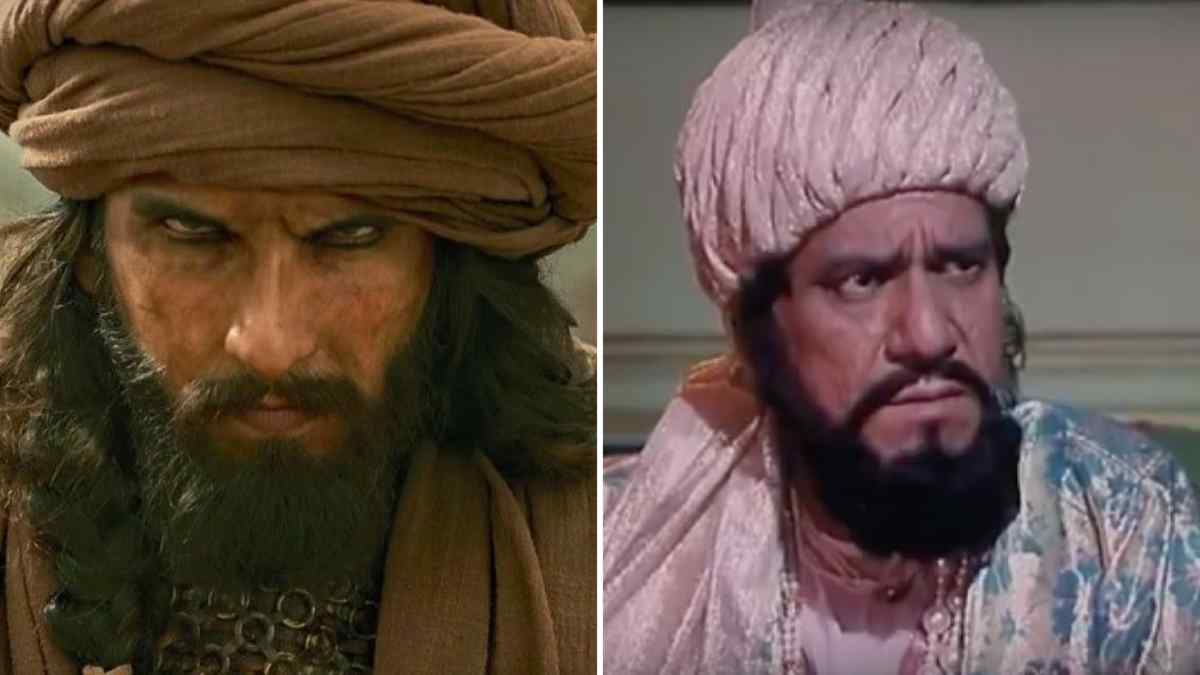
‘Padmaavat’: Ranveer Singh’s Khilji vs Om Puri’s Khilji

Long before Ranveer Singh played the Delhi Sultanate leader Alauddin Khilji in Sanjay Leela Bhansali’s Padmaavat as the mercurial monster, late veteran actor Om Puri essayed his role in Shyam Benegal’s Bharat Ek Khoj, the 53-episode Indian historical drama based on the book The Discovery of India (1946) by Jawaharlal Nehru. Both the works of art are based on Malik Muhammad Jayasi’s sixteenth-century epic poem Padmavat.

While we should give credit to Bhansali for the depiction of a strong Rani Padmini unlike the docile queen in Bharat Ek Khoj, the fault lines are evident in the depiction of the tyrant Khliji. Puri’s Khilji and Singh’s Khilji are like chalk and cheese.


The Khilji in Padmaavat comes across as a vile, snarling, meat-eating savage sans table manners driven by lust - a personification of depravity. His kohl rimmed eyes and towering, brawny physique, seems to be modelled on Khal Drogo from The Game of Thrones. His world, including his wardrobe is enveloped in a dark palette reflecting his primeval universe and his murky intentions. The Khilji in Bharat Ek Khoj dressed in vibrant royal garb looks like he bathes every day unlike Ranveer’s Khilji, a leader whose face is speckled with grime throughout the film. If Ranveer wears furry coats, Puri wears pearls. Puri may have nurtured the desire to covet Rani Padmini after hearing about her legendary beauty but his greed for the Chittorgarh jewels supersedes his desire for the queen. Unlike Ranveer’s Khilji, he is not a repulsive portrait of menace and lechery but a ruthless and authoritarian aristocrat.


A Machiavellian character, Ranveer’s Khilji steers clear of integrity, while Puri’s Khilji does stop and think before he indulges in the unscrupulous act of incarcerating and betraying Ratan Singh. He is polite and cultivated in his mannerisms.

The bisexual insinuations in Khilji’s track from Padmaavat count as firsts in mainstream Bollywood but they are missing in Benegals’ Bharat Ek Khoj. The latter does not even depict jauhar.

(Source: The Quint)

Tuesday, 30 January 2018

Dear Swara Bhasker, your letter on ‘Padmaavat’ got me thinking

The points that you put forward seem baseless if you think of it from the perspective of a viewer, writes Soumyani Ghoshal in the Quint in response to Swara Bhasker's oppen letter on Padmaavat. Read on:

Dear Swara Bhasker,

I have immense respect for you as an actor. But unfortunately, this particular open-letter has forced me to put forth some ideas regarding this film, Padmaavat(i) and the allegations that you have made against the director and the cast.

The points that you put forward seem baseless if you think of it from the perspective of a viewer. The film is merely a picturisation of 13th century 'Hindustan’, and the director has tried his best to portray that through his film. It would seem extremely unrealistic to portray these women in an emancipated light.


While having these women fight against the Khilji dynasty and safeguard themselves would indeed have been an empowering and inspiring sight, it wouldn't have made any sense to the time the movie has been set.

Needless to say, I am sure the director has made use of his creative liberty to add some glam to the film.

No one is trying to romanticise or glorify the idea of Jauhar through this film. That’s like saying that the practices of adultery and polygamy were justified, glorified and romanticised through ‘Bajirao Mastani’ (not to mention Tanu Weds Manu Returns, a film you were a vital part of).

I hope you don't believe that.

Warm regards,
A woman, and not just a vagina,

Monday, 29 January 2018

‘Padmaavat’: ‘Ram-Leela’ co-writers respond to Swara’s open letter

Swara Bhaskar wrote a no-holds-barred letter to Bhansali lamenting his depiction of ‘jauhar’ in Padmaavat but at the same time, upholding the right to freedom of speech and expression. Not denying that she is a fan of his operatic storytelling, she pointed out the possibly damaging effects of glorifying the medieval practice of self-immolation.

Read her letter here.

The co-writers of Goliyon Ki Rasleela Ram-Leela and lyricists of one of the songs from Padmaavat, Siddharth-Garima responded to her letter by writing another open letter titled, An open letter to all Vaginas. The letter begins with the dictionary definition of feminism and then goes on decry the concept.


Here are some of the excerpts from the letter. After citing all the incidents in the film that depict Rani Padmini’s agency in the film as a strong queen, they continue to question ‘equality of the sexes’ and Swara’s statement about feeling like being reduced to a vagina after watching the film.
But how can anyone advocate about ‘equality of the sexes’? A woman has a vagina, the door to life. It has the power to procure ‘life’, which no man, however hard he tries, can ever do. The question of equality is settled there, once and for all.

They must have felt like a ‘vagina’ when she chose ‘fire’ over ‘rape’? It was her ‘call’, her ‘decision’ as a vagina. Right, wrong, strong, weak is up to you to interpret as a ‘penis’ or as a ‘vagina’.

What perhaps was a victory for the filmmaker was the blinding of khilji as he entered the fort precincts, by burning embers thrown at him by the women. Such was the power of their fire within that they didn’t let the enemy lay their hands upon themselves. Why make them small and guilty of an act that they chose to protect themselves in the face of lynching and a life of slavery? Why judge that day from 700 years ago with ‘what would I do today’? It’s a film based in the 13th century when women preferred and chose death to rape.


Then don’t watch historicals, here or abroad. A ‘gladiator’ would perhaps shake your sensibilities of a slave in today’s context! Or a Troy might again make you feel like some other body part… A squishy liver perhaps. Since we cant appreciate art, lets violate it. With Karni Sena on one side and the vaginas on the other.

Padmavati was not a ‘rape victim’ who was so shamed that she didn’t have a right to live, as you make it out to be in your letter. Amazing what you all make it into. Was your open letter about Padmaavat or the regressive ‘Bhoomi’?

(Source: The Quint)

Padmaavat: ‘At the end of your magnum opus… I felt reduced to a vagina – only’

In an open letter to Padmaavat director Sanjay Leela Bhansali, actor Swara Bhaskar decries glorification of  Sati and Jauhar which deny women the right to live.

Dear Mr. Bhansali,

At the outset Sir, congratulations on finally being able to release your magnum opus ‘Padmaavat’ – minus the ‘i’, minus the gorgeous Deepika Padukone’s uncovered slender waist, minus 70 shots you apparently had to cut out.. but heyyyy! You managed to have it released with everyone’s heads still on their shoulders and noses still intact. And in this ‘tolerant’ India of today, where people are being murdered over meat, and school children are targets for avenging some archaic notion of male pride, that your film even managed a release – that is I guess commendable, and so again, congratulations.


Congratulations also on the stunning performances all around by your entire cast — primary and supporting.  And, of course, the film was a stunning visual treat. But then all of this is to be expected from a brilliant auteur like yourself, a man who leaves his stamp on everything he touches.

By the way Sir, we know each other, after a fashion. I don’t know if you remember, but I played a tiny role in your film Guzaarish. A two-scene -long role, to be precise.  I remember having a brief chat with you about my lines, and you asking me what I thought about the lines. I remember feeling proud for a whole month that Sanjay Leela Bhansali had asked me my opinion. I watched you agitatedly explaining to junior artists in one scene, and to the jimmy jib operator in the second scene; some minutiae of the particular shot you were taking. And I remember thinking to myself, “Wow! This man really cares about every little detail in his film.” I was impressed with you Sir.

An avid watcher of your films, I marveled at how you pushed boundaries with every film you made and how stars turned into fierce and deep performers under your able direction. You moulded my idea of what epic love must be like and I fantasised about the day I will be directed by you in a protagonist part. I was and remain a fan.

And I want you to know, I really fought for your film when it was still called Padmavati. I grant you, I fought on Twitter timelines –not on the battlefield, and I sparred with trolls not raving manic Muslims; but still I fought for you. I said to TV cameras the things I thought you were not being able to say because your Rs 185 crore were on the line.

Here’s proof:

And I genuinely believed what I said. I genuinely believed and still believe that you and every other person in this country has the right to say the story they want to say, the way they want to say it, showing how much ever stomach of the protagonist they want to show; without having their sets burnt, their selves assaulted, their limbs severed or their lives lost.

Also, in general, people should be able to make and release films and children should be able to get to school safely.  And I want you to know that I really wished that your film turn out to be a stupendous success, a blockbuster breaking box office records, whose collections itself would be a slap in the faces of the Karni Sena terrorists and their ilk. And so it was with great excitement and the zeal of a believer that I booked first day, first show tickets for Padmaavat, and took my whole family and our cook to watch the film.

Perhaps it is because of this attachment and concern that I had for the film that I am SO stunned having watched it. And perhaps that is why I take the liberty and have the temerity to write to you. I will try and be concise and direct though there is much to say.

Women have the right to live, despite being raped sir.
Women have the right to live, despite the death of their husbands, male ‘protectors’, ‘owners’, ‘controllers of their sexuality’.. whatever you understand the men to be.
Women have the right to live — independent of whether men are living or not.
Women have the right to live. Period.
It’s actually pretty basic.

Some more basic points:

Women are not only walking talking vaginas.
Yes, women have vaginas, but they have more to them as well. So their whole life need not be focused on the vagina, and controlling it, protecting it, maintaining it’s purity. (Maybe in the 13th century that was the case, but in the 21st century we do not need to subscribe to these limiting ideas. We certainly do not need to glorify them. )
It would be nice if the vaginas are respected; but in the unfortunate case that they are not, a woman can continue to live. She need not be punished with death, because another person disrespected her vagina without her consent.
There is life outside the vagina, and so there can be life after rape. (I know I repeat, but this point can never be stressed enough.)
In general there is more to life than the vagina.
You may be wondering why the hell I am going on and on thus about vaginas. Because Sir, that’s what I felt like at the end of your magnum opus. I felt like a vagina. I felt reduced to a vagina–only. I felt like all the ‘minor’ achievements that women and women’s movements have made over the years– like the right to vote, the right to own property, the right to education, equal pay for equal work, maternity leave, the Vishakha judgement, the right to adopt children…… all of it was pointless; because we were back to basics.

We were back to the basic question — of right to life. Your film, it felt, had brought us back to that question from the Dark Ages – do women – widowed, raped, young, old, pregnant, pre-pubescent… do they have the right to live?

I understand that Jauhar and Sati are a part of our social history. These happened. I understand that they are sensational, shocking dramatic occurrences that lend themselves to splendid, stark and stunning visual representation; especially in the hands of a consummate maker like yourself — but then so were the lynchings of blacks by murderous white mobs in the 19th century in the US – sensational, shocking dramatic social occurrences. Does that mean one should make a film about it with no perspective on racism? Or, without a comment on racial hatred? Worse, should one make a film glorifying lynchings as a sign of some warped notion of hot-bloodedness, purity, bravery – I don’t know, I have no idea how possibly one could glorify such a heinous hate crime.

Surely Sir, you agree that Sati, and Jauhar are not practices to be glorified. Surely, you agree that notwithstanding whatever archaic idea of honour, sacrifice, purity propels women and men to participate in and condone such practices; that basically Sati and Jauhar, like the practice of Female Genital Mutilation (FGM) and Honour Killings, are steeped in deeply patriarchal, misogynist and problematic ideas.  A mentality that believes that the worth of women lies in their vaginas, that female lives are worthless if the women are no longer controlled by male owners or if their bodies have been ‘desecrated’ by the touch of ; or even the gaze of a male who doesn’t by social sanction ‘own’ or ‘control’ the female.

Practices like Sati, Jauhar, FGM, Honour Killings should not be glorified because they don’t merely deny women equality, they deny women personhood. They deny women humanity. They deny women the right to life. And that is wrong. One would have assumed that in 2018, this is not a point that even needs to be made; but apparently, it does. Surely, you wouldn’t consider making a film glorifying FGM or Honour Killings!

Sir, you will say to me that I am over-reacting and that I must see the film in its context. That it’s a story about people in the 13th Century. And in the 13th century that’s what life was– polygamy was accepted,  Muslims were beasts who devoured meat and women alike, and honourable Hindu women happily jumped into their husbands funeral pyre, and if they couldn’t make it to the funeral, they built a pyre and rushed into it — in fact, they liked the idea of collective suicide so much that they gleefully discussed it over their daily beautification rituals. “Verisimilitude” you will say to me.

No Sir; Rajasthan in the 13th century with its cruel practices is merely the historical setting of the ballad you have adapted into the film Padmaavat. The context of your film is India in the 21st century; where five years ago, a girl was gang-raped brutally in the country’s capital inside a moving bus. She didn’t commit suicide because her honour had been desecrated, Sir. She fought her six rapists. She fought them so hard that one of those monsters shoved an iron rod up her vagina. She was found on the road with her intestines spilling out. Apologies for the graphic details, Sir, but this is the real ‘context’ of your film.
Swara Bhasker
A week before your film released, a 15-year-old Dalit girl was brutally gang-raped in Jind in Haryana; a crime bearing sinister similarities to the rape of Nirbhaya.

You do know that acts like Sati and raping women are two sides of the same mindset. A rapist attempts to violate and attack a woman in her genital area, penetrate it forcibly, mutilate it in an effort to control the woman, dominate her or annihilate her. A Sati- Jauhar apologist or supporter attempts to annihilate  the woman altogether if the genitals have been violated or if her genitals are no longer in the control of a ‘rightful’ male owner. In both cases the attempt and idea is to reduce women to a sum total of their genitals.

The context of art, any art is the time and place when it was created and consumed. And that’s why this gang-rape infested India, this rape condoning mindset, this victim blaming society is the actual context of your film, Sir. Surely in this context, you could have offered some sort of a critique of Sati and Jauhar in your film?

You will say that you put out a disclaimer at the beginning of the film claiming that the film did not support Sati or Jauhar. Sure Sir, but you followed that up with a two-hour-45-minute-long paean on Rajput honour, and the bravery of honourable Rajput women who chose happily to sacrifice their lives in raging flames, than to be touched by enemy men who were not their husbands but were incidentally Muslim.

There were more than three instances of the ‘good’ characters of your story speaking of Sati/Jauhar as the honourable choice, your female protagonist – epitome of both beauty, brains and virtue sought permission from her husband to commit Jauhar, because she could not even die without his permission; soon after she delivered a long speech about the war between Satya and Asatya, Dharm and Adharm and presented collective Sati to be the path of Truth and Dharm.

 Then in the climax, breathtakingly shot of course – hundreds of women bedecked in red like Goddess Durga as bride rushed into the Jauhar fire while a raving Muslim psychopathic villain loomed over them and a pulsating musical track – that had the power of an anthem; seduced the audience into being awestruck and admiring of this act. Sir, if this is not glorification and support of Sati and Jauhar, I really do not know what is.

I felt very uncomfortable watching your climax, watching that pregnant woman and little girl walk into the fire. I felt my existence was illegitimate because God forbid anything untoward happened to me, I would do everything in my power to sneak out of that fiery pit– even if that meant being enslaved to a monster like Khilji forever. I felt in that moment that it was wrong of me to choose life over death. It was wrong to have the desire to live. This Sir, is the power of cinema.

Your cinema particularly is inspiring, evocative and powerful. It can move audiences to emotional highs and lows. It can influence thinking and that, Sir, is why you must be responsible as to what it is you are doing and saying in your film.

It was with great difficulty that a group of reform-minded Indians, and the provincial British Colonial governments and Princely States in India abolished and criminalised Sati in a series of judgments between 1829 and 1861. In independent India, The Indian Sati Prevention Act (1988) further criminalised any type of aiding, abetting, and glorifying of Sati. Your act of thoughtlessly glorifying this misogynistic criminal practice is something you ought to answer for, Sir. As your ticket- buying audience, I have the right to ask you how and why you did this.

You must be aware that modern Indian history has recorded some more recent Jauhar– like acts. During India and Pakistan’s bloody Partition some 75,000 women were raped, kidnapped, abducted, forcibly impregnated by men of the ‘other’ religion. There were numerous instances of voluntary and assisted suicides by women, in some cases husbands and fathers themselves beheaded their wives and daughters before men of the ‘other’ religion could touch them.

Bir Bahadur Singh, survivor of the riots in Thoa Khalsa in Punjab, described a scene of women jumping into the village well to commit suicide. In about half an hour, he recalled, the well was full. The women on top survived. His mother was a survivor. Singh, recalls author Urvashi Butalia in her 1998 book The Other Side Of Silence, was ashamed of his mother for living for the remainder of her life. This is among the darkest periods of Indian history and ought to be remembered with shame, horror, sadness, reflection, empathy, nuance; not with thoughtless sensational glorification. These sad tales of the Partition, too, are a less obvious context of your film Padmaavat.

Mr. Bhansali, I will end in peace; wishing that you make many more films the way you want to, and are allowed to shoot and release them in peace; that you, your actors, your producers, your studio and your audiences remain safe from threats and vandalism. I promise to fight trolls and television commentators for your freedom to express; but I also promise to ask you questions about the art you make for public consumption. Meanwhile, let’s hope that no zealot member of any Karni Sena or some Marni Sena gets the idea to demand decriminalisation of the practice of Sati!

Sincerely,

Swara Bhasker
Desirous of Life


p.s: Swara Bhasker is an award winning actress in the Hindi film industry whose filmography includes the critically acclaimed Anaarkali Of Aarah (2017), the critical-commercial success Nil Battey Sannata (2016);  superhit blockbuster films Prem Ratan Dhan Paayo (2015),  Tanu Weds Manu Returns (2015), Raanjhanaa (2013) and Tanu Weds Manu (2011).
She is also an occasional writer and columnist and her short stories and articles have appeared in The Little Magazine, Seminar, The Himal Southasian, The Hindu and the Indian Express.

(Source: The Wire)

Sunday, 28 January 2018

The worst (and best) thing about Sanjay Leela Bhansali's Padmaavat

Sanjay Leela Bhansali's glorified treatment of the archaic practice of jauhar - mass suicide by fire - is a disconcerting watch. On a lighter note, if there's any lesson to take from this tragedy, it's to never send your husband shopping for jewels, writes Suhani Singh, the Senior Associate Editor, India Today, in Daily O. Read on: 

After a title change, a sartorial makeover and with two disclaimers - one elaborately long and one too short and ineffective - Sanjay Leela Bhansali's film finally releases. The only shade of grey in this film is Alauddin Khilji's kohl-lined eyes. Padmaavat is essentially a simplistic take on the good versus evil duel, in which the antagonist's crazy antics not only overshadow the righteous protagonists but also expose the flaws of their ethical code.


Padmaavat is not just a tribute to Rajput courage and in hindsight their obsession with principles of war as it is to Bhansali's filmography. Scenes from Bajirao Mastani and Devdas and a song from Saawariya will come to mind while watching the epic. Like Bajirao Mastani, here too is a married king, Rawal Ratan Singh (Shahid Kapoor), who finds a second wife while away from home. He has gone to the Singhalese kingdom to procure its famed pearls for his miffed wife. If there's any lesson to take from this tragedy, it's to never send your husband shopping for jewels.

Padmavati (Deepika Padukone) comes across as more pitiable than an inspiring figure. She is a spirited Singhalese warrior princess until she runs into Ratan Singh and soon becomes Chittor's queen. The bow and arrow and forest life is discarded for one stuck in a palace adorned with embellished ghaghras and big naths. And so begins a life of domesticity, in which Padmavati endlessly stares into her husband's eyes, exchanges amorous looks, smiles coyly and dresses him up.

This leisurely choreographed and luxurious take on romance is trademark Bhansali and also now too familiar. In this case it even makes you question the Rajput ruler's leadership skills while his kingdom is under threat.

It's all too familiar and jaded for once again Deepika plays another of Bhansali's virtuous heroines with little purpose other than to showcase the purity of her love. But her character isn't the problem here. In fact right until the #NotWithoutMyHusband climax, the queen is questioning her husband's decisions and his lack of action.

But then if history has taught us anything, it's that men rarely listen to women for the male ego is paramount. And so the weakest here is Rawal Ratan Singh who believes in making history by doing the right thing. It's hard to root for a character whose valour is misguided, is easily susceptible and thanks to Bhansali's love for craft preoccupied with his wardrobe. Sadly for him centuries later his persistence with his community's obedience to "usool" and "guroor" makes him seem an imprudent king. "Rajput kabhi peeth peeche nahi jaate." Sadly the words that ring true belong to Alauddin Khilji (Ranveer Singh) - "Jug ka ek hi usool hai, jeet".


(There is only one rule in war - victory). After all one remembers the winners, not the losers, and everything is fair in love and war.

But in Padmaavat its greed and not love which gets the plot going.

Raghav Chetan (Aayam Mehta), banished from Chittor for being a sleazy baba (the one rare occasion the film has contemporary significance), tells Khilji that he can be as celebrated a world conqueror as Alexander if he gets hold of Padmavati. Obsessed with making and rewriting history Khilji is enthralled at the prospect. Khilji attacks, struggles and then comes up with a stroke of genius. Chittor retaliates with one of its own courtesy Padmavati. Male chauvinism is at its peak when Padmavati arrives in Delhi only to be reprimanded by her husband for her daredevilry. Gradually Malik Muhammad Jayasi's 1520 poem, Padmavat, plays out.

Ranveer Singh shines as the megalomaniacal, lustful, narcissistic and ruthless Sultan. Compared to the indecisive Rajputs, the Afghan-origin Sultan of Delhi is the life of the proceedings. Women to him are objects to be mistreated and territories to be conquered. Padmavati is his Kiran, a woman to be had at all costs. Singh uses the kohl-lined eyes and muscular body effectively to put on a showy act, one which with a few jarring notes, is full of engaging moments. There is fun in the terror here. In one memorable scene, he makes his irritation of seeing Ratan Singh clear with a well-timed grimace. In another, he swaps his thali with the Rajput in fear of being poisoned. This is an actor savouring each and every moment, fully aware that deranged and debauched characters like this don't come your way every day.

Giving Khilji good company in the crazy department is his devoted aide Malik Kafur (Jim Sarbh), rewarded with the best entry sequence in the film. Labelled by the enemies as his wife, Kafur's own unconditional love for the king here is juxtaposed well against Khilji's insatiable want for Padmavati. This, and not Ratan Singh, Padmavati and Khilji, is the most fascinating love triangle in the film. The relationship only reiterates the differences between love and desire. Bhansali keeps the homoerotic tension between the two minimal but it's effective in getting the point across. Sarbh's measured performance ensures this character doesn't become a caricature and its sentiments are considered.


Apart from celebrating the Rajput spirit on the battlefield, the film inadvertently also highlights the royalty's ability to change clothes at a swift pace. The creative liberties here come at the cost of continuity. Padmaavat like any another Bhansali film excels in the craft department, with Sudeep Chatterjee's gorgeous lenswork and Rimple and Harpreet Narula's costumes playing big role in adding to the visual splendour. The grand scale is tasteful and impressive, even visible in the battle sequences.

But Padmaavat is also one of Bhansali's weakest musical efforts. Barring the censored ghoomar song, none register. The picturisation of the unreleased songs lacks the Bhansali magic. The Malhari-like track on Khilji is present only to further degrade the character.

Politics is why Padmaavat suffered and it's the film's politics which is hugely problematic. Bhansali's glorified treatment of the archaic practice of jauhar - mass suicide by fire - is a disconcerting watch. All along the Karni Sena, self-appointed custodians of Rajput honour, have been worried about the repercussions the film will have on how their community is perceived and judged.

The vilification here is entirely of Khilji and his Muslim army. Boorish they may be but at least they are not dull, a feature that the power couple does have. And that's the real failure of Padmaavat. It's inability to evoke a sense of loss and empathy for its Romeo and Juliet. Khilji may not have got what he wanted but he ensures that history remembers him. By the end of Padmaavat, it's Khilji that you are thinking about. Because really in this day and age who thinks mass immolation is a victory.

Saturday, 27 January 2018

Padmaavat: Deepika-Shahid mediocrity covered in jewels, Ranveer not convincing

This film is not about Padmavati, the Rajputs or Alauddin Khilji. 'Padmaavat' is all about Sanjay Leela Bhansali and how he saw an immensely profitable, entertaining Hindi film in a folk tale. It is not that Bhansali doesn't care about authenticity it's just that Bhansali's definition of cinema is Bollywood, thus any script that he works on will eventually turn out to be a full blown commercial entertainer. Every shade, every emotion, every flavour and then some more.

The director plays to the galleries generously and doesn't miss a single opportunity to appease the Rajput community but unlike many others who indulge in formula to embarrass themselves Bhansali is simply the best at making clichés colourful and lively. The craft supports the gripping storyline perfectly; the sequences are breathtakingly beautiful, trademark Bhansali style. Bhansali's canvas is incomparable, the only other Indian filmmaker who can produce similar sequences in terms of technical superiority is Vidhu Vinod Chopra but Mr Chopra needs a lot of focus to deliver a film like this.

The actors completely submit themselves to Bhansali and maybe that is the reason none of them really shine.

Ranveer's portrayal of Alauddin will help him garner critical acclaim & sweep award shows, 'Khilji' cut-outs will be displayed in local barber shops and stuck on windowpanes in buses. Ranveer deserves every bit of the appreciation and adulation that he is about to receive.

Bhansali's biggest strength is also his Achilles heel, craft takes over content yet you don't mind this compromise as the end product is spectacular and the execution emerges as the real hero of the film.

In Padmaavat the director reduces the principal characters to stereotypical one-liner spitting; larger than life Bollywood stars, no genuine attempt at understanding & essaying the characters of a Rajput king, a queen who is worshipped & a powerful soulless invader.


As a result Ranveer is far from convincing as Khilji, in many scenes he seems similar to Khal Drogo from game of thrones, certain dialogues that he delivers remind you of his Peshwa Bajirao avatar and in some scenes he's simply himself, the eccentric Hindi film star who never fails to amuse.

 Khilji was an unforgiving ruthless conqueror; he ruled by instilling fear in the hearts of every living thing however Bhansali's idea of Khillji seems to be that of a spoilt brat with immense power. The comedy and dance sequences Khilji participates in work for the film in a strictly commercial sense but not for the performer - Ranveer Singh. Khilji is nowhere close to the master class Ranveer delivered in Bajirao Mastani and that is a shame because he is capable of so much more.

Being a one-dimensional actress Deepika Padukone has done very well for herself but she doesn't possess the skill to essay such a character. Shahid and Deepika's portrayal of Raja Rawal Ratan Singh and Rani Padmavati can best be described as mediocrity covered with jewels. Once again, the director is to blame.

The emphasis seems to be on capturing Deepika and Shahid like Rajasthani royalty participating in a fashion show they aren't aware of. There are many sequences where both Shahid and Deepika are completely silent just posing for the camera or for each other, as a result they seem to be silent even when they 'recite' their dialogues simply because barring a couple of scenes they are not impactful at all. Having said that, all of these sequences work, there is never a dull moment and that is the magic of Sanjay Leela Bhansali, he sticks to his strengths even if that means reducing his actors to props.

The only actor who did justice to his role was Jim Sarbh who plays Malik Kafur, the male love interest and general of Alauddin Khilji. Sarbh's portrayal of Kafur is also a hyperbole but everything from his accent to his mannerisms and his expressions demand & deserve your complete attention, he is simply brilliant.

I'm going with 3.5/5 for Sanjay Leela Bhansali's 'Padmaavat', this film will not go down in history as one of the best Indian films but it could turn out to be the biggest hit of all time, bigger than Dangal and with some luck Padmaavat could challenge Baahubali's record at the domestic box office.

(Source: India Today)

Friday, 26 January 2018

I watched Padmaavat; Modi and Rahul's silence about Karni Sena violence is telling

The cadres and their patrons need productive employment so they can stay off the streets and are denied their 15 minutes of fame, writes Rajdeepa Sardesai in Daily O. Read on: 

Just finished watching Padmavati (oh sorry Padmaavat) in a special preview last night. All I can say is that every sena should be made to mandatorily watch films and read books before they get hot under the collar next time.

To have protested against the film without seeing it is absurd but familiar.

Frankly, the Karni Sena's cadres and their patrons need productive employment so they can stay off the streets and are denied their 15 minutes of fame. As for the governments which have singularly failed to protect law and order, they should be summarily sacked. And before fine talk about being the fastest growing emerging economy in Davos can we be a progressive society in India? That even the prime minister's home state has been touched by lumpen violence is a blot on our image.


Once again, the prime minister has been silent when he should be reading out the riot act to his own BJP ruled governments. You can't be the macho Mr Modi in Davos and then be unable/unwilling to rein in a Karni Sena at home. And why is the Congress and Rahul Gandhi who tweets on all other sundry issues so conspicuous in their silence? Surely an election in Rajasthan can't override a commitment to the Constitution that guarantees free speech and expression?

Oh yes, the film itself?

A tad too long but lavishly mounted and grandly picturised in true Bhansali style. Is a celebration of Rajput pride and honour (and actually of Brahmin betrayal!) Go see it, not just for the beauty of Deepika Padukone as Padmavati but for Khilji, superbly portrayed by Ranveer Singh (Shahid is good too, but Ranveer remains the standout)

And keep some popcorn for the Karni Sena in case they finally decide to watch the film from a jail cell for inciting violence; that's all they bloody well deserve!