Showing posts with label model. Show all posts

Friday, 15 November 2019

6-year-old Nigerian girl Jare Ijalana dubbed as the ‘most beautiful girl in the world’

Three portraits of Jare Ijalana have garnered nearly 50,000 likes and thousands of comments on Instagram A photogenic five-year-old from Nigeria has been dubbed the world’s “most beautiful girl” after portraits of her went viral on social media. Official images of Jare Ijalana were shared on Instagram and Twitter by photographer Mofe Bamuyiwa last week. “Oh yes, she’s human! She’s also an angel!” the Lagos camerawoman captioned one of the portraits of Jare.


With piercing eyes, beautiful complexion and gorgeous hair, the child is being revered as “doll-like,” “true work of art” and “absolutely stunning.” The three portraits of Jare have garnered nearly 50,000 likes and thousands of comments on Instagram. “I want to portray the interception between her childhood and adulthood so both stay timeless!” Bamuyiwa captioned another shot of Jare.

“I could have made her smile and make her laugh out loud but I put her in their natural moments for us to see through their eyes!” Bamuyiwa added, “Posing them as adults were my trick to create it a timeless portrait! Jare, when you clock 21 remember to do the same pose and style.” And Jare isn’t the only one in her family to be an up-and-coming model.


Her sisters Jomi, 7, and Joba, 10, have also posed for Bamuyiwa’s camera and the siblings are also featured on their family’s social media pages. “All I want is for everyone to see Jare’s powerful potential,” Bamuyiwa told Yahoo Lifestyle on Tuesday. “I want the photo to speak to her when she has reached her adulthood.”


The viral “most beautiful girl in the world” movement first started back in the early 2010s after France’s Thylane Blondeau, now 17, was called “the most beautiful girl in the world” at age 6, leading to her photos to be published in Paris Vogue‘s Vogue Enfants years later.

(Source: Zebnow)

Wednesday, 3 July 2019

Modeling agency challenges the fashion industry by only hiring models over 45 years

We live in a world that is desperately and blindly following society’s beauty standards.

As a result, we are forced to believe that our beauty has an expiration date. The media is constantly serving us content that depicts the perfect life of celebrities. All of them have the same things in common. Beautiful, porcelain skin, amazing hair and flawless bodies.

The more we look at these gorgeous people in the magazines and the tabloids, the more obsessed we become with this notion of stopping time and preserving the youthfulness of our bodies.

But sadly, by focusing our attention on staying forever young and becoming these flawless versions of ourselves, we actually forget how it feels and looks to age gracefully.

We forget the fact that youth is not the most beautiful part of life.


Luckily, one Russian modeling agency has decided to break these stereotypes and embrace the beauty of aging in a very bold and unique way. This agency is the result of a project that photographer Igor Gavar did for his blog. He had this idea of challenging society and the fashion industry by photographing retirees.

But what started as a project ultimately turned into a full-time job for this man. That is how he created the model agency which by the way has a very appropriate and interesting name. It is called Oldushka.

The majority of the models are over 60 years old with only one male model who is 45 years old. Oldushka’s models are famous all over Russia and they’ve worked on many advertising campaigns and fashion catalogs.

If you want to see some of the amazing portraits that he has done, keep scrolling.

This is what pure beauty looks like!

(Source: Curious Mind Magazine)

Monday, 13 May 2019

As a fashion model I was humiliated, objectified and forced into debt – here's why I'm exposing the truth

Former model Leanne Maskell shares the dark reality of life when your body is fair game

Like so many of us, I grew up in a world that glamorises modelling. It’s a career that’s often portrayed as a fairytale – a scout “discovers” you as a gawky teenager and turns you into a goddess, gracing catwalks and glossy magazine pages.

But as someone who’s had this exact experience, I can tell you it is all smoke and mirrors. Behind the facade of beauty and luxury, I found myself in a job with no possibility of progression, the feeling of being exploited at every angle and dealing with the mental health issues that arise as a result.

I started modelling at the age of 13, when my mum sent a photograph of me to a local agency. Having been bullied for the way I look for years, it wasn’t something I’d ever considered, but before I knew it I was being told that my photos would be in some of the biggest fashion magazines out there, which kick-started a career that lasted more than a decade.


One of the things no one ever tells you is that often as a model you have little control over your contracts or even experiences at work. Models are often seen as objects to be hired out for the day, in any capacity, and this can lead us to forget that we have rights.

Really, the only power you have as a model is choosing an agency. But there is no real guidance or official quality control system for the industry, making it hard to know whether you’re making the right choice.

In one instance, I actively chose a prestigious agency but quickly found myself being sent on unpaid test shoots that I later found out I was being charged for – some up to £400. I had experience working for big brands so I could stand up for myself, but even so I felt heavily pressured by the agency.

After a week I found myself in almost £1,000 of debt, with no sign of actual paid work on the horizon. It was impacting my mental health so terribly that I was having continuous panic attacks, and when I tried to leave I was threatened with legal action.

I have also often been humiliated at castings and spoken about as an object on the job. One client complained for two hours about the evenness of my eyebrow height.

'I left the agency, as my doctor advised me to for my mental health' (Gabi Mulder)
The majority of models I know have also been pressured to lose weight. I was scouted by an agency who told me to lose three inches (7.6cm) from my hips. When I refused, they dropped the request to 3cm. Months followed of me having weekly measurements taken at the agency after being invited in for a “quick chat”. It was humiliating and degrading to be continuously told off for not being thin enough, and I felt pathetic and worthless as a result.

Everyone around me seemed to think it should be easy. When I finally lost the weight they asked me to lose another 2cm. At this point I finally realised nothing would ever be enough.

As models, people often assume that our bodies are fair game. This created a complex relationship with my body – I suffered eating disorders as a result and still have severe body dysmorphia. But it also leaves us vulnerable to sexual harassment and exploitation.

'I started modelling at 13'
It is completely normal for castings and shoots to be held in hotel rooms, which can put us in uncomfortable positions. At one casting I was alone in a hotel room for with a male client who asked me to get undressed. I did not feel comfortable and when I refused, I was told that I could do escort trips in Dubai, earning thousands of pounds for one day. I am not a sex worker and the implication that I may as well have been in this man’s eyes made me feel incredibly unsafe.

On another test shoot, I had to leave half way through as I felt incredibly pressured into having a drink and posing nude in a stranger’s bedroom.

I recall a shoot where I was asked to spank another model’s backside with a ping pong bat, and told to "cover my face with my hair" by a photographer when I refused and was visibly upset. I ended up being maneuvered into a sexual position by the team as I cried from humiliation. I didn't feel like I could just walk out for fear of seeming unprofessional – and I wasn’t even being paid.

While agencies presumably don’t want their models to have negative experiences, the industry is largely unregulated, making it hard for them to know whether the photographer they’re sending us to is legit, or just a creepy amateur. The stress of being consistently sexualised while doing your job inevitably takes a toll.

I feel strongly that if models are aware of their rights we can ensure that these situations do not happen to other vulnerable people – that’s why I’ve written a book sharing my experience. I hope that this starts the much needed global conversation of how to improve the modelling industry.

(Source: Independent)

Wednesday, 1 May 2019

Muslim supermodel becomes first to wear burkini and hijab in Sports Illustrated Swimsuit issue

A Sports Illustrated Swimsuit Issue has featured its first ever hijab wearing model on the cover, the boundary-breaking Hamila Aden, and people are loving it.

The issue, which is set to hit newsstands on May 8, will feature the Somali-American model on its cover, while she models two custom burkinis.

In a statement about the progressive cover, the magazine's editor MJ Day said that the publication's priorities have shifted, and featuring Aden on the cover is representative of this.


In the release, Day said:

Having Halima as a part of SI Swimsuit is yet another example of the range and scope of the type of beauty that exists.

Her participation and inclusion further highlights the brand’s commitment and belief in supporting women to own who they are and what makes them unique and ultimately reaffirms what our messaging has been, that YOU are worthy.

Speaking to the Huffington Post about the cover, Aden described her appearance on the cover as a 'moment':

Being in Sports Illustrated is so much bigger than me.

It’s sending a message to my community and the world that women of all different backgrounds, looks, upbringings can stand together and be celebrated.

This is a moment, that’s for sure. Women everywhere should know their differences are what make them beautiful.

Aden was born in the Kakuma refugee camp in Kenya, before moving to the US aged 7. The model returned to Kenya for the Sports Illustrated shoot at Watama Beach on the southeast coast.

Speaking to Sky News about the cover, she said:

I keep thinking [back] to six-year-old me who, in this same country, was in a refugee camp.

So to grow up to live the American dream [and] to come back to Kenya and shoot for the Sports Illustrated in the most beautiful parts of Kenya - I don't think that's a story that anybody could make up.

She also had a positive message for other young Muslim women, saying in a release quoted in the Huffington Post:

Young Muslim women need to know that there is a modest swimsuit option available to them so they can join the swim team, participate in swim class at school, and go with their friends to the beach.

Muslim girls should feel confident taking that step and doing so comfortably while wearing a burkini.

This isn't the first time the supermodel has made headlines. In 2016, Aden became the first Miss Minnesota contestant to compete wearing a hijab and burkini. She's also the first model to wear a hijab on the cover of Allure magazine.
(Source: Independent) 

Wednesday, 3 April 2019

'He thought he'd ruin me': Indian acid attack survivor and model speaks out

Reshma Qureshi’s makeup tip videos put a spotlight on violence against women, but survivors still face an uphill struggle for justice

When catwalk model Reshma Qureshi offers makeup tips, her online tutorials end with the message that an eyeliner or lipstick is just as easy to buy in India as a pot of over-the-counter acid.

The point, coming from a woman who was left disfigured and partially sighted by an acid attack, has already proved so powerful that it has helped lead first to an international petition, and then to the supreme court of India ordering states to enforce the ban on sales of the chemical.

However, despite the attention given to her own story and to the plight of thousands like her, Qureshi says the epidemic of acid attacks in India continues unabated, and the legal system lags far behind public opinion in dealing with cases.

“The only arrest made in my case could receive bail soon, and my family is very afraid for our safety,” says Qureshi, who is from Allahabad, in the northern state of Uttar Pradesh.

“On 19 May 2014, my brother-in-law threw acid on my face,” Qureshi tells the Guardian. She was just 17 when she and her sister were attacked. The older woman suffered minor burns but Qureshi was left badly scarred and blinded in her left eye.

Despite the milestones she’s achieved – including fashion modelling – Qureshi’s struggles are far from over. After years of legal battle, Qureshi has still not received justice. Of the three men involved in the attack, only one was arrested. The trial is still ongoing.

Her experience is far from isolated. The most recent statistics from India’s National Crimes Record Bureau record 283 reported acid attacks, with 307 casualties, in 2015. Worldwide, thousands of acid attacks take place every year. Official figures show only a fraction of the actual number of such attacks, activists say, with “thousands of the cases” going unreported.

Most survivors are attacked by relatives, making it more common that the crime is not reported outside the family. Tania Singh, an activist and CEO of Make Love Not Scars, an organisation that helps survivors of acid attacks, says many others die from their injuries before they are able to go to the police.
 Reshma Qureshi has makeup applied before modelling designs by Archana
Kochhar during New York fashion week in 2016. Photograph: Lucas Jackson/Reuters

Qureshi’s struggle not just to get medical help, but also legal support, lays bare the apathy of the Indian system towards survivors of violence, she says. “The doctors wouldn’t treat my burns till we got a police complaint registered. It was six hours before I received any help. I just lay there screaming in pain.

“Eventually, when the court was hearing my case, I was called as a witness while I was in surgery. Despite my father’s pleas, they insisted I be present, or else the attacker would be let go. How is that fair?”

Singh says more courts and judges are needed to expedite such cases. “The backlog of cases in India is massive; we have survivors who were attacked 10 years ago and haven’t seen justice, their attackers are absconding. The decision needs to come faster, swifter and harder.”

Currently, the crime is punishable with up to 10 years in prison, but conviction rates are low. “In at least 40% of the cases, the attackers remain absconding,” says Singh.

“Our laws are actually very good – solid laws, such that other countries could learn from our laws. The problem lies with implementation… It is very easy to pass a law, it is very difficult to implement it.”

While her organisation helps survivors find pro-bono assistance, and covers some of their legal fees, the financial burden of such an attack is still crippling, says Singh. “Reshma’s parents had to sell their business and ancestral home to pay for her treatments and legal costs.”

Qureshi now lives with other survivors at the Make Love Not Scars shelter in Delhi. “Apart from a safe space, we also provide survivors psychological care, medical attention, help with their surgeries, post-operative care, funding [for] their children’s education, and help to become productive members of society,” says Singh. “However, the biggest challenge we face is the lack of belief survivors have in themselves. Society has put [the idea] in their minds that their lives are over. To convince them otherwise can be very hard sometimes.”

The organisation provides support and vocational training to survivors, including Qureshi, whose videos entitled “Beauty Tips by Reshma” have been hugely successful, putting a spotlight on the problem of violence against women.

“I have always loved applying makeup, but I quit after my attack,” she says. “I would see other women who were all made-up and wished I could also do that. Then I asked myself, why couldn’t I do it?

“That attack ruined everything in my life. Your face is everything in this world, your face is considered your most important identity,” she says. “The man who attacked me, he thought this would ruin me. ‘She won’t be able to do anything and she’ll die.’ But I won’t let that happen. I won’t give him the satisfaction – I will show him how I can live and move forward.

“The next thing I want to do is be in a movie about my life, and to play myself.”

Singh says many survivors are now pursuing careers they previously thought out of reach: “It is also what we strive to instil in all our survivors that you should be the best version of yourself. Let no one make you feel otherwise.

“We have a few survivors who work in the high court, another who works in a hospital – because people should be free to follow their dreams in whatever way possible.”

(Source: The Guardian)

Tuesday, 24 April 2018

Milind Soman and Ankita Konwar get married

Model-turned-actor Milind Soman tied the knot with his girlfriend Ankita Konwar in Alibaug on Sunday. Only close friends and family were present for Milind and Ankita’s wedding ceremony. The couple was colour-coordinated in white and golden traditional outfits and looked every bit happy on celebrating their togetherness. Ankita Konwar looked beautiful in minimal make-up.

The couple had hosted sangeet, mehendi and haldi ceremonies on Saturday. Milind and Ankita were seen dancing at their sangeet ceremony to the romantic song ‘Ishq Sufiyana’ from the film ‘The Dirty Picture’. Milind Soman looked handsome in a royal blue kurta, while Ankita made for a beautiful bride in a pink kanjeevaram saree.


52-year-old Milind Soman is internet’s heartthrob and a fitness enthusiast, while Ankita Konwar reportedly hails from Guwahati and is said to be an air hostess. They have reportedly known each other for four years.

Earlier, the couple had received flak for their alleged age difference after it was reported that 52-year-old Milind Soman is dating 18-year-old Ankita Konwar. However, Ankita’s age has been confirmed as 27 years, and not 18 years.

(Source: Republic)

Tuesday, 28 November 2017

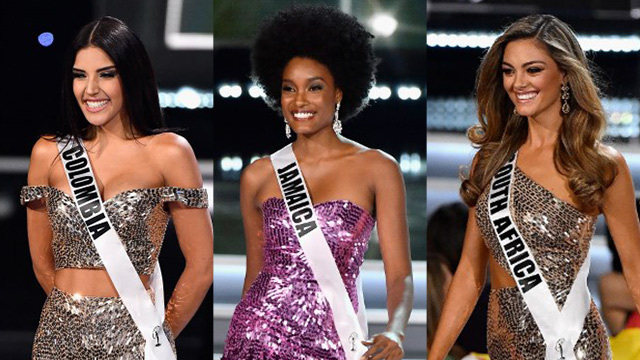
The final question that decided the winner of Miss Universe 2017

The top three contestants of Miss Universe 2017 were asked the same question, the answers to the which determined the winner of Miss Universe 2017.

The world has finally got its Miss Universe for the year 2017 and it is none other than Demi-Leigh Nel-Peters from South Africa.

Demi-Leigh Nel-Peters left behind contestants from Colombia and Jamaica, who were declared runner-up and second runner-up respectively, to win the prestigious crown.

Making their way through over 90 gorgeous women representing their respective countries, contenders from South Africa, Jamaica, and Colombia finally made it to the top three of the prestigious pageant that was held in Las Vegas, Nevada, United States.


Each of the three contestants were asked a final question that finally determined the winner of Miss Universe 2017.

The question was, ''What quality in yourself are you most proud of and how will make you apply that to your time as Miss Universe?''

The contestant from Jamaica, Davina Bennett, answered, ''It is my drive and determination. I am part of a foundation that helps deaf people. This platform will be a great platform to help people.''

The contestant from Colombia,  Laura Gonzalez, answered, ''I am incredibly passionate about everything I do. I put my full self in every situation. I have done this as an actress, as Miss Colombia and will now do the same if I win Miss Universe.''

Finally, Miss Universe Demi Leigh Nel-Peters, from South Africa, said, ''You have to be confident in who you are as an individual. Miss Universe is one who has overcome many fears and will inspire other women too, to overcome their fears.''

(Source: India Today)

Demi-Leigh Nel-Peters from South Africa is Miss Universe 2017

Hold your breath, Demi-Leigh Nel-Peters from South Africa, has won the coveted title of Miss Universe 2017.

This is the 66th edition of the world-renown beauty pageant, where India was represented by Miss Diva Shraddha Shashidhar, who didn't make it to the list of top 15 finalists.

Crowned by Iris Mittenaere of France, at an event held at The AXIS at Planet Hollywood in Las Vegas, Nevada, United States, Demi-Leigh Nel-Peters rose to glory, after being skimmed through 92 participants.


Contenders from Jamaica, Venezuela, Thailand and Colombia made it to top five, but the South African beauty beat the others, and bagged the crown. Jamaican beauty Davina Bennett was the second runner-up, while Colombian beauty Laura Gonzalez was the first runner-up.

The show was hosted by American comedian Steve Harvey and supermodel Ashley Graham, while Fergie, and Rachel Platten, who performed "broken glass", brightened up the night with their terrific performances.

This is the second major beauty pageant of the year, after Miss World 2017, which was bagged by Haryana girl Manushi Chhillar.

(Source: India Today)

Wednesday, 27 September 2017

Sex work is common among models: Yrsa Daley-Ward

She has a lot to say… about sexuality, relationships and mental health. But how did Lancashire’s Yrsa Daley-Ward become the toast of Los Angeles? Eve Barlow from the Guardian meets the poet, feminist, model and LGBTQ activist spelling out some hard truths. Read on:

If you’re afraid to write it, that’s a good sign. I suppose you know you’re writing the truth when you’re terrified.” These words in black type on a white background make up one of poet Yrsa Daley-Ward’s Instagram posts. This monochrome snapshot of her innermost thoughts has more than 5,200 “likes”. That’s more than double the number she gets for any pictures. Daley-Ward spent her late teens and early 20s as a model struggling to pay her rent in London, working for brands such as Apple, Topshop, Estée Lauder and Nike. She still models today. Ironically, however, it was the image-obsessed medium of Instagram that enabled her to pursue the written word.

“I always was a writer,” she explains today in a thick Lancashire accent, sitting in a downtown Los Angeles restaurant close to where she lives. “But I was depressed [in London] and that made me choke. Modelling is an interesting profession because it teaches you so much about here…” She points a finger at her face. “But not here…” she sighs and points at her heart. “You become introverted, you disappear into yourself.”

Daley-Ward’s debut collection of poetry, Bone, is anything but introverted. Aptly titled, it’s a visceral read candidly documenting her religious upbringing, sexuality and mental-health battles. It flew out of her in three months, as she chronicled her bad love affairs, sense of isolation and feelings of inadequacy – an uncomfortable, uninhibited read. Daley-Ward is a self-confessed firestarter and has a colourful past. She doesn’t watch TV and prefers to go to the pub to drink Guinness and “chat to old men about their lives”. When asked to give her age, she refuses. “Men don’t get asked,” she barks.

‘As a model you disappear into yourself’: Ysra Daley-Ward. Photograph: Platon for the Observer

She finds the notion of being objectified irksome. In a bodycon dress today, she tells me she’s been cat-called “seven times” en route here. “Why the fuck? Look at the patriarchy, look at rape culture. I don’t need to be subjected to what men think.” With her poems she cuts through that, deep into the parts of herself that she feels have been overseen by superficial, homogenous norms.

Bone was initially released in 2014 through Amazon’s self-publishing arm. It’s since been expanded for reissue via Penguin. Daley-Ward’s 116,000 and growing Instagram fanbase was key to that. Having followers like pop star Florence & the Machine and Hollywood actor Ellen Page also helps.

Daley-Ward read everything she could get her hands on as a kid: Roald Dahl, Spike Milligan, Shakespeare. As a young, black, LGBTQ female, she’s often said that she feels “invisible”in the literary world and maintains that poetry has a long way to go to diversify itself.

“Have I seen change? Yes and no,” she says. “There’s a lot more to do. If it wasn’t for the internet how would I have got the book out? How would I have got a publisher? If I went to a publisher armed with Bone and zero internet following…” She tapers off, suggesting they’d have looked right past her. “I didn’t know what to expect. I just persevered.”

Alongside the African-American poet Nayyirah Waheed, Zimbabwean bard Tapiwa Mugabe and Nigerian writer Ijeoma Umebinyuo, Daley-Ward, who is of West Indian and West African descent, is part of a small, elite community of black writers who are breaking down barriers. “It’s lovely to see women of colour poets,” she says. “Old poetry can be so inaccessible. Not just for people of colour but for people who aren’t super erudite, who don’t read, don’t love Shakespeare. Some people just want to connect with feelings.”

‘The queer space is varied and intricate. Every story I have is a story a friend has’: Ysra Daley-Ward.
Photograph: Platon for the Observer

The melting pot of Downtown LA is a far cry from home in Chorley. She was born in the northern town after her Jamaican mother (a nurse) had an extra-marital affair with a Nigerian man who came to the UK to study, leaving his wife and children behind. He died before Daley-Ward was old enough to meet him.

From the age of seven to 11 she was sent, with her younger brother, to live with her grandparents. They were Seventh Day Adventists. Daley-Ward describes them as “strict religious fundamentalists”. “From sunset on Friday we couldn’t do anything until sunset on Saturday,” she recalls. “During the week everything was monitored. We didn’t go outside except to see my cousins.”

Growing up fast, she was ingrained with certain gender expectations; rules that existed to be broken. “They’d tell me that a girl should be able to run a house. Every Sunday my grandma and I would be on our knees handwashing all the clothes. I learned how to clean, sew and cook. I never make my bed now.”

At the time, Daley-Ward bottled up her frustrations. When she returned to live with her mother, she was left to raise her brother while her mum worked night shifts. “Things changed completely,” she remembers. “There was all the freedom where we once had no freedom.”

As well as the liberation that came with her own sexual awakening, she gained a more rounded perspective on a woman’s place in the world. Her mum’s boyfriends weren’t always the most desirable choices. “She was the one with the money, working hard. She never received help from men, ever.” That gave birth to a sense of staunch independence in her, combined with a streak of disruption. “I’m a quiet, introverted person, but I was very internally rebellious.”

Conflict continued to bubble up inside her; she was acutely aware of not fitting in in Chorley. “I was a black girl living in a market town, alien to everything. There were so many things I wanted to be other than what I was. I wanted to be white, have different hair, have parents who were home, know my father, not be religious. When I watched TV, everything from Disney to Coronation Street, there was never a representation of me.” She would write to disappear into different realities.

‘When I was 20, I was in knots. There’s no cage now’: Ysra Daley-Ward.
Photograph: Platon for the Observer

Soon enough, however, she didn’t need prose to whisk her away. There was a man – an older music teacher. He was married. He left his wife for her. “It was a torrid, crazy time,” she recalls, awkwardly avoiding the conversation.

She left Chorley and moved to Manchester en route to London, as the pull of big multicultural cities became exhilarating to her. “I was going out dancing to reggae and African music, buying jollof rice made by someone other than my grandma.” The honeymoon period was short, though. She lost her mother in 2007. (She doesn’t say how she died but implies that her lack of quality of life contributed.) Working as a jobbing actor and model, struggling to makes ends meet, she fell into depression. Writing was unimportant when there were bills to pay. “The grind got to me. I was lonely and had no real support in the world. None. I felt awful every day. I didn’t want to get out of bed.”

The discrimination she experienced in the fashion industry made matters worse. Repeatedly she’d fail to get jobs she was more than qualified for. “This is not a face that sells in England,” she says. “They say that black models sell fewer clothes than white models. That’s stupid. Fashion just doesn’t want to be diverse.” To survive, she had to find other avenues. “I was a very enterprising young woman,” she says coyly. “Learning what to use to get by.”

I ask if she’s alluding to sex work. She laughs. “It’s the most common thing in the modelling industry, especially at high levels. I’m not talking about standing on street corners. You have a boyfriend for two months who’s a millionaire. In that situation you’re safe, eating caviar, drinking champagne. There are other situations that are considerably less safe and less consensual. It’s a reality for so many women in the entertainment industry and we’re told not to talk about it.”

In desperate need of salvation and in search of more secure modelling jobs, she moved to Cape Town where there was, she says, a guaranteed market for black models. She was 24 years old with £200 in her pocket. The experience made her rich in a way she’d never have anticipated. While there, she came across a spoken-word evening. The task was to write a poem about family discord. “I thought: easy!” she smiles. Her performance brought rapturous applause. She went again and again. Every week the audience grew.

“In acting and modelling I was so busy expressing what somebody else wanted that I’d completely shut down my own voice,” she says. “I didn’t have any mirrors. When I was 20, I was in knots. I couldn’t speak my reality to anybody. There’s no cage now. Lots of people are afraid to tell the truth. But I don’t care. It’s fucking boring otherwise.”

Ysra Daley-Ward as a toddler with her mother and brother. She says her mum ‘never received help from men, ever’. Photograph: @yrsadaleyward

Today, Daley-Ward lives between LA and London. Her audience has grown far beyond Cape Town. One poem, Mental Health, has made fans of people who have never given a thought to poetry. During a reading in south London, a man came up to her in tears. “He asked me to send it to him. I thought nobody was listening,” she says. She’s also become a poster child for the undermined, particularly the LGBTQ community. Despite writing about her relationships with women, she refuses to make her sexuality a big deal, insisting that her poems relate to people of all sexual preferences.

“I’m writing about common experience,” she says. “The LGBT community are my friends. The queer space is varied and intricate. Every story I have is a story a friend has. When I talk about a woman that you can’t get out of your head even though you know she’s going to fuck you over… Hello?! That represents 10 people I know.”

In an age of technology, the fact that Daley-Ward has built a platform for literature out of social media is perhaps her biggest act of rebellion. Next, she’ll release a memoir. “There’s nothing left unsaid,” she laughs. Titled The Terrible, it’s “The truest thing I’ll maybe ever write.” Where it will take her remains to be seen. “I move through the world at an alarming rate. Next time we speak I might be in New York,” she says. “I’m in the midst of a change. I keep dreaming about it. Something’s about to happen.”

Friday, 7 July 2017

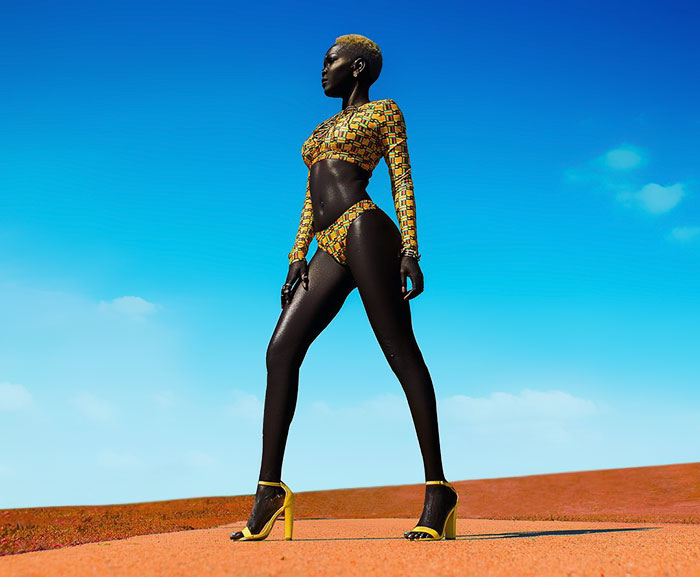
The “Queen of the Dark” who was told to bleach her incredibly dark skin by Uber driver

Meet Nyakim Gatwech, the South Sudanese model who’s teaching people not to be afraid of the dark. With her deeply pigmented skin and fierce determination, she’s breaking down the barriers of conventional beauty, and encouraging others to do exactly the same.

The 24-year-old burgeoning fashion icon, who now lives in Minneapolis, Minnesota, has no shame about her melanin, and she makes sure the world is aware. “My chocolate is elegant. So is what I represent… A nation of warriors,” she captioned one of her many Instagram photos, which routinely exceed 10 thousand likes each. In another, she details an experience in which an Uber driver suggested she try ‘bleaching’ her skin – and her only response was laughter. “You won’t believe the kind of questions I get and the kind of looks I get for having this skin.”

Gatwech is not only an advocate for diversity in the fashion industry, but also a voice for Black rights around the world. She’s even been dubbed “Queen of the Dark,” a title she happily accepts. “Black is bold, black is beautiful, black is gold… Don’t let American standards damage your African soul.” Love the skin you live in, no matter what colour or shade it may be!

24-year-old Nyakim Gatwech is making waves in the fashion industry with her sumptuously dark skin

Before the South Sudanese model found success, though, her unique beauty wasn’t celebrated by all

In 2016, an Uber driver suggested she bleach her skin, implying that her deep complexion was nothing to love

She simply responded with laughter, and has fully embraced her striking appearance ever since

“My chocolate is elegant. So is what I represent… A nation of warriors,” she captioned an Instagram photo

Now living in Minneapolis, Nyakim is a voice of encouragement for the Black community

“You are beyond beautiful and the love I have for you is unconditional because you are me,” she wrote

“Let’s show the world how beautiful and intelligent we are apart from just being dark skinned”

The burgeoning fashion icon has now gone viral, with over 100 thousand followers on Instagram

Though she still receives discouraging messages now and then, she refuses to give up her radiant self-love

She has even been dubbed the “Queen of the Dark,” a title she happily accepts

“My skin absorbs the suns rays and my hair defies gravity. Now you can’t tell me I’m not magical!”


(Source: BorePanda)

Wednesday, 28 June 2017

Nigerian bread seller accidentally photobombs rap star and gets modeling contract

It’s the stuff of dreams. You’re minding your own business and suddenly a famous photographer comes across your picture. They are utterly impressed by your image. Before you know it you’re catapulted to fame and fortune.

But for Olajumoke Orisaguna this dream became a reality, when she accidentally a photo-bombed a shoot for a famous musician.


British rapper Tinie Tempah and photographer and singer Ty Bello were doing a photoshoot in Nigeria.

They were astounded by bread seller Olajumoke and Bello took a photo and posted it to Instagram.


The photo was perfect, and both Bello and Tempah were being flooded with messages on who the mystery girl was.

“Who is she? Every one has been asking if this lady is a model… It was just perfect coincidence,” wrote Bello on Instagram.


Thanks to the help of social media, 28-year-old Olajumoke, a mother of two, was eventually found.

“So I found her …our beauty from the @tiniegram shoot and boy have I got a fantastic story to share with you all,” Bello wrote on Instagram.

Bello’s helped Olajumoke scored a modeling contract, and the enchanting beauty was just featured on the cover of This Day Style. Ty Bello also plans to create a documentary about her life.

Olajumoke, or Jumoke as she is called by her friends, was born in Ire, Osun State.


She trained as a hairdresser and later met where she craftsman Sunday Orisaguna. They later married in 2010 and had two children.

She had traveled to Lagos with one of her children to make more money selling bread. Then destiny happened and her life changed forever.

Olajumoke was offered a modelling contract despite not speaking English. She is fluent in Yoruba.


Following her success, her husband and children moved to Lagos. According to CNN, a bank in Nigeria has offered to pay for her children to attend school.

She was also awarded a scholarship by Sujimoto Group and Poise Nigeria.

She will be learning Etiquette, Soft Skills, Social Graces and Communication at Poise Nigeria (The first and most prestigious finishing school in Nigeria)


Olajumoke has also announced  she is about to start her vlog and reality show.

“My Vlog & Reality show will be launched on June 25th on CruisenChillz boat cruise event. I need all your prayers & support. God bless you all.” she wrote on Instagram.

(Source: Scubby)