Showing posts with label gender. Show all posts

Saturday, 15 January 2022

Kerala school says no more ‘sir’ or ‘madam’, only ‘teachers’

The Senior Basic School in Olassery has become the first school in Kerala to ask its students to stop addressing their teachers as ‘Sir’ and ‘Madam’.

Close on the heels of a school introducing gender-neutral uniform, another school in the state has decided to do away with gender-specific greetings to address teachers. The Senior Basic School in Olassery has become the first school in the state to ask its students to stop addressing their teachers as ‘Sir’ and ‘Madam’.


The idea was first proposed by a school staff, V Sajeev Kumar, said headmaster H Venugopalan. “We took the decision after holding a meeting of the staff. The parents were also very supportive of the move. It has been implemented as part of introducing the gender neutral concept in our school,” Venugopalan said. 


For representational purpose. (File Photo | EPS)


The students slowly have started embracing the change. “Initially, we would overhear some students address the male teacher as ‘sir’. However, they would replace it immediately with ‘teacher’,” the headmaster said. As many as 300 students are studying at the government-aided school which has eight male and nine female teachers. 


Social activist Bobban Mattumantha, who had initiated the campaign to abolish the use of ‘sir’ and ‘madam’ while addressing government officials, said it was time that schools adopted the concept. He said he has forwarded a memorandum in this regard to the government.  


“The Congress-ruled Mathur panchayat was the first local body in the state to put up a board asking the public to address officials by their designations rather than ‘sir’ or ‘madam’. This would have definitely influenced the Senior Basic School, which is located just a few kilometres away,” said Bobban Mattumantha. According to him, addressing a person as ‘sir’ or ‘madam’ is part of the vestiges of colonialism and has to be done away with. “This is why we approached the government to do away with these words. However, a decision is yet to be taken in this regard,” he said.


He said even women officers like the district collector are addressed as ‘sir’ in official correspondences. It will be interesting to note how the transgenders who are inducted into the government services are addressed, he said.


Bobban said that the memorandum to do away with ‘sir’ and ‘madam’ for government officers submitted by him has been forwarded by the Higher Education Council to the member secretary for consideration. “As per an RTI response, it will be implemented in schools only after a final decision is taken in this regard,” said Bobban. 


(Source: TNIE)

Sunday, 13 September 2020

I started the 'gender reveal party' trend. And I regret it

Jenna Karvunidis accidentally created a monster. Now she argues that the concept of gender is limiting

n 2008, while pregnant with her eldest child, Bianca, Jenna Karvunidis threw a party at which she announced the baby’s sex by cutting into a cake filled with pink icing. She wrote about the event on her blog, and her post went viral.

Soon “gender-reveal parties” became a massive trend, one that has come to involve increasingly extravagant choreographed “reveals” and sometimes even deadly stunts. One such party led to a 47,000-acre wildfire in Arizona; another involved explosives that killed a soon-to-be grandmother.

Jenna Karvunidis on gender reveal parties: ‘The problem is they overemphasize one aspect of a person.’ Illustration: Linda Liu/The Guardian
Karvunidis now considers the parties problematic, partly because they’ve gotten so out of hand, but also because of the message they send. “Who cares what gender the baby is?” she asked in a Facebook post in 2019. Her post again went viral, alongside a photo of her family featuring her daughter wearing a pale blue blazer and pants. “PLOT TWIST,” Karvunidis wrote. “The world’s first gender-reveal party baby is a girl who wears suits!”

She spoke to the Guardian about the trend she unwittingly started, and its limitations.

•••

I was certainly not anticipating creating an entire identity for my child. I was just looking for a way to up the ante and get everyone excited and involved. And I have a flair for theatrics and love to throw parties – we had a party for the goldfish once. We have a blowout for the dog every year. I just kind of invented an occasion out of it.

It was maybe a year or so later that I started seeing people I didn’t know having parties kind of copying mine with gender reveal cakes. It was really weird to me. I kept thinking maybe someone did one before me but NPR did this whole exhaustive thing and got to the bottom of it.

When I first saw that a gender-reveal party had caused a forest fire I cried because I felt responsible. But here’s the thing – when planes crash no one goes after the Wright brothers. I think the parties probably would have happened anyway. I put form to it, but it’s not that crazy of an idea.

Now I think the whole thing is not great at all, though. The problem is they overemphasize one aspect of a person. I had two more kids after Bianca, but I never had another gender reveal party.

Secretly, when I was pregnant with Bianca, I wanted a girl. But it wasn’t that I wanted to dress her up in tutus. The nursery was blue and yellow. The playroom was all primary colors. For her first birthday we put her in a black blazer. Maybe I could just feel who she was. But my thinking about gender really changed with my second daughter, who’s pretty girly.

The Karvunidis family portrait from 2018. Photograph: Courtesy Jenna Karvunidis
On Christmas morning when she was three, she opened up a set of Legos in primary colors and started crying. She said, “Santa Claus brought me a boy toy.” – she thought because they weren’t pink they weren’t for her. That’s when I was like, “You know what? Something has to change.” There’s such an obsession with gender that it becomes limiting in many ways and exploitative in others. You don’t want what’s between your legs to guide your path in life. I want my kids to grow up in a world where gender doesn’t matter.

Now I just try to cater each child. The middle one loves dolls so she has 100 dolls. Whereas Bianca rocks her suits. She is the most confident 11-year-old you’ll ever meet. The way that started is that it was time to get dressed up for our family Christmas pictures a few years ago and Bianca had been saying for a while that she didn’t want to wear dresses. I was like, “That’s fine. What do you think about a suit?” We both looked at each other and she said, “Can girls wear suits?” I said, “Absolutely. Let’s get you one.” That’s the photo that ended up going viral.

I get a lot of emails from transgender or non-binary teenagers who see themselves in Bianca. And they see her family supporting her. This one girl told me she wanted to wear a suit to Easter and her mother said she couldn’t live in the house if she was going to dress like that. I was horrified.

My parents threw me out when I was 17 years old. It wasn’t about gender or sexuality, but I know how it feels to be a teenager who’s not loved or accepted. I absolutely would not tolerate it. I mean, we have rules – she has to have lights out at 9pm – but my child is welcomed for all of her personality.

Whatever flavor we get, we’re happy with. Bianca’s pronouns are she/her, but you might be surprised how many girls might wind up in suits if they were allowed to do whatever the hell they wanted.

(Source: The Guardian)

Saturday, 18 July 2020

Raising a theybie: The parent who wants their child to grow up gender-free

Parents raising ‘theybies’ say it liberates children from gender roles and gives them the freedom to choose their own label


Long before becoming pregnant, Kori Doty knew exactly how they were going to raise their child.


When Doty was born in the picturesque seaside city of Victoria, British Columbia, in the 1980s, a doctor assigned them as female, but the label didn’t fit. “When I was born, a guess was made [about my gender] because nobody knew better than to do that. And that guess was incorrect,” says Doty, who now identifies as non-binary trans – meaning they are neither a man nor a woman, and that their identity does not correspond with their birth sex. “It caused some amount of complication, upset and harm in my life.”


So when Doty gave birth in November 2016, they were determined not to repeat the mistakes of the past. 


‘My approach has been: I don’t know. I don’t know who they’re going to be or what’s going to be important to them,’ says Kori Doty of their child Searyl. Photograph: Annie Tritt and Colleen Langford/The Guardian


Doty decided to raise their child Searyl – Sea for short – outside the gender binary from the start. The idea was to give Sea autonomy over their own identity and presentation, whether they ultimately want to identify within the gender binary or not. “I’m not prescribing what’s right,” says Doty. “I’m not saying they are a girl, or they are a boy, or they are non-binary and therefore it has to be like this. My approach has been: ‘I don’t know.’ I don’t know who they’re going to be or what’s going to be important to them. What’s important to me is that I hold all of the space so that they can figure out who they are with the full menu.”


“You parent based on who you are and what you believe in the world,” Doty adds. “What I believe in the world has led me to a place where of course my kid would have full autonomy of gender.”


Today, Sea is a sporty three-year-old who loves riding their pink bike, watching In The Night Garden on YouTube, and cozying up inside a mermaid-tail blanket. Their bedroom is decorated with all sorts of oceanic motifs – fish, mermaids and especially seahorses (“Guys who have babies” are often given seahorse-themed gifts, says Doty, “’cause that’s how seahorses do”.)


Sea enjoys being read books from the LGBTQ+ positive children’s publisher Flamingo Rampant, especially Tobi Hill-Meyer’s A Princess of Great Daring, about a trans child telling her friends she’s a girl for the first time while they play a make-believe game of fairytale knights and dragons. “They tell queer and trans stories that are positive and affirming and celebratory, not like, womp womp, your life is hard,” says Doty.


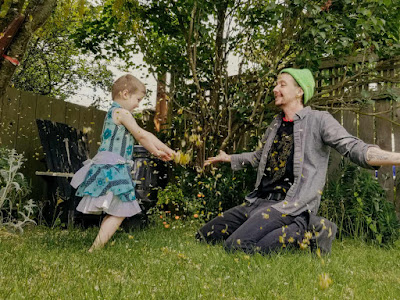
Kori Doty plays with their child Searyl at home in, British Columbia, Canada. ‘What I believe in the world has led me to a place where of course my kid would have full autonomy of gender.’ Photograph: Annie Tritt/The Guardian


Doty does not consider any colors or aesthetics to be inherently gendered. As a result, Sea is free to gravitate towards whatever clothing or toys they like, often opting to play with Legos and wear oversized T-shirt dresses. “They really love to dance, and they have this idea that dancing well requires a skirt that swishes around,” says Doty.


Since about 2018, the concept of “theybies” – a portmanteau of the neutral pronoun “they” and the word “baby”, referring to young children raised as neither boys nor girls – has gained currency, if not exactly broken through to the mainstream. This is especially true among progressive parents, some of whom feel “gender-autonomous parenting” grants their kids more leeway for self-determination, and freedom from the gender biases which might otherwise plague them from infancy.


For instance, researchers have found that adults underestimate female children’s motor skills at 11 months, and judge baby boys with high-pitched cries as “less masculine” than their deeper-voiced counterparts. A 2017 BBC experiment demonstrated that well-meaning adults often unconsciously project gender stereotypes on to babies via the toys they offer them – consequently contributing to a cumulative, substantial impact on the babies’ development.


While the term “theybies” itself is novel, Doty, who has both worked and participated in the LGBTQ+ community for over a decade, notes that gender diversity is hardly new. “All of a sudden, [gender diversity] seems like it’s coming out of nowhere. But the truth is that it was actually there all along,” they say. “The old way is really cracking. And even people who have had enough privilege to be able to not pay attention to the fact that it needed to crack – even they’re paying attention now.”


At a glance, Doty and Sea make non-binary childhood look easy. Doty says they aren’t the only person in their community raising a non-binary child. “In Sea’s peer group of kids in the two-to-four category in our Unitarian church’s family program, maybe half of them have been given full gender autonomy, and another quarter of them, their parents have decided, ‘Yeah, we’re going to use binary pronouns, but also you can be whoever and whatever.’ So it’s very normalized in our world,” they say.


Doty’s own parents switched from being conservative Christians to becoming proud members of PFLAG, an organization for supportive family and friends of LGBTQ+ people, back when Doty came out in 2006 – so wrapping their heads around a non-binary grandchild wasn’t hard. Sea’s preschool works with a trans-friendly organization, and its teachers have been on the ball about pronoun use.


“I’ve definitely had people say, ‘Oh, I’ve never come across [a non-binary child] before,’ or, ‘You can’t expect me to get [their pronouns] right all the time,’” says Doty. “And they get it right more than they think they will. It’s not as complicated as people like to think it is.”


While some parents may worry about their gender-autonomous child becoming a target for bullies, Doty and Sea haven’t crossed that bridge yet. For their part, Doty has found that kids often understand what it means to be non-binary better than adults, anyway. “I remember one of my ex’s kids, when he was five, sitting in the backseat of my parent’s car, correcting my dad about my pronouns,” they say.

Kori Doty: ‘There are people who have felt that [our family] wasn’t just problematic, but was like, the antichrist, or a sign of the end times.’ Photograph: Annie Tritt/The Guardian


In 2017, Doty and Sea made headlines when Sea received a Canadian health card with a “U” (presumably for “unknown”) instead of an “M” or “F” to indicate their gender. Although the British Columbian provincial government has since updated its policies to allow citizens to opt for an “X” gender designation on their IDs, at the time, Sea’s health card was reported as a possible “world’s first” non-binary ID. 


That news brought a lot of attention. Some of it was positive. “The most heartwarming responses were from people who hadn’t put any thought into [gender-autonomous parenting] and who were expecting or had just had kids, and who were taking it into consideration, and trying to implement ways of making sure that their kids felt like they had support and freedom to be their whole selves,” says Doty.


But Doty and Sea also received so much online harassment that Doty hired someone to filter toxic messages out of their email inbox.

“There are people who have felt that [our family] wasn’t just problematic, but was like, the antichrist, or a sign of the end times,” Doty says. “I found out that there was a campaign letter written about me by [a fundamentalist Christian activist group] and it was like, you know, ‘We’ll pray for these people because they’re so disillusioned.’


“I worry for people who have to grow up with that kind of rigidity and control and expectation,” says Doty. “I mean, I know that it’s harmful; I grew up that way. Having found my way out, I feel like if anything I will be praying for their children.”


Fortunately, the backlash against theybies hasn’t affected Sea yet – perhaps it never will. For now, they are focused on the little adventures of toddlerhood – processing a wasp sting from last summer by pretending to be a wasp themself, and learning how to count.


Doty hopes that Sea will grow up empowered, “To be able to [say], ‘Yeah, I like dressing this way,’ or ‘I like playing these games or using these words for myself because it’s what feels good to me and it’s not about anyone else,’” says Doty. “That’s how they are about it now – I want that to continue.”


(Source: The Guardian)

Tuesday, 19 November 2019

Japan’s ‘ban’ on women wearing glasses at work is sexist nonsense – but the UK’s position on dress codes isn’t much better

This is about the same central issue around the world: the practice of treating us as objects of desire while removing the right to make our own decisions

The eyes are the window to the soul – so the saying goes. But some of us can find that those windows need a little help functioning as they’re supposed to – hence the fact that many of us wear glasses. It’s a normal, regular thing for people to do. The fact that I’m even writing that feels bizarre. And yet...and yet...

Earlier this week a social media row erupted following the utterly absurd revelation that some employers in Japan had “banned” women from wearing glasses. Some of the examples cited included a nurse in a beauty clinic and those working at make-up counters. In the case of the nurse, she was instructed to wear contact lenses instead of her glasses. The long periods of wearing the lenses led to her developing dry eye.

I don’t know about you, but if a nurse were to come at me wielding any kind of needle that she planned to plunge into one of my body parts, I’d want to make damn sure her vision was perfect and that she could see exactly where she was aiming. The same goes for the lady working on a make-up counter; if she wants to show me just how good a product she’s trying to sell me looks on my face, it would be preferable that said product was not applied to my shoulder instead of my cheek.

It gets worse. There have been reports that another woman working as a receptionist in Japan was instructed to remove her glasses and wear contact lenses while her male colleague in the same role was left to wear his in peace.

Employers in Japan, of course, have form in this area. In June, the #KuToo movement began in reaction to women being instructed to wear high heels to work. Japanese actor and writer Yumi Ishikawa started a petition in June to end the outdated practice as she reported suffering from back pain and bunions as a result of having to wear heels while working. Within days the Japanese labour minister responded by saying that high heels in the workplace are “occupationally necessary and appropriate”.

In a 2018 report by the World Economic Forum, Japan was ranked 110th out of 149 countries in terms of gender equality, lower than Liberia, Azerbaijan and Myanmar – and well below the global average.  It also ranks bottom of the G7 countries for equality among the sexes.

It would be easy to think that this country almost 6,000 miles away is oh-so-different from us here in the UK and that these kinds of issues no longer affect women in Britain. But dear reader, let me draw your mind back just three years to 2016 when it emerged that PwC receptionist Nicola Thorp was sent home without pay from her job at the accountancy firm for refusing to wear high heels. Thorp’s subsequent petition garnered in excess of 150,000 signatures and was debated in parliament. However, the first attempt in 2017 to introduce legislation safeguarding employees’ rights regarding dress codes failed.

The Government Equalities Office eventually published new guidelines in 2018 but the language remains annoyingly indecisive on the subject: “It is likely to be unlawful under the Equality Act 2010 for employers to require women to wear high heels, with the discomfort or health issues that may entail, and as there is no male equivalent.” So it’s the luck of the draw of the judge you appear before? This depressingly evasive position, with no sign of clear determination by the Government Equalities Office to solve the problem, is misguided – enforcing high heel dress codes either is discriminatory, or it isn’t.

Dress codes are often necessary – never more so than when related to the safety of an employee. That employees remain safe at work is paramount. However, I cannot think of one single situation in which any person would be safer as a result of wearing high heels and a skirt.

I struggled through 10 years of wearing a skirt to school as part of my uniform – and I uniformly hated it. In winter it was freezing, no matter how many pairs of tights you wriggled into. The pocket situation was woeful; god forbid you should want to carry anything bar a coin or two about your person.

Thankfully, in many schools the rules have been amended or changed to allow female students the option to wear trousers and, indeed, male students to wear skirts, should they so wish.

But at the end of the day, these examples are the about the same central issue: the removal of an individual’s choice, their agency to make their own decisions within a fair and just framework of rules.

Sadly, there remain far too many instances of women’s right to choose being limited or, in some cases, removed entirely.

The fact that a developed country so advanced in so many ways as Japan is still treating women as objects of desire, merely pretty things to be looked at and not the architects of their own lives and futures, really feels quite sobering. That they still obsess over women being these neat, perfect, absolutely flawless creatures demonstrates the extreme social confines within which Japanese society dictates people still live.

If a woman wears glasses, it is her choice; if she gets laser eye surgery to remove the need for glasses, it is her choice; if she loves glasses and wants to wear the most outlandish designs of glasses on her face to express herself, it is her choice. It does not impinge upon her ability to carry out almost any job and it certainly is no business of her employer to tell her that she is giving a “cold impression” for simply wearing glasses.

Your eyes aren’t about being anyone’s window into your soul. Their primary function is to inform you of the world around you; the curiosities and the wonders but also the risks and the dangers. The more women’s eyes are open and able to see, the easier it will be to spot the idiot wielding the next ridiculous restriction on our appearance.

(Source: Independent)

Saturday, 2 November 2019

Apple introduces non-binary emojis with new set of inclusive faces

While celebrated, some in the LGBTQ community say it reinforces a fixed idea of what gender-neutral people should look like


Apple has expanded its emoji offerings on Monday to include non-binary versions of nearly every human emoji, including non-binary couple pairings.
The 328 new emoji designs came with the release of the company’s latest software update iOS 13.2. The non-binary emojis even extend to fantastical creatures such as merpeople, fae, and vampires.
The addition comes after Google offered Android users their own non-binary emojis in May.
Apple’s new inclusive designs allow for a choice of non-binary people and couples. Photograph: Emojipedia/emojipedia.org

Many in the LGBTQ community are celebrating the new additions, which expand on the inclusivity and diversity of the emoji library. In 2015, Apple released increased skin tone options for its human emojis.
But some are critical of the non-binary emojis for reinforcing a fixed idea of what gender-nonconforming people “look” like.
Gender inclusivity has become a new focus for brands and companies. The dating app Tinder recently allowed users to display their sexual and gender identities. Last year, fast-fashion giant H&M launched a gender-neutral fashion collection. And Mattel, the maker of Barbie and G.I. Joe, released a line of gender-neutral dolls last month.
The new iOS 13.2 update also includes emojis that represent people who use wheelchairs, walking cane, hearing aids, and mechanical arms and legs.
However, there are still improvements to be made. There are only five skin tones to choose from when it comes to human emojis. And some have criticized programmers for only allowing “raceless” (what many call the default yellow skin tone of Apple’s emojis) options for partner pairings and families.
There are some unexpected, highly specific new emojis as well, including a snorkel, a yo-yo, a banjo, and a juice box.
According to Emojipedia, the “Wikipedia” of emojis, there are now 3,178 emojis. In 2010, there were 625.

(Source: The Guardian)

Tuesday, 20 August 2019

Promoting gender equality, Maharashtra textbooks now have women as cops, pilots and men as chefs

Generation, after generation of young minds, has looked at their textbooks and seen women in the kitchen and men in hard labour or office roles. One more common stereotype, inculcated in young minds is that the mom cooks in the kitchen while dad reads the newspaper in the living room.
(Old Textbook) Image Courtesy: Balbharati

But in today's India, we are striving hard to give all genders equal representation and shake those stereotypes. Breaking away from the regular stereotypes and regressive attitude, The Maharashtra State Bureau of Textbook Production and Curriculum Research (popularly known as Balbharati) is doing away with old illustrations and text that can promote gender stereotypes in any form.
Image Courtesy: Balbharati

In their class II textbooks, they have revised and incorporated men and women sharing household chores and cleaning vegetables together. In another, a woman is shown as a doctor and as a traffic cop; while a man in one is shown as a chef and in one as ironing clothes. The books also show women as pilots and in the police force. Basically, no typecasting on the basis of one’s gender.
Image Courtesy: Balbharati

This is a welcome change and will help in making kids understand that there isn't anything called a particular gender role. Men, women, and the third gender all are capable of doing any task and be anything they wanna be! It is with these basic steps and instilling such equality-positive thoughts that we can mould a young mind to be more progressive. Kudos!

(Source: What Shot)

Tuesday, 23 July 2019

School bans skirts as part of new gender-neutral uniform policy

‘This uniform addresses the current issues of inequality and decency’

A school has banned pupils from wearing skirts as part of its newly-introduced gender-neutral uniform policy.

In 2017, Priory School in Lewes updated its uniform policy to include a rule which dictated that all new students must wear trousers.

The reason for the updated guideline was over "concerns" regarding the length of skirts worn at the academic institution, and in order to cater for pupils who identify as transgender.

Two years later, Priory School has announced that all students, regardless of whether they are new or not, must wear trousers in compliance with its gender-neutral uniform regulations.

"From September 2019, all Priory students will be required to wear our updated uniform," it states on the school's website.


"This uniform has been designed specifically in response to the many issues and suggestions raised by parents, students and school staff."

The school adds that the updated uniform "addresses the current issues of inequality and decency".

From September, the school's new uniform for all students will consist of a polo shirt, a school jumper and trousers.

During the fifth and sixth terms of the academic year, children will be allowed to swap their trousers for shorts.

Some parents of the students who attend Priory School expressed their frustration over the new uniform policy, as it will require them to purchase new items of clothing for children in their last year at the school.

"The school said at the time that the older children wouldn't have to buy it and it would be phased in. That seemed sensible," a parent of a year 11 pupil said.

"I think that if my daughter was going into year 10 I would be happier to buy it. But I've told the school I'm not buying it and I'm making a stand."

A petition has been launched on Change.org titled: "Stop Priory School from forcing everyone to wear trousers."

In the petition's blurb, it states: "Forcing everyone to wear trousers is limiting choice, preventing people from having the ability to choose whether to war a skirt or trousers and therefore preventing diversity."

It also emphasises the harmful nature of "fast fashion", stating: "It is also very bad for the environment because the old uniforms have to be thrown away, wasting old cotton uniform. Fast fashion [is] the second biggest contributor to climate change."

The petition currently has more than 200 signatures, with a target of 500.

One person who signed the petition said they believe the updated uniform policy is "another way of controlling" pupils.

"This is about choice. In what other walk of life is it thought inappropriate for girls to wear skirts."

A legal letter has also been addressed to the school, warning that the new uniform policy will be assessed by Judicial Review.

The letter has given Priory School until the end of the month to respond.

Last month, a primary school in County Wicklow, Ireland announced it would be introducing a new gender-neutral uniform policy from September.

Under the new policy, students can dress however they "feel comfortable", whether boys choose to wear skirts or girls choose to wear trousers.

(Source: The Independent)

Tuesday, 25 June 2019

Schoolboy thrown out of class for saying there are only two genders

A 17-year-old student has claimed that he was kicked out of his classroom for saying that there are 'only two genders'. 

The pupil, who has not been named, secretly filmed his teacher reprimanding him before he shared the clip online, and it went viral.

It was shared internationally, sparking a debate about transgender rights and free speech, with one YouTube version being watched nearly 90,000 times.

Now, a leading teachers' union has defended the 56-year-old teacher featured in the video, saying that the child had been 'looking for trouble', reports UniLad.

In the three-minute clip, the teacher can be heard explaining to the child why he'd been asked to leave the class at the Aberdeenshire secondary school, following the pupil's claim that there are only two genders.

The teacher can be heard telling the pupil:

You're entitled to your opinion.

However, in response, the pupil says:

If I am, then why did you kick me out of class? It's not very inclusive.

This is an inclusive school.

In response, the teacher then says:

No, I'm sorry, what you were saying is not very inclusive. This is an inclusive school.

He then goes on to explain that there are more than two genders 'by law', and that by saying there are only two, the student hadn't been very 'inclusive'. He then adds:

You were clearly given an opportunity not to pursue it. You chose to do so.

However, the 17-year-old won't give up that easily. In response, he says:

I think it's silly to have anything other than two genders, sir.

The teacher then adds:

Could you please keep that opinion to your own house?

In response, the teenager says:

So you get to put your opinion out in class, and my opinion has to stay inside my house?

In response, the teacher says:

No, I am not putting my opinion out. I am stating what is national, school, authority, policy. Ok?

The pupil then tells the teacher that it's 'not scientific whatsoever', to which the teacher responds that 'not every policy is scientific'.

It is understood that the teenager has been disciplined for sharing the video online without consent, but it is not known whether the boy has been suspended, reports the Daily Mail.

The clip generated a debate online, with many saying that the boy had been unfairly treated, while others said that the teacher was in the right.

Speaking to the Daily Mail about the situation, an Aberdeenshire Council Spokesman said:

As part of our Public Sector Equality Duty we aim to: eliminate discrimination, harassment and victimisation; advance equality of opportunity between those who have protected characteristics and those who don't; and foster good relations between those who have protected characteristics and those who don't.

It is important to understand the context of any video clip taken without a person's consent. In our schools, fostering good relations among different groups can be a real challenge but our aim is to support a fairer, inclusive environment for all.

(Source: Independent)

Saturday, 8 June 2019

School in Spain teaches household chores to boys and it’s a major score for gender equality

If you’re “old” enough to remember, there once was a Home Economics class typically for girls and “Shop” (auto repair) for boys offered in high school, but many school districts have done away with them in the States. In Vigo, Spain however, volunteer teachers and dads are offering an additional class based on household chores, particularly for boys but with a very different approach.

The home economics class at the Montecastelo School of Spain includes household chores, such as ironing, sewing, and cooking. The mission behind the class is to “build values,” shine a light on gender inequality and shatter the stigmas that come along with these types of activities on the home front.

The forward-thinkers at Montecastelo School of Spain’s motto is “Equality is learned with actions.” Launched in 2018, the class also features the teaching of other manual activities, such as carpentry, masonry, and plumbing and electrician skills.

“It seemed very useful for our students to learn to perform these tasks so that, when they form a family, they are involved from the beginning and know that a house is a matter of 2, it’s not a matter of the woman cleaning, doing the dishes, and ironing,” explained coordinator, Gabriel Bravo. “This will allow them to become aware and learn to handle themselves at home.” Bravo Señor Bravo!

(Source: Uplift Post)

Tuesday, 18 December 2018

Men with school-aged daughters less likely to be sexist

'Gender norm attitudes can significantly be shaped by adulthood experiences'

Men who have daughters who are of a school age are less likely to be sexist, a recent study has found.

A team from the London School of Economics decided to explore how men’s stances on gender norms can change when raising a daughter in primary and secondary school education.

The researchers claim that men become more aware of the challenges that girls experience when they have daughters, a consequence that they describe as the "mighty girl" effect.

Furthermore, they conclude that people's views on gender norms can evolve over the years, meaning that stereotypical views on the differing roles of boys and girls are not necessarily fixed in adulthood.

Abigail Breslin and Ryan Reynolds in 'Definitely, Maybe' (2008)( Rex Features )

For the study, which was published in journal Oxford Economic Papers, the team assessed data that had been collated by the British Household Panel Survey on an annual basis between 1991 to 2012.

They examined the responses of more than 5,000 men and more than 6,300 women, all of whom had children under the age of 21 living in their homes.

The participants were asked whether they agreed with statements such as "a husband's job is to earn money; a wife's job is to look after the home and family".

They had to select their answer from a five-point scale, with options ranging from "strongly agree" to "strongly disagree".

According to their findings, men with school-aged daughters are more likely to disagree with statements advocating conventional attitudes towards gender.

While the men who didn't have a child or only had sons had a 37 per cent likelihood of holding traditional views about gender, 33 per cent of those who had at least one daughter in secondary school felt the same way.

Dr Joan Costa-i-Font, co-author of the study, explains that having a better understanding of the challenges that girls and women face may influence preconceived ideas that fathers have about gender roles.

"They experience first-hand all the issues that [exist] in a female world and then that basically moderates their attitudes towards gender norms and they become closer to seeing the full picture from the female perspective," he tells The Guardian.

Natasha Devon, a body image and mental health campaigner, adds that it's important for all men to demonstrate that they care about the issues that girls and women face, regardless of whether or not they have daughters.

"We need men to see women as human beings even if they don't have a good relationship with their mum or sisters or have a daughter," she says.

"I think we need to find out what it is specifically about having a daughter that changes men's minds and look at how we can ingrain that more into the socialisation process for all boys from an early age."

On Friday 14 December, the Advertising Standards Authority issued new guidelines stating that adverts created by British companies that endorse harmful gender stereotypes will be banned from June 2019.

(Source: The Independent)

Thursday, 25 October 2018

Dad condemns toxic masculinity after 5-year-old son is ridiculed for wearing nail polish

‘Today he learned how harmful toxic masculinity is’

A father has been praised online for sharing a Twitter thread about “toxic masculinity” after his five-year-old son was mocked at kindergarten for wearing nail polish.

Aaron Gouveia, from Massachusetts, is a former journalist, father of three sons and founder of parenting site Daddy Files.

His middle child, Sam, has a number of hobbies that are stereotypically associated with young boys, including playing sports and being interested in trucks.

However, as Gouveia explains on Twitter, Sam also enjoys doing activities that are stereotypically associated with girls.

“Sam has a collection of purses because he likes to carry things around. And he also loves to have his nails painted bright colours because he thinks they ‘look beautiful.’ And he’s right - they are beautiful,” Gouveia writes.

Gouveia had no qualms about his son going to kindergarten wearing nail polish. However, neither he nor his son anticipated the mockery that Sam would face from his classmates.

“Sam was ridiculed for being a boy with nail polish. They called him names and told him to take it off. This lasted the entire day,” Gouveia explains.
“When my wife picked him up from school he collapsed into her arms and cried uncontrollably. He was devastated at how other kids turned on him, even his friends.”

Later that day, Gouveia was upset to hear his son ask to have his nail polish removed as a result of the bullying that he’d received.

“My son is far from perfect but he’s got a huge heart and empathy for miles,” he writes.

“He finds beauty in everything around him and for five years he’s never been afraid to be different because different has never meant ‘bad’. Until now.”

In Gouveia’s opinion, Sam’s experience at kindergarten has emphasised the fact that toxic masculinity is taught to children by parents at a very young age.

“My wife and I spent five years successfully preaching tolerance, acceptance, and the importance of expression and your kids unravelled that in one school day,” he writes in a tweet targeted at the parents of the children who derided his son.

“He now feels the shame you desperately want to associate with being different.” Gouveia encouraged his son to paint his nails an even brighter shade, and to ask the children in his class why they were making fun of him.

Sam’s 10-year-old brother then decided to paint his nails “in solidarity” with his younger brother, with Gouveia following suit. “Intolerant parents and their offspring scored a minor victory today but they don’t win the war,” Gouveia writes.

“Be brave and shine bright, my beautiful polished boy.

Know that mum and dad always have your back and if the rest of the world has a problem with your nails, they can check out my nail polish!”

A number of people have commended Gouveia for his stance on toxic masculinity, with some sharing photos of their children with painted nails.

“My son is 15 years old. He used to paint my nails and I’d paint his,” one person wrote.

“He is comfortable in his skin, wears whatever the hell he wants - swims has pink and purple suits.

Wears pink socks or shoes because he likes them. “Tell Sam he’s a badass."

(Source: The Independent)

Wednesday, 26 September 2018

No girl should be proud when she’s told "you're my son"

Riya was not as cheerful today as she would always be. I liked that spark in her eyes and the glow on her face, which was enough for anyone to get attracted to her.

Today, I was speaking to a different Riya.

“What happened?” I tried to investigate the matter.

“How would you feel if your mom says, ‘Tu beta nahi, beti hai meri’ (You are more like my daughter instead of a son) ?”, she replied.

“What? Haha, did aunty again say to you, ‘Tu beti nahi, beta hai mera’ (You are more like my son instead of a daughter)?” I tried searching for a little humour, only to comfort her.

My comment backfired, as she stood and yelled at me, “What’s the problem if I fulfil all the responsibilities as a woman? Why does everyone consider MANHOOD as a synonym of responsibility?”

She was right in a sense. Don’t we casually say to girls, ‘Aaj tune ladko wala kaam kiya hai. Shabbash! (Well done! You were as good as a man)’?

Think again and this time think from her perspective. She is your daughter, and she wants to be treated as a daughter. She isn’t a son and she even doesn’t want to become one. Why should she? Why would she like to be called a son? Doesn’t she hold her own identity?

Whatever she does, she does it because she can do it. She isn’t here to prove her superiority over males.

Why can’t a girl do job? Why can’t she earn a livelihood for the family? Why can’t she do outside chores?

She can do everything without a second doubt. Then, why do we encourage her for the efforts by comparing her to a son? We aren’t encouraging her; we are just playing another card of discrimination.

Even the girls become happy hearing that they became the ‘son’ of their homes. This isn’t appreciation, you have lost an identity for yourself and all other girls trying to make a distinct identity.

Look around and you’ll also find those couples who say, “Arre beti hui to kya, achi baat hai. Bas ek ladka ho jaye to parivar poora ho jaye (So what if a girl is born? That’s great news. Now, if a baby boy is born, our family will complete).”

Why? Why isn’t a family complete as soon as a baby was born? The day she was born, she became an integral part of the family (and not complementary to a baby boy).

This whole concept is bullshit. We shouldn’t be comparing the ability or efforts of the daughters and sons. They are both fulfilling their responsibilities and making their families proud.

To all the women reading this, stop comparing yourself to men and their efforts. What you are doing is equivalent to the efforts of every person on this earth.

To all the men reading this, let’s go ahead and tell the world that we shouldn’t be compared to each other.

(Source: YKA)

Tuesday, 4 September 2018

How to use gender-neutral words

And why they're important.

Gender-inclusive language isn’t typically something you learn in school, but its use is incredibly important to make life easier for nonbinary peers.

There are ways to practice gender-inclusive language beyond just respecting gender-neutral pronouns. For instance, replacing “ladies and gentlemen” with “everybody” helps include people who do not identify as ladies or gentlemen.

“Using gendered terms — such as “ladies [and] gentlemen” — is highly presumptuous, especially in today's society, in which many persons are aware that they don't identify as male or female and therefore are uncomfortable with this type of language,” Dara Hoffman-Fox, LPC, explains.

To help our nonbinary friends feel more included and safe around us, here are four more ways to practice gender-inclusive language:

Refrain from defaulting to "-man" in descriptors, i.e. “postman.”

Remove gendered language — like using “postman” as the default word rather than “postal worker” — from everyday speech. By not using a word ending in “-man” as the default phrase for a descriptor, we can normalize the idea that anyone can perform a job, regardless of their gender identity.


“When we speak about ‘mankind’ or ‘the achievements of man,’ what we’re doing is confirming the subconscious bias that men are intellectually, morally, and physically superior to women, which is clearly untrue,” Sam Dowd, a British didactics expert from language-learning app Babbel, says. “By using such language, we exclude women — and, for that matter, nonbinary people — from history.”
We can avoid erasing women and nonbinary people from everyday conversations by using gender-neutral descriptions. Some examples include:

  • Folks, folx, or everybody instead of guys or ladies/gentleman
  • Humankind instead of mankind
  • People instead of man/men
  • Members of Congress instead of congressmen
  • Councilperson instead of councilman/councilwoman
  • First-year student instead of freshman
  • Machine-made, synthetic, or artificial instead of man-made
  • Parent or pibling instead of mother/father
  • Child instead of son/daughter
  • Kiddo instead of boy/girl
  • Sibling instead of sister/brother
  • Nibling instead of niece/nephew
  • Partner, significant other, or spouse instead of girlfriend/boyfriend or wife/husband
  • Flight attendant instead of steward/stewardess
  • Salesperson or sales representative instead of salesman/saleswoman
  • Server instead of waiter/waitress
  • Firefighter instead of fireman

“Some people may argue that such concerns are unimportant, but if you consider that language is the primary filter through which we perceive the world, it’s obvious that it affects how we relate to and make judgments about one another,” Dowd tells Teen Vogue. “Until now, history has been written and told by men, to the detriment of others. Part of any attempt to create a society in which all people — regardless of gender, sexuality or race — have equal opportunities and freedoms is to use language that no longer excludes certain groups or creates unconscious bias.”

Just because a nonbinary person isn’t present doesn’t make it OK to use binary language.

Many nonbinary people aren’t as vocal about their identity and pronouns as others, and you can’t know someone’s gender by looking at them, Hoffman-Fox stresses. Nonbinary people reflect a wide variety of gender expressions and are sometimes still identified as male or female because they don’t present as androgynous.

“It's fairly common for people to assume that a nonbinary person isn't in the room,” Hoffman-Fox said. “The truth is, there is no way someone could know that, unless they have had conversations with every person in the vicinity and have asked them if they use binary terms to describe themselves.”

Hold those around you accountable.

Don’t be afraid to correct those around you, such as your classmates and even teachers, about using exclusive, gendered language, but do understand not everyone receives criticism in the same way.

“Some people will be comfortable with being very direct, like: ‘Excuse me, but when you used ladies to describe our friend group, it leaves out those who are uncomfortable with being gendered as female,’” Hoffman-Fox tells Teen Vogue. “Some may want to take a more subtle approach, such as repeatedly using a gender-neutral term within earshot of the person using binary language.”
Pay attention to which responses work better for certain people.

“Depending on the situation, you can address the situation with the person publicly or privately, in person or through a message,” Hoffman-Fox adds. “Try to keep it as simple as possible, explaining briefly what binary language is and how it can often result in people feeling invisible.”

Remember that binary language also harms cisgender and binary transgender people.

Nonbinary people aren’t the only ones hurt by binary language. Binary transgender people (or trans people who aren’t nonbinary) and cisgender people are also affected — and often harmed — by the gender binary and how ingrained it can be in our language. For instance, many women prefer not to be lumped into a group of “ladies” because of society’s expectations of how a lady should act.

“There are people who aren't nonbinary who are uncomfortable with binary gendered terms, thanks to these terms also being experienced as stereotypical,” Hoffman-Fox says. “Shifting to gender-neutral language is of benefit not only to those who are nonbinary but to many others in society who feel that binary terms are inaccurate ways of describing them.”

(Source: Teen Vogue)

Friday, 8 June 2018

The most complicated words in English: 'He,' 'She,' and 'They'

How to reconcile the tension between grammatical correctness and gender inclusiveness

The people of Sweden get a lot of credit for their attitudes toward gender and language. An article in the New York Times earlier this month described how, at the Nicolaigarden preschool in Stockholm, teachers use "friend" to refer to children in order to avoid using gendered pronouns. The new-ish Swedish gender-neutral pronoun hen also gets mentions in articles like Megan Garber's piece here at The Sexes this month about the overtaking of the word "mankind" by "humankind." But, as Garber shows, English isn't beyond hope.

We have "human." We have "friend" too. (And, as a non-Swedish-speaker depending entirely on Google Translate, I'm guessing we may have a better word for it than Swedes do: the top result for "friend" is "vän," which has the secondary definition "loverboy.") We have words like "folks"—which was oft-used at a camp where I once worked because we couldn't know the gender and number of the people who made up every child's home—and "people" and "hey you."

Still, English gets a bad rap, and a lot of the problem with gender in English grammar is due to three little words: He. She. They. English is full of non-gendered collective nouns like "folks," but it lacks a way to refer to one hypothetical person without referring to his—see what happened there?—hypothetical gender. A lot of grammatical handwringing goes on over whether the neutral plural "they" is or ever will be an appropriate replacement. At first glance, the choice seems to be a stark one between a grammatical wrong and a gender-conscious one. But maybe the solution is contained in the problem: He. She. They.

In an episode of Slate's excellent Lexicon Valley podcast back in May, the featured guest, Professor Anne Curzan, who researches English and gender at the University of Michigan, made a logical and mostly-convincing argument for the singular "they." She told hosts Mike Vuolo and Bob Garfield that "they" is already used widely in a singular sense (nice because it's always easier not to invent a new word)--and that this exact transition in meaning has happened before and we all lived to tell the tale. The word "you," she said, used to be exclusively plural but eventually came to replace the singular "thou."

In the same podcast episode, a 1971 incident at Harvard Divinity School was singled out as a turning point in thinking about the importance of which gender we assign our hypothetical individuals. Two female students attempted to ban the in-class use of male words when not referring to specific men; a linguistics professor wrote a letter to The Harvard Crimson mansplaining why they were off-base. The professor, Calvert Watkins, said that the male pronoun is "unmarked"--just a neutral default--but didn't address why we might think that "man" means humankind and "woman" does not.


Curzan's argument for "they" makes sense in theory. But there's no way to get around the cognitive dissonance of an English professor proscribing the use of a plural pronoun to describe a single thing. It's just icky. And I don't want to think that grammar must be sacrificed on the altar of feminism: Shouldn't gender equality help us make more sense rather than less?

Which leaves us with he and she (and new words like zhe or yo, which are nice in theory but hard to imagine ever seeing wide usage). He/she and s/he are too clunky to solve the problem. And the 1971 example shows why the constant "he" isn't the answer either. As tempting as it may be to say that one must choose one's battles and that everyone knows "he" is neutral, it would mean something if we always said, for example, "ask a doctor for his opinion" rather than "her." The male pronoun's place as the unmarked pronoun is in its own way a marking. To be the default is to be superior.

But if "they" can become singular through frequent usage, couldn't the markedness of the pronoun change too? It could, and it has.

The common in-the-meantime practice of alternating she and he--and perhaps making an effort to use "she" in situations where some assumption of maleness might occur, and vice versa--requires just as much vigilance as rearranging all your sentences so that they are properly plural, but it also comes with a bonus. While the masculine pronoun was the default, the neutral option, and it remains so, using a feminine pronoun in a neutral sense is now completely normal. When someone writes about a hypothetical "she" for whom gender isn't intrinsic, anyone who gives it a second thought is likely to guess that she could just as easily be a he. And, though we may not yet live in a world where this is the case, the opposite ought to hold true. Eventually, the nonspecific "she" and "he" could end up as pronouns that only say what such a pronoun ought to say, that the noun in question is a human being.

An unmarked masculine pronoun would be a better outcome than using "they," and not just for grammar reasons. Turning to the plural in order to promote equality just sweeps the inequality between the sexed singulars under the rug. It doesn't have to be that way; red and green are opposites too but no value judgment is implied in the color with which one draws a hypothetical apple in order to illustrate the letter "A." Continuing to use "he" and "she" in a judicious but grammatical fashion is how we'll get there, to the future where you and I and he and she and they can all speak properly in more ways than one.

(Source: The Atlantic)