Showing posts with label YouTube. Show all posts

Wednesday, 26 January 2022

Your attention didn’t collapse. It was stolen

 Social media and many other facets of modern life are destroying our ability to concentrate. We need to reclaim our minds while we still can.

When he was nine years old, my godson Adam developed a brief but freakishly intense obsession with Elvis Presley. He took to singing Jailhouse Rock at the top of his voice with all the low crooning and pelvis-jiggling of the King himself. One day, as I tucked him in, he looked at me very earnestly and asked: “Johann, will you take me to Graceland one day?” Without really thinking, I agreed. I never gave it another thought, until everything had gone wrong.


Ten years later, Adam was lost. He had dropped out of school when he was 15, and he spent almost all his waking hours alternating blankly between screens – a blur of YouTube, WhatsApp and porn. (I’ve changed his name and some minor details to preserve his privacy.) He seemed to be whirring at the speed of Snapchat, and nothing still or serious could gain any traction in his mind. During the decade in which Adam had become a man, this fracturing seemed to be happening to many of us. Our ability to pay attention was cracking and breaking. I had just turned 40, and wherever my generation gathered, we would lament our lost capacity for concentration. I still read a lot of books, but with each year that passed, it felt more and more like running up a down escalator. Then one evening, as we lay on my sofa, each staring at our own ceaselessly shrieking screens, I looked at him and felt a low dread. “Adam,” I said softly, “let’s go to Graceland.” I reminded him of the promise I had made. I could see that the idea of breaking this numbing routine ignited something in him, but I told him there was one condition he had to stick to if we went. He had to switch his phone off during the day. He swore he would.

Illustration by Eric Chow.


When you arrive at the gates of Graceland, there is no longer a human being whose job is to show you around. You are handed an iPad, you put in little earbuds, and the iPad tells you what to do – turn left; turn right; walk forward. In each room, a photograph of where you are appears on the screen, while a narrator describes it. So as we walked around we were surrounded by blank-faced people, looking almost all the time at their screens. As we walked, I felt more and more tense. When we got to the jungle room – Elvis’s favourite place in the mansion – the iPad was chattering away when a middle-aged man standing next to me turned to say something to his wife. In front of us, I could see the large fake plants that Elvis had bought to turn this room into his own artificial jungle. “Honey,” he said, “this is amazing. Look.” He waved the iPad in her direction, and began to move his finger across it. “If you swipe left, you can see the jungle room to the left. And if you swipe right, you can see the jungle room to the right.”


If you read your texts while working, you lose that time, but also the time it takes to refocus afterwards, which is a lot.


His wife stared, smiled, and began to swipe at her own iPad. I leaned forward. “But, sir,” I said, “there’s an old-fashioned form of swiping you can do. It’s called turning your head. Because we’re here. We’re in the jungle room. You can see it unmediated. Here. Look.” I waved my hand, and the fake green leaves rustled a little. Their eyes returned to their screens. “Look!” I said. “Don’t you see? We’re actually there. There’s no need for your screen. We are in the jungle room.” They hurried away. I turned to Adam, ready to laugh about it all – but he was in a corner, holding his phone under his jacket, flicking through Snapchat.


At every stage in the trip, he had broken his promise. When the plane first touched down in New Orleans two weeks before, he took out his phone while we were still in our seats. “You promised not to use it,” I said. He replied: “I meant I wouldn’t make phone calls. I can’t not use Snapchat and texting, obviously.” He said this with baffled honesty, as though I had asked him to hold his breath for 10 days. In the jungle room, I suddenly snapped and tried to wrestle his phone from his grasp, and he stomped away. That night I found him in the Heartbreak Hotel, sitting next to a swimming pool (shaped like a giant guitar), looking sad. I realised as I sat with him that, as with so much anger, my rage towards him was really anger towards myself. His inability to focus was something I felt happening to me too. I was losing my ability to be present, and I hated it. “I know something’s wrong,” Adam said, holding his phone tightly in his hand. “But I have no idea how to fix it.” Then he went back to texting.


I realised then that I needed to understand what was really happening to him and to so many of us. That moment turned out to be the start of a journey that transformed how I think about attention. I travelled all over the world in the next three years, from Miami to Moscow to Melbourne, interviewing the leading experts in the world about focus. What I learned persuaded me that we are not now facing simply a normal anxiety about attention, of the kind every generation goes through as it ages. We are living in a serious attention crisis – one with huge implications for how we live. I learned there are twelve factors that have been proven to reduce people’s ability to pay attention and that many of these factors have been rising in the past few decades – sometimes dramatically.


I went to Portland, Oregon, to interview Prof Joel Nigg, who is one of the leading experts in the world on children’s attention problems, and he told me we need to ask if we are now developing “an attentional pathogenic culture” – an environment in which sustained and deep focus is harder for all of us. When I asked him what he would do if he was in charge of our culture and he actually wanted to destroy people’s attention, he said: “Probably what our society is doing.” Prof Barbara Demeneix, a leading French scientist who has studied some key factors that can disrupt attention, told me bluntly: “There is no way we can have a normal brain today.” We can see the effects all around us. A small study of college students found they now only focus on any one task for 65 seconds. A different study of office workers found they only focus on average for three minutes. This isn’t happening because we all individually became weak-willed. Your focus didn’t collapse. It was stolen.


When I first got back from Graceland, I thought my attention was failing because I wasn’t strong enough as an individual and because I had been taken over by my phone. I went into a spiral of negative thoughts, reproaching myself. I’d say – you’re weak, you’re lazy, you’re not disciplined enough. I thought the solution was obvious: be more disciplined, and banish your phone. So I went online and booked myself a little room by the beach in Provincetown, at the tip of Cape Cod. I announced triumphantly to everyone – I am going to be there for three months, with no smartphone, and no computer that can get online. I’m done. I’m tired of being wired. I knew I could only do it because I was very lucky and had money from my previous books. I knew it couldn’t be a long-term solution. I did it because I thought that if I didn’t, I might lose some crucial aspects of my ability to think deeply. I also hoped that if I stripped everything back for a time, I might start to be able to glimpse the changes we could all make in a more sustainable way.


In my first webless week, I stumbled around in a haze of decompression. Provincetown is a little gay resort town with the highest proportion of same-sex couples in the US. I ate cupcakes, read books, talked with strangers and sang songs. Everything radically slowed down. Normally I follow the news every hour or so, getting a drip-feed of anxiety-provoking facts and trying to smush them together into some kind of sense. Instead, I simply read a physical newspaper once a day. Every few hours, I would feel an unfamiliar sensation gurgling inside me and I would ask myself: what is that? Ah, yes. Calm.


Later, I realised when I interviewed the experts and studied their research that there were many reasons why my attention was starting to heal from that first day. Prof Earl Miller, a neuroscientist at Massachusetts Institute of Technology, explained one to me. He said “your brain can only produce one or two thoughts” in your conscious mind at once. That’s it. “We’re very, very single-minded.” We have “very limited cognitive capacity”. But we have fallen for an enormous delusion. The average teenager now believes they can follow six forms of media at the same time. When neuroscientists studied this, they found that when people believe they are doing several things at once, they are actually juggling. “They’re switching back and forth. They don’t notice the switching because their brain sort of papers it over to give a seamless experience of consciousness, but what they’re actually doing is switching and reconfiguring their brain moment-to-moment, task-to-task – [and] that comes with a cost.” Imagine, say, you are doing your tax return, and you receive a text, and you look at it – it’s only a glance, taking three seconds – and then you go back to your tax return. In that moment, “your brain has to reconfigure, when it goes from one task to another”, he said. You have to remember what you were doing before, and you have to remember what you thought about it. When this happens, the evidence shows that “your performance drops. You’re slower. All as a result of the switching.”


This is called the “switch-cost effect”. It means that if you check your texts while trying to work, you aren’t only losing the little bursts of time you spend looking at the texts themselves – you are also losing the time it takes to refocus afterwards, which turns out to be a huge amount. For example, one study at the Carnegie Mellon University’s human computer interaction lab took 136 students and got them to sit a test. Some of them had to have their phones switched off, and others had their phones on and received intermittent text messages. The students who received messages performed, on average, 20% worse. It seems to me that almost all of us are currently losing that 20% of our brainpower, almost all the time. Miller told me that as a result we now live in “a perfect storm of cognitive degradation”.


For the first time in a very long time, in Provincetown I was doing one thing at a time, without being interrupted. I was living within the limits of what my brain could actually handle. I felt my attention growing and improving with every day that passed, but then, one day, I experienced an abrupt setback. I was walking down the beach and every few steps I saw the same thing that had been scratching at me since Memphis. People seemed to be using Provincetown simply as a backdrop for selfies, rarely looking up, at the ocean or each other. Only this time, the itch I felt wasn’t to yell: You’re wasting your lives, put the damn phone down. It was to yell: Give me that phone! Mine! For so long, I had received the thin, insistent signals of the web every few hours throughout the day, the trickle of likes and comments that say: I see you. You matter. Now they were gone. Simone de Beauvoir said that when she became an atheist, it felt like the world had fallen silent. Losing the web felt like that. After the rhetorical heat of social media, ordinary social interactions seemed pleasing but low volume. No normal social interaction floods you with hearts.


I realised that to heal my attention, it was not enough simply to strip out distractions. That makes you feel good at first – but then it creates a vacuum where all the noise was. I realised I had to fill the vacuum. To do that, I started to think a lot about an area of psychology I had learned about years before – the science of flow states. Almost everyone reading this will have experienced a flow state at some point. It’s when you are doing something meaningful to you, and you really get into it, and time falls away, and your ego seems to vanish, and you find yourself focusing deeply and effortlessly. Flow is the deepest form of attention human beings can offer. But how do we get there?


I later interviewed Prof Mihaly Csikszentmihalyi in Claremont, California, who was the first scientist to study flow states and researched them for more than 40 years. From his research, I learned there are three key factors which you need to get into flow. First you need to choose one goal. Flow takes all your mental energy, deployed deliberately in one direction. Second, that goal needs to be meaningful to you – you can’t flow into a goal that you don’t care about. Third, it helps if what you are doing is at the edge of your abilities – if, say, the rock you are climbing is slightly higher and harder than the last rock you climbed. So every morning, I started to write – a different kind of writing from my earlier work, one that stretched me. Within a few days, I started to flow, and hours of focus would pass without it feeling like a challenge. I felt I was focusing in the way I had when I was a teenager, in long effortless stretches. I had feared my brain was breaking. I cried with relief when I realised that in the right circumstances, its full power could come back.


At the end of every day, I would sit on the beach and watch the light slowly change. The light on the cape is unlike the light anywhere else I have ever been and in Provincetown, I could see more clearly than I ever had before in my life – my own thoughts, my own goals, my own dreams. I was living in the light. So when the time came to leave the beach house and come back to the hyperlinked world, I became convinced I had cracked the code of attention. I returned to the world determined to integrate the lessons I had learned in my everyday life. When I was reunited with my phone and laptop after taking a ferry back to where they were stashed in Boston, they seemed alien, and alienating. But within a few months, my screen time was back to four hours a day, and my attention was fraying and breaking again.


In Moscow, the former Google engineer James Williams – who has become the most important philosopher of attention in the western world – told me I had made a crucial mistake. Individual abstinence is “not the solution, for the same reason that wearing a gas mask for two days a week outside isn’t the answer to pollution. It might, for a short period of time, keep certain effects at bay, but it’s not sustainable, and it doesn’t address the systemic issues.” He said that our attention is being deeply altered by huge invasive forces in wider society. Saying the solution was to just adjust your own habits – to pledge to break up with your phone, say – was just “pushing it back on to the individual” he said, when “it’s really the environmental changes that will really make the difference”.


Nigg said it might help me grasp what’s happening if we compare our rising attention problems to our rising obesity rates. Fifty years ago there was very little obesity, but today it is endemic in the western world. This is not because we suddenly became greedy or self-indulgent. He said: “Obesity is not a medical epidemic – it’s a social epidemic. We have bad food, for example, and so people are getting fat.” The way we live changed dramatically – our food supply changed, and we built cities that are hard to walk or cycle around, and those changes in our environment led to changes in our bodies. We gained mass, en masse. Something similar, he said, might be happening with the changes in our attention.


I learned that the factors harming our attention are not all immediately obvious. I had been focused on tech at first, but in fact the causes range very widely – from the food we eat to the air we breathe, from the hours we work to the hours we no longer sleep. They include many things we have come to take for granted – from how we deprive our children of play, to how our schools strip learning of meaning by basing everything on tests. I came to believe we need to respond to this incessant invasion of our attention at two levels. The first is individual. There are all sorts of changes we can make at a personal level that will protect our focus. I would say that by doing most of them, I have boosted my focus by about 20%. But we have to level with people. Those changes will only take you so far. At the moment it’s as though we are all having itching powder poured over us all day, and the people pouring the powder are saying: “You might want to learn to meditate. Then you wouldn’t scratch so much.” Meditation is a useful tool – but we actually need to stop the people who are pouring itching powder on us. We need to band together to take on the forces stealing our attention and take it back.


This can sound a bit abstract – but I met people who were putting it into practice in many places. To give one example: there is strong scientific evidence that stress and exhaustion ruin your attention. Today, about 35% of workers feel they can never switch off their phones because their boss might email them at any time of day or night. In France, ordinary workers decided this was intolerable and pressured their government for change – so now, they have a legal “right to disconnect”. It’s simple. You have a right to defined work hours, and you have a right to not be contacted by your employer outside those hours. Companies that break the rules get huge fines. There are lots of potential collective changes like this that can restore part of our focus. We could, for example, force social media companies to abandon their current business model, which is specifically designed to invade our attention in order to keep us scrolling. There are alternative ways these sites could work – ones that would heal our attention instead of hacking it.


Some scientists say these worries about attention are a moral panic, comparable to the anxieties in the past about comic books or rap music, and that the evidence is shaky. Other scientists say the evidence is strong and these anxieties are like the early warnings about the obesity epidemic or the climate crisis in the 1970s. I think that given this uncertainty, we can’t wait for perfect evidence. We have to act based on a reasonable assessment of risk. If the people warning about the effects on our attention turn out to be wrong, and we still do what they suggest, what will be the cost? We will spend less time being harassed by our bosses, and we’ll be tracked and manipulated less by technology – along with lots of other improvements in our lives that are desirable in any case. But if they turn out to be right, and we don’t do what they say, what’s the cost? We will have – as the former Google engineer Tristan Harris told me – downgraded humanity, stripping us of our attention at the very time when we face big collective crises that require it more than ever.


But none of these changes will happen unless we fight for them. Just as the feminist movement reclaimed women’s right to their own bodies (and still has to fight for it today), I believe we now need an attention movement to reclaim our minds. I believe we need to act urgently, because this may be like the climate crisis, or the obesity crisis – the longer we wait, the harder it will get. The more our attention degrades, the harder it will be to summon the personal and political energy to take on the forces stealing our focus. The first step it requires is a shift in our consciousness. We need to stop blaming ourselves, or making only demands for tiny tweaks from our employers and from tech companies. We own our own minds – and together, we can take them back from the forces that are stealing them.


(Source: The Guardian)

Tuesday, 3 November 2020

Baby Shark becomes YouTube's most-watched video of all time

 Baby Shark, the infuriatingly catchy children's rhyme recorded by South Korean company Pinkfong, has become the most-watched video ever on YouTube.

The song has now been played 7.04 billion times, overtaking the previous record holder Despacito, the Latin pop smash by singer Luis Fonsi.


Played back-to-back, that would mean Baby Shark has been streamed continuously for 30,187 years.


Pinkfong stands to have made about $5.2m (£4m) from YouTube streams alone.


It took four years for Baby Shark to ascend to the top of YouTube's most-played chart, but the song is actually much older than that.


The song has inspired tributes from Cardi B, Josh Groban and Blackpink. PINKFONG / YOUTUBE


It is thought to have originated in US summer camps in the 1970s. One theory says it was invented in 1975, as Steven Spielberg's Jaws became an box office smash around the world.


There are a huge number of variations on the basic premise, including one version where a surfer loses an arm to the shark, and another where the protagonist dies.


There are also international versions - including the French Bebe Requin and the German Kleiner Hai (Little Shark), which became a minor hit in Europe in 2007.


But none of them could match the phenomenal success of Pinkfong's interpretation, which was sung by 10-year-old Korean-American singer Hope Segoine and uploaded to YouTube in 2015.


It's addictive "doo doo doo doo doo doo" hook and fishy dance moves became a craze in South Korea, where popular bands like Red Velvet, Girls' Generation and Blackpink started incorporating it into their concerts.


The following June, Pinkfong put out a second video, titled Baby Shark Dance, featuring two cute kids performing the dance routine.


That clip that inspired the hashtag #BabySharkChallenge - with everyone from Indonesian farmworkers to pop stars Cardi B and Josh Groban joining the fun.


The song is catnip for children, whose appetite for repetition has undoubtedly helped it climb the ranks of YouTube's most-watched videos.


"Nursery rhymes have always been sort of slow, very cute, but something that would help your children fall asleep - as opposed to Baby Shark," Pinkfong's marketing director Jamie Oh told the BBC in 2018.


"Pinkfong's Baby Shark is very trendy and it has a very bright beat with fun dance moves. The animation is very vivid. We call it K-Pop for the next generation."


The company is turning the song into a movie and a musical, and aspires to make Baby Shark "another classic for kids music, like Twinkle Twinkle Little Star", Oh added.


Prison torture claim

However, Pinkfong's parent company SmartStudy was sued last year by children's songwriter Jonathan Wright, who recorded a similar arrangement of the song in 2011 and argues that he owns the copyright to that interpretation.


SmartStudy responded that their verison was "based on a traditional sing-along chant which has passed to public domain". 


The case is still under consideration by the Korea Copyright Commission.


Last month, the song was at the centre of another controversy, when three prison workers in Oklahoma were accused of using it to punish inmates.


According to court documents, five prisoners were handcuffed against a wall and forced to stand for two hours while listening to Baby Shark on repeat.


Exposure to the song put "undue emotional stress on the inmates who were most likely already suffering", said district attorney David Prater.


But the song has also been put to positive use.


When Eliane Jabbour unexpectedly found herself in the middle of an anti-government demonstration in Lebanon last October, she was concerned the commotion would scare her 15-month-old son, who had just woken from a nap in the passenger seat of her car.


Instead, the protestors circled her car and sang Baby Shark to help calm the toddler down.


A video of the episode in Beirut - with Robin staring wide-eyed at the singing and dancing - itself went viral, and became a symbol of hope amid the protests.


(Source: BBC)

Saturday, 8 August 2020

Google deletes 2,500 China-linked YouTube channels over disinformation

Move comes amid rising US-China tensions over TikTok and WeChat apps that White House says are ‘significant threats’

Google says it has deleted more than 2,500 YouTube channels tied to China as part of its effort to weed out disinformation on the video-sharing platform.

The Alphabet-owned company said the channels were removed between April and June “as part of our ongoing investigation into coordinated influence operations linked to China.“

The channels generally posted “spammy, non-political content,” but a small subset touched on politics, the company said in a quarterly bulletin on disinformation operations.

Google has deleted 2,500 YouTube channels as part of its investigation into ‘influence operations’ linked to China. Photograph: Kenzo Tribouillard/AFP/Getty Images

Google did not identify the specific channels and provided few other details, except to link the videos to similar activity spotted by Twitter and to a disinformation campaign identified in April by social media analytics company Graphika.

The report comes as tensions between the US and China over technology and social media rise ahead of the US general election. 

On Wednesday, the White House said it was stepping up efforts to purge “untrusted” Chinese apps from US digital networks, calling the Chinese-owned short-video app TikTok and messenger app WeChat “significant threats.”

TikTok faces a deadline of 15 September to either sell its US operations to Microsoft or face an outright ban. US secretary of state Mike Pompeo said a US campaign called “Clean Network” would focus on five areas and include steps to prevent various Chinese apps, as well as Chinese telecoms companies, from accessing sensitive information on American citizens and businesses.

In the run-up to Trump’s November re-election bid, US-China ties are at the lowest ebb in decades. Relations are strained over the global coronavirus pandemic, China’s military buildup in the South China Sea, its increasing control over Hong Kong and treatment of Uighur Muslims, as well as Beijing’s massive trade surpluses and technological rivalry.

Disinformation seeded by foreign actors has emerged as a burning concern for American politicians and technologists since the 2016 presidential election, when Russian government-linked actors pumped hundreds of thousands of deceptive messages into the social media ecosystem.

Many have spent the past four years trying to avoid a repeat of 2016, with companies like Google and Facebook issuing regular updates on how they’re combating online propaganda.

In an interview with state news agency Xinhua on Wednesday, Chinese foreign minister Wang Yi accused Pompeo of trying to “drawn an iron curtain” and create new divisions, calling actions against TikTok a “a textbook case of bullying”.

“Anyone can see through clearly that the intention of the US is to protect it’s monopoly position in technology and to rob other countries of their proper right to development,” said Wang.

(Source: The Guardian)

Sunday, 31 May 2020

Coronavirus: Hairdressers offer virtual appointments in lockdown

Hairdressers have been offering virtual appointments to help people style their hair at home.

Stylists are using apps including FaceTime, Zoom, and YouTube to provide customers live one-to-one advice and tutorials.

While salons have already reopened in France and Germany, hairdressers in the UK expect to remain closed until July.


Paul Phillips owns Chopp Hair salon in Leigh-on-Sea in Essex, which shut in March when the coronavirus lockdown began.
Paul Phillips has been offering consultations over FaceTime. PAUL PHILLIPS / CHOPP HAIR

He provides a service called Chopp Drops, in which he delivers hair products to customers’ doorsteps and then demonstrates via video call how to apply the treatment.

“Most hairdressers say you should never colour your hair at home, and in normal times I’d agree,” he says.

“But lots of clients’ mental health has been affected by the current situation, so sorting out grey roots and split ends makes them feel better.”

Paul says he serves up to 26 clients a day, but adds that he is cautious to only offer advice that is achievable at home.

“It’s too technical to dye blonde hair, so those clients sadly have to sit tight and wait for the lockdown to be over,” he explains.

“You don’t want somebody to mess up and then have to live with it for another seven weeks.”

'Time to focus'
Most of the hairdressers the BBC spoke to offered bespoke hair kits and virtual appointments priced between £30 and £150.

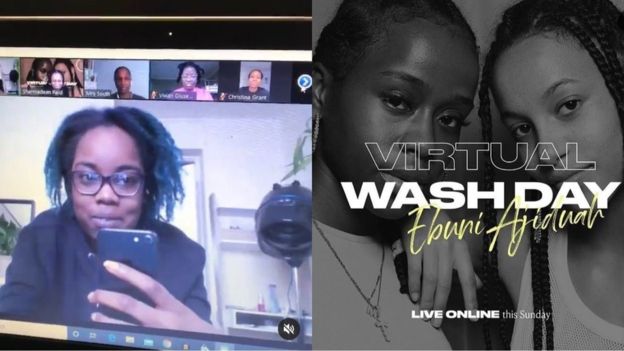
Ebuni Ajiduah is a hair loss-specialist. She has also moved her appointments online, offering clients home treatments, and when required referring them to dermatologists for further advice.

“People now have the time to focus on things they may have neglected,” she says, adding that she’s seen an increased demand for her services.

Ebuni Ajiduah runs a weekly wash day online. EBUNI AJIDUAH / BEAUTYSTACK

Ebuni has also launched a Virtual Wash Day every Sunday, when she invites people to join her on Zoom to wash, treat, and style hair together.

“We talk about the products we use and how we twist our hair,” she says. “It’s really nice, you get some people in shower caps and others trying to keep their kids still.

“It gives people a sense of normalcy when the world is on fire - you can still have a routine and focus time on yourself.”

Some hairdressers advise against cutting your own hair but are still offering other tips online.

“I've trimmed mine at the front but even I wouldn't attempt [to cut] mine at the back,” Michael Van Clarke says in a video on Instagram. Instead, he proceeds to show the audience how to style short hair that has grown out over a few weeks.

Hand holding
Since closing its doors, the team from his salon has been posting videos on social media and booking virtual colour consultations, serving more than 3,000 customers online.

“We have new clients which have never even been to our salon, the demand is huge,” Mr Van Clarke says.

“It’s a lot easier to do the video consultations if we’ve seen them in person before, but we are still able to give advice to new customers.”

Michael Van Clarke is trying to continue service the customers he normally sees in his salon. MICHAEL VAN CLARKE

Senior technicians carry out a hair assessment over an initial video call, advise on treatments and products, send them out and then offer a follow-up consultation to observe and guide the client.

“Some people like their hands held for reassurance, so our technicians can show them how to hold the brush and how long to leave colour on for,” Mr Van Clarke adds.

Gina Conway, who runs three salons in London, thinks this could become the "new normal".

“Even when lockdown is over, it’s going to be chaos,” she explains. 

“Some people might not be able to afford to go to the salon, they might be working from home or looking after children still, so I hope we can relieve that stress through technology.”

Gina says she’s now pivoting to focus on the internet.

“At first I was hesitant as I wanted to keep my business as professional as possible, but this is our way of giving proper advice and helping people to feel good about themselves.”

(Source: BBC)

Friday, 29 May 2020

Tokyo joins world film festivals for 10-day YouTube event

As competition programmer for the Tokyo International Film Festival (TIFF), Yoshi Yatabe has pretty much seen it all. But finding an email from Robert De Niro in his inbox still felt like a big deal.


“It was very difficult to neglect that email,” he says with a laugh.

It was mid-April when De Niro and his producing partner, Jane Rosenthal — co-founders of New York’s Tribeca Film Festival — contacted Yatabe with an intriguing proposition: Would TIFF be interested in joining an online event they were organizing?

They didn’t mention any other names at that point, but the resulting We Are One: A Global Film Festival, which will take place on YouTube from May 29, would turn out to feature contributions from many of the biggest festivals: Cannes, Venice, Berlin, Sundance, Toronto.

“It’s kind of a historic event,” says Yatabe. “It’s the first time for all these festivals to gather in one place and do a festival together, so it’s very exciting.”

There are 21 festivals taking part, each providing its own program, from features and shorts to talks and musical performances. In addition to bringing comfort to cinephiles, the 10-day event aims to raise money for a variety of COVID-19 relief efforts.

Tokyo’s program includes director Masaaki Yuasa’s 2008 animated short, “Genius Party: Happy Machine,” and Akiko Ooku’s eccentric romantic comedy “Tremble All You Want,” which won the Audience Award at TIFF in 2017.


There will also be multiple shorts by festival regular Koji Fukada, including a new film, “The Yalta Conference Online,” which stages Oriza Hirata’s historical play “The Yalta Conference” over Zoom.

Yatabe says that putting the program together was a learning process.

“It was much more difficult than I’d expected to clear the film rights for an online festival, on YouTube,” he says. “When you do a festival, for example in Tokyo, you only have to clear the domestic rights — but here, I (had to do it) for the whole world.”

Festivals typically serve as a film’s coming-out party: a place to create positive buzz, secure distribution deals or build momentum ahead of awards season.

With COVID-19 forcing many festivals to take a year off or drastically reconfigure, Yatabe says, “The whole film industry is in a bit of a mess.”

Movies that were selected for this year’s Cannes, for instance, now face an uncertain fate: Do their producers take the films elsewhere, or sit tight until next year’s festival?

“They’re kind of like lost children,” Yatabe says. This may seem like an opportunity for TIFF to snag some prestige titles, and he reveals he’s already been contacted about potential submissions for films that have seen their original plans fall through.

“I don’t think I can say I hope that these kinds of films will come to us, because it’s kind of taking advantage of other festivals’ cancellations,” he says.

As for TIFF — due to start on Oct. 31 — Yatabe thinks there’s a “very high probability” that the festival will go ahead. He’s less confident about whether it will be able to invite its usual bevy of overseas filmmakers and industry folk, given that many travel restrictions could still be in place.

“The question is: Can we make an international program without having guests?” he says. “I think that’s a challenge.”

Toronto International Film Festival, which takes place a month earlier, has said it is considering a hybrid model this year, using a mixture of physical and online screenings. Yatabe says Tokyo may do something similar, and concedes that festivals should be doing more to embrace digital platforms.

After a couple of months of lockdown, he says, “Nobody can ignore the importance of online viewing. So I think that the physical festival and the online part of the festival should be compatible.”

Yatabe also sees a more long-term role for distribution models such as Temporary Cinema, where films are streamed online and proceeds are split equally between the distributor and exhibitor.

“I think that scheme could stay after theaters reopen,” he says, “so that people in remote areas can also have access to new films.”

Given that Yatabe professes to have spent most of his free time in cinemas before Japan’s state of emergency went into effect, you would think it was a struggle for him to go cold turkey over the past couple of months. Not so, apparently.

“In one month, I watched 25 Ingmar Bergman films,” he says. “I was not expecting to be able to do that until after retirement. I hope that theaters will open as soon as possible, but I’m not bored at all staying home.”

(Source: JT)

Monday, 20 August 2018

The flourishing business of fake YouTube views

Plays can be bought for pennies and delivered in bulk, inflating videos’ popularity and making the social media giant vulnerable to manipulation.'

Martin Vassilev makes a good living selling fake views on YouTube videos. Working from home in Ottawa, he has sold about 15 million views so far this year, putting him on track to bring in more than $200,000, records show.

Mr. Vassilev, 32, does not provide the views himself. His website, 500Views.com, connects customers with services that offer views, likes and dislikes generated by computers, not humans. When a supplier cannot fulfill an order, Mr. Vassilev — like a modern switchboard operator — quickly connects with another.

“I can deliver an unlimited amount of views to a video,” Mr. Vassilev said in an interview. “They’ve tried to stop it for so many years, but they can’t stop it. There’s always a way around.”

After Google, more people search on YouTube than on any other site. It is the most popular platform among teenagers, according to a 2018 study by the Pew Research Center, beating out giants like Facebook and Instagram. With billions of views a day, the video site helps spur global cultural sensations, spawn careers, sell brands and promote political agendas.

Just as other social media companies have been plagued by impostor accounts and artificial influence campaigns, YouTube has struggled with fake views for years.

The fake-view ecosystem of which Mr. Vassilev is a part can undermine YouTube’s credibility by manipulating the digital currency that signals value to users. While YouTube says fake views represent just a tiny fraction of the total, they still have a significant effect by misleading consumers and advertisers. Drawing on dozens of interviews, sales records, and trial purchases of fraudulent views, The New York Times examined how the marketplace worked and tested YouTube’s ability to detect manipulation.

Inflating views violates YouTube’s terms of service. But Google searches for buying views turn up hundreds of sites offering “fast” and “easy” ways to increase a video’s count by 500, 5,000 or even five million. The sites, offering views for just pennies each, also appear in Google search ads.

To test the sites, a Times reporter ordered thousands of views from nine companies. Nearly all of the purchases, made for videos not associated with the news organization, were fulfilled in about two weeks.

One of the businesses was Devumi.com. According to company records, it collected more than $1.2 million over three years by selling 196 million YouTube views. Nearly all the views remain today. An analysis of those records, from 2014 to 2017, shows that most orders were completed in weeks, though those for a million views or more took longer. Providing large volumes cheaply and quickly is often a sign that a service is not offering real viewership.

Devumi’s customers included an employee of RT, a media organization funded by the Russian government, and an employee of Al Jazeera English, another state-backed company. Other buyers were a filmmaker working for Americans for Prosperity, a conservative political advocacy group, and the head of video at The New York Post. (Al Jazeera and The Post said the workers were not authorized to make such purchases and were no longer employed there.)

Multiple musicians bought views to appear more popular: YouTube views factor into metrics from the ratings company Nielsen and song charts including Billboard’s Hot 100.

Some companies bought views for clients with the promise of social media promotion that would result in real people watching their videos.

Dr. Judith Oppenheimer, 78, paid a company $5,000 to promote a book she had self-published in hopes of securing a mainstream deal. Her video soon had over 58,000 views, delivered through Devumi.

“There was no increase in sales and no book deal,” she said. “Soon after I signed the contract I thought, ‘I’ll have no proof of what they do or don’t do.’ Now it begins to make sense. They can do it in a day.”

Purveyors depend on constantly evolving tactics to deliver views, including automated or “bot” traffic and pop-under videos on unsuspecting users’ computers, but YouTube says it has effective processes to defend against these approaches.


“This has been a problem we have been working on for many, many years,” said Jennifer Flannery O’Connor, YouTube’s director of product management. The company’s systems continuously monitor a video’s activity, and the anti-fraud team often buys views to understand better how these sites operate, she said. “Our anomaly detection systems are really good.”

Still, the challenges are significant. At one point in 2013, YouTube had as much traffic from bots masquerading as people as it did from real human visitors, according to the company. Some employees feared this would cause the fraud detection system to flip, classifying fake traffic as real and vice versa — a prospect engineers called “the Inversion.”

“The problem itself was extraordinary,” said Blake Livingston, a member of YouTube’s fraud and abuse team at the time who has since left the company.

But fixes were made that relieved the fake-traffic surge, which YouTube said resulted from an attack against the website.

Years later, the battle against fake views continues, even as YouTube contends with disinformation campaigns, like Russia’s efforts during the 2016 election, and language it considers hate speech, including posts by the recently banned Infowars site.

YouTube would not disclose the number of fake views it blocked each day, but said its teams worked to keep them to less than 1 percent of the total. Still, with the platform registering billions of views a day, tens of millions of fake views could be making it through daily.

“View count manipulation will be a problem as long as views and the popularity they signal are the currency of YouTube,” Mr. Livingston said.

Carlton E. Bynum II runs a website, GetLikes.click, from a home office in Houston that sells YouTube views as well as Instagram and Twitter followers, Facebook likes and SoundCloud plays. Scott Dalton for The New York Times
“I can deliver an unlimited amount of views to a video,” said Martin Vassilev, owner of 500Views.com, a website based in Ottawa. Renaud Philippe for The New York Times
Real Money, Sham Audience
It took Mr. Vassilev about 18 months to go from being on welfare and living with his father in Canada to buying a white BMW 328i and a house of his own.

By late 2014, his website was on the first page of Google search results for buying YouTube views, fulfilling 150 to 200 orders a day and bringing in more than $30,000 a month, he said. “I really couldn’t believe you could make that much money online,” he said. The Times reporter’s order on his site, for 25,000 views, was fulfilled one day later.

A spokeswoman for Google, which is owned by the same company as YouTube, said that sites selling views appeared in search results because they were relevant, but that there was “room for improvement” in warning users.

Mr. Vassilev declined to name his clients but said that many orders came from public relations or marketing firms.

Today, he fills most orders through SMMKings.com, a wholesale supplier run by Sean Tamir, 29. Mr. Tamir charges him about a dollar for a thousand views, which Mr. Vassilev resells for $13.99, throwing in 100 free likes.

Several times a year, YouTube makes changes to its detection system to try to disrupt fake views, Mr. Tamir said. A recent episode came in late January, but many of the sites were functioning a few weeks later when The Times made most of its purchases. Suppliers say they get around system updates by making their traffic appear more humanlike, ensuring that it comes from users with prior views, for example.

One purveyor, Carlton E. Bynum II, 24, uses advertising to attract customers. He collected more than $191,000 in revenue this year but spent over $109,000 in ads that appeared at the top of Google, according to financial records. His site, GetLikes.click, run from a home office in Houston, sells YouTube views as well as Instagram and Twitter followers, Facebook likes and SoundCloud plays.

Google does not allow ads with terms like “buy YouTube views.” But Mr. Bynum said one workaround was to misspell the words and submit an ad multiple times if it was denied at first. When asked about advertising for paid YouTube views, Google removed some of the ads, including Mr. Bynum’s, but similar ones returned after two weeks.

Before Mr. Bynum sold views, he was buying them for himself. After he was discharged from the Marine Corps last year, he began posting product reviews on YouTube and taking a cut when visitors made purchases using his links. The views he bought would often cause his videos to rank higher than his competitors’ in search, he said. The effect would snowball: His videos would gain traffic through search, and he would make more money. (A YouTube spokeswoman said views were just one factor among many that affected search rankings.)

“It worked great,” he said. “I can get views within a day. I can get likes within hours.”

Mr. Bynum said he believed real people were watching his videos. “But let’s say there’s a small chance I’m wrong and it is bots,” he said. “Their videos are still getting ranked.”

Mr. Vassilev, who also said he used fake views to increase the search ranking of videos promoting his website, makes no pretense that what he is selling is authentic viewership. “It’s impossible,” he said.

“They told me if I got a certain number of hits I would sell a certain amount,” said Elizabeth Clayton, a self-published poet. William Widmer for The New York Times
“The beautiful thing about these social media platforms is when they came out it was genuine,” said Aleem Khalid, a musician. “But now I feel it’s all fake.” Joshua Lott for The New York Times
Promised a Following
The salesman on the phone said it would be simple: Elizabeth Clayton, a retired English and psychology professor, could pay Hancock Press $4,200 to publicize her self-published works of poetry. The company said online promotion, including 40,000 guaranteed YouTube views, would translate into sales, emails show.

Ms. Clayton, 77, was optimistic. She had been publishing for seven years but had not sold much. One royalty check came to $1.47, another to $0.75. She signed up for Hancock to promote two videos, costing her $8,400, records show.

“They told me if I got a certain number of hits I would sell a certain amount,” she said.

Instead of traditional marketing, Hancock paid $270 for 55,000 views from Devumi for each video, the records show. The views eventually reached about 60,000, where they remain. But there was no increase in sales. “They couldn’t tell me anything about the people that were watching the video,” Ms. Clayton said. “I suspected something, but I couldn’t get any information.”

Wayne Hancock, the 92-year-old chief executive of the Arkansas-based company, said he believed real people were watching the videos. That’s how Devumi marketed its views. Mr. Hancock’s daughter, K. C. Shay, who helps run the business, dismissed Ms. Clayton’s documents and the Devumi receipts as fakes.

But Devumi records show that Hancock Press spent about $26,000 over three years, obtaining more than five million views for 75 or so authors. Interviews with six other Hancock clients are consistent with Ms. Clayton’s experience.

Devumi did not respond to repeated requests for comment. The company, whose website says that it has closed, came under investigation in two states in January after The Times reported that it sold fake Twitter followers.

Many Devumi clients came from the music industry, where buying views is common and often seen as necessary. “YouTube is one of the premier sources of music consumption and an important indicator of musical trends and popularity,” said Silvio Pietroluongo, a vice president at Billboard.

As a new artist, Aleem Khalid hired Crowd Surf, a promotion company, in 2014. Without his knowledge, he said, the firm bought 10,000 views each on three of his videos. They now have between 11,000 and 42,000 views. “The beautiful thing about these social media platforms is when they came out it was genuine. But now I feel it’s all fake,” said Mr. Khalid, 25. (Cassie Petrey, a co-founder of Crowd Surf, said she thought Devumi was producing real views, based on statements on its website.)

Others who relied on Devumi said they were similarly surprised at the company’s tactics. Ami Horowitz, the conservative filmmaker, bought 10,000 views for a video he appeared in — “What We Learned at the People’s Climate March” — on the YouTube channel for Americans for Prosperity, the Koch brothers’ political influence group. Mr. Horowitz, who is often a guest on Fox News, also bought views for a video about the protests in Ferguson, Mo.

In a statement, he said he had believed Devumi worked like traditional web advertising. But “it wasn’t what we expected,” he said, adding that he never used Devumi or similar services again. A spokeswoman for Americans for Prosperity called the behavior unethical and said the group would “not knowingly engage” in it.

Spotting the Forgeries
YouTube’s engineers, statisticians and data scientists are constantly improving in their ability to fight what Ms. O’Connor calls a “very hard problem,” but the attacks have “continually gotten stronger and more sophisticated,” she said.

After the Times reporter presented YouTube with the videos for which he had bought views, the company said sellers had exploited two vulnerabilities that had already been fixed. Later that day, the reporter bought more views from six of the same vendors. The view count rose again, though more slowly. A week later, all but two of the vendors had delivered the full amount.

Even when it looks closely, YouTube can miss videos with fake views. A 2017 Google public report on disinformation during the 2016 election looked at RT’s YouTube channels, concluding that there was “no evidence of manipulation of our platform or policy violations.” Yet The Times recently found that an RT employee bought fake views for videos in 2016, which YouTube acknowledged it did not detect.

James Brown, a correspondent for RT, had purchased 30,000 views and 300 likes across three videos that focused on problems involving homelessness and immigration in Europe. Mr. Brown said he took Devumi at its word that the views would be real people. An RT spokeswoman said the company was unaware of the purchases and was conducting an internal review.

“It concerns me that while Twitter and Facebook appear to have made some credible progress in this area, YouTube still struggles to identify inauthentic and coordinated activity on its platform,” said Senator Mark Warner of Virginia, the top Democrat on the Intelligence Committee.

View-selling sites continue to advertise with apparent impunity. A post on the YouTube Creator Blog warning users against fake views has numerous comments linking to view-selling sites.

“The only way YouTube could eliminate this is if they removed the view counter altogether,” said Mr. Vassilev, the fake-view seller. “But that would defeat the purpose of YouTube.”

(Source: NYT)

Monday, 9 July 2018

Three YouTube vloggers die in waterfall plunge at Canada's Shannon Falls

Three members of a YouTube travel blogging collective have died after falling over a waterfall in Canada.

Ryker Gamble, Alexey Lyakh and Megan Scraper were part of High On Life, who post videos of their travel adventures.

The group said: "They were three of the warmest, kindest and most driven and outgoing people you could ever meet."

Photos of the trio were posted on a GoFundMe page
Police said the trio were swimming at the top of Shannon Falls in British Columbia on Tuesday when they "slipped and fell into a pool 30m (98ft) below".

Other members of the group, who have 1.1 million followers on Instagram and more than 500,000 YouTube subscribers, named the three on their memorial fund page and in a tribute video.


They said: "There are truly no words that can be said to ease the pain and the devastation we are all going through right now."

According to the Vancouver Sun, the accident happened when Scraper slipped and fell, with Gamble and Lyakh also getting swept away as they tried to save her.

High On Life are based in Vancouver and were formed by Gamble, Lyakh and another high school friend, Parker Heuser, after they travelled the world in 2012.

Shannon Falls is a popular destination for visitors
They decided to turn travel and video production into a full-time job and often promoted brands and destinations in the pictures and videos they posted from exotic locations.

Their Facebook page says: "High On Life is the attitude to embrace all of life's opportunities with a positive outlook and energy."

In one of his last Instagram posts, Gamble, spoke about the things we can all learn from "our younger selves".

He wrote: "Life isn't about responsibilities, tough decisions and hard work, it's about feeling bliss and living in the moment."
Last year, Gamble, Lyakh and another group member, Justis Price Brown, were banned from US federal land for five years after pleading guilty to walking on a sensitive hot spring in Yellowstone National Park and other crimes at parks across the western US.

In a statement released on Wednesday, Royal Canadian Mounted Police said they had received a call about three people swimming in one of the pools at the top of Shannon Falls, about 36 miles (58km) north of Vancouver.

"The individuals were with a group of friends when they slipped and fell into a pool 30 metres below," they said.

They added that teams had "worked throughout the day to complete the complex recovery of all three people from Shannon Falls" and that the file had been given to the coroner's office.

The British Columbia Coroners Service said on Friday they were in the early stages of the investigation.

An official confirmed the three were in their 20s, though Gamble's age has been reported as 30.

The Shannon Falls region and its old growth forests are an increasingly popular destination to visit in the province.

The waterfalls themselves are among of the tallest in British Columbia, reaching 1,009ft (335m) at their highest point.

In the wake of the tragedy, officials are warning people to be cautious in the area.

"Areas like Shannon Falls have very polished granite, it's very slippery with the mist and the lichen and etcetera that builds up around there-going in or near those pools has great risk," John Wilcox with Squamish Search and Rescue told radio station News 1130 on Wednesday.

"It's a very unfortunate circumstance hopefully we can all learn from."

(Source: BBC)