Showing posts with label hair. Show all posts

Tuesday, 1 September 2020

Job hunting is scary as a greying, middle-aged woman, but for now I’m ditching the dye

High-profile women with naturally grey hair are few – it doesn’t conform to the narrow social standards of female beauty

My quiet Covid rebellion is – as feminist fightbacks go – a rather low-key affair.

In my 20s I Reclaimed the Streets with the best of them. Bra-burning has been done, and besides, I consider mine critical weaponry in the Great Gravity War.

My iso struggle, however, is not entirely lacklustre. It has a little sparkle, a sprinkle of silver. Lockdown has delivered a visible three-inch-wide streak of grey hair, along with a less obvious but sizeable spread underneath.

What to do about it has become a mild obsession and strangely complicated.

At first I gladly threw open the door and stamped the back of Mother Nature’s hand with an access-all-areas pass. I didn’t want to spend hours in a hair salon in this health crisis and I hadn’t used box colours in years so I didn’t want to buy one now.
‘Defying the societal expectations born of years of patriarchy and sexism, I have continued grombreying, if I can manufacture a verb.’ Photograph: Gary John Norman/Getty Images/Image Source

Plus, I grew to quite like the silvery shimmer, and I was working from home and not going out.

But as restrictions eased and our lives began to resemble normality a little, my greying hair became cause for mild anxiety.

The vibrant and growing social media movement #grombre is full of women of all ages decrying fake hues. They’re embracing their grey with the Insta pics to not only prove it, but to celebrate it.

And there’s much to be said for ditching the dye. In the past five years I must have spent upwards of $6,000 for a salon colourist to saturate my scalp with ammonia and hydrogen peroxide every six or eight weeks.

But … what awaits the grey-haired woman? Is society kind to her?

I am far from ready to don the fluffy slippers and shuffle off into invisibility, and years of conditioning make me fearful that accepting the grey is a kind of giving up – on upkeep, any semblance of sexual attraction, maybe even respect in a professional setting.

Throughout our lives the clever marketers of the multibillion-dollar beauty industry have insidiously instilled in us a resistance to, if not downright revulsion of, ageing.

High-profile women with naturally grey hair are few, presumably because it doesn’t conform to the narrow social standards of female beauty.

Do we often (ever?) hear the term silver vixen?

So, just as iso ended, my role at work became redundant and the hunt for a new professional place in the world suddenly seemed scarier as a greying, middle-aged woman.

I have been dithering about what to do and while I dithered, Melbourne relapsed and iso 2.0 is upon us.

Defying the societal expectations born of years of patriarchy and sexism (and harbouring my aforementioned fear of the salon) I have continued grombreying, if I can manufacture a verb. I am Reclaiming my Hair. No angry marching needed.

But maybe ageing naturally is not a feminist act at all – the younger grey-and-proud Insta posters are certainly signs of a brave new world. Many are in their 20s and 30s and allowing their early silver strands to shine.

My fears may well be unfounded.

For now, I embrace my authentic self and wave a metaphorical flaming bra on behalf of the anti anti-ageing movement.

Admittedly, ageing gracefully (disgracefully?) with my revealed, shimmering sign of years lived is easy within the confines of lockdown. I don’t know how high my metaphorically blazing bra will be hoisted in the flagpole when socialising is a thing again – or (slow, deep breath) a potential employer calls me for an interview.
Will keep you posted.

(Source: The Guardian)

Wednesday, 12 August 2020

Rapunzel, draft one thousand

I call the Wig Man. He picks up. “My sister,” I say, “was diagnosed …” He interrupts me because he is driving and he is in a rush. “My store,” he says, “was looted last night.” “My sister,” I want to say, “…” He tells me he gathered all the hair that was left on the floor. “Glass everywhere,” he says. “I filled my Toyota Tacoma with all the hair that was left. I am driving home now,” he says. “Is you sister’s hair long?” he asks. It is. It is very long. “Because if it’s long what your sister should do before treatment begins is cut all her hair off and I will sew it, strand by strand, into a soft net. It’s called a halo,” he says. “I want to help your sister,” says the Wig Man. I imagine his Toyota Tacoma so stuffed with wigs that black and brown and blond hairs press up against the windows. Like animals trapped inside their own freedom. He starts to cry. I am certain he is driving across a bridge. “I don’t know how much more of this I can take,” he says.

“Neither do I,” I don’t say.

Sewing a wig strand by strand is called ventilating. I watch a tutorial. With a needle you draw each strand through a lace net and knot it on itself. The needle goes in and then out like thousands of tiny breaths. Ventilating a wig takes the patience of the dead. Each knotted strand is like a person sewn into a free country. The knot is tight, and the net is manufactured. “Of course my life matters,” says Eli my six-year-old. “Why wouldn’t it matter?”

My sister decides not to cut her hair. Instead she lets it fall out, slowly and then suddenly. She yawns, rises, and climbs up the stairs. She leaves behind a trail of blondish gold thread, like a princess coming undone. I write six different essays on Rapunzel. All of them are terrible. I help my sister into bed, though she prefers I not touch her. On her nightstand are six glittering tiaras. She wears one to chemo. Another to breakfast. “Isn’t it strange,” I say, “that I write about fairy tales and you are a fairy tale princess?” She looks at me hard. “A sick princess,” she says.

Of all the fairy tales, Rapunzel gives me the most difficult time. “It’s because,” says my husband, “you are trying to use her to write about systemic racism, and protest, and cancer, and a global pandemic.” “Should I just take out the racism?” I ask. “No,” he says. 
PHOTO © SABRINA ORAH MARK

“You can’t take out the racism.” “I know,” I say. “That was a stupid question,” I say. “Can I take out my mother?” “Does your mother appear?” he asks. “I don’t remember your mother appearing.” 

“Eventually,” I say, “my mother always appears.”

I am following my husband around the kitchen. “Should I add how after George Floyd was killed you sat on the edge of the bathtub and cried? Remember how you said,” I say, “‘We’ve been here before’? Remember when you said, ‘When will this stop,’ but you said it like an answer not a question?”

“Thugs,” says the Wig Man. “They destroyed my shop,” he says. “Everything is ruined.” I never call the Wig Man back. Instead, my mother buys my sister four wigs made out of strangers’ hair. Two brown ones, and two blond. My sister refuses to try the wigs on so my mother tries them on instead. In the wigs my mother looks sad and incredibly young. I can see my sister’s face gazing out from inside my mother’s, like a girl locked inside a tower.

My husband sits on the edge of the bathtub and cries. “We’ve been here before so many times,” he says. “When will it stop?” he says. “I don’t know how much more of this I can take,” says the Wig Man. “Of course my life matters,” says Eli, “why wouldn’t it matter?” “Did you know,” says my sister, “that in Disney’s Tangled Rapunzel lives inside a kingdom called Corona?” “That can’t be right,” I say.

I cut off all my hair. A twelve-inch braid long enough for nobody to climb. I throw the braid in the trash and then remove it from the trash. It’s soft and dumb. “I can’t look at it,” says my mother. “Get it away from me,” says my sister. I put it in an envelope and send it to a dear friend’s brother, an artist who makes Torahs and animals and money out of human hair and skin. I mean it as an act of solidarity, but I get the feeling my sister and mother read it as an act of pointless sacrifice. To punish Rapunzel for betraying her captivity, the enchantress winds her braids around her left hand, cuts them off, then takes Rapunzel to a wilderness and leaves her there. “See,” I say to my sister. “It’s not so bad.” She looks at my short hair, and a small forest grows between us.

Other than Disney’s, in no version of Rapunzel is Rapunzel’s hair magical. It can’t bring back the dead, or heal a broken bone, or keep a woman young forever. It can’t light up dark water. It can’t be thrown like a lasso so Rapunzel can glide from mountaintop to mountaintop. It doesn’t, like his hair does for Samson, give her god’s power or the strength to kill a lion with her bare hands. It cannot keep a man from being shot for his blackness. It’s just hair.

“I’m sure Rapunzel is wonderful and not terrible,” emails a friend, “but also there’s something Sisyphean about Rapunzel …” She’s right. I know what she means. Rapunzel’s hair is no more magical than a mountain the enchantress climbs day after day, pushing the burden of her own spell. I know what she means, but now I am imagining rolling boulders up Rapunzel’s back as she bends down to pick the roots and berries she survives on while pregnant in the wilderness. I roll the boulder up Rapunzel’s back, and each time I reach the crest the boulder rolls back down. Rapunzel, the mountain. Rapunzel, my sister. I am using my sister’s cancer to write about the impossible because it’s impossible my sister has cancer. And it’s impossible my sons cannot go to school or play with their friends. And it’s impossible my husband could be shot for being black. And it’s impossible the air is filled with tear gas and viral particles. I have stolen my sister’s tiara to wear. I am covered in sweat and dust, and on my head the tiara is crooked. I stole the most beautiful one. I stole the one embellished with glass stones and little pink stars.

It is late afternoon and my sister is sleeping. In the dining room, my mother has lined up all the wigs on their Styrofoam heads. Like four extra daughters. She keeps walking by them and smoothing their hair with her hand. She puts one to her face and inhales. The afternoon light lengthens her shadow. I don’t know if she notices I am there. The story of Rapunzel begins with a pregnant woman’s insatiability, her hunger for the finest rapunzel (also known as rampion, or the “king’s cure-all”) that results in the barter and entrapment of her daughter. In Giambattista Basile’s “Petrosinella,” one of the earliest versions of the story, a pregnant woman is caught stealing parsley from an ogress’s garden. She apologizes, and explains she had to satisfy her craving. In the sixteenth century, there was a widespread belief that if a pregnant woman’s cravings weren’t satisfied, the shape of whatever she craved would appear on her newborn. Birthmarks are called voglie in Italian, which means longings. My sister and I have identical birthmarks on the right side of our faces. Near our ears. Like a handful of scattered acorns. I am twenty-five years older than my sister. We don’t have the same father, but we do have the same mark of our mother’s longing.

Every two weeks my mother takes my sister to be infused with poison through a hole in her neck so she doesn’t die. My mother looks over at me. I am writing a birthday card with butterflies on it. “I hate butterflies,” says my mother. “It’s a stupid thing to put on a birthday card. They’re barely alive and then they’re dead.” Every mother has the exact same single greatest fear. It’s the boulder we push while praying for no crest.

“Of course my life matters,” says Eli, my seven-year-old. “Why wouldn’t it matter?”

By now the Wig Man must have stopped crying and arrived home. I imagine he is working in the same afternoon light that comes in through my mother’s window. He is bent over as he sews each of us, like strands of hair, into a soft net. Listen, we are breathing. You are breathing. My sons and husband are breathing. The Wig Man sews and sews. One piece of glass is still caught in a strand but he doesn’t notice it yet. My mother is breathing. My sister is breathing. 

We will make a magnificent wig. Rapunzel will wear us in this lost version of her fairy tale. We are not magical, but at least we are alive. “Rapunzel, Rapunzel, / Let your hair down.” When she lets us down what will climb up? We have one last chance to answer right. A revolution or the enchantress who keeps us?

(Source: The Paris Review)

Monday, 6 July 2020

Coronavirus: 'We'll be cutting hair from midnight' post-lockdown

Hairdressers and barbers in England will be allowed to reopen from 4 July - and some don't want to wait a moment longer.


Carole Rickaby, who owns Tusk Hair in Camden, north London, will be opening the doors of her salon at the stroke of midnight.


"It is just a fun thing to do [but] we're busy anyway. We are completely booked up from 7:00 in the morning until about 8pm because we're spreading our clients out as well, taking longer over each appointment."


Four stylists will work socially-distanced in the salon and allow up to 15 minutes between each client for cleaning. Cuts will be booked in in the morning, with colour treatments that take longer in the afternoon.


Carole and all her staff will also wear visors, and will wash only one client's hair at a time.


Carole Rickaby says some of her clients have had "horrific" DIY jobs during lockdown. Carole Rickaby 


Sandra Jacobs has been going to Carole for haircuts and colour for about 30 years. But the last time that she managed to get a haircut was in early March - just before lockdown measures were introduced in a bid to stop the spread of Covid-19.


"I've been doing what I can with products and rollers, but it's not looking great," she says. "I'm wearing a lot of hats these days!"


She will be Carole's first client once Tusk Hair is allowed to reopen at midnight on 4 July.


"She's fully booked for weeks after reopening, and I'm just not a morning person. So I thought why not? It'll be a fun experience."


Most of Carole's customers on Saturday will be coming with long hair needing a cut or roots that need re-dyeing. But she has heard of some DIY hair horror stories.


Sandra will be Carole's first client at midnight. Sandra Jacobs


"I've got one client - it was horrific what she did. She had a really nice red bob and she thought she'd take the scissors to the hair... and she literally hacked it," says Carole.


"So she won't be coming back to see me just yet because it still needs to grow out."


What are the new rules in salons and barbers?

  • Social distancing must be observed, with 2m between clients, or 1m with additional protection, such as a plastic screen
  • Clients must be seen by appointment only
  • A clear visor should be worn by the hairdresser
  • Clients should be given disposable gowns, or a separate one which is washed before and after each use
  • Equipment such as scissors or chairs should be cleaned between each client

Source: The National Hair and Beauty Federation


'Demand was mad'

Carole isn't alone in opening at midnight for clients desperate for a haircut.


"Demand was mad as soon as we posted on social media just to say the booking system was open," says Matt Hughes, who owns Idris Barbering Company in Tottenham.


Matt Hughes and his team will all wear clear visors when they reopen. Matt Hughes


With appointments booked for the coming weeks, Matt decided to open exclusively for a few regulars at midnight on 4 July.


"It is a bit of fun and to be honest, we are all absolutely buzzing to get back in the shop. I never thought I'd want to get back to work so bad after three months off the tools," he says.


His team will be offering a stripped back service though, amid the pandemic: "We're not going to offer any service where we have to come fully in front of the customer.


"We will still trim down the sides of the beard - and we'll do what we can because a lot of people will have pretty heavy growth on there."


He adds: "I have no doubt that what will probably start happening is you'll find that higher-end, premium barber shops will adhere to [social distancing guidelines] for a little bit longer."


'I'm desperate!'

Twenty-nine-year-old Levi Robbins has been one of Matt's regular customers over the last year and is looking forward to a trim on Saturday.


Levi says he "definitely" needs a haircut. Levi Robbins


"Once you've got a hairdresser you know is amazing, you want to stick with them. When Matt said they're offering midnight cuts, I thought, 'Of course!'


"I definitely need a haircut, it's terrible at the moment," Levi says, adding that his girlfriend was also roped in to give him a "very quick cut, which has grown out again - so I'm desperate!"


Levi says that he will wear a face mask to attend his appointment, although he is "almost certain" that he got coronavirus around March.


"It's more disconcerting knowing you may be passing it on to other people unwittingly. So my partner and I are treating it as though it's full lockdown.


"Being safe at home has been enjoyable, but it will be nice to mark a break with lockdown."


(Source: BBC)

Sunday, 31 May 2020

Coronavirus: Hairdressers offer virtual appointments in lockdown

Hairdressers have been offering virtual appointments to help people style their hair at home.

Stylists are using apps including FaceTime, Zoom, and YouTube to provide customers live one-to-one advice and tutorials.

While salons have already reopened in France and Germany, hairdressers in the UK expect to remain closed until July.


Paul Phillips owns Chopp Hair salon in Leigh-on-Sea in Essex, which shut in March when the coronavirus lockdown began.
Paul Phillips has been offering consultations over FaceTime. PAUL PHILLIPS / CHOPP HAIR

He provides a service called Chopp Drops, in which he delivers hair products to customers’ doorsteps and then demonstrates via video call how to apply the treatment.

“Most hairdressers say you should never colour your hair at home, and in normal times I’d agree,” he says.

“But lots of clients’ mental health has been affected by the current situation, so sorting out grey roots and split ends makes them feel better.”

Paul says he serves up to 26 clients a day, but adds that he is cautious to only offer advice that is achievable at home.

“It’s too technical to dye blonde hair, so those clients sadly have to sit tight and wait for the lockdown to be over,” he explains.

“You don’t want somebody to mess up and then have to live with it for another seven weeks.”

'Time to focus'
Most of the hairdressers the BBC spoke to offered bespoke hair kits and virtual appointments priced between £30 and £150.

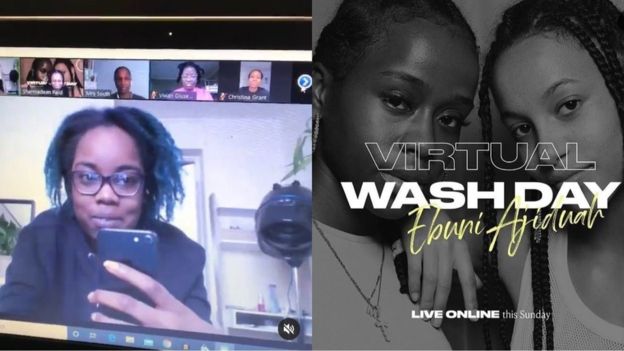
Ebuni Ajiduah is a hair loss-specialist. She has also moved her appointments online, offering clients home treatments, and when required referring them to dermatologists for further advice.

“People now have the time to focus on things they may have neglected,” she says, adding that she’s seen an increased demand for her services.

Ebuni Ajiduah runs a weekly wash day online. EBUNI AJIDUAH / BEAUTYSTACK

Ebuni has also launched a Virtual Wash Day every Sunday, when she invites people to join her on Zoom to wash, treat, and style hair together.

“We talk about the products we use and how we twist our hair,” she says. “It’s really nice, you get some people in shower caps and others trying to keep their kids still.

“It gives people a sense of normalcy when the world is on fire - you can still have a routine and focus time on yourself.”

Some hairdressers advise against cutting your own hair but are still offering other tips online.

“I've trimmed mine at the front but even I wouldn't attempt [to cut] mine at the back,” Michael Van Clarke says in a video on Instagram. Instead, he proceeds to show the audience how to style short hair that has grown out over a few weeks.

Hand holding
Since closing its doors, the team from his salon has been posting videos on social media and booking virtual colour consultations, serving more than 3,000 customers online.

“We have new clients which have never even been to our salon, the demand is huge,” Mr Van Clarke says.

“It’s a lot easier to do the video consultations if we’ve seen them in person before, but we are still able to give advice to new customers.”

Michael Van Clarke is trying to continue service the customers he normally sees in his salon. MICHAEL VAN CLARKE

Senior technicians carry out a hair assessment over an initial video call, advise on treatments and products, send them out and then offer a follow-up consultation to observe and guide the client.

“Some people like their hands held for reassurance, so our technicians can show them how to hold the brush and how long to leave colour on for,” Mr Van Clarke adds.

Gina Conway, who runs three salons in London, thinks this could become the "new normal".

“Even when lockdown is over, it’s going to be chaos,” she explains. 

“Some people might not be able to afford to go to the salon, they might be working from home or looking after children still, so I hope we can relieve that stress through technology.”

Gina says she’s now pivoting to focus on the internet.

“At first I was hesitant as I wanted to keep my business as professional as possible, but this is our way of giving proper advice and helping people to feel good about themselves.”

(Source: BBC)

Thursday, 30 April 2020

A cut above: Tokyo barber launches 'telecut' service as COVID-19 hits business

As a 'quick fix,' customers of Mr. Brothers Cut Club get real-time tutorials via video-conferencing

The COVID-19 pandemic has prompted many services and events to go virtual in Japan, leading to the advent of online classes, online nomikai (drinking parties) and even online hostess bars.

But online haircuts?

Not a chance, you might say, but one barbershop in Tokyo is trying to make the impossible possible.

In what may be an industry first, Mr. Brothers Cut Club, whose flagship store is located in the fashion mecca of Harajuku, has launched what it calls a “telecut” service, in which its barbers will offer customers self-haircut tutorials in real time via the Zoom video-conferencing app.
Saito Kon, a barber at Mr. Brothers Cut Club in Harajuku, demonstrates how he teaches customers how to cut their own hair using video conferencing app Zoom. | TOMOHIRO OSAKI

“We figured many people are getting annoyed at how their hair keeps growing while they’re staying at home,” said Saito Kon, one of the Mr. Brothers barbers.

“But the only option they have at the moment is either to risk infection by venturing outside to get a haircut, or to do nothing as their hair keeps growing.”

So the barbershop decided to offer a temporary solution to that problem.

Customers interested in the telecut service need to prepare a simple collection of necessary paraphernalia themselves, such as scissors, clippers, a garbage bag and a portable mirror. There are two service options — one for parents trying to trim the hair of their children, and the other for adults looking to cut their own hair. English-speaking staff are also available, too.

Mr. Brothers admits the telecut initiative is more of a “quick-fix” measure, unlikely to blossom into a viable business model. No matter how adept barbers have become at online tutorials, “We can’t really guarantee that customers can get the perfect, high-quality haircut they would look for at barbershops,” Kon said.

“The best we can do is teach them how not to mess up,” he said, adding that the initiative boils down to him and his colleagues trying to “make a social contribution.”

The service is free of charge.

But the project also reflects a message that barbers at Mr. Brothers want to get across to men nationwide who are growing increasingly indifferent to self-grooming as they go out less and less.

“I know many guys are taking perfunctory care of how they look during this stay-at-home period, but we hope this initiative will make them stay motivated about their appearance,” Kon said.

Like many barbershops and beauty salons across the nation, Mr. Brothers has not been immune to the economic fallout of the pandemic.

“Customers have halved from the period before COVID,” Kon said with a sigh. “Not that there’s much we can do about it. We just need to hang tough.”

(Source: JT)

Tuesday, 28 January 2020

Scientists discover 'why stress turns hair white'

Scientists say they may have discovered why stress makes hair turn white, and a potential way of stopping it happening without reaching for the dye.

In experiments on mice, stem cells that control skin and hair colour became damaged after intense stress.

In a chance finding, dark-furred mice turned completely white within weeks.

The US and Brazilian researchers said this avenue was worth exploring further to develop a drug that prevents hair colour loss from ageing.

Men and women can go grey any time from their mid-30s, with the timing of parental hair colour change giving most of the clues on when.
Although it's mostly down to the natural ageing process and genes, stress can also play a role.

But scientists were not clear exactly how stress affected the hairs on our heads.

Researchers behind the study, published in Nature, from the Universities of Sao Paulo and Harvard, believed the effects were linked to melanocyte stem cells, which produce melanin and are responsible for hair and skin colour.

And while carrying out experiments on mice, they stumbled across evidence this was the case.

"We now know for sure that stress is responsible for this specific change to your skin and hair, and how it works," says Prof Ya-Cieh Hsu, research author from Harvard University.

'Damage is permanent'
Pain in mice triggered the release of adrenaline and cortisol, making their hearts beat faster and blood pressure rise, affecting the nervous system and causing acute stress.

This process then sped up the depletion of stem cells that produced melanin in hair follicles.

"I expected stress was bad for the body," said Prof Hsu.

"But the detrimental impact of stress that we discovered was beyond what I imagined.

"After just a few days, all of the pigment-regenerating stem cells were lost.

"Once they're gone, you can't regenerate pigment any more - the damage is permanent."
The mouse before pain was induced (top) and some time afterwards (bottom image)


In another experiment, the researchers found they could block the changes by giving the mice an anti-hypertensive, which treats high blood pressure.

And by comparing the genes of mice in pain with other mice, they could identify the protein involved in causing damage to stem cells from stress.

When this protein - cyclin-dependent kinase (CDK) - was suppressed, the treatment also prevented a change in the colour of their fur.
This leaves the door open for scientists to help delay the onset of grey hair by targeting CDK with a drug.

"These findings are not a cure or treatment for grey hair," Prof Hsu told the BBC.

"Our discovery, made in mice, is only the beginning of a long journey to finding an intervention for people.

"It also gives us an idea of how stress might affect many other parts of the body," she said.


(Source: BBC)

Friday, 17 January 2020

'There should be clear warnings': Hair dye cancer risk stokes fear in black women

Permanent hair dye increases a black woman’s risk of breast cancer by 45% and the more they’re used, the greater the risk, as products believed to contain more dangerous chemicals

Priscilla Graves is a hairstylist with 15 years’ experience straightening and coloring black women’s hair. She has endured bouts of dizziness, nausea and difficulty breathing from applying potent chemical straighteners, and regularly deals with distraught clients suffering alopecia and painful blisters after using dyes and lotions specifically marketed to African Americans.

“I try to find out online what’s in the products, but the government should be doing more to keep us safe and keep dangerous chemicals out of cosmetics,” said Graves, 34, at a salon in Harlem. “There should be clear warnings on the labels, we need more information.”
Priscilla Graves at the Aicha’s African braiding salon in Harlem says: ‘The government should be doing more to keep us safe’ Photograph: Demetrius Freeman/The Guardian

The risks are very real. A new landmark study that tracked almost 47,000 American women over eight years has found that using permanent hair dye increases a black woman’s risk of breast cancer by 45%, compared to an increased risk of 7% in white women.

The more frequently women colored their hair, the greater the risk, rising to 60% for black women who used permanent dyes at least every five to eight weeks. Prior studies on the link between hair dye use and cancer had been inconsistent.

It’s not certain why, but several studies suggest that cosmetic products specifically designed for use by black women and children contain more chemicals that disrupt the endocrine or hormonal system than products aimed at white women. Disrupting the endocrine system – which regulates reproduction, metabolism, sleep, tissue function and growth and development – can cause cancerous tumors, birth defects, reproductive problems, developmental and neurological disorders. The way dye is applied and differences in hair texture and absorption could also play a role.

Hair products sold in the US contain more than 5,000 chemicals, including aromatic amines in dyes that can cause DNA mutations, parabens in hair lotions that are linked to reproductive and hormonal problems and known carcinogens such as formaldehyde, which are used in embalming fluids and some popular hair smoothing or straightening products.

But information about toxic chemicals is not easy to find. Manufacturers are not federally required to list ingredients on professional salon products.
In the EU, at least 1,300 chemicals are banned or restricted in cosmetics such as shampoos, soaps, dyes and nail polish, while the US has outlawed or curbed only 11.

The study, published in the International Journal of Cancer, is the first to analyze the link between chemical hair straighteners and breast cancer since the introduction of so-called Brazilian keratin treatments, which contain up to 11.5% formaldehyde, to the global market in the 2000s.

The researchers found that regardless of race, using hair straighteners at least every five to eight weeks increased the risk of breast cancer by 31%. About 74% of black women reported using chemical straighteners compared to only 3% of white women.

“Black women straighten their hair to assimilate,” said Amelia Govan, 31, a sales rep who as a teenager straightened her hair every month. “We have to fit in – you never see black women with braids working in corporate.”
Priscilla Graves mixes hair dying product at the Aicha’s African braiding salon in Harlem. Photograph: Demetrius Freeman/The Guardian

“It’s popular with African American women, who still associate curly hair with being ugly,” said Graves, whose current salon does not use Brazilian keratin treatments on safety grounds. “That stuff makes you sick, it made my eyes and throat burn. It should be banned.”

Graves’ mother has used chemical straighteners all her life and is currently undergoing treatment for breast cancer; several other relatives have had the disease. “I need to know what’s in the products, as I’m already high-risk,” she said. “My clients are increasingly worried about the dangers.”

Breast cancer is an unequal disease. Almost one in three African American women diagnosed with breast cancer dies – a 40% higher mortality rate than white women, according to the Centers for Disease Control.

The reasons for the disparities are not fully understood, but black women are more likely to be diagnosed later, and with aggressive tumors. African Americans are also disproportionately exposed to high rates of carcinogens and other dangerous chemicals from polluting fossil fuel plants and factories – and toxic cosmetics.

The global beauty industry is huge: in 2017, the cosmetics products market was worth $532bn and is expected to grow 50% by 2023. Last year in the US, consumers could choose from 2,727,847 lines of cosmetic imports from 177 countries. African Americans spent $473m on haircare in 2017, accounting for almost 9% of sales.

But standards and regulations vary hugely across the world.

The US Food and Drug Administration (FDA) is not required to approve or review the safety of cosmetic products and ingredients, other than color additives. In fact, participation in many FDA regulatory mechanisms, such as product registration and recall, is completely voluntary for manufacturers.

In 2018, for instance, the FDA issued a warning about hair smoothing products containing formaldehyde, but was powerless to recall or ban them.
The beauty industry says the onus should be on consumers, not manufacturers.

“People have been told that these straighteners are not a good idea, industry should not be held responsible if they choose not to pay attention to recommendations,” said Ken Marenus, president of the industry group Independent Cosmetic Manufacturers and Distributors (ICMAD). He insists that most US manufacturers already follow international standards, but agrees that regulations needs to be updated.

The current standards are ineffective and inadequate, and it’s especially bad for black women
Janet Nudelman
Priscilla Graves at the Aicha’s African braiding salon in Harlem. Photograph: Demetrius Freeman/The Guardian

“The current standards are ineffective and inadequate, and it’s especially bad for black women because products marketed to them are the most toxic,” said Janet Nudelman, director of Breast Cancer Prevention Partners’ campaign for safe cosmetics, which wants American consumers to be protected like those in Europe.

The congressional energy and commerce committee is currently considering legislation which would overhaul cosmetics regulation and could vastly expand FDA powers.

The most ambitious bill on the table is proposed by the Illinois congresswoman Jan Schakowsky, and includes provisions designed to protect “highly exposed and vulnerable populations” including salon workers and women of color.

The bill would immediately ban 12 toxic ingredients such as formaldehyde, parabens, lead compounds and coal tar dye, and includes federal money for research into chemicals linked to adverse health effects among women and girls of color and the marketing of those products, as well as support research to develop safer alternative ingredients.
.
In Harlem, consumers and stylists want more information, and better protection from toxins.

Hairstylist Astou Sow, 40, who is originally from Senegal but lived in France before moving to the US, said: “In Europe they care much more about quality, safety and good health. Here it’s mostly about business and money.”

(Source: The Guardian)