Showing posts with label Iceland. Show all posts

Thursday, 17 December 2020

The cold blood of Iceland

 The American artist Roni Horn first visited Iceland in 1975, when she was nineteen. Since that initial journey, she has returned to the island nation, both in person and through art, time and again; she has described Iceland as “a force, a force that had taken possession of me.” Island Zombie: Iceland Writings, which will be published this week by Princeton University Press, collects vignettes and photo


MAKING BEING HERE ENOUGH

I don’t want to read. I don’t want to write. I don’t want to do anything but be here. Doing something will take me away from being here. I want to make being here enough. Maybe it’s already enough. I won’t have to invent enough. I’ll be here and I won’t do anything and this place will be here, and I won’t do anything to it. And maybe because I’m here and because the me in what’s here makes what’s here different, maybe that will be enough, maybe that will be what I’m after.


But I’m not sure. I’m not sure I’ll be able to perceive the difference. 


How will I perceive it? I need to find a way to make myself absolutely not here but still be able to be here to know the difference. I need to experience the difference between being here and not changing here, and being here and changing here.


I set up camp early for the night. It’s a beautiful, unlikely evening after a long rainy day. I put my tent down in an El Greco landscape: the velvet greens, the mottled purples, the rocky stubble.

But El Greco changes here, he makes being here not enough. I am here and I can’t be here without El Greco. I just can’t leave here alone.


*


SOMETIMES DEAD

A sunny blue morning and I’m looking for a place to rest. On the map there’s a beach not far ahead. I leave the road and drive across a grassy field and soon I’m on a red-sand beach. The tide is out, the ocean far away. I get off the bike and wander down the shore. It’s windy and cold, but the sun is warm in a cloudless sky. The arctic terns are about, they screech and hover and swoop down at my head.


PHOTO: MICHAL KLAJBAN. CC BY-SA 4.0 (HTTPS://CREATIVECOMMONS.ORG/LICENSES/BY-SA/4.0), VIA WIKIMEDIA COMMONS.


I lie down on the sand; near the earth the wind is still. I fall into a deep, brief sleep. Through my eyelids the bright light of the sun saturates my body. As though from outside, I see myself translucent and feathered red to orange at the edges of my silhouette, a science fiction. I dream of my body inanimate, prone, giving up its opacity.


As I wake I feel a weight on my chest. And there, as my eyes slowly open, is a large brown bird perched on my stomach. It casts a shadow over my face. I lift my head as the bird takes a peck at my chest and wonder is this in life or in death? I panic and the bird spreads its wings, digging its perch in a little deeper as it takes off.


*


THE COLD BLOOD OF ICELAND

There are no reptiles here. No snakes, no crocodiles or alligators. No lizards, turtles, or frogs. No mammals that could hurt you, either. The people are rarely criminal and only occasionally violent, and almost never toward a stranger. There are no serial murderers here, maybe a few crimes of passion here and there, but no decapitated women or otherwise mutilated bodies. Essentially there is no violence. No irrational threats. No intimidating predators. No cold-blooded animals. All the things that aren’t here resolve what is. Relief from fear is freedom.


But there’s something else here: the weather. The weather is here instead—a Freudian slip of ecology. As though weather was wittily and mercilessly substituted for reptiles. Weather, a natural force magnified by island circumstance, is the cold blood of Iceland. Weather with its amoral, wanton violence is lethal here.


Weather moves rivers and makes them, too. Weather blows roads away or turns them into mud. It washes the rocks out of the mountains and dams the roads. The weather is one thing here and fifty feet away something else. Cars are blown off roads, frequently in some places, and people are picked up or knocked down by sudden gusts. In the interior, near the glacier for example, the winds can get so bad you must crawl on the ground to get through. Sandstorms stop visibility a foot in front of your face; this is a way of being lost without having gone anywhere. When the glaciers begin to melt the earth trembles at the gushing vehemence of engorged rivers. Water is thrashed out of the ocean and thrown in the air, whole fields of water are blown out of lakes. Waterfalls are smashed into fine spray and blown back up into the clouds.


Changing weather can strand you quickly. Just around the bend a whiteout might erase the world entirely. Sometimes briefly, sometimes not. Rivers can turn into lakes, and so can fields. When a field becomes a lake it’s intimidating just standing near. These instant lakes have properties unpredictable and unmapped. Encountering these new bodies of water presents a unique form of being lost. You are lost not because you don’t know where you are but because where you are is not what it is.


*


BLUFF AND PSYCHO

I’d been living on the bluff only three weeks when I ran out of reading material. I searched the lighthouse for possibilities. Up in the tower I found the repair manual for the electric generator (good over breakfast, but not more) and True Life, Unsolved English Murder Mysteries. It would be hard not to read the mysteries, I thought. I spent the better part of the evening resisting. But then … I succumbed—hideous, detailed descriptions of wives cut into pieces and sent around town or stashed under bridges by their husbands, often doctors.


In the room overlooking the bluff, I sat and read. The mood was intensified by the thick fog that was presently enveloping the bluff and obscuring the view. I was dreading the moment I would finish. My only option, I knew, was to keep reading and rereading, and just not stop.


Though I lingered purposefully over each criminal act, savoring the occasional and extraordinary detail, I finished quickly. These terrible images—headless women, body parts washed up on the Thames, disemboweled torsos—populated the bluff. The lighthouse diminished in size, a claustrophobic energy entered the building.


I sat still, very still, listening to the late-night silence of the room. It was loud and tiring. I waited for a break, a way out, a pause in the feeling of terror that filled me. It came quickly when the electricity shut down and the building went dark. Seconds later the electric generator exploded into action, a twisted parody of my fear and helplessness. It was unbearably loud and intense. I laughed and laughed and then I froze. My muscles strained with immobility.


I sat in the dismal bare-bulb light staring into the darkness, into my reflection in the glass. Intermittent bursts of white swept past the window and over the bluff, racing around the room and washing over my face.


*


HOW — IS VISIBLE HERE

I’m standing on the mountain Kerlingarfjöll, high up in the interior of Iceland. A warm, sunbaked evening fills the air. The atmosphere is a lens, focusing the view into vivid and stunning clarity. The air is thin and transparent, so much so, it feels new. Things far away are as visible as those that are near. There’s little distinction between the two.


Looking around I can see the ocean way out there, in all directions. With a sense of omnipotence, I can also see everything in between. No haze, no dirt, no trees, nothing obscures the view. I am seeing all that is visible in each direction, as far as that direction goes. Only the curvature of the earth diminishes and eventually removes the most distant part of each view.


To the east the view is briefly interrupted by the mountain I’m standing on. But every little thing on the mountain stands out in magnified clarity too. The blades of grass, the grains of sand, the perfect pebbles, each rock, and every flower, and every part of every flower are brilliantly visible. I can see the smooth, rough, and granulated textures of all things: the earth, vegetation, and rocks. I see this simultaneously and without hierarchy. Every road, lava field, lake, and river, every glacier, mountain, boulder, and bridge, each holds its place in the view.


Provided it’s the right arctic atmosphere, you can stand almost anywhere on this island, not necessarily high up, and experience these deep views. The terrain is an ocean of expanse; an expanse interrupted only occasionally by a mountain or a glacier. And only rarely do buildings or vegetation interfere, and trees never do.


There are no trees in Iceland. Their absence brings out the remarkable nature of this landscape. The views here are the trees of Iceland. In other places no trees creates a vacuum, obscuring the view with longing and desire.


Iceland is young; some of the island is less than thirty years old. Surtsey was cooling its molten mass into the Atlantic Ocean within months of John F. Kennedy’s assassination in 1963. Iceland’s so young erosion hasn’t yet obscured the origin of things.


Youth and no trees reveal things rarely seen anywhere. Like how a place comes to be, continuously.


How the landscape takes shape.


How the lava flows and where it stops. And how many times it flows here or there, because each flow is a layer, looking like a single step in a staircase.


How these layers and steps now laminated into a solid mass tilt this way or that.


How the water emerges from underneath a lava field and forms a wall of waterfalls.


How the earth splits open in a miles-long, straight, v-shaped canyon.

How molten lava rides the rivers out to sea.


How boiling water spontaneously jumps out of the earth.


How basalt cools into accordion walls of architectural clarity and scale.


How lava flows over wet earth and becomes a field of breasts and cones that together create an undulating and sexy horizon.


How fjord mountains stop happening way up in the air like the blades of upturned knives and how these sharp mountains form a row of pinnacles like the teeth of a comb.


How a lava flow becomes a maze.


How a mountain breaks down into particles that settle into vast slopes in dazzling angles of repose.


How, precisely, tectonic plates—enormous pieces of global crust, come together exactly as one might expect the edges of some enormous crack to do.


The hows build up everywhere, forming a landscape of infinite depth and transparence. Each how takes you one step deeper, beyond appearance, beyond the simple visibility of things.


No trees. No trees introduces something as complex and necessary as trees themselves. But when this absence combines with the right atmospheric conditions, Iceland grants omniscience to the visitor free of superior forms.


Roni Horn is an artist and writer whose books include Another Water, Wonderwater (Alice Offshore), Weather Reports You, and Roni Horn aka Roni Horn.


Excerpted from Island Zombie: Iceland Writings, by Roni Horn. Copyright © 2020 by Roni Horn. Reprinted by permission of Princeton University Press.


(Source: The Paris Review)

Tuesday, 8 December 2020

The cold blood of Iceland

The American artist Roni Horn first visited Iceland in 1975, when she was nineteen. Since that initial journey, she has returned to the island nation, both in person and through art, time and again; she has described Iceland as “a force, a force that had taken possession of me.” Island Zombie: Iceland Writings, which will be published this week by Princeton University Press, collects vignettes and photographs from Horn’s ongoing fascination with the country. An excerpt appears below. 


MAKING BEING HERE ENOUGH

I don’t want to read. I don’t want to write. I don’t want to do anything but be here. Doing something will take me away from being here. I want to make being here enough. Maybe it’s already enough. I won’t have to invent enough. I’ll be here and I won’t do anything and this place will be here, and I won’t do anything to it. And maybe because I’m here and because the me in what’s here makes what’s here different, maybe that will be enough, maybe that will be what I’m after.


But I’m not sure. I’m not sure I’ll be able to perceive the difference. How will I perceive it? I need to find a way to make myself absolutely not here but still be able to be here to know the difference. I need to experience the difference between being here and not changing here, and being here and changing here.


I set up camp early for the night. It’s a beautiful, unlikely evening after a long rainy day. I put my tent down in an El Greco landscape: the velvet greens, the mottled purples, the rocky stubble.


PHOTO: MICHAL KLAJBAN. CC BY-SA 4.0 (HTTPS://CREATIVECOMMONS.ORG/LICENSES/BY-SA/4.0), VIA WIKIMEDIA COMMONS.


But El Greco changes here, he makes being here not enough. I am here and I can’t be here without El Greco. I just can’t leave here alone.


*


SOMETIMES DEAD

A sunny blue morning and I’m looking for a place to rest. On the map there’s a beach not far ahead. I leave the road and drive across a grassy field and soon I’m on a red-sand beach. The tide is out, the ocean far away. I get off the bike and wander down the shore. It’s windy and cold, but the sun is warm in a cloudless sky. The arctic terns are about, they screech and hover and swoop down at my head.


I lie down on the sand; near the earth the wind is still. I fall into a deep, brief sleep. Through my eyelids the bright light of the sun saturates my body. As though from outside, I see myself translucent and feathered red to orange at the edges of my silhouette, a science fiction. I dream of my body inanimate, prone, giving up its opacity.


As I wake I feel a weight on my chest. And there, as my eyes slowly open, is a large brown bird perched on my stomach. It casts a shadow over my face. I lift my head as the bird takes a peck at my chest and wonder is this in life or in death? I panic and the bird spreads its wings, digging its perch in a little deeper as it takes off.


*


THE COLD BLOOD OF ICELAND

There are no reptiles here. No snakes, no crocodiles or alligators. No lizards, turtles, or frogs. No mammals that could hurt you, either. The people are rarely criminal and only occasionally violent, and almost never toward a stranger. There are no serial murderers here, maybe a few crimes of passion here and there, but no decapitated women or otherwise mutilated bodies. Essentially there is no violence. No irrational threats. No intimidating predators. No cold-blooded animals. All the things that aren’t here resolve what is. Relief from fear is freedom.


But there’s something else here: the weather. The weather is here instead—a Freudian slip of ecology. As though weather was wittily and mercilessly substituted for reptiles. Weather, a natural force magnified by island circumstance, is the cold blood of Iceland. Weather with its amoral, wanton violence is lethal here.


Weather moves rivers and makes them, too. Weather blows roads away or turns them into mud. It washes the rocks out of the mountains and dams the roads. The weather is one thing here and fifty feet away something else. Cars are blown off roads, frequently in some places, and people are picked up or knocked down by sudden gusts. In the interior, near the glacier for example, the winds can get so bad you must crawl on the ground to get through. Sandstorms stop visibility a foot in front of your face; this is a way of being lost without having gone anywhere. When the glaciers begin to melt the earth trembles at the gushing vehemence of engorged rivers. Water is thrashed out of the ocean and thrown in the air, whole fields of water are blown out of lakes. Waterfalls are smashed into fine spray and blown back up into the clouds.


Changing weather can strand you quickly. Just around the bend a whiteout might erase the world entirely. Sometimes briefly, sometimes not. Rivers can turn into lakes, and so can fields. When a field becomes a lake it’s intimidating just standing near. 


These instant lakes have properties unpredictable and unmapped. Encountering these new bodies of water presents a unique form of being lost. You are lost not because you don’t know where you are but because where you are is not what it is.


*


BLUFF AND PSYCHO

I’d been living on the bluff only three weeks when I ran out of reading material. I searched the lighthouse for possibilities. Up in the tower I found the repair manual for the electric generator (good over breakfast, but not more) and True Life, Unsolved English Murder Mysteries. It would be hard not to read the mysteries, I thought. I spent the better part of the evening resisting. 


But then … I succumbed—hideous, detailed descriptions of wives cut into pieces and sent around town or stashed under bridges by their husbands, often doctors.


In the room overlooking the bluff, I sat and read. The mood was intensified by the thick fog that was presently enveloping the bluff and obscuring the view. I was dreading the moment I would finish. My only option, I knew, was to keep reading and rereading, and just not stop.


Though I lingered purposefully over each criminal act, savoring the occasional and extraordinary detail, I finished quickly. These terrible images—headless women, body parts washed up on the Thames, disemboweled torsos—populated the bluff. The lighthouse diminished in size, a claustrophobic energy entered the building.


I sat still, very still, listening to the late-night silence of the room. It was loud and tiring. I waited for a break, a way out, a pause in the feeling of terror that filled me. It came quickly when the electricity shut down and the building went dark. Seconds later the electric generator exploded into action, a twisted parody of my fear and helplessness. It was unbearably loud and intense. I laughed and laughed and then I froze. My muscles strained with immobility.


I sat in the dismal bare-bulb light staring into the darkness, into my reflection in the glass. Intermittent bursts of white swept past the window and over the bluff, racing around the room and washing over my face.


*


HOW — IS VISIBLE HERE

I’m standing on the mountain Kerlingarfjöll, high up in the interior of Iceland. A warm, sunbaked evening fills the air. The atmosphere is a lens, focusing the view into vivid and stunning clarity. The air is thin and transparent, so much so, it feels new. Things far away are as visible as those that are near. There’s little distinction between the two.


Looking around I can see the ocean way out there, in all directions. With a sense of omnipotence, I can also see everything in between. No haze, no dirt, no trees, nothing obscures the view. I am seeing all that is visible in each direction, as far as that direction goes. Only the curvature of the earth diminishes and eventually removes the most distant part of each view.


To the east the view is briefly interrupted by the mountain I’m standing on. But every little thing on the mountain stands out in magnified clarity too. The blades of grass, the grains of sand, the perfect pebbles, each rock, and every flower, and every part of every flower are brilliantly visible. I can see the smooth, rough, and granulated textures of all things: the earth, vegetation, and rocks. I see this simultaneously and without hierarchy. Every road, lava field, lake, and river, every glacier, mountain, boulder, and bridge, each holds its place in the view.


Provided it’s the right arctic atmosphere, you can stand almost anywhere on this island, not necessarily high up, and experience these deep views. The terrain is an ocean of expanse; an expanse interrupted only occasionally by a mountain or a glacier. And only rarely do buildings or vegetation interfere, and trees never do.


There are no trees in Iceland. Their absence brings out the remarkable nature of this landscape. The views here are the trees of Iceland. In other places no trees creates a vacuum, obscuring the view with longing and desire.


Iceland is young; some of the island is less than thirty years old. Surtsey was cooling its molten mass into the Atlantic Ocean within months of John F. Kennedy’s assassination in 1963. Iceland’s so young erosion hasn’t yet obscured the origin of things.


Youth and no trees reveal things rarely seen anywhere. Like how a place comes to be, continuously.


How the landscape takes shape.


How the lava flows and where it stops. And how many times it flows here or there, because each flow is a layer, looking like a single step in a staircase.


How these layers and steps now laminated into a solid mass tilt this way or that.


How the water emerges from underneath a lava field and forms a wall of waterfalls.


How the earth splits open in a miles-long, straight, v-shaped canyon.


How molten lava rides the rivers out to sea.


How boiling water spontaneously jumps out of the earth.


How basalt cools into accordion walls of architectural clarity and scale.


How lava flows over wet earth and becomes a field of breasts and cones that together create an undulating and sexy horizon.

How fjord mountains stop happening way up in the air like the blades of upturned knives and how these sharp mountains form a row of pinnacles like the teeth of a comb.


How a lava flow becomes a maze.


How a mountain breaks down into particles that settle into vast slopes in dazzling angles of repose.

How, precisely, tectonic plates—enormous pieces of global crust, come together exactly as one might expect the edges of some enormous crack to do.


The hows build up everywhere, forming a landscape of infinite depth and transparence. Each how takes you one step deeper, beyond appearance, beyond the simple visibility of things.

No trees. No trees introduces something as complex and necessary as trees themselves. But when this absence combines with the right atmospheric conditions, Iceland grants omniscience to the visitor free of superior forms.


Roni Horn is an artist and writer whose books include Another Water, Wonderwater (Alice Offshore), Weather Reports You, and Roni Horn aka Roni Horn.


Excerpted from Island Zombie: Iceland Writings, by Roni Horn. Copyright © 2020 by Roni Horn. Reprinted by permission of Princeton University Press.


(Source: The Paris Review)

Tuesday, 19 May 2020

Why women make better crisis leaders

While many countries continue to grapple with escalating COVID-19 outbreaks, two have declared theirs effectively over: New Zealand and Iceland. It is no coincidence that both countries’ governments are led by women.

New Zealand Prime Minister Jacinda Ardern and her Icelandic counterpart, Katrin Jakobsdottir, have both received considerable — and well-deserved — praise for their leadership during the COVID-19 crisis. But they are not alone: Of the top 10 best-performing countries (in terms of testing and mortality), four — Estonia, Iceland, New Zealand and Taiwan — have woman leaders. German Chancellor Angela Merkel and Danish Prime Minister Mette Frederiksen have also been commended for their pandemic leadership.

Women account for less than 7 percent of the world’s leaders, so the fact that so many have distinguished themselves during the COVID-19 crisis is noteworthy. But that’s not all. Some of the worst-performing countries are led by unapologetically old-fashioned “men’s men.” Brazilian President Jair Bolsonaro’s entire persona channels a retrograde masculinity and a patriarchal view of women. Accordingly, he has called the virus a “measly cold,” boasting that he “wouldn’t feel anything” if infected.
New Zealand Prime Minister Jacinda Ardern and other female national leaders have received high praise for their leadership during the COVID-19 crisis. | BLOOMBERG

In the United Kingdom — which has recorded the most COVID-19 deaths in Europe — Prime Minister Boris Johnson also has a history of sexist comments. Like Bolsonaro, Johnson’s first instinct was to minimize the threat COVID-19 poses, though he changed his tune after being infected and ending up in an intensive care unit.

It’s the same story with U.S. President Donald Trump. A leader who came to power gloating about powerful men’s ability to assault women sexually — which he and his supporters dismissed as “locker room banter” — Trump has often worn his misogyny like a badge of honor. He, too, has consistently downplayed the COVID-19 crisis, focusing instead on “making China pay” for allowing the virus to spread beyond its borders.

Just as leaning into masculine stereotypes seems to correlate with poor pandemic responses, many observers seem to believe that woman leaders’ success may be rooted in their traditionally “feminine” qualities, such as empathy, compassion and willingness to collaborate. Forbes called Norwegian Prime Minister Erna Solberg’s televised address to her country’s children an example of the “simple, humane innovations” that are possible under female leadership.

This reading is outdated, reductive and simply wrong. Trump and his ilk may act tough, but ultimately their leadership is an incompetent charade of bluster, vacillation and self-aggrandizement. High-performing female leaders, by contrast, have been resolute, assessed the evidence, heeded expert advice and acted decisively.

Following the mantra “go hard and go early,” Ardern imposed a strict lockdown four days before New Zealand’s first COVID-19 death. Taiwanese President Tsai Ing-wen introduced more than a hundred public health measures in January — when the World Health Organization was still casting doubt on the possibility of human-to-human transmission.

If traditionally “feminine” traits don’t explain female leaders’ strong performance in times of crisis, what does? The answer may be related to the path women take to power, which is generally more demanding than that faced by men. In particular, it may be linked to the “glass cliff” phenomenon, whereby women are more likely than men to be appointed to leadership positions that are “risky and precarious.”

Research into the glass cliff began with the finding that, before appointing men to their boards, companies in the Financial Times Stock Exchange 100 Index typically experienced stable share prices. Before appointing a woman, however, those same companies often experienced five months of poor share-price performance. Another study found that companies listed on the U.K. stock exchange tended to increase gender diversity on their boards after experiencing big losses.

A similar tendency can be seen in politics. Margaret Thatcher became leader of a Conservative Party in crisis and prime minister after a “winter of discontent.” Archival analysis of the 2005 U.K. general election found that female Conservative Party candidates tended to contest seats that would be significantly more difficult to win (judged according to their rival’s performance in the previous election).

Ardern also got her break by being thrust onto a glass cliff: She became the leader of New Zealand’s Labour Party in 2017 after poor polling forced her predecessor to resign. A mere two months later, she became the country’s youngest prime minister in 150 years.

According to the researchers, the glass cliff may appear because organizations are more willing to challenge the status quo when the status quo isn’t working. The visible difference of having a woman in charge could also reassure stakeholders that change is happening. As for the women, they may be more likely to accept leadership positions in times of crisis because they have fewer opportunities to reach the top. They can’t simply wait for an easier post to open up.

Regardless of why it happens, the fact is that by the time a woman reaches the heights of corporate or political power, she is likely to have overcome massive hurdles. With men, that is possible but far from guaranteed. Johnson (who was fired from multiple jobs for lying) and Trump (with his meticulously documented history of business failures, including several bankruptcies) never seem to run out of second chances. These leaders’ paths to power are characterized more by plush cushions than glass cliffs — and it shows.

While many factors are shaping outcomes during the COVID-19 pandemic, leadership is undoubtedly one of the most important. It should surprise no one that, by and large, it is the leaders who have already had to prove themselves who are the most effective. That very often means they are women.

(Source: JT)

Sunday, 27 January 2019

Iceland still selling own-brand palm oil products despite pledge

Supermarket giant Iceland has continued to sell own-brand products containing palm oil despite pledging to stop doing so by the end of 2018.

The retailer made the promise last April, saying demand for the oil was devastating rainforests in Asia.

But Iceland still sells 28 own-brand products with palm oil or fat, as well as more than 600 from other brands.

Iceland said it had "fulfilled" its promise and no longer made own-brand products containing palm oil.

It added that own-brand products still available were old stock, including frozen desserts and frozen pastry products, which "obviously have a longer shelf life than fresh and chilled food lines".

However, the BBC also found non-frozen perishable goods such as fairy cakes, hot cross buns and jam tarts - all made with palm oil - available to buy online. One product carried a logo saying it was "new".

The BBC was also able to purchase frozen own-brand products containing palm oil in store, though not fresh ones.

Iceland said: "If there is fresh food on our website that is labelled as still containing palm oil, this is a website issue and our team are working quickly to resolve."

It insisted there were no Iceland own-label fresh items available that still contained palm oil.

Since the BBC contacted the retailer, a number of products containing palm oil have been marked as "currently unavailable" on the website.

The BBC was able to purchase numerous Iceland products containing palm oil in store
Iceland has spent weeks telling its customers on social media that it has achieved that goal while its website states the company is "simply saying no to palm oil".

In some stores, a cartoon orangutan featured in the supermarket's "No palm oil" promotional campaign appears at checkouts.

Even before the end of 2018, Iceland tweeted one customer to say: "There's no palm oil in our own-brand products."

It has repeated this claim on social media multiple times since.

When the BBC put it to Iceland that there was in fact still palm oil in its own-brand products, it said it now expected there to be no more products available to buy with palm oil "within the next few weeks".

What did Iceland promise?
"The Iceland no palm oil pledge is that by the end of 2018, 100 per cent of the supermarket's own label food lines will contain no palm oil, reducing demand for palm oil by more than 500 tonnes per year."

A supposedly "new" product containing palm oil for sale on the Iceland website on 23 January
John Sauven, executive director of environmental charity Greenpeace UK, said: "If they still have old stock on their shelves, they need to make that clear to consumers in order to fulfil the promise they made."

In November, Iceland attempted to run a Christmas advert - originally a short film made by Greenpeace - telling the story of an orangutan whose home had been destroyed by deforestation caused by the palm oil trade.

Due to UK legislation surrounding political messaging on TV, the advert was never broadcast - yet the supermarket received significant attention and praise from consumers online.

The Iceland/Greenpeace advert highlights the impact that palm oil production is having on the planet
Responding to the news Iceland was still selling products containing palm oil, a spokesman for consumer organisation Ethical Consumer said: "If the target has been missed, it should now be revised and the company should be transparent about how they are dealing with problems they have faced in their supply chain.

"This transparency would have two positive effects - firstly it would maintain customer trust and secondly it could help other producers overcome similar difficulties."

Iceland became the first UK supermarket to announce the removal of palm oil from its products when it made the pledge last year.

Why is palm oil controversial?
Palm oil cultivation can destroy habitats for orangutans


  • Palm oil production is said to have been responsible for about 8% of the world's deforestation between 1990 and 2008
  • Burning large areas of forests to clear areas where oil palms can be grown has also been blamed for high levels of air pollution in South East Asia
  • Palm oil is used in almost half the products stocked by UK supermarkets and can be found in everything from shampoos to biscuits, as well as biofuels
  • Some experts say eating palm oil is unhealthy because it is high in saturated fat
  • EU labelling laws were changed in 2014 so products must now state specifically if they contain palm oil


(Source: BBC)

Tuesday, 10 July 2018

Iceland is having the worst summer for 100 years – is Britain’s heatwave to blame?

Reykjavík’s ice-cream vendors, camp sites and outdoor swimming pools are struggling as our unusually pleasant summer spells bad news for our north-western neighbours

As you enjoy the sunshine, spare a thought for Iceland. It is having the greyest, wettest summer since 1914, preceded by rain every single day in May.

According to Icelandic meteorologist Trausti Jonsson, the UK heatwave is to blame for Iceland’s struggling ice-cream vendors, outdoor pools and campsites. “The people of Reykjavík are paying for the sunshine in England and southern Scandinavia,” he said, thanks to high pressure over western Europe changing the jet stream and pushing clouds over the north of the continent.

But is our sunny luck really causing Iceland’s damp squib? “It’s a chicken-and-egg scenario,” says the Met Office’s Alex Deakin. “Is the high pressure causing the jet stream, or is the jet stream causing the high pressure?”

‘Take that, Reykjavík!’ Two Icelandic girls join in the Independence Day celebrations on 17 June. Photograph: Alamy
The location of the jet stream (a group of strong winds above the Earth’s surface, which helps to steer weather around the world) is the main driver of heatwaves. To necessitate Icelanders getting the sun cream out, it needs to move north. If it moves closer to Britain, it could bring sun to the country, but they won’t get much heat.

No other countries have the strong meteorological relationship that the UK does with Iceland. “Often our weather is the opposite to what’s happening in Iceland,” says Deakin. “The geography is such that the width of the jet stream is either going to be across Iceland or the UK.”

Both countries are in exposed positions in a huge ocean, whereas the rest of Europe is influenced by the large land mass.

Are any other countries affected by our heatwave? “Iceland has borne the brunt of it in this scenario,” says Deakin. With high pressure across the UK and north-west Europe, low-pressure systems can appear across the Mediterranean, which lead to thunderstorms, such as those recently across Greece.”

At some point, for the sake of our lawns, we may want the jet stream back. Will that happen any time soon? “It looks very unlikely. This fine and sunny weather will continue for most of next week.” Sorry, Iceland.

(Source: The Guardian)

Monday, 23 October 2017

The Museum of Icelandic Sorcery and Witchcraft holds the secrets of a long tradition of magic

In the small town of Holmavik, located on the western coast of Iceland, there is a museum dedicated to preserving the world of magic and sorcery. The Strandagaldur, also known as the Museum of Icelandic Sorcery and Witchcraft, started out as a small but enthusiastic project from its original curator, Sigurður Atlason, and ended up as a popular tourist attraction.

A caped skeleton reaches out while bursting through the stone floor, welcoming guests and setting the haunting tone of a past world filled with incomprehensible recipes for over-riding your troubles. So, if you are interested in making yourself invisible, obtaining an infinite source of money, or just getting really good at fishing, this place is right for you, offering spells for each of these fortunes.

The Strandagaldur gives a unique insight into an age dominated by superstition and magic. When the heritage of a polytheistic religion clashed with the notion of Christianity, the byproduct arose in the form of sorcery. It was present in everyday life, since it was an instrument by which a person could influence their destiny, foresee it, or perhaps even shape it.

Christianity became an official religion in Iceland in 1000 AD, but a developed pagan culture had already put down deep roots in Icelandic society. It was something of a bond with Iceland’s former motherland in Scandinavia.

The exterior of Strandagaldur, the Museum of Icelandic Sorcery and Witchcraft, in Hólmavík.
Author: Bensisto CC BY-SA 4.0
Therefore, pagan sorcery accepted the authority of the Christian church and even attempted to “misuse” it for personal gain. For example, a spell for producing a tilberi includes stealing sanctified wine from three consecutive Sunday communions. A tilberi, for all those not acquainted with Icelandic folklore, is a demon summoned by a witch, with the sole purpose of stealing milk from neighbors.

Even though this type of witchcraft sounds almost harmless, there is a macabre twist in Icelandic sorcery. One of the main exhibits, which is a replica and is certainly the one that causes the most disgust, is the Nábrók. These can be translated as the “necropants,” trousers made of human skin meant to supply the wearer with an endless source of wealth and fortune.

Now, putting the gore aside, this does have a tempting promise. The spell includes a Stave, which is an Icelandic system of magical songs, permission from the person whose skin was used after his death, and a coin stolen from a poor widow.

Museum of Icelandic Sorcery & Witchcraft. Author: Jennifer Boyer CC BY2.0
In order for the person wearing the pants and exploiting the spell to avoid eternal punishment in the afterlife, he is required to give his Nábrók to someone else before he dies.

Even though there is not sufficient evidence of someone actually producing the necropants, this strange and dark piece of folklore is captivating, even more so since a very realistic replica was made for the purpose of the Museum.

Museum of Icelandic Sorcery & Witchcraft.  Author: Jennifer Boyer CC BY2.0
Other exhibits include occult books, scrolls, and records of witchcraft and magic, mostly dating from the 17th century, when a bulk of the Staves were first documented in various spell books, or grimoires, as they were called.

Decorated rather spookily, the Museum is somewhere between a horror show and a site of historic value. Perhaps that is why it is so popular among tourists who happen to visit the region of Westfjords.

Museum of Icelandic Sorcery & Witchcraft.  Author: Jennifer Boyer CC BY2.0
Opposition initially arose among the more conservative locals, as the scenery of the museum was considered to be too macabre for the community.

As the small coastal town began to experience the benefits of such an attraction, all opposition disappeared. The Museum of Icelandic Sorcery and Witchcraft was opened in 2000, running consistently for 17 years, and it continues to draw the attention of visitors while exploring and demystifying the long and forgotten tradition of Icelandic sorcery.

(Source: The Vintage News)

Sunday, 16 July 2017

Iceland is sick of tourists' bad behavior

Visitors are underestimating the country’s dangers—and taking locals for granted.

This month, Iceland’s ongoing tourism problems took a dark turn.

Over the first weekend of July, two tourists in separate incidents died while hiking in the country’s notoriously hardscrabble terrain. One male visitor died after falling from a cliff at Hljóðaklettar in Iceland’s northeastern highlands, while a woman lost her life after tumbling from the slopes of Iceland’s most photographed mountain, Kirkjufell, from a spot lying off the official path. While they may have been caused by unforeseen circumstances rather than negligence, the two deaths point to a worrying trend. Too many tourists are coming to Iceland without being fully prepared for its extreme terrain and weather.
That water's hot: Tourists walk in mist near the geyser at Geysir, Iceland, which gave the phenomenon its name.

Icelanders repeatedly warn visitors of what might seem the obvious dangers of approaching crashing surf or water at 175 degrees Fahrenheit, often to little avail. There’s more to Iceland visitors’ poor behavior than simple lack of preparation, however. The Icelandic public has been losing it recently over visitors’ bad behavior, sick of people who treat the country as some sort of fire-and-ice theme park where elves arrive to magically tidy up their mess.

Barely a week goes by without a tale of inappropriate public pooping going viral. Indeed, this story of tourists in East Iceland using a porta-potty as a luggage locker suggests restrooms themselves are among the few public places to be spared the wrath of visitors’ bowels. Iceland’s sparse population might possibly be leading tourists to bad behavior because they take perceptions of its emptiness to extremes and assume there’s almost nobody there. This could explain why the unwitting star of this video treated the road from Reykjavik to Keflavik Airport (among the country’s busiest) as if it were some backwoods horse track.

It’s not just toilet facilities that are the issue. When it comes to accommodation, many visitors seem to ignore the rules. As a high-cost country, Iceland can even be expensive to camp in, leading people to pitch tents in vulnerable landscapes, or go from door to door requesting free accommodation. Even Reykjavik’s main concert hall, the Olafur Eliasson-designed Harpa, has had to ban visitors from napping or making sandwiches inside after a growing number of tourists started treating it as a kind of daytime dorm.
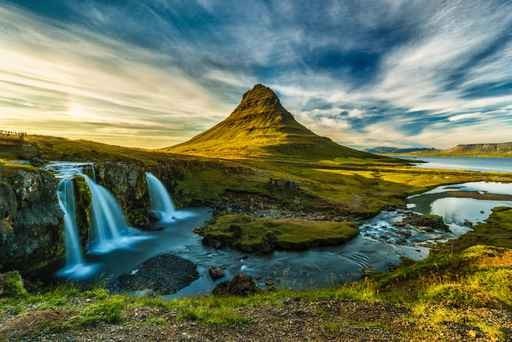
Kirkjufell, where a tourist died earlier this month
There’s a clear failure to engage with Iceland’s realities going on here, albeit one that’s partly understandable. Given how easy the country is to reach nowadays, it can be easy to forget what an untamed place it remains. Almost all its citizens’ homes are restricted to a narrow ring of land around the coast—with the great majority of them around Reykjavik—while the interior is largely, rocky, icy desert. Much of this area is inaccessible outside the brief summer and even then, dramatically changing weather and rocky landscapes make it a challenging environment that even Icelanders enter with great care.

Even in the more inhabited coastland, crashing breakers on the beaches can and do sweep people out to sea, while rivers and lakes are pitted with volcanic springs that belch dangerously hot water or scalding steam. All this is stunning. But it isn’t risk-free.

At its worst, naive ignorance of this can spill over into insensitivity, however, suggesting an indifference to the country beyond one’s own immediate experience of it. Perhaps the worst recent example of this to hit the media came last month when somebody picked out the words “SEND NUDES” on a mossy hillside—a joke that might be funny had it lasted a week, but will actually take 70 years to disappear as the moss slowly, laboriously regrows.

Anyone who tries to be a sensitive traveler must surely wince hearing these stories. Iceland itself must also take some of the blame, though. The country went big on the tourist industry after the 2008 financial crisis, when its booming, unsustainable banking sector crashed, leaving the country’s national debt at seven times what its annual GDP was before the crisis hit. The tourism industry’s expansion has helped save the economy, but just as its banking sector over-extended itself in the run-up to the crisis, so its tourist sector has mushroomed before it had all the necessary facilities in place.

The country is now rushing to catch up—and genuinely trying. This past year, major sites such as the rift valley and former parliament site at Thingvellir, the rift valley in which Iceland’s parliament once met, and the waterfall at Gullfoss have been a whirr of construction activity, with footpaths being widened and ample new restrooms being installed. Still, visitor numbers continue to grow—almost 1 million tourists visited this year between January and June, a rise of nearly 30 percent compared to the same period last year. More restrooms, beds, and better preparation by visitors should help smooth out some of the industry’s excesses, while Iceland still remains an easy, manageable place to travel around outside peak seasons.

The rising value of the Iceland’s currency might possibly prevent the boom going even further. But if tourist arrivals continue to rise as they do—American visitor numbers have leaped 58 percent this year compared to the same period last year—it’s hard to see how the county’s facilities will manage to catch up with the flow.

(Source: City Lab)