Showing posts with label New Zealand. Show all posts

Saturday, 1 January 2022

The missing continent it took 375 years to find

It took scientists 375 years to discover the eighth continent of the world, which has been hiding in plain sight all along. But mysteries still remain.

It was 1642 and Abel Tasman was on a mission. The experienced Dutch sailor, who sported a flamboyant moustache, bushy goatee and penchant for rough justice – he later tried to hang some of his crew on a drunken whim – was confident of the existence of a vast continent in the southern hemisphere, and determined to find it.


At the time, this portion of the globe was still largely mysterious to Europeans, but they had an unshakeable belief that there must be a large land mass there – pre-emptively named Terra Australis – to balance out their own continent in the North. The fixation dated back to Ancient Roman times, but only now was it going to be tested.


And so, on 14 August, Tasman set sail from his company's base in Jakarta, Indonesia, with two small ships and headed west, then south, then east, eventually ending up at the South Island of New Zealand. His first encounter with the local Māori people (who are thought to have settled there several centuries earlier) did not go well: on day two, several paddled out on a canoe, and rammed a small boat that was passing messages between the Dutch ships. Four Europeans died. Later, the Europeans fired a cannon at 11 more canoes – it’s not known what happened to their targets. 


Abel Tasman arguably did find the great southern continent, though he didn’t realise 94% of it is underwater (Credit: Alamy)


And that was the end of his mission – Tasman named the fateful location Moordenaers (Murderers) Bay, with little sense of irony, and sailed home several weeks later without even having set foot on this new land. While he believed that he had indeed discovered the great southern continent, evidently, it was hardly the commercial utopia he had envisaged. He did not return.


(By this time, Australia was already known about, but the Europeans thought it was not the legendary continent they were looking for. Later, it was named after Terra Australis when they changed their minds).

Little did Tasman know, he was right all along. There was a missing continent.


In 2017, a group of geologists hit the headlines when they announced their discovery of ZealandiaTe Riu-a-Māui in the Māori language. A vast continent of 1.89 million sq miles (4.9 million sq km) it is around six times the size of Madagascar.


Though the world's encyclopaedias, maps and search engines had been adamant that there are just seven continents for some time, the team confidently informed the world that this was wrong. There are eight after all – and the latest addition breaks all the records, as the smallest, thinnest, and youngest in the world. The catch is that 94% of it is underwater, with just a handful of islands, such as New Zealand, thrusting out from its oceanic depths. It had been hiding in plain sight all along.


"This is an example of how something very obvious can take a while to uncover," says Andy Tulloch, a geologist at the New Zealand Crown Research Institute GNS Science, who was part of the team that discovered Zealandia.

But this is just the beginning. Four years on and the continent is as enigmatic as ever, its secrets jealously guarded beneath 6,560 ft (2km) of water. How was it formed? What used to live there? And how long has it been underwater?


A laborious discovery

In fact, Zealandia has always been difficult to study.


More than a century after Tasman discovered New Zealand in 1642, the British map-maker James Cook was sent on a scientific voyage to the southern hemisphere. His official instructions were to observe the passing of Venus between the Earth and the Sun, in order to calculate how far away the Sun is.


Possibly due to a quirk of geology, the enigmatic kiwi bird’s closest relative hails from Madagascar (Credit: Alamy)


But he also carried with him a sealed envelope, which he was instructed to open when he had completed the first task. This contained a top-secret mission to discover the southern continent – which he arguably sailed straight over, before reaching New Zealand.


The first real clues of Zealandia's existence were gathered by the Scottish naturalist Sir James Hector, who attended a voyage to survey a series of islands off the southern coast of New Zealand in 1895. After studying their geology, he concluded that New Zealand is "the remnant of a mountain-chain that formed the crest of a great continental area that stretched far to the south and east, and which is now submerged…". 


Despite this early breakthrough, the knowledge of a possible Zealandia remained obscure, and very little happened until the 1960s. "Things happen pretty slowly in this field," says Nick Mortimer, a geologist at GNS Science who led the 2017 study.


Then in the 1960s, geologists finally agreed on a definition of what a continent is – broadly, a geological area with a high elevation, wide variety of rocks, and a thick crust. It also has to be big. "You just can't be a tiny piece," says Mortimer. This gave geologists something to work with – if they could collect the evidence, they could prove that the eighth continent was real.


Tasman’s ships left New Zealand after a bloody encounter with the Māori people – but he believed that he had found the legendary southern continent (Credit: Alamy)


Still, the mission stalled – discovering a continent is tricky and expensive, and Mortimer points out that there was no urgency. Then in 1995, the American geophysicist Bruce Luyendyk again described the region as a continent and suggested calling it Zealandia. From there, Tulloch describes its discovery as an exponential curve.


Around the same time, the "United Nations Convention on the Law of the Sea" came into force, and finally provided some serious motivation. It states that countries can extend their legal territories beyond their Exclusive Economic Zone, which reaches 200 nautical miles (370km) out from their coastlines, to claim their "extended continental shelf" – with all the mineral riches and oil this encompasses.


If New Zealand could prove that it was part of a larger continent, it could increase its territory by six times. Suddenly there was an abundance of funding for trips to survey the area, and the evidence gradually built up. With every rock sample that was collected, the case for Zealandia improved.


The final flourish came from satellite data, which can be used to track tiny variations in the Earth's gravity across different parts of the crust to map the seafloor. With this technology, Zealandia is clearly visible as a misshapen mass almost as large as Australia. 


Satellite data can be used to visualise the continent of Zealandia, which appears as a pale blue upside-down triangle to the east of Australia (Credit: GNS Science)


When the continent was finally unveiled to the world, it unlocked one of the most sizeable maritime territories in the world. "It is kind of cool," says Mortimer, "If you think about it, every continent on the planet has different countries on it, [but] there are only three territories on Zealandia."


In addition to New Zealand, the continent encompasses the island of New Caledonia – a French colony famous for its dazzling lagoons – and the tiny Australian territories of Lord Howe Island and Ball's Pyramid. The latter was described by one 18th-Century explorer as appearing "not to be larger than a boat."


A mysterious stretching

Zealandia was originally part of the ancient supercontinent of Gondwana, which was formed about 550 million years ago and essentially lumped together all the land in the southern hemisphere. It occupied a corner on the eastern side, where it bordered several others, including half of West Antarctica and all of eastern Australia.


Then around 105 million years ago, "due to a process which we don't completely understand yet, Zealandia started to be pulled away", says Tulloch.


Continental crust is usually around 40km deep – significantly thicker than oceanic crust, which tends to be around 10km. As it was strained, Zealandia ended up being stretched so much that its crust now only extends 20km (12.4 miles) down. Eventually, the wafter-thin continent sank – though not quite to the level of normal oceanic crust – and disappeared under the sea.


Despite being thin and submerged, geologists know that Zealandia is a continent because of the kinds of rocks found there. Continental crust tends to be made up of igneous, metamorphic and sedimentary rocks – like granite, schist and limestone, while the ocean floor is usually just made of igneous ones such as basalt.


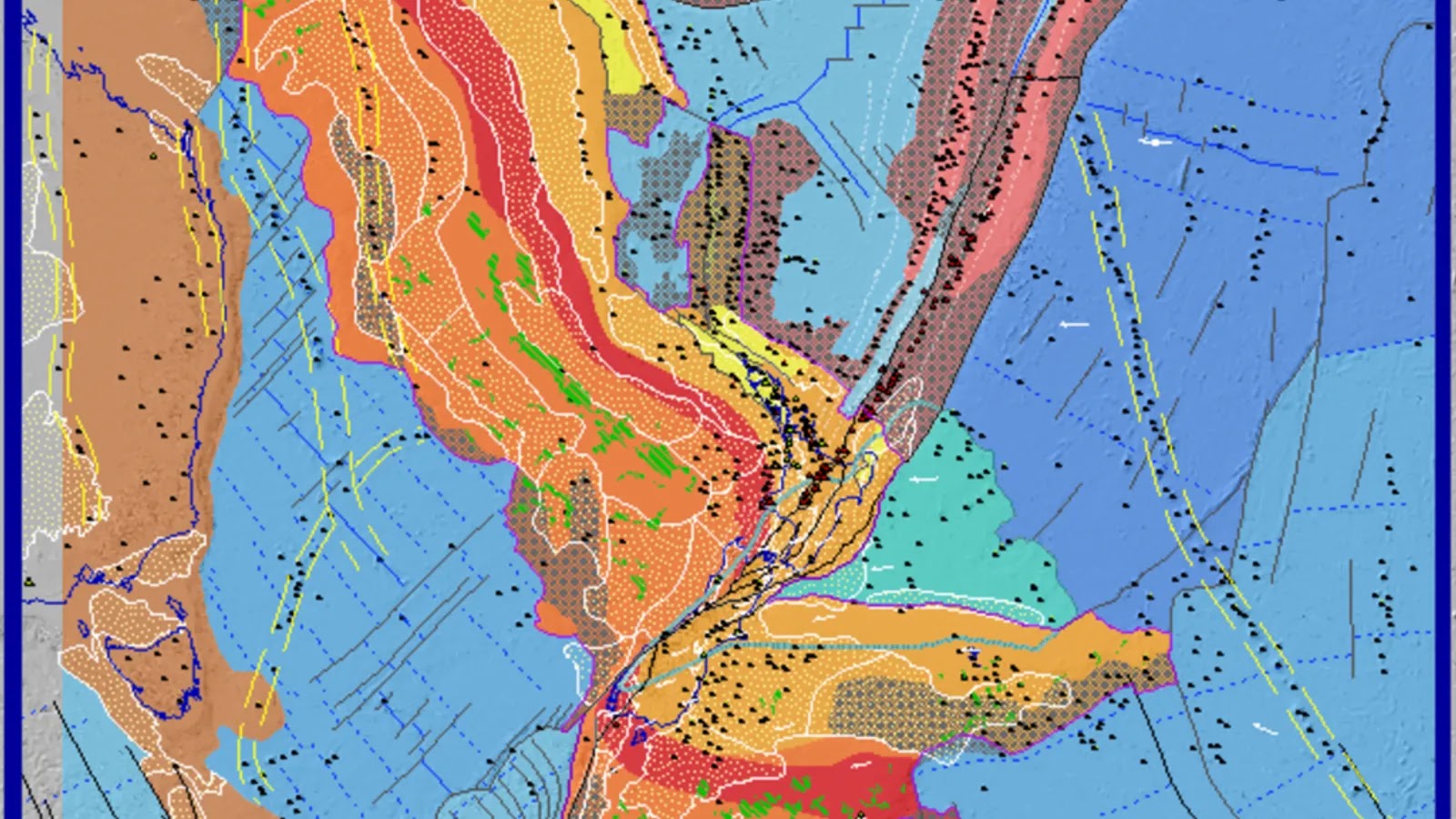
The red band of rock – the Median Batholith – should travel all the way down Zealandia in a diagonal line, but instead it has been twisted out of shape (Credit: GNS Science)


But there are still many unknowns. The unusual origins of the eighth continent make it particularly intriguing to geologists, and more than a little baffling. For example, it's still not clear how Zealandia managed to stay together when it's so thin and not disintegrate into tiny micro-continents.


Another mystery is exactly when Zealandia ended up underwater – and whether it has ever, in fact, consisted of dry land. The parts that are currently above sea level are ridges that formed as the Pacific and Australian tectonic plates crumpled together. Tulloch says opinion is split as to whether it was always submerged apart from a few small islands, or once entirely dry land.


This also raises the question of what lived there.


With its mild climate and 39 million-sq-mile (101 million-sq-km) range, Gondwana itself was home to a vast array of flora and fauna, including the first four-limbed land animals and later, an abundance of the largest to ever live – the titanosaurs. So, could the rocks of Zealandia be studded with their preserved remains?


A debate about dinosaurs

Fossilised land animals are rare in the southern hemisphere, but the remains of several were found in New Zealand in the 1990s, including the rib bone of a giant, long-tailed, long-necked dinosaur (a sauropod), a beaky herbivorous dinosaur (a hypsilophodont) and an armoured dinosaur (an ankylosaur). Then in 2006, the foot bone of a large carnivore, possibly a kind of allosaur, was discovered in the Chatham Islands, about 500 miles (800km) east of the South Island. Crucially, the fossils all date to after the continent of Zealandia split from Gondwana.


However, this doesn't necessarily mean there were dinosaurs roaming over the majority of Zealandia – these islands may have been sanctuaries while the rest was drowned, as it is now. "There's a long debate about this, about whether it's possible to have land animals without continuous land – and whether without it, they would have been snuffed out," says Rupert Sutherland, a Professor of Geophysics and Tectonics at the Victoria University of Wellington.


The plot thickens with one of New Zealand's weirdest and most beloved inhabitants, the kiwi – a dumpy, flightless bird with whiskers and hair-like feathers. Oddly, its closest relative is not thought to be the Moa, which is part of the same group – the ratites – and lived on the same island until its extinction 500 years ago, but the even-more giant elephant bird, which stalked the forests of Madagascar until as recently as 800 years ago.


The finding has led scientists to believe that both birds evolved from a common ancestor that lived on Gondwana. It took 130 million years to fully break up, but when it did, it left behind fragments which have since been scattered all across the globe, forming South America, Africa, Madagascar, Antarctica, Australia, the Arabian Peninsula, the Indian Subcontinent, and Zealandia.


This, in turn, suggests that at least part of now-submerged Zealandia has remained above sea level the whole time. Except around 25 million years ago the entire continent – even possibly the entirety of New Zealand – is thought to have been plunged underwater. "It was thought that all the plants and animals must have colonised afterwards," says Sutherland. So what happened?


Though it's not possible to collect fossils from the seafloor of Zealandia directly, scientists have been plumbing its depths by drilling. "Actually the most helpful and distinctive fossils are the ones which form in the very shallow seas," says Sutherland. "Because they leave a record – there are zillions and zillions of tiny, tiny little fossils that are very distinctive."


In 2017, a team undertook the most extensive surveys of the region so far, and drilled more than 4,101ft (1,250m) into the seabed at six different sites. The cores that they collected contained pollen from land plants, as well as spores and the shells of organisms that lived in warm, shallow seas. 


"If you have water, which is only you know, 10m (33ft) deep or something like this, then there's a good chance that there was land around as well," says Sutherland, who explains that the pollen and spores also hint at the possibility that Zealandia was not quite as submerged as was thought.


A (literal) twist

Another lingering mystery can be found in Zealandia's shape.


"If you look at a geological map of New Zealand, there are two things that really stand out," says Sutherland. One of these is Alpine Fault, a plate boundary that runs along the South Island and is so significant, it can be seen from space.


The second is that the geology of New Zealand – as well as that of the wider continent – is oddly bent. Both are split in two by a horizontal line, which is where the Pacific and Australian tectonic plates meet. At this exact point, it looks like someone has taken the lower half and twisted it away, so that not only do the previously-continuous ribbons of rock no longer line up, but they are almost at right angles.


An easy explanation for this is that the tectonic plates moved, and somehow deformed them out of shape. But exactly how or when this happened is still totally unresolved.


"There are various interpretations, but this is quite a large unknown thing," says Tulloch.


Sutherland explains that the continent is unlikely to give up all its secrets anytime soon. "It's quite hard to make discoveries, when everything is 2km (1.2 miles) underwater, and the layers that you need to sample are 500m (1,640ft) beneath the seabed as well," he says. "It's really challenging to go out and explore a continent like that. So, it just takes a lot of time, money and effort to go out and ships and survey regions."


If nothing else, the world's eighth continent surely shows that – nearly 400 years after Tasman's quest – there is still plenty to be discovered.


Zaria Gorvett is a senior journalist for BBC Future. Twitter: @ZariaGorvett


(Source: BBC)

Sunday, 28 March 2021

The missing continent it took 375 years to find

 It took scientists 375 years to discover the eighth continent of the world, which has been hiding in plain sight all along. But mysteries still remain.

It was 1642 and Abel Tasman was on a mission. The experienced Dutch sailor, who sported a flamboyant moustache, bushy goatee and penchant for rough justice – he later tried to hang some of his crew on a drunken whim – was confident of the existence of a vast continent in the southern hemisphere, and determined to find it.


At the time, this portion of the globe was still largely mysterious to Europeans, but they had an unshakeable belief that there must be a large land mass there – pre-emptively named Terra Australis – to balance out their own continent in the North. The fixation dated back to Ancient Roman times, but only now was it going to be tested.


And so, on 14 August, Tasman set sail from his company's base in Jakarta, Indonesia, with two small ships and headed west, then south, then east, eventually ending up at the South Island of New Zealand. His first encounter with the local Māori people did not go well: on day two, several paddled out on a canoe, and rammed a small boat that was passing messages between the Dutch ships. Four Europeans died. Later, the Europeans fired a cannon at 11 more canoes – it’s not known what happened to their targets. 


And that was the end of his mission – Tasman named the fateful location Moordenaers (Murderers) Bay, with little sense of irony, and sailed home several weeks later without even having set foot on this new land. While he believed that he had indeed discovered the great southern continent, evidently, it was hardly the commercial utopia he had envisaged. He did not return.


(By this time, Australia was already known about, but the Europeans thought it was not the legendary continent they were looking for. Later, it was named after Terra Australis when they changed their minds).

Little did Tasman know, he was right all along. There was a missing continent.


Abel Tasman arguably did find the great southern continent, though he didn’t realise 94% of it is underwater (Credit: Alamy)


In 2017, a group of geologists hit the headlines when they announced their discovery of ZealandiaTe Riu-a-Māui in the Māori language. A vast continent of 1.89 million sq miles (4.9 million sq km) it is around six times the size of Madagascar.


Though the world's encyclopaedias, maps and search engines had been adamant that there are just seven continents for some time, the team confidently informed the world that this was wrong. There are eight after all – and the latest addition breaks all the records, as the smallest, thinnest, and youngest in the world. The catch is that 94% of it is underwater, with just a handful of islands, such as New Zealand, thrusting out from its oceanic depths. It had been hiding in plain sight all along.


"This is an example of how something very obvious can take a while to uncover," says Andy Tulloch, a geologist at the New Zealand Crown Research Institute GNS Science, who was part of the team that discovered Zealandia.

But this is just the beginning. Four years on and the continent is as enigmatic as ever, its secrets jealously guarded beneath 6,560 ft (2km) of water. How was it formed? What used to live there? And how long has it been underwater?


A laborious discovery

In fact, Zealandia has always been difficult to study.


More than a century after Tasman discovered New Zealand in 1642, the British map-maker James Cook was sent on a scientific voyage to the southern hemisphere. His official instructions were to observe the passing of Venus between the Earth and the Sun, in order to calculate how far away the Sun is.


Possibly due to a quirk of geology, the enigmatic kiwi bird’s closest relative hails from Madagascar (Credit: Alamy)


But he also carried with him a sealed envelope, which he was instructed to open when he had completed the first task. This contained a top-secret mission to discover the southern continent – which he arguably sailed straight over, before reaching New Zealand.


The first real clues of Zealandia's existence were gathered by the Scottish naturalist Sir James Hector, who attended a voyage to survey a series of islands off the southern coast of New Zealand in 1895. After studying their geology, he concluded that New Zealand is "the remnant of a mountain-chain that formed the crest of a great continental area that stretched far to the south and east, and which is now submerged…". 


Despite this early breakthrough, the knowledge of a possible Zealandia remained obscure, and very little happened until the 1960s. "Things happen pretty slowly in this field," says Nick Mortimer, a geologist at GNS Science who led the 2017 study.


Then in the 1960s, geologists finally agreed on a definition of what a continent is – broadly, a geological area with a high elevation, wide variety of rocks, and a thick crust. It also has to be big. "You just can't be a tiny piece," says Mortimer. This gave geologists something to work with – if they could collect the evidence, they could prove that the eighth continent was real.


Tasman’s ships left New Zealand after a bloody encounter with the Māori people – but he believed that he had found the legendary southern continent (Credit: Alamy)


Still, the mission stalled – discovering a continent is tricky and expensive, and Mortimer points out that there was no urgency. Then in 1995, the American geophysicist Bruce Luyendyk again described the region as a continent and suggested calling it Zealandia. From there, Tulloch describes its discovery as an exponential curve.


Around the same time, the "United Nations Convention on the Law of the Sea" came into force, and finally provided some serious motivation. It states that countries can extend their legal territories beyond their Exclusive Economic Zone, which reaches 200 nautical miles (370km) out from their coastlines, to claim their "extended continental shelf" – with all the mineral riches and oil this encompasses.


If New Zealand could prove that it was part of a larger continent, it could increase its territory by six times. Suddenly there was an abundance of funding for trips to survey the area, and the evidence gradually built up. With every rock sample that was collected, the case for Zealandia improved.


The final flourish came from satellite data, which can be used to track tiny variations in the Earth's gravity across different parts of the crust to map the seafloor. With this technology, Zealandia is clearly visible as a misshapen mass almost as large as Australia. 


Satellite data can be used to visualise the continent of Zealandia, which appears as a pale blue upside-down triangle to the east of Australia (Credit: GNS Science)


When the continent was finally unveiled to the world, it unlocked one of the most sizeable maritime territories in the world. "It is kind of cool," says Mortimer, "If you think about it, every continent on the planet has different countries on it, [but] there are only three territories on Zealandia."


In addition to New Zealand, the continent encompasses the island of New Caledonia – a French colony famous for its dazzling lagoons – and the tiny Australian territories of Lord Howe Island and Ball's Pyramid. The latter was described by one 18th-Century explorer as appearing "not to be larger than a boat."


A mysterious stretching

Zealandia was originally part of the ancient supercontinent of Gondwana, which was formed about 550 million years ago and essentially lumped together all the land in the southern hemisphere. It occupied a corner on the eastern side, where it bordered several others, including half of West Antarctica and all of eastern Australia.


Then around 105 million years ago, "due to a process which we don't completely understand yet, Zealandia started to be pulled away", says Tulloch.


Continental crust is usually around 40km deep – significantly thicker than oceanic crust, which tends to be around 10km. As it was strained, Zealandia ended up being stretched so much that its crust now only extends 20km (12.4 miles) down. Eventually, the wafter-thin continent sank – though not quite to the level of normal oceanic crust – and disappeared under the sea.


Despite being thin and submerged, geologists know that Zealandia is a continent because of the kinds of rocks found there. Continental crust tends to be made up of igneous, metamorphic and sedimentary rocks – like granite, schist and limestone, while the ocean floor is usually just made of igneous ones such as basalt.

When the supercontinent of Gondwana broke up, fragments drifted all across the globe. Many of its ancient plants still live in the Australian Dorrigo forest (Credit: Getty Images)


But there are still many unknowns. The unusual origins of the eighth continent make it particularly intriguing to geologists, and more than a little baffling. For example, it's still not clear how Zealandia managed to stay together when it's so thin and not disintegrate into tiny micro-continents.


Another mystery is exactly when Zealandia ended up underwater – and whether it has ever, in fact, consisted of dry land. The parts that are currently above sea level are ridges that formed as the Pacific and Australian tectonic plates crumpled together. Tulloch says opinion is split as to whether it was always submerged apart from a few small islands, or once entirely dry land.


This also raises the question of what lived there.


With its mild climate and 39 million-sq-mile (101 million-sq-km) range, Gondwana itself was home to a vast array of flora and fauna, including the first four-limbed land animals and later, an abundance of the largest to ever live – the titanosaurs. So, could the rocks of Zealandia be studded with their preserved remains?


A debate about dinosaurs

Fossilised land animals are rare in the southern hemisphere, but the remains of several were found in New Zealand in the 1990s, including the rib bone of a giant, long-tailed, long-necked dinosaur (a sauropod), a beaky herbivorous dinosaur (a hypsilophodont) and an armoured dinosaur (an ankylosaur). Then in 2006, the foot bone of a large carnivore, possibly a kind of allosaur, was discovered in the Chatham Islands, about 500 miles (800km) east of the South Island. Crucially, the fossils all date to after the continent of Zealandia split from Gondwana.


The elephant bird stood 3 m (9.8 ft) tall and fragments of its eggshells still litter beaches to this day (Credit: Alamy)


However, this doesn't necessarily mean there were dinosaurs roaming over the majority of Zealandia – these islands may have been sanctuaries while the rest was drowned, as it is now. "There's a long debate about this, about whether it's possible to have land animals without continuous land – and whether without it, they would have been snuffed out," says Sutherland.


The plot thickens with one of New Zealand's weirdest and most beloved inhabitants, the kiwi – a dumpy, flightless bird with whiskers and hair-like feathers. Oddly, its closest relative is not thought to be the Moa, which is part of the same group – the ratites – and lived on the same island until its extinction 500 years ago, but the even-more giant elephant bird, which stalked the forests of Madagascar until as recently as 800 years ago.


The finding has led scientists to believe that both birds evolved from a common ancestor that lived on Gondwana. It took 130 million years to fully break up, but when it did, it left behind fragments which have since been scattered all across the globe, forming South America, Africa, Madagascar, Antarctica, Australia, the Arabian Peninsula, the Indian Subcontinent, and Zealandia.


This, in turn, suggests that at least part of now-submerged Zealandia has remained above sea level the whole time. Except around 25 million years ago the entire continent – even possibly the entirety of New Zealand – is thought to have been plunged underwater. "It was thought that all the plants and animals must have colonised afterwards," says Sutherland. So what happened?


New Zealand is one of the highest points of Zealandia, after being pushed up by the movement of tectonic plates (Credit: Alamy)


Though it's not possible to collect fossils from the seafloor of Zealandia directly, scientists have been plumbing its depths by drilling. "Actually the most helpful and distinctive fossils are the ones which form in the very shallow seas," says Sutherland. "Because they leave a record – there are zillions and zillions of tiny, tiny little fossils that are very distinctive."


In 2017, a team undertook the most extensive surveys of the region so far, and drilled more than 4,101ft (1,250m) into the seabed at six different sites. The cores that they collected contained pollen from land plants, as well as spores and the shells of organisms that lived in warm, shallow seas. 


"If you have water, which is only you know, 10m (33ft) deep or something like this, then there's a good chance that there was land around as well," says Sutherland, who explains that the pollen and spores also hint at the possibility that Zealandia was not quite as submerged as was thought.


A (literal) twist

Another lingering mystery can be found in Zealandia's shape.


"If you look at a geological map of New Zealand, there are two things that really stand out," says Sutherland. One of these is Alpine Fault, a plate boundary that runs along the South Island and is so significant, it can be seen from space.


The red band of rock – the Median Batholith – should travel all the way down Zealandia in a diagonal line, but instead it has been twisted out of shape (Credit: GNS Science)


The second is that the geology of New Zealand – as well as that of the wider continent – is oddly bent. Both are split in two by a horizontal line, which is where the Pacific and Australian tectonic plates meet. At this exact point, it looks like someone has taken the lower half and twisted it away, so that not only do the previously-continuous ribbons of rock no longer line up, but they are almost at right angles.


An easy explanation for this is that the tectonic plates moved, and somehow deformed them out of shape. But exactly how or when this happened is still totally unresolved.


"There are various interpretations, but this is quite a large unknown thing," says Tulloch.


Sutherland explains that the continent is unlikely to give up all its secrets anytime soon. "It's quite hard to make discoveries, when everything is 2km (1.2 miles) underwater, and the layers that you need to sample are 500m (1,640ft) beneath the seabed as well," he says. "It's really challenging to go out and explore a continent like that. So, it just takes a lot of time, money and effort to go out and ships and survey regions."


If nothing else, the world's eighth continent surely shows that – nearly 400 years after Tasman's quest – there is still plenty to be discovered.


(Source: BBC)

Saturday, 3 October 2020

New Zealand firms switch to using nation's Māori name, Aotearoa

 Vodafone and communications agency DDB respond after calls on companies to use the reo term

One of New Zealand’s biggest telecommunications companies has heeded an exhortation to use the country’s original, Indigenous name of Aotearoa, joining others that have pledged to use more reo, the Māori language, or tikanga – protocols – in their daily business operations.


Earlier this week Vodafone – which has about 2,000 New Zealand employees – confirmed it had changed its banner at the top of users’ phones from “Vodafone NZ” to “VF Aotearoa”. The company gave short shrift to those on social media who complained about the change. Rival companies backed the move.


It came as DDB Group Aotearoa – a communications agency with 250 local staff – changed its name from DDB Group New Zealand. The shift came along with efforts to recruit more diverse staff and funding for employees to attend Māori language courses on work time. Both firms were prompted by an urging by Ngāti Whātua Ōrākei – a hapu, or sub-tribe, in the city of Auckland – to “individually and collectively use the word ‘Aotearoa.’”


Once under threat, the Māori language te reo is undergoing a resurgence Photograph: Fiona Goodall/Getty Images


Tina Ngata, an Indigenous rights advocate, said the move was “healing” and an act of anti-racism, affirming “the story that there were people living here before colonisation happened”.


“[The name] New Zealand does erase who was there,” she said. “I personally think when you use the term Aotearoa, it’s more inclusive.”


Justin Mowday from DDB Group said the firm wanted to be involved in “creating an Aotearoa more embracing of Te Ao Māori”, meaning the Māori worldview.


Te reo Māori is experiencing a resurgence in New Zealand – until recent years, there were fears it would die out altogether – with individual words, greetings or proverbs more apparent in daily life and long waiting lists for those eager to take lessons. Jacinda Ardern, the prime minister, hopes to see 1 million New Zealanders speaking the language by 2040.


Its renewed popularity has provoked a debate about whether placenames should be returned to their original monikers from before European and British colonisers arrived. The name New Zealand comes from the Dutch “Nieuw Zeeland”, and was bestowed on the country by a Dutch mapmaker.


Aotearoa is commonly translated as “land of the long white cloud”.


When one Vodafone user threatened on Twitter to switch service providers after noticing the change on his phone this week, Vodafone replied that the move was “simply to celebrate one of the three beautiful official languages” in the country (the third is New Zealand sign language).


“There are no plans to change it at this stage,” the company added on Twitter.


A rival company, 2Degrees, asked the complainant “kei te pēhea koe,” or “how are you?” before telling the man that he “better not switch to us” because the firm “love[s] celebrating te reo Māori too!”


And Spark, Vodafone’s largest competitor, added on Twitter: “Te Reo is a normal part of our country and we will continue to encourage and give tools to those who wish to expand their knowledge and cultural understanding.”


It is common for companies to use more te reo during the annual Māori language week in September, but many abandon it afterwards. Ngata said companies deploying the language should follow it up by becoming “more inclusive in your companies’ policies as well”.


Māori still face discrimination, worse health outcomes, and overrepresentation in the justice system compared with Pākehā, or New Zealanders of European descent.


(Source: The Guardian)

Tuesday, 23 June 2020

Coronavirus: What is a second wave and is one coming?

Coronavirus is far from over. Some countries are still dealing with large epidemics, but even those currently controlling the virus fear "the second wave".


The second phase of Spanish flu a century ago was deadlier than the first.


So, is a second wave inevitable? And how bad could it be?


Firstly, what is a second wave?

You can think of it like waves on the sea. The number of infections goes up and then comes back down again - each cycle is one "wave" of coronavirus.


Yet, there is no formal definition.


"It's not particularly scientific, how you define a wave is arbitrary," Dr Mike Tildesley, from the University of Warwick, told the BBC.


Some describe any rise as a second wave, but it is often a bumpy first wave. This is happening in some US states.


To say one wave has ended, the virus would have been brought under control and cases fallen substantially.


For a second wave to start you would need a sustained rise in infections. New Zealand, which has its first cases after 24 days without coronavirus, and Beijing which is facing an outbreak after 50 virus-free days are not in this position.


But some scientists argue Iran may be starting to meet the criteria for a second wave.


People shopping in Norwich as lockdown is eased in the UK. Getty Images


Will a second wave come to the UK?

The answer lies almost entirely with the decisions we make so it could go either way.


"I really think at the moment there's huge uncertainty... but to be honest it's something I'm very concerned about," says Dr Tildseley.


The potential is clearly there - the virus is still around and it is no less deadly or infectious than at the start of 2020.


Only around 5% of people in the UK are thought to have been infected and there is no guarantee they are all immune.


"The evidence is the vast majority of people are still susceptible, in essence if we lift all measures we're back to where we were in February," says Dr Adam Kucharski from the London School of Hygiene and Tropical Medicine.


"It's almost like starting from scratch again."


What could trigger a second wave?

Lifting lockdown restrictions too far.


Lockdowns have caused massive disruption around the world - destroying jobs, affecting people's health and taking children out of school - but they have controlled the virus.


"The ultimate puzzle is how to maintain control, while minimising daily disruption," says Dr Kucharski.


Nobody is 100% sure how far we can go.


That is why measures are being lifted in stages and new ways of controlling coronavirus are being introduced, such as contact tracing or face-coverings.


"In the UK and neighbouring countries, flare-ups could happen quite quickly if measures are lifted beyond the point transmission is controlled," says Dr Kucharski.


This is already starting in Germany where 650 people have tested positive for the virus after an outbreak at an abattoir.


It is not a major problem if clusters can be rapidly identified, local lockdowns introduced and spread of the virus stopped.


Otherwise, they contribute to a second wave.


South Korea, which has been widely praised for its handling of the coronavirus, has had to re-impose some restrictions due to such clusters.


Will a second wave be the same as the first?

Something will have gone seriously wrong if it is.


The value of R - the number of people each infected person passed the virus to on average - was 3 at the start of the pandemic.


It meant the virus was spreading fast, but our behaviour has changed, we're social distancing, and it's hard to see how R will get that high again.


Dr Kucharski told the BBC: "No country is going to just lift everything and go back to normal.


"Even countries without control of coronavirus - like Brazil and India - don't have an R of 3.0."


If cases did start to grow again, it is likely to be relatively slow.


However, a second wave could, theoretically, still end up bigger than the first because so many people are still susceptible.


"[But] if cases climb again we can reintroduce lockdown to suppress a second wave, that's always an option available to us," says Dr Tildseley.


When will a second wave happen? Will winter make it worse?

Dr Kurcharski says local flare-ups could be seen in "even the coming weeks or months" as measures are lifted.


But that does not mean a guaranteed second wave.


Dr Tildseley says: "If measures are relaxed significantly, we may end up with a second wave in late August or early September."


Winter may be a crucial time as other coronavirus do spread more readily then.


If we were only just controlling the virus, even a small seasonal-boost could lead to the virus spreading.


"Spring undoubtedly helped us," Prof Jonathan Ball, a virologist at the University of Nottingham says.


"A second wave is almost inevitable, particularly as we go towards the winter months.


"The challenge for government is to ensure the peak isn't so much that it overburdens the healthcare system."


Will the virus become milder and no longer a problem?

One argument against a deadly second wave is viruses become less dangerous as they evolve to better infect people.


Even HIV seems to be getting milder. The theory goes that viruses will spread further if they don't kill their host and so become milder.

"But it's not guaranteed, it's a bit of a lazy thing some virologists trot out," says Prof Ball.


It is also something that takes place over long periods of time. More than six months into the pandemic there is no clear evidence the virus has mutated to spread more easily or be less deadly.


Prof Ball adds: "I think the virus is doing very well at the minute. 


People often have very mild or symptomless infection, if they can transmit then there is no reason to imagine coronavirus needs to become milder."


(Source: BBC)