Showing posts with label CCTV camera. Show all posts

Friday, 19 April 2019

How does it feel to be watched at work all the time?

Is workplace surveillance about improving productivity or simply a way to control staff and weed out poor performers?

Courtney Hagen Ford, 34, left her job working as a bank teller because she found the surveillance she was under was "dehumanising".

Her employer logged her keystrokes and used software to monitor how many of the customers she helped went on to take out loans and fee-paying accounts.

"The sales pressure was relentless," she recalls. "The totality was horrible."

She decided selling fast food would be better, but ironically, left the bank to do a doctorate in surveillance technology.

Courtney is not alone in her dislike of this kind of surveillance, but it's on the rise around the world as firms look to squeeze more productivity from their workers and become more efficient.

More than half of companies with over $750m (£574m) in annual revenue used "non-traditional" monitoring techniques on staff last year, says Brian Kropp, vice-president of research firm Gartner.

These include tools to analyse e-mails, conversations, computer usage, and employee movements around the office. Some firms are also monitoring heart rates and sleep patterns to see how these affect performance.

In 2015, 30% used such tools. Next year, Mr Kropp expects 80% will.

There is a wrong and right way to carry out workplace surveillance
And workforce analytics will be a $1.87bn industry by 2025, says San Francisco's Grand Review Research.

So why is business so keen?

Ben Waber, chief executive of Humanyze, a Boston workplace analytics company, says it gives firms the ability to assess how their staff are performing and interacting, which can be good for the firm but also good for employees themselves.

His company gathers "data exhaust" left by employees' email and instant messaging apps, and uses name badges equipped with radio-frequency identification (RFID) devices and microphones.

These can check how much time you spend talking, your volume and tone of voice, even if you dominate conversations. While this may sound intrusive - not to say creepy - proponents argue that it can also protect employees against bullying and sexual harassment.

Humanyze calls these badges "Fitbit for your career".

Some of this data analysis can produce unexpected results, says Mr Waber. For example, one large tech client discovered that coders who sat at 12-person lunch tables tended to outperform those who regularly sat at four-person tables.

The larger tables led to more interaction with staff from other parts of the company, he says, and this improved idea sharing.

Larger lunch tables were "driving more than a 10% difference in performances". A fact that would probably have gone undetected without such data analysis.

Over the last few years a Stockholm co-working space called Epicenter has gone much further and holds popular "chipping parties", where people can have RFID-enabled rice-sized microchips implanted in their hands.

They can use the implants to access electronically controlled doors, swap contacts, or monitor how typing speed correlates with heart rate, says Epicenter's Hannes Sjöblad, who has an implant himself.

The implant "cannot transmit any data unless you put it within a centimetre of a reader, so the person with the implant controls when it can be read", he says.

Embedded chips may seem extreme, but it is a relatively small step from ID cards and biometrics to such devices, says Prof Jeffrey Stanton, a University of Syracuse academic who researches work-related stress.

As long as such schemes are voluntary, "there will probably be a growing number of convenience-oriented uses such that a substantial number of workers would opt to have a chip implanted", he believes.

But if embedded chips are used to reduce slack time or rest breaks, "we are probably in the bad zone", he says. And if surveillance tools "take away autonomy", that's when they prove most unpopular.

A lot depends on how such monitoring initiatives are communicated, Gartner's Mr Kropp argues.

In 2016, Britain's Telegraph newspaper installed heat and motion monitoring devices under employees' desks. While management said it was to find out which desks were occupied for energy management purposes, staff thought they were been spied on and staged a revolt.

The devices were removed after 24 hours.

If bosses don't communicate effectively, employees assume the worst, Mr Kropp says. But if they're open about the information they're collecting - and what they're doing with it - 46% of employees are "generally okay with it".

Although many such monitoring schemes use anonymised data and participation is voluntary, many staff remain sceptical and fear an erosion of their civil liberties. In less liberal countries, workers are not given any choice at all.

But for some, the benefits are obvious.

"I've got a condition called narcolepsy," explains Jessica Johnson, 34, from Canberra, Australia.

She falls asleep for short periods during the day, then is disorientated when she wakes.

This "impacts my memory, my ability to focus and concentrate," she says.

She worked with an insurance company where employees used a programme called Timely to track billable hours. It helped her quickly find what she had been doing before she fell asleep, and pick up where she left off.

"You install it on your phone, and then on your computer, and that's how you get all the raw data," says Mathias Mikkelsen, Timely's Norwegian chief executive.

"Machine learning algorithms analyse all the data, and create beautiful charts," he says.

You can then see how much time you're wasting in unproductive meetings, say, or replying to e-mails.

You could show managers you were "spending so much time on stuff that's not what you were hired to do," says Mr Mikkelsen.

So workplace surveillance could be empowering for staff and useful for companies looking to become more efficient and profitable.

But implemented in the wrong way, it could also become an unpopular tool of oppression that proves counterproductive.

(Source: BBC)

Sunday, 24 March 2019

Korea spycam porn: 1,600 fall victim and four men arrested

Four men have been arrested in South Korea, accused of secretly filming 1,600 hotel room guests and selling the footage via a website.

Mini-cameras were installed in TVs, hair-dryer holders and sockets. The men allegedly earned $6,200.

If convicted, they face up to 10 years in prison and a 30m won ($26,571; £20,175) fine.

The covert filming of sex and nudity in South Korea has been described as an epidemic and has sparked protests.

Speaking to the BBC, Korean police said the men set up the 1mm lens cameras last August in 30 separate hotels across 10 South Korean cities.

The cameras are often hidden in devices like hair dryers, smoke detectors and sockets
In November, a website was then created, allowing users to pay for full videos or watch 30-second clips for free.

The men reportedly posted 803 videos and evaded the law by basing the website server overseas.

Police said the men earned money from 97 paying members before the site was taken down this month.

"The police agency strictly deals with criminals who post and share illegal videos as they severely harm human dignity," a spokesman for the Seoul Metropolitan Police Agency told local newspaper the Korea Herald.

Producing and disseminating pornography is illegal in South Korea.

The ban - along with the country's fast internet access - has been blamed for the prevalence of hidden filming.

Many videos are taken secretly in toilets and changing rooms, or posted by ex-partners out for revenge.

The country saw more than 6,000 cases reported in 2017, up from 2,400 in 2012.

More than 5,400 people were arrested for spy camera related crimes in 2017, but fewer than 2% were jailed.

Anger at the widespread use of filming prompted a series of protests last year in the capital Seoul, with calls for tougher sentencing.

(Source: BBC)

Monday, 3 September 2018

Home alone, with a spy cam

Smart devices make it possible for parents to keep close tabs on their latchkey children, but is it really a good idea?

My son is off the leash. When he starts middle school next week, he will have the house to himself after school on the days when I’m not working from home.

I could let him revel in this preadolescent milestone where he gets to play Splatoon 2 all afternoon with no one yelling at him. Or, I could fill my house with smart devices and watch him do whatever it is an 11-year-old does when he thinks he is alone.

Sure, he could pick up the phone and call me to let me know he’s arrived home, but why rely on such an archaic option when I could instead turn my front door into Big Mother?

I could install a keyless lock, like Kevo by Kwikset, and receive a text message when he unlocks it. With a digital home security system, like SimpliSafe, I could get an alert that he has disarmed the system and a video clip of him walking in. I could use SimpliSafe door sensors to warn me if he opens anything off limits — that’ll keep him out of the cookie drawer.

With a microphone-enabled camera, like Canary, I could talk to him from the mantle. Imagine his reaction when he hears my disembodied voice emanating from a little box ordering him to put down the Nintendo Switch. “We see lots and lots of family members using this as a tool to monitor their kids,” said Bob Stohrer, the chief marketing officer for Canary.

While parents of young children have long used nanny cams to keep tabs on the babysitters, companies are now marketing these products to parents of teens and preteens, too. This time, the camera lens is pointed not at the untrustworthy caregiver, but at the potentially rebellious adolescent.

“Parents use it to better understand when they come and go, what they’re doing, what time they go to sleep, when they have friends over,” Mr. Stohrer said.

A Canary television ad trades the creepy home invader in the bushes for the wild teenage babysitter who invites her boyfriend over and, while they canoodle on the couch, the unsupervised children take the car out for a spin and flood the bathroom. The message is clear: Home security is about keeping tabs on the people inside your house, not the strangers lurking outside.


More than half of the parents who use Canary cite a need to monitor their children as a primary reason for buying the device. SimpliSafe reported similar behavior, finding that the safety alerts were particularly popular among parents, who primarily use their products to “keep their kids safe,” said Melina Engel, the company’s chief marketing officer.

These new surveillance options come at a time of heightened angst about parental supervision. In her memoir “Small Animals: Parenthood in the Age of Fear,” released in August, Kim Brooks chronicles being charged with contributing to the delinquency of a minor after she briefly left her small child alone in a car. She argues that her odyssey through the criminal justice system was a product of a culture convinced that our children are in a constant state of peril and only a vigilant parent can protect them.

“We are living in an age of fear,” she writes. Most of the dangers our children face — a changing climate, a vanishing middle class, spiraling health care costs — are beyond our control. And so our grip on the things we think we can control — like what our children do with their afternoons — grows tighter.

Gone are the days of riding your bike around the neighborhood on your own until dusk. A 2014 Reason-Rupe poll found that 68 percent of Americans thought that a 9-year-old should not be allowed to play in a park unsupervised, and just over half of Americans thought a 12-year-old deserved such independence. Yet more than 40 percent of children are left home alone at times, according to the American Academy of Child and Adolescent Psychology.

Since we’re expected to always be watching even when we can’t, we look to technology to solve the impossible. If we download the right app, maybe we can keep harm at bay, and no one can call us a neglectful mother. Just as parents use GPS tracking devices on cellphones to monitor their children out in the world, parents can point to that camera on the bookshelf as proof that our attention is squarely focused on home, even when it isn’t. With enough devices, we can constantly guard the roost.

But do I really want to know about everything that’s happening in my house? A live feed into my living room means my home is only as safe as the last time I checked. Sure, my son was fine when he arrived, but is he now? How about now? And should he decide to go play with a neighbor, I’ll get a fresh alert reminding me that until that next one chimes, I should be on, well, alert.

“The more you engage in this sort of fear-driven buying and reacting, the more scared and worried and distrustful you’re likely to become,” said Barry Glassner, the author of “The Culture of Fear: Why Americans Are Afraid of the Wrong Things.”

Yet, our children are alone sometimes, and technology can help us know when they’ve gotten home safely. A microphone-enabled camera could make it easier to help children with homework or to intervene in a sibling dispute.

Ann Marie Luft, who lives with her husband and two daughters near Orlando, Fla., used a camera to check in on her older daughter, Hannah, now 15, when she first started coming home from school alone four years ago. Ms. Luft, a registered nurse, would check the camera, scanning the room for her daughter and talking to her through the smartphone app. The camera helped ease the transition to independence, Ms. Luft said.

Eventually, it no longer felt necessary. Now, Hannah texts her mother when she gets on or off the bus, although she sometimes forgets. Ms. Luft said she tolerated the flakiness as part of the price of adolescence. “When we were kids, we never had our parents spying on us,” she said.

I think back to my own adolescence and mostly remember hours spent hanging out with friends, calling my mother once and then making it home by dinnertime. I was no angel, but I somehow muddled through. If my son were to know that a camera was pointed at him, he might feel the need to find ways around it. Or, perhaps worse, not bother to step outside at all.

“These technologies and their use have a potential to erode that gray area zone where we actually do a lot of learning about ourselves and our family and friends, where we learn how to deal with questions about what should I do? When it is right for me to break the rules?” said Lee Tien, a senior staff attorney and the Adams Chair for Internet Rights at the Electronic Frontier Foundation. “Those are important parts of growing up.”

As smart home technology improves, we’ll get more novel ways to manage our homes, and the people inside them. Sensors could soon monitor a lack of activity in your house.

So, if your teen doesn’t leave the couch all afternoon, “you could get an alert that there’s been no alert,” Mr. Stohrer, of Canary, said. And with that, you’d get something new to worry about.

(Source: NYT)

Thursday, 24 May 2018

Apple employees describe the best — and worst — things about working for Apple

Apple has a strict code of secrecy that it expects all employees to live by. Anyone who breaks it is fired.
Unsurprisingly, employees rarely speak publicly about what it is like to work there.

Luckily, there are several Quora threads written by former and current employees devoted to answering questions about life inside the Fruit Company. We put some highlights together with info we got from our own sources, and reports elsewhere.

Their comments reveal how employees are prepared to pull all-nighters at a moment's notice, how their trash is monitored by security, and how much they enjoy working with the best. 

New interns get a box that contains the following hardcore message:


If Apple rejects your internship application, forget about trying again.
Apple has software that prevents would-be interns from applying twice. So if you're rejected, that's it.


According to Mac Consultant Frank Lazar: "Apple is such a golden opportunity for interns that it can be extremely choosy about who gets to play in their circular sandbox. They look for interns with amazing talent, and in their view, if you failed to show evidence of talent the first time around, a little experience somewhere else isn't going to change anything."

"We don't waste time with the dumb."
UX designer Luis Abreu (pictured) had a grueling job interview process in a failed attempt to get into Apple. 

He described it on his blog:

"3 screening calls, 5 FaceTime interviews, a trip to Cupertino for 5 two-person interviews lasting a whole day and a lunch at the newest Café Macs.

In the end, I got a shallow no."


During one interview he was told, "We don't waste time with the dumb."

Once you get in, "it's a tough place to be if you're more than 20 pounds overweight."
Anonymous: "There are a lot more fit and good-looking people at Apple, than otherwise. It's actually pretty ridiculous. Almost everyone is really athletic: many people do triathlons, bike races, and marathon. It's a tough place to be if you're more than 20 pounds overweight, but then again, it can also be that extra push you need to get in shape. I know of people who've lost 60 pounds and are no longer pre-diabetic because they started going cycling with their coworkers over lunch."

"Trash bins were monitored."
Tim Su wrote this list describing secrecy at Apple:
- code names for every product - no one referred to products any other way
- team members who are also on "special" teams don't tell their co-workers what they do
- black curtains and frosted windows
- trash bins were monitored


"Guys in the developer group had to show up for meetings at 4:00am."
David Graham, former writer at Apple: "I remember when bleary-eyed guys in the developer group had to show up for meetings at 4:00am to allow for time-zone differences around the world. They had to do it every day, and I'm sure it disrupted their personal lives."

"Apple employees don't just use Macs — they use really buggy Macs, often with really buggy apps."
Brent Royal-Gordon, code writer: "Internally, most devices are running test builds of all the software on them, often updating every couple of weeks with the very latest code from the engineering teams. So Apple employees don't just use Macs—they use really buggy Macs, often with really buggy apps. People on the iOS teams often use really buggy iPhones, iPads, and Apple Watches, too. This ensures that the company catches a lot of bugs before anyone on the outside ever sees the software."


Apple products are built in factories that run on ... Microsoft Windows.


In 2014, CEO Tim Cook tweeted a photo of an Apple factory in Asia he had visited. The manufacturing line was run using screens that clearly showed Microsoft's Windows operating system. That is no surprise: Certain industrial CNC milling programs only run on Windows.

In the stores, there is a lot of clapping.
Renee Morales, former Apple Store Specialist: "There will be a lot of clapping. As a new hire you'll get 'clapped in.' At the end of every shift meeting there's clapping. When someone quits, on their last day they get 'clapped out'. Sometimes just for kicks to make a little kid feel good you'll clap. ….there's just a lot of clapping."


You might get death threats from customers whose devices break down.
An Apple store worker told Business Insider: "I have had death threats before. I had someone, I can't even remember why — it may have been an out-of-warranty fix — who told me that because we wouldn't repair it for free that they would wait outside until I finished work to run me down with their car."


You will have to learn Apple's weird internal secret culture — quickly.
Wei Sun, Data Science / Software Engineering: "Almost everything will be at least slightly different from your previous job. If you're an engineer, there are custom internal tools, unusual practices, and odd office culture norms — even more so than is typical at other companies. Questions should be asked as often as possible during your first month; don't be afraid to ask."

"Furthermore, since secrecy is so important at Apple, different teams' cultures had a chance to become incredibly different from each other. When working in cross-functional projects, take the time to learn about the other teams' preferred communication styles and other peculiarities. This will save you a lot of time."


Apple controls what you talk about with your spouse.
Justin Maxwell was a user interface designer:
"The measures that Apple takes to protect its creative and intellectual environment are unparalleled in the valley, and it's been a disappointing experience since leaving there. Apple's security policy extends to blogs, to speaking engagements, to what we talk about with our spouses. Most people get it and respect it. The ones who don't -- the ones who need to put Apple under their name so they can get a speaking gig at SxSW -- are kindly ushered to move on."

"If I was still at Apple, I would not be responding to this question, nor would I feel wronged for not being able to."


Apple makes grammar and punctuation changes in its internal documents in order to track leaks.
After Business Insider obtained a couple of leaked memos from retail chief Angela Ahrendts, the company began making changes to its internal communications to help it figure out where the leaks came from. It now sends differently worded memos to different sections of the company in hopes of tracking leaks back to the source when those memos are quoted in the media.


"It's not the place for children."


Anonymous: "It's an older demographic working there, not the 24-year old MBAs, most seem to be late 30's to 40's, super smart but with real-life experience, too. There aren't any Nerf guns or any of that crap, just people past all that and at the top of their game. It's not the place for children."


"I've been in meetings at 4pm where a dozen people decide we are going to all work all night that night."
Anonymous: "Apple comes first. Not to say you can't have some personal life or even a pretty normal one, but when stuff gets crazy, work comes first ahead of all else. I've been in meetings at 4pm where a dozen people decide we are going to all work all night that night in the office on a problem. No discussion about 'hey, I have to pick up my kids' or 'let me call home first' - everyone nods and agrees, no hesitation."


"You are in the office every day unless you are sick or dead."
Anonymous: "No work from home. The company culture wants everyone face-to-face every day and they are very up-front and clear about it. You are in the office every day unless you are sick or dead. Nobody watches what time you are in every day but telecommute is something they very vocally say is not and will not be part of the culture."


They will email you in hospital.
Former Apple employee Ben Farrell (pictured) wrote a lengthy, detailed blog post explaining the reasons he quit the company:


"In recent weeks I contracted a nasty incapacitating mosquito born virus and was hospitalised for a short time. However, rather than receiving support, I was emailed a presentation to my hospital bed with a note that it needed to be completed 'urgently'. Even on the very morning of my wedding I was still being harassed by phone and email to send a report someone had lost."


Sunday is a work day.
Don Melton (pictured) was the former director of internet technologies. He did a podcast in which he described Apple's insane work schedule:


"Sunday is a work night for everybody at Apple because it's the exec meeting the next day. So you had your phone out there, you were sitting in front of your computer, it didn't matter if your favorite show was on."

Some hiring managers discriminate against older employees.
There is a great story about JK Scheinberg (pictured) in the New York Times:


Scheinberg was "the engineer at Apple who led the effort that moved the Mac to Intel processors. A little restless after retiring in 2008, at 54, he figured he'd be a great fit for a position at an Apple store Genius Bar, despite being twice as old as anyone else at the group interview. 'On the way out, all three of the interviewers singled me out and said, "We'll be in touch,"' he said. 'I never heard back.'"


"I'd scare the engineer by telling them how bad things would be if anyone inside or outside knew what I was going to ask them to do."
Simon Woodside (pictured), program manager in Core OS: "Having all these secrets was difficult from my perspective. I couldn't really engage in idle banter with my colleagues for fear of slipping something out."

"... I'd scare the engineer by telling them how bad things would be if anyone inside or outside knew what I was going to ask them to do. They would verify with their director, and hopefully be able to fix the relevant problem. We'd slip them some PC hardware if needed or preferably use Virtual PC or the like to be more inconspicuous. They certainly couldn't tell their co-workers about this work."


"Personally, I didn't talk either ... my close friends and family knew I was working on some secret project but they didn't find out what until Steve himself made the announcement. Apple had total control of the message. The secrecy paid off big time for the company."


There is a serious risk of burnout.
Steve Fenwick, hardware engineer: "You don't work at Apple unless you are seriously motivated to work there. The ones who are there for a check, or stock, are the ones who burn out first and fastest."

You will meet a LOT of different people with very different backgrounds.
Rodrigo Estrada Gil, former maps engineer: "In my office there is a sports photographer, a documentary filmmaker, a pole dancer, a folk musician, engineers, translators, QA testers, a nurse, a forklift driver, advertising creatives, video game testers, a trance producer, marketing people, a screenwriter, a documentary producer, ex-housewives, a Pink Floyd cover band singer, a pole dancer, a biologist, a theoretical physicist, a costumier, etc."

“On a regular basis you either get positive feedback or are told to stop doing stupid s--t.”
Andrew Borovsky (pictured), a former Apple designer: Every week, the highest-level execs review every aspect of Apple's business, Fortune reported:


"From a design perspective, having every junior- level designer getting direct executive-level feedback is killer," says Andrew Borovsky, a former Apple designer who now runs 80/20, a New York design shop. "On a regular basis you either get positive feedback or are told to stop doing stupid s--t."

Borovsky now works at CADRE.

Folks who work in Apple's stores are so poorly paid they often cannot afford to buy the products they sell.

An anonymous store worker told Business Insider: "I had a friend who worked there who absolutely loved the products and would go into his overdraft, go into debt, to buy the latest Apple product. It is crazy. One of the managers had to leave because his landlord wouldn't renew his lease. He had to leave the store because he couldn't afford to even move into a new studio flat on an Apple Manager salary. I think he went back to live with his parents. He was in his late 30s. Maybe 40."

Ariel Maislos: Stay paranoid and keep running.
The former CEO of Flash memory company Anobit, which was acquired by Apple, told ZDNet:

"They say that Intel is full of paranoids, but at Apple, 'they' really are after you."

"At Apple, you have to run ahead just to stay in place, and there are very high expectations of everyone. Apple expects everything you do to be amazing."


"Paranoid management, disrespect, constant tension, and long hours."
Anonymous: "Generally speaking it is a pressure cooker and all communication is one directional (guess which way that is)."

"... Paranoid management, disrespect, constant tension, and long hours sum up most of the real culture in operations ... Most of the people in SDM (supply demand management) see it as something they need to suck up for a few painful years after b-school so they can move on to a better gig with the Apple brand on their resume. Like the investment banking of tech."


"... Work here at your own risk. On the upside, cafe food is pretty good and dress is casual."

Andrew Guan, Apple China: It can be like a cult.
"I don't know what the internal culture is like in the States, [but] in China, it's pretty insane. Imagine, on the quarter meeting, manager stand on the table and shouting 'WHO ARE YOU!' All the employees raise their hands over the head and answer 'WE ARE APPLE!'"

Austin Meyer: Working at Apple is like being at war. A fun war.
Meyer told this story, as published on Macrumors: "Being at Apple is almost like what I imagine it would be like to be inside of Boeing during World-War 2: Everything is running at 100% throttle, with knowledge that we are running at 100% of our abilities, and that is enough to guarantee the best product, and guarantee success in the final outcome, but nothing less than a 100% delivery is acceptable. Apple is fighting a War against Microsoft, with a clearly FAR superior product, but with the very clear knowledge that it is a FUN war to fight, that they are clearly WINNING, but that they can NOT slip up even the slightest bit if they want to have ultimate success."

Brandon Carson, contractor: "Your work is peer-vetted."
"They desire and demand a collaborative atmosphere. Your work is peer-vetted -- we had to present our work to the team and take feedback."

"At first I found this a bit disruptive, cause I'm used to working on my own projects in a silo, but at the end of the day, the collaboration ensured a better product. And the work didn't progress too far without checks and balances."


"More companies need to operate like that internally."

"All the maple surfaces in all the retail stores are harvested at one particular time of the year in Canada so they all look the same."
Richard Francis (pictured), formerly of Intel, who worked on a project with Apple says on Quora:


"The brand is guarded with a zeal that borders on zealous obsession. For instance - I heard (unconfirmed) that all the maple surfaces in all the retail stores are harvested at one particular time of the year in Canada so they all look the same."

Back when Tim Cook was only the COO, he gave this explanation for Apple's secrecy:


"Well, that is a part of the magic of Apple. And I don't want to let anybody know our magic because I don't want anybody copying it," Fortune reported.


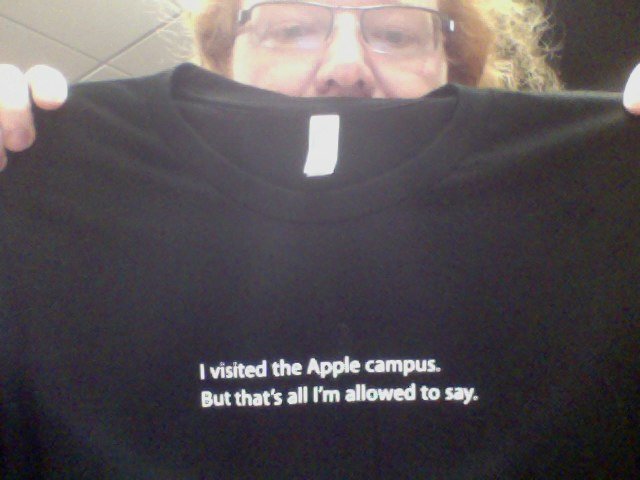
Apple used to sell this T-shirt at its HQ campus store.


Enough said.

(Source: BI)

Wednesday, 16 May 2018

Employers are monitoring computers, toilet breaks – even emotions

From microchip implants to wristband trackers and sensors that can detect fatigue and depression, new technology is enabling employers to watch staff in more and more intrusive ways. How worried should we be?

Last year an American company microchipped dozens of its workers. In a “chip party” that made headlines around the world, employees lined up to have a device the size of a grain of rice implanted under the skin between their thumb and forefinger. At first, Todd Westby, the CEO of Three Square Market, thought only about five or six people – him and a couple of directors, some of the people who worked in the IT department – would volunteer. But of the 90 people who work at the headquarters, 72 are now chipped; Westby has a chip in each hand. They can be used to open security doors, log on to computers and make payments at the company’s vending machines.

 Monitoring is built in to many of the jobs that form the ‘gig economy’ – but surveillance is increasing across the workplace. Illustration: Nishant Choksi
Can he see it taking off at lots of other companies? “Not necessarily,” he says. Or at least not yet. It’s partly a generational thing, he believes. “You may never want to be chipped but if you’re a millennial, you have no problems. They think it’s cool.” There are other uses for it – two months ago, the company (whose core business is selling vending machines and kiosks) started chipping people with dementia in Puerto Rico. If someone wanders off and gets lost, police can scan the chip “and they will know all their medical information, what drugs they can and can’t have, they’ll know their identity.” So far, Three Square Market has chipped 100 people, but plans to do 10,000.

The company has just launched a mobile phone app that pairs the chip with the phone’s GPS, enabling the implantee’s location to be tracked. Last week, it started using it with people released from prison on probation, as a replacement for ankle tags, which Westby describes as “intimidating and degrading”. Could he ever see the company using GPS to track its chipped employees? “No,” he says. “There’s no reason to.”

 Tony Danna, vice-president at Three Square Market, gets his microchip implant. Photograph: Jeff Baenen/AP
Not all firms would agree. Tech companies are coming up with ever more bizarre and intrusive ways to monitor workforces. Last week the Times reported that some Chinese companies are using sensors in helmets and hats to scan workers’ brainwaves and detect fatigue, stress and even emotions such as anger. It added that one electrical company uses brainwave scans to decide how many breaks workers get, and for how long. The technology is used on high-speed train drivers to “detect fatigue and attention loss”. While this sort of technology may have legitimate safety applications – a similar project was carried out with Crossrail workers using wristbands that sensed fatigue – it’s not hard to see how it could creep into other areas.

In February, it was reported that Amazon had been granted patents for a wristband that not only tracked workers’ locations in the warehouse as they “picked” items to be dispatched, but could “read” their hand movements, buzzing or emitting a pulse to alert them when they were reaching for the wrong item. In the filing, Amazon describes it as being able to “monitor performance of the placing of the incoming inventory item into the identified storage location by the inventory system worker”.

There are tech companies selling products that can take regular screenshots of employees’ work, monitor keystrokes and web usage, and even photograph them at their desks using their computers’ webcams. Working from home offers no protection, as all this can be done remotely. Software can monitor social media usage, analyse language or be installed on employees’ phones to monitor encrypted apps such as WhatsApp. Employees can be fitted with badges that not only track their location, but also monitor their tone of voice, how often they speak in meetings and who they speak to and for how long.

Employees have always been watched at work, and technology has always been used to do it. But where it was once a factory foreman with a stopwatch, or workers having to physically clock in and out, now “all of that physical stuff has gone into digital technology”, says André Spicer, professor of organisational behaviour at Cass Business School. “It captures things that you weren’t able to capture in the past, like how many keystrokes are people taking, what are they looking at on their screen while they’re at work, what kind of language are they using. And surveillance follows you outside the workplace now.”

 Some Chinese companies are using sensors to detect employees’ levels of fatigue and their emotional state. Photograph: AFP/Getty Images
How much of this is legal? In the UK, employers are allowed to monitor which websites you look at while at work, says Philip Landau, a partner at Landau Law Solicitors who specialises in employment law. “However, the device they monitor must be partly or wholly provided by work. Employers must also give prior warning if they are going to monitor your online activity, and should make you aware of the relevant social media policy.” It is also legal to monitor keystrokes, though again employees must be told they will be watched. “In companies where this system is in place, it is not uncommon for employers to speak to employees if they feel that their number of keystrokes is low,” says Landau. “It is worth noting that a high number of keystrokes does not necessarily mean high levels of productivity and vice versa.”

Employers could theoretically use your computer’s webcam to see when you’re at your desk but “there should be a justification for such monitoring, and you should be informed of it beforehand. You should also be informed what the pictures will be used for, and how they will be stored.” As for GPS tracking, “a company may track any vehicles that they supply to their staff. However, the data they collect must only be used for the management purposes of the company. Any GPS device is not allowed to be turned on if the employee is using the vehicle for personal reasons outside of work.”

James Bloodworth spent a month working as a “picker” – the person who locates the products ordered – for Amazon in March 2016 for his book Hired: Six Months Undercover in Low-Wage Britain. “We carried this handheld device at all times and it tracks your productivity,” he says. It would direct workers to the items they need to find on the shelves in one of Amazon’s vast warehouses. “Each time you picked up an item, there would be this countdown timer [to get to the next item] which would measure your productivity.” Bloodworth says supervisors would tell people how productive they were being; he was warned he was in the bottom 10%. “You were also sent admonishments through the device saying you need to get your productivity up. You’re constantly tracked and rated. I found you couldn’t keep up with the productivity targets without running – yet you were also told you weren’t allowed to run, and if you did, you’d get a disciplinary. But if you fell behind in productivity, you’d get a disciplinary for that as well.” It didn’t feel, he says, “that you were really treated as a human being”. Workers had to go through airport-style security scanners at the beginning and end of their shifts, or to get to the break areas. He says going to the loo was described as “idle time” and once found a bottle of urine on one of the shelves.

A worker in an Amazon distribution centre. Photograph: Ralph Freso/Reuters
Amazon says its scanning devices “are common across the warehouse and logistics sector as well as in supermarkets, department stores and other businesses, and are designed to assist our people in performing their roles”, while the company “ensures all of its associates have easy access to toilet facilities, which are just a short walk from where they are working”. It adds: “Associates are allowed to use the toilet whenever needed. We do not monitor toilet breaks.”

Some of Bloodworth’s colleagues, he says, were angry about the level of monitoring – “but it was more cynicism and resignation. Most of the people I met hadn’t been in the job very long or were looking for other jobs. Every job was temporary and it was a workforce completely in flux.” Has Bloodworth seen the future? Will we all be monitored like this by our bosses in years to come? Possibly, he says. “One of the things that has arisen in response to the book is that people say work is going to be automated anyway, or workers need to be more flexible, as if this is the way of the future and it’s inevitable, which I think is quite dangerous. Amazon can get away with this because of political choices and because the trade union movement is quite weak. I think other businesses will look at Amazon, see they have had success with this business model – and seek to replicate it.”

For his book Working the Phones, Jamie Woodcock, a sociologist of work at the Oxford Internet Institute, spent six months working in a call centre. You get a sense of the monitoring, he says, “from the moment you walk in. You have TV screens that have everyone’s relative performance to each other displayed. Managers collect data on almost every single part of what you do. Every single phone call I ever made was digitally recorded and stored. In terms of monitoring, it’s like being able to call back every single thing somebody has made on an assembly line and retrospectively judge it for quality. We all make mistakes and we all have bad days, but this kind of monitoring can be made retrospectively to sack people and is used to give people a sense that they could lose their jobs at any moment.”

Monitoring is built into many of the jobs that form the so-called “gig economy”. It’s not easy to object to the constant surveillance when you’re desperate for work. What has surprised Spicer is how willingly people in better-paid jobs have taken to it. “Prisoners in the past were forced to wear tracking bands but now we willingly put on step trackers or other kinds of tracking devices given to us by our employers, and in some cases we pay for the privilege.” Companies such as IBM, BP, Bank of America, Target and Barclays have offered their employees Fitbit activity trackers.

It is part, Spicer says, of “this whole idea of wanting to improve or optimise yourself. A lot of technology is designed to not just feed back data about your performance to your boss, but also give it to you. I guess they’re also seen as cool or fashionable, so it’s not surprising they’re taken up so readily.”

Spicer has watched the shift away from “monitoring something like emails to monitoring people’s bodies – the rise of bio-tracking basically. The monitoring of your vital signs, emotions, moods.” Of Three Square Market’s practice of chipping employees, he says: “You can imagine that slowly extending. You could imagine things like employers asking to have your DNA in the future, and other kinds of data.”

 Deliveroo already monitors its riders and drivers’ performance. Photograph: Charles Platiau/Reuters
Surveillance can have positive applications. It’s necessary (and legally required) in the financial industry to prevent insider trading. It could be used to prevent harassment and bullying, and to root out bias and discrimination. One interesting study last year monitored emails and productivity, and used sensors to track behaviour and interaction with management, and found that men and women behaved almost identically at work. The findings challenged the belief that the reason women are not promoted to senior levels is that they are less proactive or have fewer interactions with leaders, and simply need to “lean in”.

Still, says, Woodcock, “we need to have a conversation in society about whether work should be somewhere that you’re surveilled”. That need is perhaps most urgent where low-paid, insecure jobs are concerned. “If you work in the gig economy, you have a smartphone,” Woodcock points out, and that smartphone can be used to track you. “I think because many of these workplaces don’t have traditional forms of organisation or trade unions, management are able to introduce these things with relatively little collective resistance.”

The Independent Workers Union of Great Britain is well aware of the issues of monitoring and data collection. James Farrar is the chair of its United Private Hire Drivers branch, and the Uber driver who won a legal battle against the company last year for drivers’ rights. “They do collect an awful lot of information,” he says. “One of the things they will report to you on a daily basis is how good your acceleration and braking has been. You get a rating. The question is: why are they collecting that information?” Uber also monitors “unusual movements” of the phone when someone is driving (implying it knows if someone is using their phone while at the wheel) and, of course, tracks cars and drivers by GPS.

“My concern with it is this information is being fed into a dispatch algorithm,” he says. “We should have access to the data and understand how it’s being used. If some kind of quality score on my driving capability [is put into an algorithm], I may be offered less valuable work, kept away from the most valuable clients – who knows?” It’s not an unreasonable fear – the food delivery company Deliveroo already does something similar, monitoring its riders’ and drivers’ performance, and has started offering “priority access” when booking shifts to those who “provide the most consistent, quality service”. Uber, however, says its monitoring is intended only to deliver “a smoother, safer ride … This data is used to inform drivers of their driving habits and is not used to affect future trip requests.”

Not all surveillance is bad, says Farrar. In some ways, he would like more. He was assaulted by a passenger and is calling for CCTV in all vehicles, partly for the safety of drivers. “There is a role for surveillance technology,” he says. Ironically, when Farrar went for a meeting with Uber to discuss the assault, the company made him turn his phone off to prove he wasn’t recording it.

(Source: The Guardian)

Wednesday, 18 January 2017

Karnataka police have the most number of CCTVs in India

If one were to go by a recent Union Home Ministry report, Karnataka police top the list in the number of cameras or CCTVs deployed among the states.

According to statistics as on January 1, 2016, Karnataka police use 3,952 cameras/CCTV cameras for traffic, security and investigative purposes. The state is followed by Madhya Pradesh (2,977 cameras/CCTVs), Kerala (2,458), Andhra Pradesh (2,443) and Rajasthan (2,025).

Interestingly, the ratio of police personnel in the state is the second lowest among southern states after Andhra Pradesh. In Karnataka the police-to-people ratio stands at a worrying 1:876. UN standards prescribe one police officer for every 454 people.

With the Karnataka government mulling installation of 5,000 more CCTV cameras in Bengaluru alone to strenghten security, activists feel video surveillance can’t replace visible police presence or night patrolling.

“The visible beat policing system is the most effective crime prevention measure especially in places where streetlights are inadequate or in spots prone to crimes like chain snatching. CCTV visuals may help trace offenders but visible police patrolling will prevent incidents of chain snatching, house break-ins and robbery attempts,” said K S Vimala of All India Democratic Women’s Association (AIDWA). “Presence of police vehicles on streets will discourage offenders and instil confidence in people, particularly women,” she said.

While police officials say 250 Hoysala and 400 Cheetah vehicles patrol the city, many residents complain it is not effective. “Criminals seem to be aware about the timing of mobile patrol squads. They are often stationed on main roads and rarely patrol interior stretches. There are complaints against Hoysala staffers about extorting money from street vendors,” said Muneer Sherif of Kammanahalli.  

Sources say e-beat system, which was first introduced in Indiranagar police station limits in 2001, is dysfunctional. Under e-beat system, details of beat policeman were stored in cards that had to be swiped on e-Beat machines installed at road junctions in residential areas.

“We are planning to resume the e-beat system to strengthen police patrolling at night. Action will be initiated against police personnel who are extorting money from people,” said a senior police officer.

(Source: New Indian Express)

Sunday, 20 May 2012

How number 13 became unlucky in my life

The Number 13 is considered to be unlucky by many and don’t know how many films have come on this unlucky number and its effects. I used to laugh when people used to tell me how unlucky the number 13 is and can be till I myself went through certain incidents.

Before what others say and think about the number, let me tell you how this number changed the very course of my life. In a way, it ruined my studies and changed the very way of looking the number.

Two months ago we shifted the house and went to an apartment. We didn’t give much attention when we were given a flat on the 13thfloor. When people in the apartment started asking me if the 13thfloor was lucky or unlucky, I was taken aback, but with a smile kept on telling them that so far it was lucky as there were no problems associated with it.

I was supposed to visit India and went to book my flight tickets. I wanted to return on 15th, but the agent booked it on 13th as most of the seats on 15th were already booked!

On the day I started from Doha, unfortunately, the door got locked from inside and the apartment staff had to struggle to open the door of our flat. I blamed myself for being very careless and didn’t pay much attention towards the incident.

I reached the airport and unfortunately, my seat number was 13! I had to change my flight at Sharjah and I was waiting at the airport. I wanted to use the wash room and requested the guy sitting next to me to look after my luggage and left the place. Within two minutes I returned to the place where I was sitting and the guy had disappeared with my luggage. I was totally shocked, I asked other passengers sitting and they too didn’t know when the guy disappeared with my bag! I requested the police to search the CCTV cameras and catch the guy, as the bag had my laptop, the same laptop which had my four years of research. The cops promised me to look for the guy, took my number and made me to board the flight. No need to say that the cops never searched the CCTV cameras and caught the thief. I lost all my research material and all the dreams and hopes of completing the research were shattered in a moment. Then also, I took the blame on myself and thought it was my fault to trust a guy sitting next to me. I had a wrong notion that thefts won’t happen at airports, as there would be CCTV cameras everywhere. But I was wrong, extremely wrong.

I reached India and came to know that I was expecting. After getting the scanning report everybody became happy that I was pregnant and even I tried to console myself that whatever happens is for good. When I went for the second scanning after 10 days, there was yet another shocking news. The G-sac which was very slow in growing and docs were also surprised at it. They prescribed all the required medicines, but in vain. So they started wondering what should be done next.

Meanwhile, I cancelled my return ticket which was booked on this 13th. Even before the docs could decide what could be done further, I suffered a miscarriage on 13th. And I couldn’t help myself from sitting back and thinking about the number 13 and its effect on my life. After all these, I asked my hubby to change the flat to another floor and he shifted to 15th floor.

After all these, how can I think the number 13 is not unlucky? Now let me show what others think about this number. As far as I have seen and known many westerners consider 13 as a devil number, very inauspicious and very unlucky. Not many apartments and hotels will have 13thfloor or 13th room or house in the building! 
The number has different meanings and interpretations in different religions and parts of the world.
In Hindi, the number 13 is called 'Terah', means 'yours'. It represents your karmas. In the spiritual context, it could also mean that everything belongs to one God/Creator, including the soul present in every human being.

The number 13 brings the test, the suffering and the death according to the tarot cards. It symbolises the death to the matter or to oneself and the birth to the spirit: the passage on a higher level of existence. (In Tarot, no. 13 card is named as Death, but it mostly means death of a struggling period and new beginning s. In some Tarot decks, the thirteenth mystery of the Tarot does not have a name. It marks the uncertainty, the hesitation, the fickleness or again a transformation, the end of something (the death) and a renewal, a rupture, that is to say a very important change.)

In ancient cultures, the number 13 represented femininity, because it corresponded to the number of lunar (menstrual) cycles in a year (13x28 = 364 days). The theory is that, as the solar calendar triumphed over the lunar, the number 13 became anathema.

But coming back to it as the sign of bad luck, it is believed that it brings bad luck and misfortune. This belief dates back to Biblical ages. Judas who betrayed Jesus is said to be the 13thdisciple. Also, the 13th chapter of the Revelation is reserved to the anti-christ and to the beast. It is also the day when Christ is said to have died on the Cross.

According to a legend, a year which contained 13 full moons instead of 12 posed problems for the monks who were in charge of the calendars. This was considered a very unfortunate circumstance, especially by the monks who were in charge of the calendar of 13 months for that year and it upset the regular arrangement of church festivals. For this reason, 13 came to be considered an unlucky number.

However, in a typical century, there will be about 37 years which have 13 full moons compared with 63 years with 12 full moons, and typically every third or fourth year would have 13 full moons, making it a reasonably common occurrence, unlikely to tax monks any more than leap years.

There are certain superstitions associated with the number. To see a black cat on Friday 13 leads to misfortune. It is preferable not to go out on that day, but if one leaves by a door, it is always necessary to enter by the same door. The superstition of Friday 13 was also revivified in this era of the computer by some viruses introduced into the computer systems appearing only on Friday 13.

But on the other hand, there are some fortune tellers who predict a better future on Friday 13. In France, as soon as there is a Friday 13 to the calendar, the National Lottery organises a special drawing because some choose that day to bet money.

The number 13 in the Coperos religion (small culture in Brazil) is like a God number.

Thirteen is the name of a custom and cruiser motorcycle magazine that is published in New Zealand. The name Thirteen refers to the letter "M", as it is the 13th letter in alphabet.

So, I think I’m not the only one to think that the number 13 is unlucky.