Showing posts with label Andhra Pradesh. Show all posts

Friday, 10 April 2020

Telangana mom makes 1400-km round-trip on scooty to bring home son stranded in Andhra

The 48-year-old headmistress of a government school drove 1,400 km on her scooty from Bodhan in Nizamabad in Telangana to Nellore in Andhra Pradesh and back to bring back her son who was stranded at a friend's house.

“He is with me now, I am very happy,” Razia Begum giggled over the phone. The 48-year-old headmistress of a government school drove 1,400 km on her scooty from Bodhan in Nizamabad in Telangana to Nellore in Andhra Pradesh and back to bring back her son who was stranded at a friend’s house. Her son, 19-year-old Mohammed Nizamuddin, a student at Narayana Medical Academy at Hyderabad, had gone with his classmate to Rehmatabad in Nellore on March 12.

Razia drove 1,400 kms on her scooty from Bodhan in Nizamabad in Telangana to Nellore in Andhra Pradesh

“I accompanied him as he was going to see his father who was unwell and I also wanted to visit a dargah at Rehmatabad. We went by train on March 12. I had booked a return ticket for March 23 but the trains were cancelled and the lockdown started and I got stranded there,” said Nizamuddin. He tried unsuccessfully for several days to find some transport to reach Hyderabad but to no avail.

“I stayed with my friend’s family while I and my mother tried to figure out over the phone how to return home,” he said. Razia Begum, who is headmistress at Bodhan Mandal Parishad Territorial Constituency School, approached Assistant Commissioner of Police (ACP) Bodhan V Jaipal Reddy twice to seek advice on how to bring back her son.

“I was worried that he won’t take enough precautions to stay in a safe zone to protect himself from coronavirus. Nellore is one of the affected districts and I was really worried about him. If he is at home I can keep a watch. Police suggested I wait for a few days as the lockdown was being implemented strictly,” she said.

Razia Begum is headmistress of a government school in Telangana

On Sunday, April 5, with the prospect of the lockdown getting extended, Razia Begum decided to go to Nellore and bring back her son. “I had no option but to go on my scooty. Hiring a car was out of question as no one was interested and besides, if I was travelling in a car the chances of being allowed by police on the highway were bleak. I thought that by riding on the scooty alone I would be able to convince cops to allow me to travel. I neither informed my son nor my brothers and sisters. I started off early Monday morning and only after reaching Toopran on the outskirts of Hyderabad I informed my son that I was coming to pick him up,” she said.

“I have been driving two-wheeler since 25 years. My husband passed away 14 years ago and even at that time I used to drive to Hyderabad on a two-wheeler when he had to undergo dialysis. So I was not afraid although the distance was daunting,” she said.

Razia Begum topped up petrol wherever she found a fuel station and carried a five-liter can with additional fuel. She carried rotis and sabzi for the journey. “I took 15-20 minute breaks at fuel stations, drank water and let the scooty engine cool down. Thankfully, the scooty did not break down anywhere. When I reached the Telangana-Andhra Pradesh border, it was late evening and the cops there were surprised to see me. They were taken aback when I told them where I was coming from and where I was going and it took a lot of convincing to allow me to go. They were worried about my safety; they said that there was no one on the highway and night was falling. However, I convinced them that I will be safe and drove away. The highway was dark and lonely but I had to pick up my son. I was stopped by police at a check post at 2 am on Tuesday on the outskirts Nellore. After listening to my story, they said that the road ahead was dangerous and advised me to halt for some time. I waited at a roadside shelter near the check post till 4 am and then called my son that I was nearby,” she said.
“She arrived at 7:30 am. She drove almost 23-24 hours to pick me up,” said her son.
“She arrived at 7:30 am. She drove almost 23-24 hours to pick me up and I was overwhelmed and very happy to see her. We left again in the afternoon and returned to Bodhan Wednesday evening. She had her first good meal after two days,” Nizamuddin said.

“She is a gutsy lady. I tried to persuade her to hire a car but she said she doesn’t have that much money and went on the scooty. She requested a letter from me stating the reason for which she was traveling to be shown if she was stopped at check-posts. Her courage to bring back her stranded son is very moving,” Assistant Commissioner of Police (ACP) Bodhan V Jaipal Reddy said.

(Source: TIE)

Saturday, 7 September 2019

Indian woman, 73, gives birth to twin girls

A 73-year-old woman in the southern Indian state of Andhra Pradesh has given birth to twin girls.

Doctors delivered the twins, who were born following IVF treatment, on Thursday.

"The mother and the babies are doing well," Dr Uma Sankar, the woman's doctor, told BBC Telugu.

Mangayamma Yaramati said she and her husband, who is 82 years old, have always wanted children but had been unable to conceive until now.

"We are incredibly happy," her husband Sitarama Rajarao told BBC Telugu on Thursday, hours after the babies were born.
Mangayamma Yaramati is 73 years old

But just a day later, Mr Rajarao suffered a sudden stroke and is currently being treated in hospital.

"Nothing is in our hands. Whatever should happen will happen. It is all in the hands of God," Mr Rajarao had said when asked who would care for the children in case anything were to happen to the couple due to their advanced age.

Having children was important to the couple, who also said that they felt stigmatised in their village.

"They would call me a childless lady," Ms Yaramati said.

"We tried many times and saw numerous doctors," she added, "so this is the happiest time of my life."

The twin girls were delivered by Caesarean section, which is the usual method in such rare cases.

In 2016, another Indian woman in her 70s, Daljinder Kaur, gave birth to a boy.

(Source: BBC)

Tuesday, 12 March 2019

Indian population is growing much faster in the north – and the south is paying the price

The disparity in the rate of population growth could reshape the country politically, economically and culturally.

That India has a population problem is a truism every schoolchild learns. It was the first country in the world to adopt family planning, back in 1952. Yet, the problem persists: India is expected to surpass China as the most populous country on the planet by 2024, an incredible overtake given that in 1950, China’s population was one and a half times more than India’s.

This overarching narrative of India’s population explosion, however, becomes complicated as one zooms in. West Bengal’s fertility rate – the average number of children a woman would have in a given population – is lower than that of Norway, a nation worried about its social welfare system being stretched by an ageing population. Japan’s fertility rate of 1.5 is so low that the country is facing a socio-economic crisis. Yet, according to data released by the Union government last week, Kerala’s fertility rate is nearly the same – 1.56.

Clearly, then, it makes little sense to talk of India’s population problem without discussing the vast disparities that characterise how the population is growing across states. Have a look at this map:

Most news about fertility rates tends to separate the data by religion. But given that states and not religious communities make up India’s constituent units, significant differences in population growth rates among states will affect Indian politics far more explicitly. As the map shows, there is a clear cleavage between South India and North India. The south is blue, with fertility rates lower than the replacement rate, meaning that fewer babies are being born than people are dying – a trend that would eventually result in a declining population. The north is mostly orange or red with Uttar Pradesh and Bihar – two states that together make up a quarter of India’s population – recording very high fertility rates of 2.74 and 3.41, respectively. The result: in 1951, Tamil Nadu’s population was slightly higher than Bihar’s. Six decades later, Bihar’s population is nearly 1.5 times Tamil Nadu’s. Madhya Pradesh in 1951 had 37% more people than Kerala; in 2011, it had 217% as many.

Question of representation
The direct effect of such significant changes in population will be on the representation of states in Parliament. In other federal polities such as the United States, methods to decide seats in the federal legislature have often been torturous. In 1787, for example, the US went so far as to institute the odious practice of counting each African-American slave as three-fifths of a White person – known to history as the “Three-Fifths Compromise” – to get states with competing interests to agree to a formula for deciding the number of seats in one house of the federal legislature. In the other house, each state, no matter its size or population, is represented by two members. The US has thus ignored the principle of one-man-one-vote in order to get its union working.

India has had to make its own adjustments in order to keep big and small states in the same boat. In 1976, Parliament – then under the Emergency – passed a constitutional amendment that froze the number of seats each state had in Parliament as per the 1971 Census. The freeze was to end in 2000. But because it was so expedient, Parliament, in 2001, extended it till 2026. Thus, until 2026, Parliament’s seat composition will essentially represent a population snapshot taken more than 50 years ago.

The freeze has meant that the Hindi-speaking states such as Uttar Pradesh and Bihar, which have outstripped many other sates in population growth since the freeze, have not seen their seats in Parliament increase as they should have. Like the compromises to constitute the US Congress, this has weakened the principle of one-man-one-vote in India’s Parliament. In Uttar Pradesh, for example, one Lok Sabha MP now represents 25 lakh people. In Bihar, 26 lakh. In West Bengal, however, the number drops to 22 lakh. In Tamil Nadu, it is 18 lakh and in Kerala only 17 lakh. In effect, a Malayali has more than 1.5 times the representation of a Bihari in the Lok Sabha.

India has tolerated this attenuation of the one-man-one-vote principle given the instability redistributing seats among states might cause. But considering the significant changes in population, the seats have to be redistributed. When that happens, the share of parliamentary seats of low fertility southern states will fall sharply.

The consequences for Indian politics could be significant: the country is already politically dominated by the more populous Hindi states and any change in the current distribution of seats in their favour will seal this domination. In the 2014 Lok Sabha election, for example, the Bharatiya Janata Party won 51% of its seats from just four states – Uttar Pradesh, Bihar, Rajasthan and Madhya Pradesh. If the seats were allotted proportionate to population, this ratio would likely have been much higher.

A central government that does not reflect enough states from all corners of the Union might breed disaffection. This is especially true for southern states, which already feel neglected. They contribute much more to the Indian Union’s finances per capita than, say, Uttar Pradesh or Bihar, but get much less funding from the Centre. Nor does their financial muscle translate to political heft. For example, former Tami Nadu Chief Minister J Jayalalithaa opposed the Goods and Services Tax on the ground that it would hurt the state but was powerless to stop it given how few members of Parliament the state had.

Changing migration patterns
The vastly differing rates of fertility – paired with differences in economic growth – will also affect inter-state migration.

India has actually seen little migration across states so far, mainly because of vast cultural differences between states. For example, between 1991 and 2001, intra-state migrants were nearly five times the number of inter-state migrants.

Inter-state movement is still fairly modest considering the overall population, but it is growing fast. Compared to the 1991-2001 period, the following decade saw inter-state migration nearly double. Moreover, the influx of migrants is acutely concentrated in the southern states. From 2001 to 2011, migration into Tamil Nadu went up by 39 times. The outflux of migrants from Bihar and Uttar Pradesh in the same period went up by 2.3 times and two times, respectively

Politics in the southern states has responded to this sharp uptake in migration from the north. In 2015, Andhra Pradesh Chief Minister N Chandrababu Naidu called for Telugus to have more children, comparing Andhra Pradesh with Japan. Bengaluru has seen a vigorous agitation against Hindi signage, driven by the fact that Hindi is the lingua franca of migrants to the city while older residents speak mostly Kannada, Tamil, Telugu and (Dakni) Urdu.

There are few parallels to India given that it is a multi-ethnic, uber-polyglot country of 1.3 billion people. China is the closest and migration in the Communist state is closely controlled by the state. Moreover, even in China, inter-provincial (and hence inter-ethnic) migration has led to significant tensions.

The European Union is much smaller than India but migration across the region caused tensions sharp enough to break the confederation. One of the key justifications for Brexit that was articulated by right-wing parties was migration from mainland Europe into the United Kingdom. In France, the far right captured a large share of vote in last year’s parliamentary election by opposing migration and promising to leave the European Union.

(Source: Scroll)

Monday, 12 November 2018

Andhra village elders ban nighties during daytime, officials step in to counsel

Local officials visited the village and cautioned the elders against taking the law into their own hands by issuing such bans.

The announcement of a ban on wearing ‘nighties’ during the daytime in a West Godavari village prompted a sharing frenzy on social media in the district, forcing local authorities to visit the place and launch an enquiry.

Behind the ban, which is clearly about moral policing, are elderly women and some men in Thokalapalle village who say they find it “inconvenient” to see young women and girls going in nighties to nearby shops, village meetings and other formal occasions.

Based on their request, some six months ago, the village elders arranged for announcements to be made over loudspeakers that a fine of Rs 2,000 would be slapped on women seen wearing nighties in the streets between 7 am and 7 pm. They also announced a reward of Rs 1,000 for those who report any violations of the ban. Those suffering from ill-health were spared from the ban and allowed to wear nighties round the clock.

There have been no complaints against the ban to authorities so far and nobody has been fined all these months. But during the recent Diwali festival, some residents informed the local media about the ban, which then went viral on social media locally. The villagers confidently told visiting local media why they supported the ban.


When local revenue and police officials enquired about this during their visit to the village on Thursday, the elders said that they announced the ban following pressure from women themselves. They told officials that nobody had been penalised till now and that it was just a small announcement meant to put “a little fear” into young women and girls.

The elderly women, sticking to their absurd argument, said that it was not “appropriate” to wear nighties outside the home and for all occasions, though these may be comfortable to wear. They argued that these nighties are meant for night-time dressing only and are also not part of "Hindu" culture. Their contention was that the younger generation does not wear traditional outfits like sarees or half-sarees or dupattas at home and while moving around in the village; they wear nighties even while visiting the temple to offer puja. The elderly women alleged that the young do not care about discipline and are not abiding by ‘kattubatlu’ (conventions) set down by their ancestors.

The elders defended their decision to impose the ban saying that it is the general practice in their village to take decisions after discussions in village gatherings called ‘sanghams’, a tradition being observed for many generations.

Thokalapalle is a remote village located on the fringes of the sprawling Kolleru lake. It falls under the Nidamarru mandal limits of Unguturu Assembly constituency.

When contacted, Nidamarru Tehsildar M Sundar Raju said he visited the village along with the local sub-inspector of police and they found no law and order problems because of the ban. He said he cautioned the village elders against taking the law into their own hands by issuing such bans that do not have any legal standing. The villagers were also asked to provide immediate information to the available officials if anyone was punished or fined in this respect.

Officials created awareness among the residents that it was incorrect to put the rights of others at risk with such unlawful regulations.

Officials said they were taking all steps necessary to prevent the ‘nighties’ issue from becoming a major problem in the village and surrounding areas. They plan another visit to Thokalapalle soon to get information from more residents. The overall effort is to prevent untoward incidents and ensure peaceful living in the villages, says Tehsildar Raju, who made the visit based on social media posts and despite the fact that there was no formal complaint.

Mainly a fishing village, Thokalapalle has nearly 1,000 families who belong to the ‘vaddi’ community. As per the 2011 census, the village has a population of 3,272 with a literacy rate of 62.63%, lower than the state average of 67.02%. Male literacy in the village is at 68.10% and female literacy is at 57.36%.

(Soure: TNM)

Wednesday, 18 October 2017

A Ramayan, but not about Ram

The quintessential epic, known to be a Valmiki masterpiece that glorifies Ram in all his muscle, wit and grandeur, and upends it in the most inconceivable manner. The 16th century woman poet flouts conventions and gave Sita a voice, She makes Sita the beating heart of the story, writes Radhika Iyengar in Live Mint. Read on:   

In the 16th century, a Bengali poet reimagines the Ramayan. Far ahead of her time, she chooses to offer her rendition of the epic not in Sanskrit that was revered at the time, but in her mother tongue. Though she will be scorned for her attempt, her retelling will be revolutionary, for it will possibly be the first of its kind, written from a woman’s perspective: Sita’s.

It is 1575 and 25-year-old Chandrabati is sitting by the Phuleswari river in Patwari, a village near the town of Kishoreganj, now in Bangladesh. Chandrabati appears disturbed: Her father has set her an herculean task—she must rewrite the Ramayan.

Agni Pariksha: A scene from the Ramayan where Sīta undergoes the ordeal by fire watched by Rām, Laxman and Hanuman, circa 1820, artist unknown. Photo: Wikimedia commons

Her retelling will languish in obscurity. Centuries later, in one of the last surviving tattered copies, Nabaneeta Dev Sen, an award winning academic and an authority on the 16th century poet, will meet Chandrabati in her epic’s introduction: “Chandra sings the Ramayana at the insistence of her father.”

The poet will have no inkling that her Ramayan will be criticized by some of the respected literary authorities of the day, most of them men.

But let’s return to the day Chandrabati is sitting by the river, lost in thought. A few days earlier, she had learnt that Jayananda, whom she was promised to, had wedded another woman. Heartbroken, she will seek her father’s permission to stay unmarried and dedicate her life to Lord Shiva. And he will allow her to do so, on the condition that she writes the epic.

Chandrabati’s father, a poet, worshipped the snake goddess, Manasa. Referring to him as a “poor Brahmin”, folklore historian Dineshchandra Sen, in his collection of The Bengali Ramayanas (1920), describes Bansi Das as “one of the best exponents of the poetical literature of the Manasa-cult”. In her epic’s introduction, Chandrabati thanks her father, saying it is he “who has educated me in the Pauranic literature”.

Historically, her version of the Ramayan is one of the early—possibly one of the first—examples of feminist literature. Historically though, it has been cast aside as a shoddy piece of writing, incomplete and structurally fragile. Though he appreciated Chandrabati’s attempt, Chandra Sen called it an “unfinished” piece: “She had brought (the epic) down to Sita’s exile, and there it ends,” he wrote. Noted 20th century linguist Sukumar Sen “ripped the text apart, and (believed) it to be fake,” writes Dev Sen in her paper, Rewriting The Ramayana: Chandrabati And Molla (India International Centre Quarterly, 1997). For Chandrabati takes a quintessential epic—known to be a Valmiki masterpiece that glorifies Ram in all his muscle, wit and grandeur—and upends it in the most (to his mind) inconceivable manner: She makes Sita the beating heart of the story.

The cover of Molla’s Ramayan—Battle at Lanka, Udaipur (1649-53). Photo: Wikimedia commons/The British Library
An unlikely narrator
Chandrabati crafts an epic far from the heroic, far from the Bhakti tradition of absolute veneration. It undermines the extravagant and gallant battle fought between Ram and Ravan, and gives a detail-drenched perspective of Sita’s emotional turmoil. “As unconventional as ever, (Chandrabati) begins her Ramayan with the story of Sita’s miraculous birth,” writes Dev Sen.

In fact, Chandrabati does something even more unthinkable. While Valmiki’s epic is grounded in the premise that Ram was born as the destroyer of Ravan, Chandrabati steers the spotlight away from him and introduces Sita as the one birthed to destroy the Lanka king.

In A Woman’s Ramayana: Candravati’s Bengali Epic, authors Mandakranta Bose and Sarika P. Bose describe a Mandodari (Ravan’s wife) distraught at Ravan’s affairs with the women he has abducted. In a moment of absolute helplessness, she “consumes the blood drawn by Ravana from the sages he torments, mistaking it for poison”, they write. Mandodari conceives an egg, but is cautioned by a prophecy: “The child born from (the egg) would bring ruin upon Ravana.” Fearing Ravan’s descent, she hurls it into the ocean. The egg, discovered by a fisherman, is gifted to king Janak’s queen, and Sita is born.

Chandrabati paints Ram as an ordinary, flawed man who abandons his pregnant wife. The poet is subversive, but this is a subversion driven by an urgency to give agency to the plight of women.

Chandrabati takes a quintessential epic—known to be a Valmiki masterpiece that glorifies Ram in all his muscle, wit and grandeur—and upends it: She makes Sita the beating heart of the story
“She made the Ramayan a kind of women’s unending tragedy,” says T. Vijay Kumar over the phone, a professor of literature at Osmania University who has translated The Liberation Of Sita (2016), a book also written from Sita’s perspective by Telugu feminist writer Volga. “Chandrabati links Mandodari’s plight (a husband who lusts after other women) to Sita’s (whose husband banishes her). Also, Chandrabati took on the exercise of retelling the Ramayana when she was going through her personal trauma. Therefore, it is through that theme of rejection that she connects herself with these two mythological figures, making it a larger tale of women’s misery.”

Chandrabati’s epic is rooted in the folk genre. “In the second part of her epic...she brings in Sita herself as the narrator,” explains Dev Sen. “The war is over and Sita is back in Ayodhya, with her girlfriends in the palace. Chandrabati gives us the whole story through a Baromaasi.” A Baromaasi, characteristic of the folk genre, is a song sung by women to describe their woes, and the poet uses this as a literary device for Ram’s wife. Sita’s lucid and layered narration of grief then, becomes the linchpin of the epic.

In the 16th century, at a time when women had a peripheral presence in literature and the public realm, Chandrabati flouted the norm. That was the beauty of her epic.

***

A more ‘feminine’ Sita
While Chandrabati was retelling the Ramayan in Bengali, another woman in Andhra Pradesh—unmarried, equally subversive in some ways and equally vocal—was choosing to write the epic in Telugu. Unlike Chandrabati though, she belonged to the potter caste. And while Chandrabati’s Ramayan was rubbished, hers was embraced.

So how did Atukuri Molla manage to have her voice heard? “Though it was a custom for poets to dedicate their poems to kings or other powerful persons, Molla…chose to dedicate her work directly to Rama,” says the book Women Writing In India: 600 B.C. To The Early Twentieth Century (edited by historians Susie J. Tharu and K. Lalita).

Molla is unequivocally deferential towards Ram. Her epic does not have unfamiliar contours. In her literary offering, Ram retains his title as the hero, while Sita is elbowed to the periphery.
Molla’s Ramayana cover. Photo: Courtesy: T. Vijay Kumar

Not only does Molla exclude the part about Sita’s birth, she barely makes Sita’s presence felt in her swayamvara—a ceremony that revolves around the bride, notes Nabaneeta Dev Sen, the award winning academic. In addition, she doesn’t include the final chapter, “Uttarakanda”, the aftermath of the battle, where Ram banishes his wife.

“Molla brings in her own style: She adds, deletes, imagines, interpolates, suffusing the text with metaphors and similes. She introduces songs in the epic where there were none, and brings in the native flavour,” says Osmania University professor T. Vijay Kumar. In addition, Molla gives her readers (predominantly male at the time) two popular themes: sex and violence.

She weaves in the gut-wrenching battle scenes, the artillery, the dismembered bodies, and introduces salacious descriptions. “(Molla) portrays the strong urban nature of Ayodhya by telling us how everything is brimming with sexual energy,” writes Dev Sen. “When Surpanakha describes Sita to her brother Ravana in order to incite his lust, she uses a sensual language that would make anyone lust after Sita.”

Believed to be king Krishnadeva’s concubine, and a poet vying for respect in the royal court, Molla would embrace the structural and ideological conventions of the traditional epic. She would conform. In fact, Molla portrays her Sita as extremely feminine. “In her Ramayan, the feminine quality comes through very strongly, in terms of the songs she interpolates,” says Prof. Vijay Kumar. “She makes Sita even more feminine than perhaps Valmiki’s Sita.”

All this, perhaps, makes Molla’s rendition more “acceptable”.

Molla is driven by a different agenda though: For her, the need to retell the Ramayan is more of a linguistic experiment. For although it was available in Telugu in the 16th century, it was written in a complex language. “So she puts herself in the place of the reader and asks, ‘What about people like me who don’t appreciate the Ramayan written in the highly literary, chaste Telugu? What is the point of such a wonderful story if it’s not understood by the common people?’” says Prof. Vijay Kumar. She takes the onus of making the epic more accessible to the common man.

Centuries later, Molla’s Ramayan has survived; its light vocabulary made it popular among readers. If you go looking, you might be able to unearth a copy or two of her epic in book stores in Andhra Pradesh even today. Chandrabati’s Ramayan, however, is harder to come by.

Friday, 22 September 2017

An alien fish is wreaking havoc in the Krishna river after it was linked to the Godavari

Fishermen say the non-native rakashi fish, which no one wants to buy, is damaging their nets and keeping other fish away, writes Manasa Chennapragada in the Scroll. Read on: 

The linking of the Godavari and the Krishna rivers in Andhra Pradesh, which was inaugurated last year, seems to have led to an unforseen problem.

Fishermen in Guntur district’s Tadepally village on the banks of the Prakasam Barrage, which straddles the Krishna, are complaining that a species of fish, hitherto never seen in the river before, was damaging their nets and scaring away other fish. Consequently, they say their catch, and earnings, have dropped.

“I have been a fisherman since I was child,” said Paikam Suresh, 35, of Tadepally village. “Nowadays we are catching a new kind of fish which we call rakashi. This rakashi is ruining our livelihood.”

Drop in income
Rakashi, in Telugu, means the devil. The fishermen of Tadepally have given the fish this name thanks to the havoc it is wreaking with their livelihood.

The carnivorous fish belongs to the armoured catfish family. It is not native to the Krishna river, where species like the Bengal carp (catla), reba carp, grunter, white carp (mrigal), the snakehead (murrel) and other small fish called jalalu locally are found.

The rakashi is more trouble than it is worth. For one, there is scant demand for it. Then, fishermen complain that the rakashi’s fins get entangled in their nets, and it takes at least two hours to extricate it. If 10 such fish get entangled in one net, it can take the whole day to get them out. Fishermen say they are often forced to cut their nets to extricate these fish.

All this has affected their daily income.

Suresh and his fellow fishermen say they used to earn Rs 500 a day from catching 200-300 fish. Now their catch has dwindled, and no one wants to buy the rakashi that they invariably catch.

“We are a poor family and because of this fish our nets are being spoiled,” said Suresh. “Each net costs a minimum of Rs 5,000. Also the Rakashi feeds on other fishes in the river and we are losing our livelihood.”

He added: “Recently officials from the Fisheries Department came and examined the fish and told us not to sell or eat it.”


Suesh said that the fish had only been spotted since the Pattiseema lift irrigation project started. The Rs 1,300 crore project, inaugurated in August 2015, is envisioned to take 80 thousand million cubic feet of water from the Godavari through the Krishna to Andhra Pradesh’s parched Rayalaseema district.

Dangerous for diversity
Flummoxed experts are now studying whether the new species entered the Krishna river from the Godavari.

“Even we came know about this only recently,” said M Basava Raju, joint director of fisheries, Andhra Pradesh. “It might have come due to the interlinking of Godavari and Krishna waters. Even we don’t know the exact reason. We have asked our officials to investigate.”

Farida Tampal, state director, Worldwide Fund for Nature in Hyderabad sounded an alarm, saying that the armoured catfish doesn’t belong to either the Godavari or the Krishna rivers.

“It is highly carnivorous and an aggressive breeder too,” she said. “We have to take immediate steps to eradicate this breed. Government officials don’t take anything seriously until we lose all our fish diversity. It feeds on other fish species, especially on fingerlings. That way it is more dangerous.”

Tampal added that the rakashi is a native of South America that lives in shallow muddy waters and hooks onto pebbles using its spines.

Since the fish also feeds on algae, it is much sought after across the world as an aquarium fish, as it keeps the tanks clean. Tampal added that even the South Americans are trying to eradicate this fish from their rivers.

Environmental impact study
Marine experts say that rivers should not be interlinked without studying the environmental impact of such projects on marine life.

“Before interlinking rivers, we have to consider many things,” said marine biologist A Manimekalan. “We have to study the native species present in that area, see how breeding is affected if rivers are interlinked.”

Manimekalan added: “Rivers can be interlinked if they have the same native species in both waters. Otherwise the entire ecosystem will be disturbed.”

Tampal agreed. “Apart from different species, even pollutants can be carried from other river to another and water quality could change,” she said. “It is difficult to predict all this as this type of research is very poor in India. Interlinking needs to be studied seriously before implementation.”

Tuesday, 15 August 2017

What is 'Silent Angel' syndrome and should you worry about it?

The disease does not have a cure for now, but could probably have one in future through gene therapy.

A two-old year from Guntur has been recorded as the first victim of the Rett syndrome - also known as ‘Silent Angel Syndrome’ - in Andhra Pradesh. A rare neurological disease, Rett Syndrome does not have a treatment so far, and it primarily affects females.

Doctors at the Guntur General Hospital (GGH), who diagnosed the child, Sahitya, on Thursday, said that there is no cure right now, but it may be possible in future through gene therapy.

GGH Neurology Wing Chief, Dr NV Sundarachary, said that two-year-old Sahitya could not speak properly and suffered non-rhythmic opening and closing of hands.

The Times of India reported that the child was fine up to nine months, but later, she lost her ability to stand and speak even in monosyllables.

Following this, Sahitya's parents took her to a paediatrician. However, the doctor found nothing abnormal, except for her hand movements.

Later, when she was taken to GGH, after imaging and EEG, the doctors still couldn’t find anything wrong with her. “Then we worked on two important clues, that she was a female child and had stereotypical hand movements. She was diagnosed with Rett syndrome,” Sundarachary said.

The child is in observation now at the GGH.


What is Rett syndrome?
The Indian Rett Syndrome Foundation describes it as a “unique neurodevelopmental disorder that is first noticed in infancy and primarily affects girls, but can be rarely seen in boys.” It affects one in 10,000 to 23,000 cases, according to some estimates.

The syndrome is non-inherited, and is usually discovered in the first two years of life.

In many cases, Rett Syndrome is falsely diagnosed as Autism or Celebral Palsy, because the symptoms are similar to one or more development disorders. Children with Rett Syndrome have typical hand movements, slow brain growth, problems with muscles and coordination, trouble with breathing, etc.

But one of the biggest effects of Rett Syndrome is the loss of speech - the disorder is therefore also known as ‘Silent Angel Syndrome.’

While there's no cure, early identification and treatment may help girls and families who are affected by Rett syndrome.

Symptoms
While Rett Syndrome can be noticed at different ages, most babies start showing signs between 12 and 18 months. Some of the symptoms you should look out for are:

1. A smaller than normal head size, caused due to slow brain growth.

2. Typical hand movements, as if the child is constantly ‘washing’ or ‘rubbing together’ her hands.

3. A sudden decline in language skills and social skills, and extreme social anxiety.

4. Difficulty in walking and coordination.

5. Uncoordinated breathing, seizures, hyperventilation, and forceful exhaling of air or saliva.

6. Constant irritability or long fits of laughter.

Symptoms of Rett syndrome usually don’t improve over time. It is a lifelong condition. Mostly, the symptoms worsen, or don’t change. And, people affected with it mostly need assistance.

(Source: TNM)

Saturday, 25 March 2017

Faith versus conservation: Tirupati temple, forest department fight over the Indian civet

Fridays are considered auspicious at the Tirupati Tirumala temple in Andhra Pradesh. Every week on this day, temple priests anoint the idol of Lord Venkateshwara, an incarnation of Vishnu, with a perfumed substance during prayers. This sacred offering is called punugu, made from the aromatic secretion of the small Indian civet, a nocturnal mammal.

The civet secretes a wax-like substance with a strong smell from the perineal gland located near its tail. This is then diluted with gingelly oil, which gives it a musky fragrance, to make the offering for the weekly ritual. But the practice has led to an almost-decade-long row between temple authorities and the forest department, which came back to life this month.

Till 2008, the temple bred civets at its dairy farm in Tirupati. The waxy secretion was collected from wooden planks where the animals habitually rubbed themselves. But that year, the Andhra Pradesh forest department seized the animals from the farm as the Wildlife Protection Act of 1972 prevents their domestication. Since then, the department and the temple have been at loggerheads over the management and care of the animals, which are currently housed at the Sri Venkateswara Zoological Park in the city. In 2013, the forest officials filed a criminal case against the temple authorities for keeping the animals in captivity. But four years later, in the first week of March, a court dismissed the case.

The dispute is far from over, though, and proposals for a solution are in limbo.


Long-standing dispute
Civets rarely breed in close captivity. This realisation drove the temple authorities in 2006 to propose a different arrangement for the animals: they offered to fund a nocturnal house for them at the Sri Venkateswara zoo. However, they insisted that their own staff be allowed to look after the animals to ensure the required amount of secretion was procured for the weekly ritual.

The forest department rejected the proposal, saying extraction and exchange of civet oil was a violation of the Wildlife Protection Act.

Today, the temple authorities are still willing to fund the nocturnal house at the zoo, provided forest officials assure them that they can avail of the secretion in the quantity they require.

At present, they depend on zoo officials to extract the secretion and give it to them, according to Dr Srikanth Babu, director of Animal Care Land, a non-governmental organisation based in Tirupati.

However, while the forest authorities are in favour of the temple-funded house for the animals, they are against facilitating any supply of the civet secretion to the temple. “We are only protectors and keepers of the wild animals and we cannot do any extractions or trading,” PV Chalapathi Rao, chief conservator of forests, told Firstpost.

The ritual aspect to this long-standing tussle makes this a sensitive case, said Srikanth Babu. “Since this is an offering for God, there is a lot of sentiment attached to this custom by locals,” he added. “It is better to provide a natural environment to the civet while providing punugu to the temple, so that both are satisfied.”

Ancient practice
The use of civet secretion in India is not restricted to temple rituals. It is an expensive ingredient that is also used in ayurvedic medicine, said Francis Xavier, a member of the Species Survival Commission of the International Union for Conservation of Nature.

In this study by James McHugh, professor of religion at the University of South Carolina, the secretion finds mention in medical and pharmacological literature of the 9th or 10th centuries. It is also found in early Sanskrit texts and in the accounts of foreign travelers.

“The earliest foreign reference to civet in India is apparently given by Friar Jordanus in the early fourteenth century, who reported a cat with highly odoriferous sweat, which was collected from a ‘certain wood’ on which the animal rubbed itself. This would seem to establish that the method still used at Tirupati is very old, and it also appears to be distinctively Indian.”

— James McHugh, The Disputed Civets and the Complexion of the God: Secretions and History in India

The Wildlife Protection Act of 1972 has not only come in the way of the Tirupati Tirumala temple’s rituals, it has also affected traditional healers in villages across South India. Many of these medical practitioners have lost their livelihoods as they can no longer keep the civet as a domestic animal or use its secretion.

Xavier, who spent five years researching small mammals in South Indian forests, said the practice of collecting the civet’s secretion has been ritualised in villages. “There is a special cage made for civets with proper dimensions,” he said. “This animal has a curious habit of walking to and fro continuously, and this cage gives enough space for the animal to roam. A small bamboo reed is kept in the centre and the civet will rub itself on the reed while prowling.”

Xavier observed that the civet uses its secretion to mark its territory and to attract potential mates. “Each civet has its own unique smell, like a human fingerprint,” Xavier said. “This secretion contains a unique property called civetone, which is chemically very similar to musk [collected from the musk deer]. It is because of this fragrance that civetone is collected to make perfumes.”

It is now easy to produce civetone synthetically, since its chemical structure is known. But the real deal remains in demand. “Actual civet secretion is a very costly product,” he added. “It is said that one gram of civet extraction is equivalent to one gram of gold. It has that much value.”

(Source: Scroll)

Monday, 27 February 2017

15 progressive Indian villages that will make you want to ditch your city life right away

In today’s world, Gandhi’s words that India’s survival depends on the well-being of its villages seem even more pertinent.

Seventy percent of India’s population – roughly one-tenth of humanity – live in the countryside. This makes rural India a focal point for issues of national and global concern: the impact of high population and development on natural resources; lack of sanitation and its impact on health; water pollution from raw sewage and pesticide runoff; soil loss and desertification due to erosion, overgrazing and deforestation.

This is also why the ability of India’s villages to offer fulfilling lives to their inhabitants is germinal to India’s future as a great global power.

Over the years, a few of India’s resilient rural villages have been trying to remain relevant and adapt to change without losing their valued traditions and skills that have survived down the ages.

From renewable energy to organic farming, here are 15 Indian villages that have walked the talk and are shining examples of what a community can do when it comes together for a better tomorrow.

1. Dharnai, Bihar

Once struggling to get basic electricity like most villages in India, Dharnai has now changed its fate and become the first village in India to completely run on solar power. Residents of Dharnai had been using diesel-based generators and hazardous fuel like cow dung to meet the electricity requirement for decades, which were both costly and unhealthy. Since the launch of Greenpeace’s solar-powered 100 kilowatt micro-grid in 2014, quality electricity is being provided to more than 2,400 people living in this village in Jehanabad district.

2. Payvihir, Maharashtra

An obscure village in the foothills of Melghat region of Amravati district in Maharashtra, Payvihir, has set an example for the country by consistently showing how communities and NGOs can work together to conserve the environment and ensure sustainable livelihood for people.

In 2014, Payvihir bagged the Biodiversity Award from the United Nation’s Development Programme for turning a barren, 182-hectare land under community forest right, into a forest. Recently, the village also came up with an out-of-the-box idea of selling organic sitafals (custard apples) and mangoes in Mumbai under their brand Naturals Melghat!

3. Hiware Bazaar, Maharashtra

Amid the desperate denizens scrounging for water in the drought-affected parts of Maharashtra stands a village that has not felt the need to call a single water tanker – in fact, it hasn’t called for one since 1995. The village also has 60 millionaires and the highest per-capita income in India.

Facing a major water crisis each year because of the measly rainfall it gets, the village decided to shun water-intensive crops and opted for horticulture and dairy farming. Their consistent water conservation initiatives led to rising groundwater levels and the village started to prosper. Today, the village has 294 open wells, each brimming with water just as the village brims with prosperity.

4. Odanthurai, Tamil Nadu

Odanthurai, a panchayat situated in Mettupalayam taluk of Coimbatore district, has been a model village for the other villages for more than a decade. The panchayat has not only been generating electricity for their own use, but also selling power to Tamil Nadu Electricity Board.

Having already won international acclaim through its unique welfare schemes and energy self-sufficiency drives, Odanthurai near Mettupalayam has begun efforts to develop a corpus of Rs 5 crore to install wind and solar energy farms. This project will enable free supply of electricity to over 8,000 residents.

5. Chizami, Nagaland

A small village in Nagaland’s Phek district, Chizami has been scripting a quiet revolution in terms of socioeconomic reforms and environmental protection for almost a decade. A model village in the Naga society, Chizami is today visited by youth from Kohima and neighbouring villages for internships in the Chizami model of development.

What is unique in the Chizami model of development is that marginalised women have played an important role in bringing about this socio-economic and sustainable transformation that is rooted in traditional practices of the state.

6. Gangadevipalli, Andhra Pradesh

If India lives in its villages, then the model it perhaps must follow is Gangadevipalli, a hamlet in Andhra Pradesh’s Warangal district where every house has the bare necessities of life, and more. From regular power and water supply to a scientific water filtration plant, a community-owned cable TV service and concrete, well-lit roads, this model village has been steadily gaining in prosperity thanks to a disciplined and determined community that has also managed to work in harmony towards goals set collectively.

7. Kokrebellur, Karnataka

Kokrebellur, a small village in Maddur taluk of Karnataka, offers you an unusual and mesmerizing sight as you’ll find some of India’s rarest species of birds chirping in the backyards of these village homes. Named after the Painted Storks, which are called Kokkare in Kannada, this small village (which is not a reserved bird sanctuary) has set an example of how birds and humans can co-exist in complete harmony. The villagers treat these birds as a part of their family and have also created a small area for wounded birds to rest. Birds are so friendly here that they even allow you to go very close to them.

8. Khonoma, Nagaland

From being a cradle of resistance to the British colonial rule, Khonoma has come a long way to become India’s first green village. Home to a 700-year-old Angami settlement and perfectly terraced fields, this unique, self-sustaining village in Nagaland is a testament to the willpower of the tribal groups of Nagaland to protect and conserve their natural habitat. All hunting is banned in the village, which also practices its own ecofriendly version of jhum agriculture (instead of the traditional slash-and-burn method) that enriches the soil.

9. Punsari, Gujarat

Punsari village, barely 100 km from Ahmedabad, could be a textbook case of development. Closed-circuit cameras, water purifying plants, biogas plants, air-conditioned schools, Wi-Fi, biometric machines – the village has it all. And all of it was done in a matter of eight years, at a cost of Rs. 16 crore. The man behind the transformation is its young tech-savvy sarpanch – 33-year-old Himanshu Patel – who proudly states that his village offers “the amenities of a city but the spirit of a village.”

10. Ramchandrapur, Telangana

The first village in Telangana region to win the Nirmal Puraskar in 2004-05, Ramchandrapur came into focus a decade ago when the villagers pledged to donate their eyes for the visually challenged. Among its many achievements, all the houses in the village have smokeless chullahs and toilets with tap-water facilities. It is the first village in the state to construct a sub-surface dyke on the nearby river and solve drinking water problems by constructing two over-head tanks in each house. The village does not have drainage system and all the water generated from each house is diverted to the gardens, which are planted by the villagers in each house.

11. Mawlynnong, Meghalaya

In the tiny hamlet of Mawlynnong, plastic is banned, spotless paths are lined with flowers, bamboo dustbins stand at every corner, volunteers sweep the streets at regular intervals and large signboards warn visitors against littering. Here, tidying up is a ritual that everyone – from tiny toddlers to toothless grannies – takes very seriously. Thanks to the tireless efforts of the village community, this small, 600-odd-person hamlet in Meghalaya is today renowned as the cleanest village in India and Asia.

12. Piplantri, Rajasthan

For the last several years, the Piplantri village panchayat has been saving girl children and increasing the green cover in and around it at the same time. Here, villagers plant 111 trees every time a girl is born and the community ensures these trees survive, attaining fruition as the girls grow up. They also set up a fixed deposit for the girls and make their parents sign an affidavit that ensures their education.

Over the last nine years, people here have managed to plant over a quarter million trees on the village’s grazing commons. To prevent these trees from being infested with termite, the residents planted over 2.5 million aloe vera plants around them. Now, these trees, especially the aloe vera, are a source of livelihood for several residents.

13. Eraviperoor, Kerala

At a time when the country is abuzz with talks about Digital India, and how technology can be taken to the remotest corners of the country, the Eraviperoor gram panchayat in Pathanamthitta district of Kerala is leading way. It is the first gram panchayat in Kerala to have free Wi-Fi for the general public.

The village has also launched a free palliative care scheme for the poor and is the first panchayat in the state to get ISO-9001 certification for its Primary Health Centre. It has also been recognised as a Model Hi-tech Green Village, by the Horticulture Department, for its green initiatives.

14. Baghuvar, Madhya Pradesh

A small village in Madhya Pradesh, Baghuvar is the only village in India that has functioned without a sarpanch since independence, and that too efficiently. Every house in the village has its own lavatories and there is a common toilet complex that is used for social functions. The village has underground sewage lines as well as the highest number of biogas plants in the state. The gas produced is used as cooking fuel and to light up the village. Thanks to its unique way of water conservation, this village also has enough water to survive drought-like conditions for years.

15. Shikdamakha, Assam

Way before Swacch Bharat, in 2010, a remote Assam village had set cleanliness goals for itself. Shikdamakha, near Guwahati, runs cleanliness drives and competitions, and wants to surpass Mawlynnong in Meghalaya as Asia’s cleanest village. A plastic-free village that earned the maximum points in the cleanliness sub-index of Union Ministry of Drinking Water and Sanitation, Shikdamakha has also earned the coveted Open Defecation Free status recently.

(Source: Better India)

Meet India’s ‘water doctor’, who has turned 84 acres of barren land into a water bowl

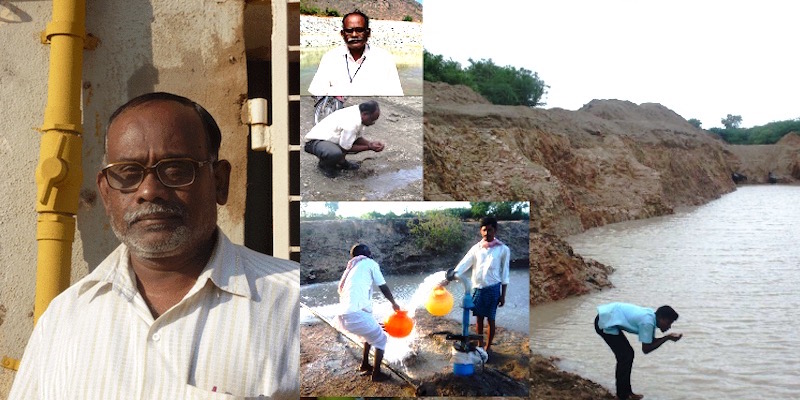
Ayyappa Masagi has a simple message: “You want water? Call me!” Thousands have. And his phone rings dozens of times a day. There appears to be an endless supply of patients for the man nicknamed India’s “Water Doctor”. “I faced a lot of water problems in my childhood,” he said. “I used to go at 3am to fetch water from the stream. So I made an oath that when I grew up I would find a solution. So I quit my job as a mechanical engineer in 2002 to solve India’s water problem,” Ayyappa told BBC.

India is enduring a catastrophic water crisis. About 330 million people are suffering water shortages after the failure of the last two monsoons. Reservoirs are dry. Farmers have committed suicide. Thousands of drought-stricken villagers have flocked to cities, desperate for water, praying for rain. According to Ayyappa’s calculations, if just 30 per cent of India’s rainwater were captured and stored, “one year’s rain would sustain the nation for three years.”

To prove it, in 2014 Ayyappa bought 84 acres of barren land near Chilamathur, a famously drought-prone region of Andhra Pradesh, 110km northeast of Bangalore. “The wind here was like a firewind. I told my partners, ‘Within one year I will make this land a water bowl.'” Today, a network of 25,000 sand-filled pits and four new lakes capture and store any rainwater that falls here. No drop is allowed to escape into rivers and run off to the sea. It stays on and in the land, keeping the subsoil charged with water which, when needed, is drawn from five shallow bore-wells.

The topsoil from digging out the lakes has helped level the land, which has been planted with trees and crops. Roughly 60 per cent of the trees will form dense forest, while 40 per cent will be fruit trees to generate income. Grains and vegetables have also been planted, and next year there will be a dairy here too. The plan is to make this a sustainable organic farm, totally self-sufficient for all its water needs.

Through his Water Literacy Foundation, Ayyappa is training “water warriors” to spread his message. He’s already written seven books and trained more than 100 interns from India and abroad, including Germany, Japan and the US. “If you only talk, nothing will happen. You have to do something and prove it. Governments are coming forward to take up my service, replicating my model. Once the community attitude changes, our political attitudes change, we can replicate this concept throughout the world.” Earlier, in 2013, Yourstory had published a story on Ayyappa.

(Source: Your Story)

Friday, 10 February 2017

How did Tamil, Telugu, Kannada and Malayalam arise from one Dravidian language family?

Telugu, Kannada, Malayalam and Tamil are related languages belonging to one Dravidian family. Together with another 20 languages, they have evolved from a common ancestral language labeled as Proto-Dravidian.

EARLY SOUTHERN INDIANS
Early Indians were the aboriginal tribes, who spoke various Austro-Asiatic languages. They were the original hunter-gatherers of Southern India, who were assimilated into the mainstream population. These people have left their foot prints among all South Indian languages.

All Dravidian languages still share a common word for hunting derived from Veddah tribe (veta in Telugu). South India was populated by several such Austro-Asiatic tribes. Many of our words for flora and fauna have Austro-Asiatic origins
Veddahs with their primitive weapons. Once their ancestors have populated the entire southern India. 

New Immigrants to Southern India
Around 2,500 BCE, these Austro-Asiatic people were gradually displaced by a new culture. Unlike the hunter-gatherers, these new comers were semi-nomads and animal herders, probably cultivated jowar, ragi, bajra like millets as well.

Their earliest pottery and ground axes in South India date to 3,000 BCE. There is archaeo-botanical evidence for cultivation, from 2,200 BCE, while they probably domesticated cattle, sheep and goats before 2,600 BCE.

Ash Mound Culture
These semi-nomads have created their own unique culture, called the Ash Mound culture. A particularly distinctive aspect of this ancient culture are “ashmound” sites which consist of large heaped accumulations of ash and vitrified material, which are now generally accepted as having originated from burnt cattle dung.

The petroglyphs are works of rock art found in Anantapur, Kurnool of AP and Bellary districts of Karnataka, India. Thousands of petroglyphs have been found, which date to the neolithic or even the old stone age.
Rock paintings at Ketavaram hill range in Kurnool district (AP),

ORIGIN OF DRAVIDIAN LANGUAGES
Ancestors to Ash Mound people spoke a common language labeled as Proto-Dravidian. These ancestors came to South India as a small band of nomads and initially settled along lower Godavari basin. The river name itself has Dravidian origins.

The lower Godavari Dravidian Home land hypothesis was originally proposed by Prof. F C Southworth (University of Pennsylvania). The Dravidian homeland is assumed to be the region with a maximum diversity of Dravidian languages. Because both in genetics as well as linguistics, geographical region with maximum diversity is assumed to be the origin. The rationale is based on the dynamics of population

The red outlined region (above) has the maximum diversity of Dravidian languages and hence it is the most probable origin of Proto-Dravidian language. Please read, Urheimat - Wikipedia. Oldest languages are closest to lower Godavari basin, around the red outlined region.

Now there is independent confirmation from genetic evidence. There is a high frequency of rare Haplogroup-T in coastal Andhra as well as the Horn-of-Africa. This rare haplogroup-T is associated with the neolithic farmers of Mesopotamia. For details please read, Genetics and the Afro-Dravidian Hypothesis

Geographical Expansion
As the population increased, proto-Dravidians began to expand into the neighboring regions. Ancient migrations are known to take place along the river routes because the rivers were the source of livelihood for these semi-nomads, so they expanded progressively and settled along river banks of Godavari, Krishna, Tungabadra and Kaveri and spread out into farthest corners of Southern India . Others have expanded upstream Godavari into Maharashtra and further into Gujarat.
Zdenek Burian: A neolithic settlement

Those who settled along lower Krishna basin became the ancestors to TELUGU speakers. Next, those who expanded westwards along the upper Krishna and Tungabadra into Karnataka became the ancestors to KANNADA speakers. Those who expanded further west became MALAYALAM speakers and finally those who expanded along the Kaveri river became the ancestors to TAMILS.
Dravidian migration along the river routes from Andhra to Karnataka to Kerala and finally Tamil Nadu
As they expanded, they got geographically isolated from each other and came into contact Austro-Asiatic tribes. Their languages evolved into different dialects that ultimately became distinct languages.

CONCLUSIONS
Proto-Dravidian speakers first settled along the lower Godavari basin, next they further expanded along the river routes of Krishna, Tungabadra and Kaveri, gradually displacing the aboriginal Austro-Asiatic tribes. TELUGU ancestors settled along the lower Krishna basin to emerge as a distinct language. Others have further expanded along upper Krishna into Karnataka, westwards to reach Kerala, then southwards along the Kaveri to reach Tamil Nadu. Isolated from each others by mountain ranges and forests, KANNADA, MALAYALAM and TAMIL became distinct languages. Lower Godavari homeland is genetically associated with the Neolitihic farmers from Mesopotamia, as found from the high occurrence of Y-DNA haplogroup-T in coastal Andhra.

References:
  1. Please see page-15 of http://ccat.sas.upenn.edu/~fsout...
  2. Evidence Regarding Dravidian Linguistic Origins
  3. Genetics and the Afro-Dravidian Hypothesis
  4. Franklin C. Southworth, David W. McAlpin. "South Asia: Dravidian linguistic history". Blackwell Publishing Ltd, 2013.
EDIT
Many of the comments posted below seem to be skeptical about the external origins of Dravidians. This is quite understandable because, since the 19th century it is believed that Dravidians were native to India, while the Indo-Aryans supposedly came from outside. This was the very basis for the assumption that Indus Valley Civilization was Dravidian.

However, for a long time, evidence is mounting indicating the external origins of Dravidians. First, a setback to Dravidan Hypothesis came when it failed to decipher the Indus Valley Script. Next, conclusive evidence came from the craniometry measurements of human skulls from Indus Valley. It proved that Indus Valley people were similar to the existing populations of Haryana and Punjab, not the Dravidians of south. This is a categorical and positive evidence against the Dravidian hypothesis.

If the Dravidians were not IVC people, then who were they? How does one account for the presence of Haplogroups ‘L-M20’ and ‘T’ that spread with the ancient neolithic farmers of Mesopotatmia? How does one account for the cultivation of African pearl millet in the Deccan plateau? There are many other linguistic and cultural features that indicate the external origins of Dravidians.

(Source: Quora)

Wednesday, 1 February 2017

Lust in the name of god: Temple prostitution in India

After centuries of traditionally imposed prostitution, young girls in Wadia village near Palanpur are, for the first time, getting ready for a mass marriage. Wadia is known for being the ‘village of prostitutes’ in Gujarat, where young girls are trained to provide sexual services as soon as they attain puberty. Seven girls above 18 years of age will take part in the mass marriage.

Wadia has a population of 750 people of which 100-odd women are believed to be involved in prostitution since pre-Independence days. The men of the families often live off the women’s income, pimping clients.

The fate of girls in the village of Wadia might be on a road to transformation, but what about the countless number of women in India who are still engaged in forced temple prostitution under the garb of traditional customs like the Devadasi system?

The caste system is in Hindu religion has many manifestations. It has not only divided the society in to various layers of graded hierarchy but has also created inhuman practices in the name of God. One of it is the Devadasi system prevalent in different forms all over India.

This cult is prevalent even today throughout India with some regional variances. Young girls are dedicated or married to, not a mortal-man, but an idol, deity or object of worship or to a temple. The barbarism of the tradition reflects in the very rituals it involves. The initiation ritual is said to include a ‘deflowering ceremony’, known as Uditambuvadu in some parts, where the priest would have intercourse with every girl enrolled at his temple as part of his religious ‘duty’. So much so that a Marathi saying states “Devadasi devachi bayako, sarya gavachi”, meaning ‘Servant of god, but wife of the whole town’. The Devadasi is from the lowest caste, whose parents have given them to local goddesses or temples as human ‘offerings’. She has to remain unmarried, and maintain herself by ceremonial begging to make ends meet.

There are various myths around this inhuman practice. This system is based on the traditional belief in Andhra Pradesh that evil over the family or the village can be avoided by dedicating a girl in the family to the temple deity. As soon as she reaches puberty, she becomes a concubine for the feudal gentry in the village.

In Maharashtra, these women are made to sacrifice their first-born daughters. When she becomes of marriageable age, she is formally married to Khandoba, the deity and becomes his ‘nominal wife’.

In Karnataka, there is a traditional belief that when there is famine, drought or an epidemic, to appease gods and goddesses, a lower-caste girl is dedicated to the local goddess Huligamma. The Banchara, Rajnat, Dommara and Bedia tribes in Madhya Pradesh also practice traditional prostitution.

There has been influence of the Devadasi tradition on the Muslim community as well. Some Muslim sects started offering girls to dargahs. The girl is then married to the Qu’ran. After the nikah is performed, the girl is called a bibi and is condemned to lead a life of prostitution.

Married to God before puberty, Devadasis or Joginis, many of whom live in the temples, become sexual servants to the villages’ upper-caste men after their first menstrual period. In some villages, men who buy them keep them as concubines. In others, they are public chattels, who are used by men free of charge. Socially, they are outcasts and they do suffer from severe venereal and sexually transmitted diseases. A majority of Devadasis, after reaching a certain age, migrate to towns where they join brothels and become commercial sex workers.

Some of the states where the Devadasi practice are still prevalent have tried to eradicate it through state laws like the Bombay Devadasis Protection Act, 1934, the Prohibition of Dedication Act, 1982 of Karnataka and the Andhra Pradesh Prohibition of Dedication Act, 1988.

However, the practice lives on in the states in South India mainly in Karnataka, Andhra Pradesh and Tamil Nadu. Districts bordering Maharashtra and Karnataka are known as the ‘Devadasi belt’ of the country. According to the National Commission on Women of India, it is estimated that around 2,50,000 Dalit girls are dedicated as Devadasis to Yellamma and Khondaba temples in the Maharashtra-Karnataka border.

There is a separate residential area allotted for the ex-Devadasis families, which is outside the village just like the Dalits. All the families of ex-Devadasis are headed by women. Andhra Pradesh and Karnataka Government have also allotted a few acres of land to each Devadasi family. But the stigma attached to their identity cannot be removed through these mere rehabilitation program.

Village communities are not ready to accept ex-Devadasi families. So, the Devadasis, through the support of the local NGOs, organise themselves to form cooperatives. Through this, they have started income-generating activities. Very few of them are able to get married legally.

But, this move out of the traditionally prescribed structure cannot be without obstacles. The decision to marry girls in Wadia has not gone down well with the male touts of the community, as young girls fetch a higher price when first introduced to the trade. Fearing they will lose the girls, they have made some threats to the organizers. A local guardian of the girls and leader of Vicharti Jaati Samuday Samarthan Manch, which got the girls and their families ready for marriage, has also filed a complaint with the police.

Nevertheless, there is a ray of hope. The women of the community have built a support system for themselves and are determined to move out of the oppressive flesh trade they have been caged in for centuries now. The example of the Sarania women in Gujarat should be seen as a breakthrough and should inspire women suffering under the Devadasi system to move out of these traditional shackles.

(Source: Youth Ki Awaaz)