My French grandmother came to the US to escape the Nazis. What did a box of letters and photographs reveal about the sacrifice she made?
When my grandmother died I did not go to her funeral. I was 16 at the time, so it wasn’t that I was too young. Instead, the agreed family line was that I was too sick, in between hospital stays for anorexia. But even if I’d been in the rudest of health I wouldn’t have gone. All my life, I’d avoided my grandmother – why would that change now that she’d died?
Of course I loved my Grandma Sala, but I enjoyed her a lot more in theory than in practice. I loved how beautiful she was, and that she was French; having a French grandparent, albeit one who lived in Miami, seemed incredibly exotic when I was growing up in New York. She told me to call her grande-mère, and you’d better believe that I dropped that into conversation with friends at any opportunity, along with references to how “chic” she was, another word I learned from her.
 |
Sala Glass, Hadley Freeman’s grandmother in the early 1930s: ‘She was chic, incredibly so. But she never stopped seeming sad to me.’ Photograph: courtesy of Hadley Freeman
|
My grandmother always looked as if she was on her way to a fashion show, even when she was going to the supermarket
And she was chic, incredibly so. While other Jewish grandmothers in Miami wore shapeless shift dresses and garish prints, my grandmother always looked as if she was on her way to a fashion show, even when she was going to the supermarket. Her American husband, my Grandpa Bill, dressed the part of a true Floridian, in his white trousers and pastel golf shirts, and he would sit with us by the pool, letting my sister and I twirl his handlebar moustache. My grandmother, however, would sit alone – under an umbrella, separate from us, reading the French fashion magazines her brothers still sent her from Paris.
She wore distinctly French styles – Yves Saint Laurent-like peasant tops, Chanel-esque jackets, mini Dior handbag in her lap. She looked as French as my grandfather looked American, the soft, elegant looks of a Renoir painting, but overlaid with the melancholy of an Edward Hopper.
 |
The Glass siblings with their mother in Henri and Sonia’s apartment in about 1932, L-R: Henri, Sonia, Sala, Chaya and Jacques. Photograph: courtesy of Hadley Freeman
|
Bill and Sala were my paternal grandparents and although I loved them both, they did not seem to love one another, or so it appeared to me as a child. When we visited them, they snapped at one another continuously, which scared me because I never saw my parents fight. I loved to talk about my grandmother when she wasn’t there – but when she was, I fled. She would hold me just that bit too close, looking at me as if she was asking for something I knew I could never give.
I squirmed away from a love that felt oppressive, because, for reasons I was in no way capable of articulating then, I found my grandmother difficult. If pressed, I would have said that she was “weird”; but what I meant was that she seemed sad, and sad adults are confusing for children, especially ones as sheltered as I was.
I have one memory of her running away from me. When I was five, my parents took me to Europe for the first time. We went to Deauville, a seaside town in Normandy, to meet my French family – Sala’s family, in other words. I knew that my grandmother had left France a long time ago to escape what was vaguely described to me as “the war”, before marrying my grandfather in New York. But I hadn’t, until we went to Deauville, ever thought about what she’d left behind.
On the first night, we arranged to meet everyone in the hotel dining room: my grandmother’s older brothers, Henri Glass and Alex Maguy, and Henri’s wife, Sonia. Sala flew over from Miami to join us, but that first night she was late. As I waited with my parents and this trio of impossibly old French people, I spotted my grandmother in the doorway, hanging back, watching us. Then I noticed something else: she was crying. She turned around and rushed out of the room.
“What’s wrong with Grandma?” I asked my mother, but she shook her head and put her finger to her lips. I looked to my father. He was looking towards where his mother had disappeared, before going after her.
It was a lovely holiday. Alex Maguy – whose surname was “Glass”, like Henri’s and Sala’s, though he went by Maguy professionally – made the biggest impression: this namedropping art dealer, full of fire and fury, but always gentle with me. Sonia, who looked like a firecracker with her red hair and blue eye shadow, taught me how to play bridge and introduced me to pain au chocolat. Gentle, kind Henri couldn’t speak English, so we would just nod and smile shyly at each other across the table. And then there was Sala, clinging on to Henri’s arm, growing quieter as the week went on.
 |
Sala’s brother Alex Maguy welcoming her and her sons, Ronald (Freeman’s father, front) and Richard, to Paris in 1948. Photograph: courtesy of Hadley Freeman
|
Afterwards, I went back to New York and everyone I met in Deauville slowly, inexorably died. Sala died in 1994 and although she had made a life for herself in America, she never stopped seeming sad to me, and her sadness never stopped unnerving me. I never let her get close, and to this day there is a cold part of me that recoils from neediness. For years afterwards, thinking about all this made me feel things I couldn’t articulate. Again, I probably would have said it made me feel weird, when what I really meant was that it made me feel terrible. So I deliberately didn’t think about it at all.
As I got older, I spent some time with Alex, the last surviving Glass sibling. I’d have lunch with him in his flat, surrounded by his collection of paintings by Monet and Matisse and Picasso, and I’d never question why his supremely glamorous life in Paris was so different from my grandmother’s in Miami. But after he died in 1999, when I was 21, I suddenly couldn’t stop thinking about that and more. I knew there was a story about what had happened to the Glasses during and after the war, but even thinking about it felt like touching a bruise. I started alternately tapping this tender spot, and running away in horror at what I was doing. I spent whatever free time I had in archives in France, Poland and New York, and then hid my notebooks around my flat, kidding myself that I wasn’t doing what I was, in fact, doing.
***
In 2006, when I was working on the Guardian’s fashion desk, I came up with what seemed like a painless way to write about my grandmother: I would write about her relationship with fashion, and how, despite living in the US for almost 60 years, she had used her clothes to emphasise her un-Americanness.
 |
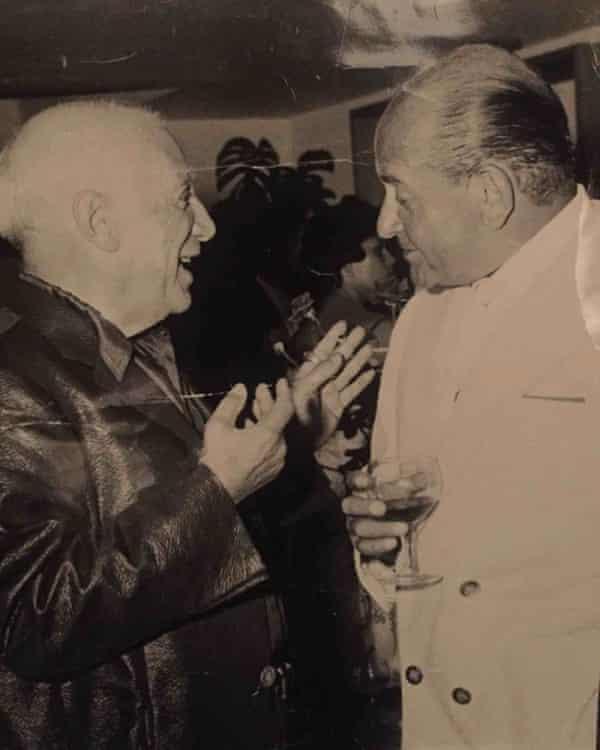
Alex Maguy (right) with Pablo Picasso in the late 60s. Photograph: courtesy of Hadley Freeman
|
My uncle Rich, my father’s younger brother, was living in my grandparents’ former apartment, and fortunately for me, he had kept most of her things. So I flew to Miami, intending to go through my grandmother’s closet and describe her wardrobe, using it as a way to write about her, because writing about her without any proxy still felt too much like staring into the sun. I opened her closet and started to go through her belongings. At the back, I spotted a shoebox, covered in more than a decade’s worth of dust. I was sure it would contain another pair of battered kitten-heeled sandals but, determined to be thorough, I pulled it out. It did not contain sandals. Instead, inside were the secrets my grandmother had kept all her life.
They included:
A small album featuring photos of Alex, Henri and Sala, younger than I’d ever seen them before. There were also photos of Sala embracing a man whose face had been gouged out by someone’s – presumably my grandmother’s – fingernail;
Photos of a man I’d never seen before with round spectacles. In some photos he was with a group of other men, standing in or next to a cabin;
A letter in French saying that “la famille Glass” was hiding in Paris under an assumed name;
Letters between the Glasses spanning over half a century;
Photos of Alex Maguy with Pablo Picasso;
A sketch of a man holding a gun to his head that was signed, “Avec amitié, Picasso.”
For the next 13 years, I followed these clues, often feeling like Casaubon in Middlemarch, the silly fool who embarks on an impossible book project that he never finishes. Originally I planned to write just about my grandmother, not her brothers, but it quickly became clear that this was impossible: their lives were completely entwined. Also, Alex, Henri and the third brother, Jacques – the man in the round glasses whom I had never met – each had extraordinary and strikingly different stories, and I couldn’t let them fade away, like old photos in the back of a closet.
Her brothers led lives of masculine adventure. My grandmother, on the other hand, represented the quiet feminine
I learned that Henri invented a machine that microfilmed and shrunk down documents, and that during the war he had travelled in secret all over France with his machine, saving public and private archives from Vichy and Nazi forces. After the war, Henri’s microfilms helped to rebuild towns and ports. Multiple times, he was nearly arrested and saved only by the fake ID card Sonia got for him on the black market, which said he was a Catholic named Henri Classe. After the war, this machine would make him enormously wealthy.
Sonia, who stayed hidden in Paris during the war, was in even worse danger; although her German was good, it’s not easy for a firecracker to stay in the shadows. She moved out of her and Henri’s apartment in central Paris and rented one under a false name by the Bois de Vincennes. But her former neighbours frequently pinned denunciation letters to her door, attempting to turn her in to the Gestapo. Sonia would rip them off and, in one case, posted a note to my grandmother in the US, to let her know what was happening.
 |
Sala (centre) with Alex and a friend, early 30s. Photograph: courtesy of Hadley Freeman
|
Jacques, the brother I never met, was arrested in 1942 and sent to Pithiviers, a French concentration camp. He also posted my grandmother memorabilia to keep her updated, in this case, photos of himself and his fellow prisoners. Incredibly, he was allowed out for a day to visit his newborn daughter. Henri and Alex met him by his wife’s bed and begged him to go into hiding, saying they would help him. But Jacques refused, because he had given his word to the prison guards. So he went back and soon after was shipped out – on the same train as Irène Némirovsky,
author of Suite Française – to Auschwitz, where he was killed.
By far the most time-consuming brother to research was Alex. The files on him, which were scattered across France in various archives, were so fat they took me years to go through. Originally a couturier, whose closest friend in the business was Christian Dior, Alex joined the Foreign Legion as soon as war was declared, and was awarded the Croix de Guerre for his bravery in combat.
But when France fell to the Germans, he was arrested and put on a train to the camps – which he escaped by climbing out through the roof and jumping off. Alex spent the rest of the war hiding in a farmhouse in central France – which I eventually found – while working for the resistance. Afterwards, he switched careers from fashion to art and was a celebrated gallerist in Paris. Picasso drew the poster for one of his most important exhibitions and the two men became close friends, initially because the artist so admired Alex’s wartime record.
Henri, Jacques and Alex led lives of masculine adventure, which were recorded in official archives. My grandmother, on the other hand, spent the war as a housewife in Long Island. She represented the quiet feminine: domestic, private – what George Eliot described as “a hidden life”, one of “unrecorded acts”, filled not with adventure but emotional drama, and that is not something I would find in an archive. Instead, I needed to talk to those who knew her best, and that meant her sons – my father Ronald, and my uncle Rich. I dreaded hurting them by asking difficult questions, but it turned out that what had hurt them most was feeling they had to keep these stories to themselves. Slowly, Sala’s life, one she’d always kept in the shadows, came into focus.
***
Despite seeming like the embodiment of Frenchness to me, Sala and her brothers weren’t French at all; they were Polish. They were born and raised in Chrzanów, then famous for its large market place, but better known today for being only 20km from Auschwitz, so close that the towns considered themselves to be sisters. In 1918, the pogroms began and the Glass family fled to Paris, to join their cousins, the Ornsteins. These pogroms terrified the Glasses but ultimately saved their lives, because any Jew who was still in Chrzanów at the beginning of the second world war was killed.
 |
Sala and Bill with their granddaughter Hadley in the late 70s. Photograph: courtesy of Hadley Freeman
|
The siblings fell in love with Paris: its beauty, its sense of style and, of course, its safety, which was to prove all too transitory. Henri and Sala made themselves over to be as French as possible, and with the enthusiasm of converts, lost their Polish accents and dressed in the most Parisian of clothes, which Alex made for them.
All of them worked in the fashion business – or “schmatte” trade, to use the Yiddish term. Fashion – like the movie industry today – was then considered a Jewish industry, specifically a Jewish immigrant industry. Partly this was a practical issue: in contrast to many other professions at the time, there were no quota limits on how many Jews could work in it. On a more emotional level, fashion (like art, another profession that was then heavily Jewish) is an industry that celebrates beauty. It is not surprising that Eastern European Jewish immigrants, who had experienced so much ugliness in their lives, might crave a corrective.
Alex and Jacques ran a tailoring shop in the Marais, the then Jewish quarter in Paris, and Sala, a talented artist, made patterns for mass-produced clothing: swirling, psychedelic drawings filled with colour, excitement and happiness. At 25, she was independent, living in a city she loved, with a family she adored, and was engaged to a young man – a dentist and socialist – with whom she was deeply in love. And then in February 1937, it was all taken away from her.
The American man reached across the table and told her he’d fallen in love with her at first sight. Marry me, he begged
One night, Alex brought an American man over to Sala’s apartment for dinner. He was, Alex told her, a millionaire from Manhattan. Suddenly over dinner, the American man, who had been staring at Sala since he arrived, reached across the table and told her he’d fallen in love with her at first sight. Marry me, he begged, come with me to America. Sala laughed this off, but after the American left, Alex – who closely followed what was happening in Germany – told her she had to do it, because staying in Paris was a death sentence. This guy was rich and a good friend, Alex said; she’d never get a better offer. To Sala’s horror, Henri agreed, and so, in what must have been a state of shock, in June 1937, Sala sailed to New York, to marry a man she didn’t know, leaving behind everything she loved.
When she arrived and her beaming husband-to-be drove her to her new home, she realised some things pretty quickly: this man was not a millionaire, he did not live in Manhattan, and he did not work in the fashion business. He didn’t even really know Alex. He ran a gas station out on Long Island and he just happened to meet Alex one day while on holiday in France. Alex, banking on my grandmother’s beauty to woo this man, had then lied to her in the hope of getting her out of Europe. This is how my grandparents met.
My grandfather Bill loved Sala very deeply, and would do so for the rest of his life. But while she appreciated him as a good man and a good husband, she didn’t love him the same way, and this hurt him. She was miserable in his small town and complained often, to his astonishment. Hadn’t he saved her from the Nazis? She was a lot less grateful than he’d expected. She was no longer making the art she loved; instead, she was a housewife and dependent on a man she barely knew. The fights started soon after they married. She was all alone in this strange place, and once the war started, she spent years not knowing whether her family was alive or dead.
By the end of the war, she was the mother of two sons. There was no way she could survive as a single mother in Paris, a city emotionally and economically destroyed by the war. So she resolved to wait until Bill died, when she could return to France. The grandmother I met 40 years later was someone who was still waiting for her life to begin.
Sala endured a specifically female tragedy: she gave up her true love, her dreams and professional fulfilment for protection by marriage with someone she did not love. Alex got a medal for going to war, but no one was going to give her plaudits for what she did. On the contrary, this kind of self-sacrifice was so expected of women that, in the eyes of those around her, it would have been extraordinary if she had refused to do it.
The story of my grandmother confused people, especially Jewish Americans, who understandably assume that any story about escaping the war to the US is a happy one. But individual lives are more complicated than great sweeps of history, and while Sala was alone and frustrated in America, Alex and Henri went on to live gloriously successful lives in France. Sala had done what she had to in order to survive, but in saving herself she lost everything that had made her life worth living. Other things took their place – her children, eventually her grandchildren – and she was demonstratively affectionate to them, naturally loving, but also desperate to justify to herself the path her life had taken. If she loved them enough, if they loved her enough, then maybe it would have been worth it. This is the need I sensed in her as a child, but was too young to understand.
Sala never saw her former fiance again; he almost certainly died in the war. She also never lived in France again. Thwarting his wife to the very end, Bill lived into his 90s, and just as he started to decline, Sala had a massive stroke that stilled both her body and her tongue. At Bill’s funeral, people remarked on how affecting it was to see her in her wheelchair, crying silently as she looked at her husband’s coffin. But she wasn’t sad that Bill had died. She was sad that the day she had waited for had finally come, and it didn’t matter any more. All those fantasies of living in Paris, of travelling to Israel: all gone. Two years later, she died in a US hospital, far from the place she still thought of as home, 60 years after leaving it.
***
Once the Glass siblings died, my extended family drifted apart. None of us were good at staying in touch, and we’d all got the same message from the Glasses: that the past should be pushed away and not discussed. So didn’t that include our own families? But as perhaps Jews know better than most, you can never entirely escape your past.
 |
Freeman’s grandparents Sala and Bill in Long Island, mid 50s. Photograph: courtesy of Hadley Freeman
|
Once I finally started to slough off the anorexia that had blanketed my teens and 20s, I realised there was some kernel in me, one that I could neither explain nor understand, that meant I wanted to work in fashion. Like the Glasses I, too, wanted to see beauty.
After finishing university, I lived in Paris and started working as a freelance fashion journalist. This eventually translated into the job on the Guardian’s fashion desk, where I was to stay for eight years. One of my favourite parts of the job was covering the shows and one day, when I was at the Dior show in Paris, I felt a hand on my shoulder.
“Aren’t you my cousin?” asked a handsome man. It was Alexandre de Betak, Henri and Sonia’s grandson. He worked then – and still does – as a fashion show producer, collaborating with brands such as Calvin Klein and Yves Saint Laurent. But probably his most enduring relationship has been with Dior, whose shows he has worked on for years, just as Alex Maguy’s strongest relationship in France was with Dior himself. Neither De Betak nor I knew of this connection until I started researching this book.
Soon after that, I met another cousin, Philippe Ornstein, the grandson of one of the Glasses’ cousins, Maurice Ornstein, who was killed in the war. Philippe and I also found each other through fashion: he was then working as a fashion publicist, and when we met it felt as if we had grown up together.
For decades, I ran away from this story, researching it with my right hand and fearfully covering my eyes with my left. I told myself that it was self-indulgent to write my family history – who would be interested in reading about Grandma? But the truth is, I just found it too painful to leave alone, picking at it like a scab. Even before I knew the details of Sala’s story, I’ve always known that I would not exist if the Holocaust hadn’t happened – because then Sala would never have come to America. For a long time, this added another dimension to my well-established sense of Jewish guilt: that I was alive only because of the suffering of other people, and one person in particular – my grandmother. But Sala would not have seen it that way. In her eyes, we were not the compensation for what she had left behind but the explanation for it. I had avoided her sadness when she was alive, but two decades after her death it still felt so palpable to me that my research took up an entire bookshelf – and still, I couldn’t bear to write the story. Then in January 2018, I sat down and did just that.
It is probably no coincidence that I finally committed in the shadow of the Brexit referendum and Donald Trump’s election. Neither of these political shifts were about keeping out the Jews, but they were about keeping out immigrants, and the story of the Glasses was one of immigration, from Poland to France, and France to America. Alongside that, antisemitism was on the rise throughout Europe in a way I never thought I’d see in my lifetime, on both the right and the left.
A 2018 survey found that one in five Europeans believe Jews have “too much influence in the media and politics”.
In France, antisemitic acts
rose by 74% between 2017-2018. As I was writing, furious arguments raged across British politics about antisemitism, particularly within the Labour party, where non-Jews on the left suddenly felt very comfortable telling Jews that they knew better what is and isn’t antisemitic. At the same time,
reports of antisemitic acts in Britain rose every year as I worked on the book, culminating in 2019 with 1,805 incidents, the highest number in 35 years. Meanwhile,
41% of Americans now don’t even know what Auschwitz is. Reading these news stories quashed any concerns I had that writing about the past, or my family, was self-indulgent.
But my obsession with this story had little to do with political prescience on my part. Instead, it was because of the people involved, each one such an extraordinary force of personality that I couldn’t shake them off decades after they died.
Sala had longed to move back to Europe, to be with her family, to have lunches in Paris with them, to go to the fashion shows, to live the life of her choosing. She never got to do that – but I do. Because she gave up everything, I get to live her dream. I think of her every time I walk along the Boulevard Saint-Germain; when meeting one of my cousins for lunch in the Marais; when I go to a fashion show. I think of all the Glasses every time my train pulls into the Gare du Nord – how they arrived in Paris from Poland by train a century ago, knowing no one and owning less. How far they went in their lives; how politics and fate tore them apart. And I think of how we all came back together, in the end.