Thursday, 29 November 2018

In Mount Everest region, world's highest glaciers are melting, receding

In this photo essay, the editor of the Nepali Times, Kunda Dixit, describes the dramatic changes underway in the ice and snow of the Himalayan Mountains.

For many tourists trekking to Mount Everest Base Camp, the trip is an adventure of a lifetime. The thin clear air, stark landscape and ice-tipped peaks pierce the inky sky providing Instagram backdrops.

However, what is stunning scenery to tourists is for climate scientists an apocalyptic sight. They see dramatic evidence all around of a rapidly warming atmosphere.

Visitors returning to the Everest region after many years will notice changes in the landscape: large lakes where there were none; glacial ice replaced by ponds, boulders and sand; the snowline moving up the mountains; and glaciers that have receded and shrunk.


All these features are visible from ground level right from the start of the trek in Lukla. The banks of the Bhote Kosi, part of the river system that drains the slopes of the Himalayas in Nepal and Tibet, still bear the scars of a deadly flash flood in 1985 that washed off a long section of the Everest Trail and the hydropower plant in the village of Thame. The flood was caused by an avalanche into the Dig Tso, a glacial lake.

Further up, near the village of Tengboche, the Imja Khola bears signs of another huge glacial lake outburst flood that thundered down the western flank of Ama Dablam in 1977. And below the formidable south face of Lhotse is Imja Tso, a lake 2 kilometers long that has formed and grown in the last 30 years. It does not exist on trekking maps from the 1980s. All these lakes were formed and enlarged as a result of global warming melting the ice.

Imja Tso, a glacial lake, did not exist on trekking maps 30 years ago. Today it is 2 kilometers long and 1 kilometer wide. Credit: Kunda Dixit/Nepali Times
"When I look at the Nepal Himalaya, we can see this is global climate change impact on fast-forward," said Dipak Gyawali of the Nepali Water Conservation Foundation and the Nepal Academy of Science and Technology.

Green and blue meltpools on the North Ama Dablam Glacier, where the vanishing icefall has exposed the eroded bedrock below. Credit: Kunda Dixit/Nepali Times
The Lobuje Icefall is now a hanging glacier, having retreated above the cliff. Credit: Kunda Dixit/Nepali Times
The terminal moraine of the Khumbu Glacier looms 400 meters above Dughla, a rest stop for climbers. This is the debris bulldozed down from Mount Everest and surrounding peaks over millions of years and represents the extent of the glacier's advance in the last Ice Age. Today, the surface ice on the world's highest glacier is all but gone due to natural and anthropogenic warming.

Khumbu Glacier, the world's highest glacier, has retreated as the planet has warmed. Its lower portion is largely covered by debris. Credit: NASA Landsat 8 image by Jesse Allen and Robert Simmon
For a dramatic glimpse of how global warming is changing the Himalayan landscape, there is nothing like the aerial perspective. The barren beauty foretells of a time when this terrain will be stripped of much of what remains of its ice cover.

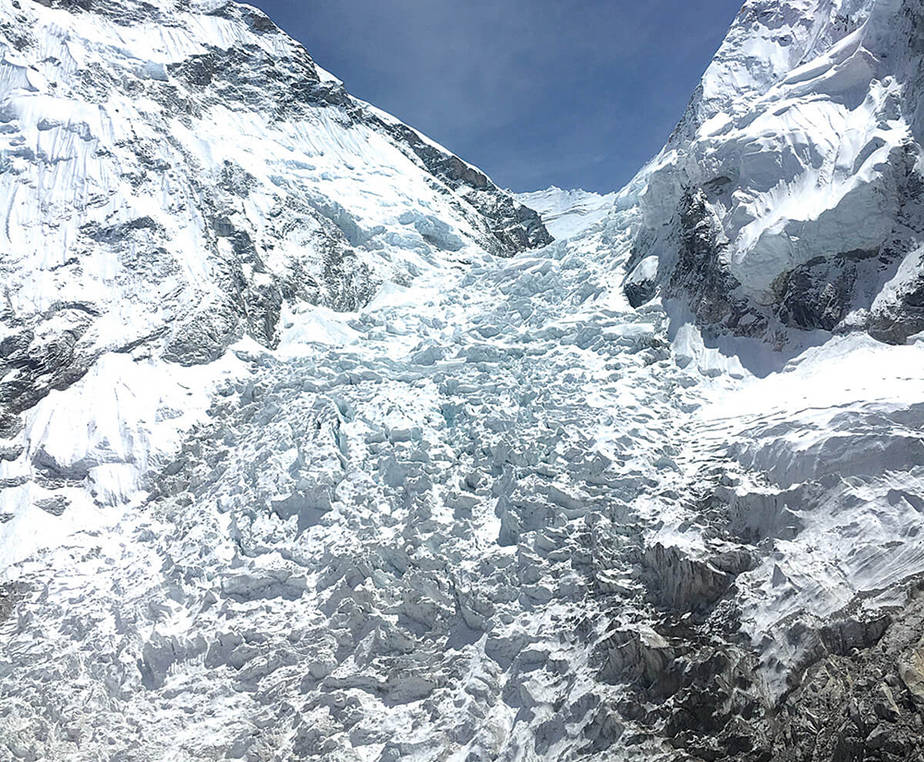
The Khumbu Icefall carries debris and ice from the Western Cwm to the Khumbu Glacier, 1,000 meters below. Credit: Kunda Dixit/Nepali Times
The Khumbu Icefall funnels ice from the Western Cwm below Everest, Lhotse and Nuptse to the glacier below. The ice here has receded at an average of 30 meters per year in the past 20 years, but it has also shrunk vertically, losing up to 50 meters in thickness. Everest Base Camp was at 5,330 meters when Sir Edmund Hillary and Tenzing Norgay climbed Mount Everest in 1953; today it is at 5,270 meters.

A map shows base camp and how a key climbing route up Mount Everest changed after a deadly avalanche in 2014. Credit: Gregory Leonard, with data by Digital Globe and Mark Fahey/USGS, via NASA
The glacier is also getting flatter: the darker debris makes the ice beneath melt faster near Base Camp, but the thicker layers of boulders and sand further down insulate the ice. Glaciologists say this flatter profile means the ice moves slower, leading to more ponding and more rapid melting of the ice underneath.

The velocity of the glacier is about 70 meters per year at Base Camp, and it slows to about 10 meters per year further below. It's zero at the terminus at 4,900 meters. This means the ice is decelerating as it is squeezed, and the pressure is being released by the melting of the ice mass.

Khumbu Glacier is receding at about 30 meters per year and shrinking: Base Camp is now 50 meters lower than when Sir Edmund Hillary and Tenzing Norgay climbed Mount Everest in 1953. Credit: Kunda Dixit/Nepali Times
Researchers monitoring the supraglacial ponds say their area has grown by 70 percent in the past 10 years alone. The ponds are fringed by ice cliffs and caves that accelerate the melting. The melted ice has carved an outflow channel through the left lateral moraine, so there is no large glacial lake on the Khumbu like elsewhere in Nepal.

Scientists conclude that the Khumbu Glacier is not about to vanish, and the Icefall is not going to turn into a waterfall any time soon. However, the permanent ice catchment of the glacier above 6,000 meters could start to deplete under a worst-case scenario of 5 degrees Celsius warming.

(Source: Inside Climate News)

Concrete jungle taking shape atop Chamundi Hills

Rise in number of houses has led to leaking UGD pipelines, garbage heaps

“There used to be barely 100 houses here till a few years ago. Now, there could be more than 700,” rued Subbanna, an 85-year-old long-time resident of Veera Madakari Nayaka Street atop Chamundi Hills.

Even as the environmentalists have their daggers drawn against the State government for taking up developmental works including construction of a multi-level parking lot to accommodate 600 cars and 50 buses and a commercial complex to house 116 shops atop Chamundi Hills, the number of houses atop the hillock, which draws a large number of tourists and pilgrims, is perceptibly increasing.

Even though the Chamundi Hills Gram Panchayat officials deny having issued building licenses, house construction activity appears to be going on unabated.


Illegal
“Only 80 to 90 houses, which were built a long time ago, are authorised. The rest had been built illegally”, said Poornima, Panchayat Development Officer of Chamundi Hills Gram Panchayat. During the last count, there were about 380 houses, she said.

“Whenever people approach us for a licence to build houses, we ask them to bring a no-objection certificate from Forest, Archaeology and Muzrai Departments. So, we have not issued any building licences. When we serve notices against illegal construction, pressure is brought upon us from higher-ups”, said Ms. Poornima.

Property tax
Chamundi Hills Gram Panchayat member Rathnamma, who admitted that the number of houses atop Chamundi Hills had increased several fold in the last few years, said property tax was being paid only by around 60 houses.

The increase in the number of houses has already brought pressure on the infrastructure, leading to leaking UGD pipelines and mounting heaps of garbage.

Ms. Poornima regretted that a survey of the land atop Chamundi Hills had not been taken up.

“It is up to the Revenue Department or the Forest Department to crack down on encroachment and illegal construction”, she said.

(Source: The Hindu)

Autism prevalence now 1 in 40 US kids, study estimates

A survey of parents across the United States estimates that one in 40 children has autism spectrum disorder, according to a study published Monday in the journal Pediatrics.

In other words, the condition was reported in 2.5% of children, representing an estimated 1.5 million kids ages 3 to 17.

A report released this year by the US Centers for Disease Control and Prevention estimated the prevalence at one in 59 children or about 1.7%, based on 2014 data.

"Prevalence is not growing that rapidly, although the CDC's data suggests it is still growing," Thomas Frazier, chief science officer of the advocacy organization Autism Speaks, said in an emailed statement. He was not involved in the new report.

"What is happening is that these studies use methods that are a bit more liberal and inclusive than the CDC's methods," Frazier said, adding that he prefers the CDC's numbers but understands "that they are likely a bit conservative."

The new study is based on the 2016 National Survey of Children's Health, which was conducted by the US Census Bureau and which collected information from parents of more than 50,000 children up to age 17. To be included in the estimate, parents would have had to report that their child had ever received a diagnosis of autism spectrum disorder and that they currently had the condition.

The new numbers were also slightly lower than those in the 2017 National Health Interview Survey. It estimated that 2.76% of children had ever received such a diagnosis, which the authors of the new report note is a broader definition.

The fact that the new study relies on parental reporting -- which is not validated by health and education records, as in the CDC report -- may be a limitation despite the broad scope of the research, the authors say.

Frazier said the 1-in-40 figure is "generally consistent with previous parent surveys and other direct prevalence studies where researchers directly screen for and attempt to identify autism."

The parents in the new study also reported more difficulties getting the health care their children need, versus those with Down syndrome, or other behavioral disorder, such as attention-deficit hyperactivity disorder.


"Though we've seen progress in recent years, this confirms what we know from our parents -- that many children face unacceptable delays in getting a diagnostic evaluation, even after parents, teachers or other caregivers have recognized the signs of autism," Frazier said.

In the new study, more than a quarter of children with autism spectrum disorder were taking medication for symptoms related to the condition, and nearly two-thirds have received "behavioral treatments" in the past year, the study says.

It also found a higher prevalence for autism spectrum disorder among certain groups such as boys, children of single mothers and households below the federal poverty level, compared with those at least four times above that income threshold.

The differences between the new study's numbers and those of the CDC study might be explained by the years they were conducted, the ages of children studied and where they lived, according to the new study.

The CDC report was based on data collected from 11 communities across the country but was not necessarily nationally representative, according to that report's co-author Daisy Christensen, surveillance team lead in the developmental disabilities branch of the CDC's National Center on Birth Defects and Developmental Disabilities.

"Parents know their child best," Christensen, who was not involved in the new report, previously told CNN. "We want to encourage parents to be aware of their child's development, to be aware of the milestones that children achieve."

Autism spectrum disorder, a lifelong developmental disability, is characterized by problems with communication and social interaction with accompanying repetitive behavior patterns.

The authors note that it's difficult to compare the new report with prior iterations due to updates in how the survey collected its data and how questions were worded.

"We cannot tell what proportion was explained by internal survey changes rather than external factors," the authors wrote.

Still, the report comes as estimated prevalences of the disorder have been rising for decades.

"Over the '80s and '90s, the diagnostic criteria expanded to include more children," Christensen said, "so I think that's definitely a possibility for the increase that we've seen."

In the past, more than half of children identified with autism also had intellectual disability, and now it's about a third, she said. "And that's really consistent with identifying children who are perhaps at the milder end of the spectrum."

The new study's authors also note that universal screening recommendations in the 2000s may have led to a rise in prevalence among younger children, for example.

"Because there is no biological marker, [autism spectrum disorder] is a particularly challenging condition to track," the authors note.

But understanding how common it is allows health experts to distribute resources and get families the help they need, according to Frazier.

"Having prevalence estimates -- even if there is some variation -- helps us to advocate for improved screening, diagnosis, interventions and supports," he said.

(Source: CNN)

Wednesday, 28 November 2018

The woman who decides if men can take a second wife

Islamic law, also known as Sharia, is often associated by critics with harsh punishments and hardline attitudes. But one of Malaysia's first female Sharia high court judges says her role gives her an opportunity to protect women in the Muslim-majority nation.

Judge Nenney Shushaidah presides over five trials a day and can hear up to 80 cases a week.

Malaysia practises a moderate form of Islam but conservative attitudes have been on the rise and the use of Sharia is growing as well. Under a dual-track legal system, thousands of Muslims use it to settle moral and family matters. Non-Muslims are required to follow secular laws that deal with the same matters.

She passes judgment on everything from financial cases to those involving the Sharia concept of Khalwat [unmarried Muslim couples being caught in compromising situations].

But her expertise lies in child custody and cases of polygamy - the Muslim concept of allowing men to marry up to four wives, which is legal in Malaysia.

Judge Shushaidah says there are many factors she considers before, for example, allowing a polygamous union.

"Every case is complex and different," she explained. "You can't generalise Islamic law and say it favours men and treats women badly... I want to correct that misconception."

Malaysia is a Muslim-majority nation

All those involved in a proposed polygamous marriage are required to be physically present in Judge Shushaidah's court.

"I want to hear from everyone, not just [the] men," she said. "I make it a point to speak with women to find out if they are on board with the arrangement. It is important that they agree to it because if I see any signs that say otherwise then I won't grant permission."

"I am female and I can understand most women would not like the idea. But it is allowed under Islam, and our Malaysian courts have enacted strict laws to govern this."

"A man has to have very strong reasons for wanting another marriage," she said.

"He must show he can look after the welfare of his first wife as well as the women who come after. He is not allowed to neglect the needs of anyone."

Judge Shushaidah added that some wives can be supportive of the idea.

'My robes remind me of the heavy responsibilities that come with being a Sharia judge'
She recalls, for example, a case which involved a seriously ill woman who could no longer bear children.

"She loved her husband and wanted me to grant him permission to marry a second wife. So I did."

She defends her religion's reputation for strict laws by arguing that it is capable of fairness.

But critics and rights groups argue Sharia is often misused.

"We have no objection to Sharia law that doesn't discriminate against women, gay people or social and religious minorities," Asia deputy director of Human Rights Watch Phil Robertson told BBC 100 Women.

"But the problem with Sharia law in Malaysia is that too often it does precisely that.

"Religion is never an acceptable reason to violate international human rights standards of equality and non-discrimination."
Critics and rights groups argue Sharia is often used to discriminate
For example rights activists were outraged by the recent caning of two Malaysian women convicted of attempting to have lesbian sex, and say Sharia law was misused in this case.

Judge Shushaidah would not address the case, but said: "Caning under Sharia law serves to educate offenders so as not to repeat the act again."

Judge Shushaidah also argues that Sharia does not always rule in favour of men.

"Our law exists to protect women's rights. It looks at their welfare and safeguards their livelihoods," she said.

"Islam holds women in high regard and as judges, we must return to its teachings and maintain worthiness using Sharia."

Her greatest concern lies with Muslim men bypassing strict Sharia court procedures by marrying overseas.

"He wouldn't be bound by Malaysian law if he marries abroad. Some wives actually consent to this to protect their husbands but they don't realise how it works against them," she said. "Our Sharia laws are in place to protect the interests of women and hold men accountable."


Women's groups like Sisters in Islam highlighted a "severe shortage of female representation" in the courts and a "strong sense of patriarchy" in the overall system.

"The Sharia legal context in Malaysia not only selectively discriminates against women, it vilifies them as the cause of social immoralities," said spokeswoman Majidah Hashim.

"State Islamic institutions... have done little to ensure women are accorded due justice. In fact, the recent prosecution of women under Sharia law clearly shows that their voices are alarmingly silenced and access to justice is worryingly stifled."This makes Judge Shushaidah's appointment a particularly significant one.

"Back in my day, most Sharia judges were men who questioned the need for women in the practice," said Judge Shushaidah.

"I never dreamed of becoming a judge," she admitted. "As a lawyer, I didn't know if I could take on such a senior role that dealt with complicated cases. And as a woman, I felt doubt and fear."

"Sometimes I do feel uneasy. As a woman, I must feel, and I'd be lying if I said I felt nothing. But I am a judge and I have to make sure I am always clear and objective. So in my judgment, I try and address this. I make do with the best evidence I get in court."

What is Sharia?
Sharia is Islam's legal framework, derived from the Koran, Islam's holy book; the Hadith, the sayings and conduct of the Prophet Muhammad; and fatwas, the rulings of Islamic scholars.
In Malaysia, it is applied to different degrees across the country's states.

(Source: BBC)

7 haunted places in Delhi that you (do not) want to visit

“Don't go there after sunset, it's unsafe.”

As a child, you must have heard a lot of scary ghost stories, but how many of us actually believe in ghosts? Do they actually exist? Can they be felt?

Believers will give an affirmative answer, while non-believers will perish the thought. But everyone is intrigued by supernatural stories, and the list of haunted places in Delhi offer the curious souls more than just an exciting story.

In case you happen to be in Delhi, you should totally visit these haunted places places at least once. But at your own risk!

I'm not saying you'll see a ghost, but you just never know.

Malcha Mahal
Located within thick forest, the entry to this palace has a signboard saying:


ENTRY RESTRICTED

CAUTIOUS OF HOUND DOGS

PROCLAMATION

INTRUDERS SHALL BE GUNNED DOWN

A community house of 1600 A.D., it was renamed to Wilayat Mahal when Begum Wilayat Mahal of Awadh was gifted the palace by the Government of India in 1985. Malcha Mahal still remains one of the most haunted places in Delhi, with a legacy of agony and death.

In 1993, Begum Wilayat Mahal committed suicide by drinking crushed pieces of diamonds and this gave rise to the sinister and haunted image of Malcha Mahal.

She left behind her two kids, Prince Riaz and Princess Sakina, who still live here, with few Dobermans and some royal treasure. And guess what? They don't keep any contact with the outside world.

Delhi Cantonment

The eerily silent Delhi Cantt finds a mention on the all India list of the most haunted places. Apparently, the paranormal protagonist here is a woman in a white saree who asks for a lift. If she is denied, she reportedly runs at the speed of your car. The woman clad in white sari was supposedly killed while hitchhiking her way to some place.

It is not so much the spirit that gives this place its distinction, but the number of people who have experienced her supernatural presence, making it a popular haunted places in Delhi.

House No. W-3, GK - 1
Legend has it, that house No. W-3 located in one of the posh localities of the city, Greater Kailash 1, has seen the gruesome murder of an aged couple, whose bodies were later found in the water tank.

The residents of the area complain about strange noises, screams and sobs coming from the house with some of them even claiming to see the ghosts of the couple.

Ugrasen Ki Baoli

As per the claims, the Baoli was earlier filled with filthy black water, which mostly attracted disheartened, discouraged and depressed admirers with magnetic effects. The fatal attraction of the mystic waters hypnotised people to their death by alluring them to jump into the waters. It is believed that the "Baoli of the unseen", used to beckon people to offer their lives and raise its water levels.

Feroz Shah Kotla Fort


Built by Sultan Feroz Shah Tughlaq in the 14th century, this fort now lies eerily between a cricket stadium and Delhi's Ring Road, and is supposedly occupied by a multitude of Djinns, invisible to the naked eye.

Every Thursday at the fort, locals come and light incense sticks, and offer milk and grains, in order to calm the ruffled djinns, who they believe can make their wishes come true.

Sanjay Van

Reportedly, a good 10 km stretch of forest is inhabited by spirits of children who can routinely be heard crying and shouting. The real deal, however, is the ghost of the woman in white. The woman is often spotted near the banyan trees, appearing and disappearing, leading to the reputation of Sanjay Van being haunted.

Khooni Darwaza

Khooni Darwaza, literally meaning the “Bloody Gate”, is a monument which has centuries of bloody history attached to it and legend has it that blood drips from its ceilings during the monsoon.

During the partition riots of 1947, hundreds of refugees were murdered at Khooni Darwaza while they were proceeding towards the refugee camp at Purana Qila, and their spirits still haunt this Khooni Darwaza.

Jamali Kamali Tomb

The Jamali Kamali is a marvel of Mughal architecture that built in 1528 right next to Qutub Minar complex. Situated in the Mehrauli Archaeological Park, this mosque was built to commemorate the tomb of prominent Sufi saint Jamali and his supposed partner Kamali.

During daytime the place is filled with people, kids, families and elders enjoying the open space but when it gets dark a different set of stories occupy the place. People are mentioned several abnormal sightings and feelings such as getting slapped by an invisible force, the feeling of someone breathing on their neck, hysterical laughter and the sensation of being watched by someone.

Parthasarthy Rocks
The Parthasarthy Rocks in Jawaharlal Nehru University are popular for being the highest natural point in Delhi. Students and visitors climb to the highest rock and enjoy a panoramic view of Delhi. But given the vast history of JNU, this spot is especially known for a few dark incidents.

Ex-students of JNU tell the story of two Northeastern Indian girls who were raped and murdered near the amphitheatre over a decade ago. It is reported that sometimes past midnight men, only men, hear sounds of girls giggling. The spot where this phenomenon is common, is now called the 'giggling girls' spot because of how often the sounds are heard.

Kamala Nehru Ridge
The Kamala Nehru Ridge is a massive forest area near the Delhi University that is frequented by tourists and residents alike. The place already has a notorious reputation for the horror monkeys spread on visitors.

There is a Khooni Jheel inside the ridge that is considered one of the most haunted places in Delhi. People tell the stories of a group of students who were brought to the Khooni Jheel and ragged horrifically. These students ended up killing themselves in the same spot. People who visit the Khooni Jheel late at night, feel paranormal presence and hear sounds of boy screaming, alluding to the group who died here.

P.S: This article has been compiled by studying various sources online and offline. I'm not trying to create rumours or defame any place. On that note, go ahead and explore away – at your own risk!

(Source: Tripoto)