Showing posts with label drought. Show all posts

Thursday, 13 February 2020

New soil study confirms 1943 Bengal famine was caused by Winston Churchill’s policies, not drought

A group of Indian and American researches simulated soil moisture content during major Indian famines to come to the conclusion.

The 1943 Bengali famine was caused by then-British Prime Minister Winston Churchill’s policies and not drought, a group of Indian and American researchers have found in a study published in the journal, Geophysical Research Letters.
The researchers came to this conclusion by using weather data to simulate the amount of moisture present in the soil during six major Indian famines, those of 1873-’74, 1876, 1877, 1896-’97, 1899 and 1943. Deficit of soil moisture is a key indicator of poor rainfall and high temperatures.
Wikimedia Commons

According to the study, the first five famines were a result of drought, as concluded by the soil moisture study, but not the one that happened in 1943.

“There have been no major famines since independence,” Vimal Mishra told CNN, “And so we started our research thinking the famines would have been caused by drought due to factors such as lack of irrigation.”

Mishra, an associate professor of Indian Institute of Technology, Gandhinagar, has co-authored the study, along with Amar Deep Tiwari, Saran Aadhar, Reepal Shah, Mu Xiao, DS Pai and Dennis Lettenmaier.

The 1943 Bengal famine led to the deaths of an estimated three million people, and is widely believed by several historians to have been caused or made worse by British policies of the time.
A destitute mother and child on the sidewalk in Calcutta during the Bengal famine of 1943-44. Courtesy Kalyani Bhattacharyee, and Sj. Manoj Sarbadhikar/Wikimedia Commons.

The study showed that though the eastern region of India experienced severe drought in the early-1940s, the amount of rainfall was above average in late-1943, a period considered to be the peak of the famine.

The British policies alleged to be the cause of the famine were the heavy distribution of food and vital necessities to the military during the second world war, halting import of rice, and the British government not declaring famine in India.

According to the study, another factor that exacerbated the mortality count of the 1943 famine was the Japanese capture of Burma (now Myanmar), which was a major source of rice imports in India. The study noted that in the past, famines, despite being deadly, could not cause much damage due to rice imports from Myanmar and the British government’s relief aid.

Speaking to CNN, Mishra said that during the 1873-’74 famine, the Bengal lieutenant governor, Richard Temple, saved many lives by importing and distributing food. But the British government criticised him and dropped his policies during the drought of 1943, leading to countless fatalities.

That the 1943 Bengal famine was a result of wilful negligence by the British government was accepted and believed strongly across India for quite a while. In 1981, Nobel Prize-winning economist Amartya Sen said that supplies should have been in abundance during 1943 to control the deaths brought about by the famine.


Madhushree Mukherjee’s 2011 book, Churchill’s Secret War: The British Empire and the Ravaging of India during World War II, notes that the famine was caused by heavy exports of food from India. As the famine got worse, she wrote, 70,000 tons of rice were exported from India between January and July, 1943.

Despite Churchill’s War Cabinet being warned about the famine at the time, Mukerjee wrote, the British Prime Minister was reluctant to devote time and resources to fix the Indian problem, and instead, strengthen his military operations and accumulate stocks at home.

“A concession to one country at once encourages demands from all the others,” Churchill commented in a memo on March 10, 1943, as quoted in Mukerjee’s book. “They must learn to look after themselves as we have done. The grave situation of the UK import programme imperils the whole war effort and we cannot afford to send ships merely as a gesture of good will.”

In 2017, Congress MP Shashi Tharoor said about Churchill, “This is a man the British would have us hail as an apostle of freedom and democracy, when he has as much blood on his hands as some of the worst genocidal dictators of the 20th century.” He chronicled the havoc wreaked by the British empire on India in his book, Inglorious Empire.
Image of Midnapore famine victim from Chittaprosad's Hungry Bengal, five thousand copies of which were burned by Indian police. Courtesy Wikimedia Commons.

Since independence, India’s population has increased manifold, but famine deaths have been brought under control. “Expansion of irrigation, better public distribution system, rural employment, and transportation reduced the impact of drought on the lives of people after the independence,” Mishra’s study said.

The revelations of Mishra and his fellow researchers’ study vindicated several Indians as well as others, as seen on Twitter. One user questioned the validity of a study complimenting Churchill as a human rights crusader.


(Source: Scroll)

Monday, 1 July 2019

Ancient palace emerges from drought-hit Iraq reservoir

A 3,400-year-old palace has emerged from a reservoir in the Kurdistan region of Iraq after water levels dropped because of drought.

The discovery of the ruins in the Mosul Dam reservoir on the banks of the Tigris River inspired a spontaneous archeological dig that will improve understanding of the Mittani Empire, one of the least-researched empires of the Ancient Near East, the Kurdish-German team of researchers said in a press release.

"The find is one of the most important archaeological discoveries in the region in recent decades," Kurdish archeologist Hasan Ahmed Qasim said in a press release.


The palace would have originally stood just 65 feet from the river on an elevated terrace. A terrace wall of mud bricks was later added to stabilize the building, adding to to the imposing architecture.

Ivana Puljiz, an archeologist from the University of Tübingen's Institute for Ancient Near Eastern Studies, describes the palace, known as Kemune, as a carefully designed building with mud-brick walls up to two meters (6.6 feet) thick.

Some of the walls are more than two meters high, and various rooms have plastered walls, she added.
The team also found wall paintings in shades of red and blue, which were probably a common feature of palaces at the time but have rarely been found preserved.

"Discovering wall paintings in Kemune is an archaeological sensation," she said in a press release.
"Kemune is only the second site in the region where wall paintings of the Mittani period have been discovered," Puljiz told CNN in an email.

Ten clay tablets covered in cuneiform, an ancient system of writing, were also discovered and have been sent to Germany for translation.

"From the texts we hope to gain information on the inner structure of the Mittani empire, its economic organisation, and the relationship of the Mittani capital with the administrative centers in the neighboring regions," Puljiz told CNN.

Archeologists first became aware of the site in 2010 when water levels in the reservoir were low, but this is the first time they have been able to excavate.

However, the site was submerged shortly after the dig, Puljiz said, adding: "It is unclear when it will emerge again."

Qasim also worked on another project with the University of Tübingen, uncovering a Bronze Age city in northern Iraq in 2016.

The team unearthed the city, which lies beneath what is now the small village of Bassetki in the autonomous region of Kurdistan, close to territory that was held by ISIS.

Days after the dig was completed, Iraqi security forces began their push to take Mosul back from ISIS.

Measuring a kilometer in length and 500 meters across (about 1,000 yards by roughly 550 yards), the ancient urban area features grand houses, a palace, an extensive road network and a cemetery.

(Source: CNN)

Tuesday, 18 June 2019

Namibia looks to sell 1,000 wild animals to game farms as national parks run out of water

Six hundred buffaloes, 28 elephants and 60 giraffes set to be auctioned

Namibia is reportedly selling 1,000 wild animals from its national parks as the southwestern African country continues to struggle with drought.

The African nation’s government is hoping that game farmers will buy the animals, despite the fact that the farmers raise animals for hunting.

Stanley Simataa, Namibia’s Information Minister, said the environment ministry suggested the sale to reduce the amount of wildlife in the parks, which were struggling with the drought.

Namibia’s current drought is the second in three years and is so severe that Hage Geingob, the country’s president, declared a state of emergency in May 2019.

Officials said the national parks were unable to provide adequate feeding conditions for animals.

A wildebeest photographed in Namibia near a waterhole ( AFP/Getty )
“The grazing condition in most of our parks is extremely poor and if we do not reduce the number of animals, this will lead to loss of animals due to starvation,” said Romeo Muyunda, according to AFP.

Mr Simataa said that between 500 and 600 buffaloes would be sold from Waterberg Plateau Park and 150 springbok would be sold from the Hardap and Naute game parks, according to The Namibian.

The government will sell the animals at auction and is hoping they will be bought by game farmers, as the group have facilities to care for wild animals.

“Given that this is a dry year, the ministry would like to sell various types of game species from various protected areas to preserve grazing, and to generate much-needed funds for parks and wildlife management,” said Mr Muyunda.

Namibia also plans to sell 65 oryx, 28 elephants and 20 impala, as well as 35 eland, 16 wildebeest, 60 giraffes and 16 kudus.

Officials hope to raise $1.1m from the sale.

The proceeds will go towards the government’s Game Products Trust Fund, which will support conservation efforts.

Namibia has previously been criticised by animal conservation activists, for its trophy hunting policy.

The country permits the controlled and authorised hunting of wildlife and around 20% of conservancy revenues come from hunting.

The money generated is used to increase anti-poaching policing and relocate animals, as well as being funnelled back into the local community to build waterholes and infrastructure.

The country is home to some of the world’s largest remaining populations of free roaming elephants and black rhinos.

(Source: Independent)

Monday, 6 May 2019

North Korea regime slashes food rations to just 300g per person, per day

World Food Programme warns famine could take hold within next few months if action is not taken

North Korea has slashed official food rations to just 300g per person per day after suffering its worst harvest in more than a decade, the United Nations (UN) has said.

The country could face famine within a matter of months, the UN’s World Food Programme (WFP) warned.

A year of unexpected dry spells, heat waves and flooding, as well as well as ongoing international economic sanctions have all been blamed for the severe shortages.

The dire assessment comes after authorities in the secretive communist state asked the WFP to assess its food security.

It found the country was some 1.36m tonnes short of supplies and estimated 40 per cent of the population – about 10.1 million people – do not have enough to last until the next harvest in the autumn.

Mario Zappacosta, a senior economist at the UN's Food and Agriculture Organisation, who worked on the assessment in April, said: “It used to be they only reached this low level in July, August, and September. If the international community does not take action somehow, and quickly, there are some social groups who will suffer - the kids, the pregnant women, lactating mothers."

Speaking to the BBC, he added: "This year they have had a real series of weather shocks. They had everything. Low rains, then a heat wave, then floods."

The US blamed the North Korean government, saying its chronic mismanagement was responsible for the potential tragedy.

A spokeswoman for the state department said the "regime continues to exploit, starve, and neglect its own people in order to advance its unlawful nuclear and weapons programme."

North Korea has continually struggled with food production under the decades of its one-party rule.

A famine is estimated to have killed up to three million people in the mid-1990s, while, even at times of high production, most citizens live off just 500g of food a day, mainly consisting of rice and kimchi.

(Source: Independent)

Friday, 3 May 2019

Water crisis is leading to child kidnappings and rape in South Sudan

The struggle for clean water is sparking fresh conflict in the world's youngest nation – and women are bearing the brunt

For a split second it looked like the young South Sudanese woman and her baby, swaddled in a cloth-carrier on her back, were taking a breather from the heat of the day under a tree.

But then Mary, 25, a mother herself, took a second look. The two motionless figures were awkwardly propped up against the trunk. The bodies were stiff. Both had died from dehydration.

This is Boma, a state in South Sudan that is suffering from one of the country’s worst water shortages.
Women walk an exhausting eight hours to fetch water ( Photos Bel Trew )
The world’s youngest country has been ravaged by a brutal five-year civil war that has killed over 400,000 people and pushed its population to the brink of famine. That conflict nominally ended in September, with South Sudan’s president, Salva Kiir Mayardit, and the rebel group led by Riek Machar signing a historic peace deal.

But six months on, a simmering humanitarian crisis is threatening to unpick the tense truce.

And water, though often ignored, is now at the heart of a new wave of unrest.

Nearly 80 per cent of the country has no access to clean water, according to the government water authority, which said vital infrastructure has been destroyed in the fighting.

With climate change driving up temperatures, water resources for cattle and agriculture are also in dwindling supply.

The shortages have sparked armed conflicts between several of the country’s 60 or so ethnic groups and could be the tinder box for fresh conflict in the future, officials have warned.

Caught in the crossfire are women, who are responsible for fetching water supplies even if it means making long and dangerous journeys.

Mary says she found the bodies along the dirt track that leads to a water pump from Gumuruq, a remote village only accessible by helicopter and a long drive on dirt track roads.

In this area, dozens of bore holes were destroyed in the civil war and so it is a treacherous eight-hour hike to the nearest water pump.

Along the way, women risk dying of thirst or hunger, as well as being attacked and even raped by men, who in the searing heat of the dry season ambush them for their jerry cans.

This, aid agencies say, is not a unique phenomenon for South Sudan – across the world, women are often the water fetchers and face similar violence.

Mary and five women who sit beside her all say they have been ambushed fetching water. One had been raped at gunpoint.

“I personally know 10 people who have died from thirst in the last 12 months, at least three already this year,” she tells The Independent from a tukul, or mud-packed reed hut, in her village.

“It is a common problem and it is going to get worse in the next few weeks, which is the peak of the dry season.”

“We have all been attacked walking to the bore holes. Water is scarce and the dry seasons are getting longer. This year we expect the number of deaths and attacks to be even higher.”

South Sudan is limping through one of the world’s most severe humanitarian crises. Four million people have been displaced internally or externally, while more than two-thirds of the country, or 7.1 million, rely on aid to survive.

Last month, the United Nations said that 1.5 million were on brink of starvation, and tens of thousands are already in famine.

Despite the peace deal, battles still rage in southern regions between the army and a rebel force that refused to sign the September deal.

Even the signatories to the agreement are wary of each other. The deal set a deadline for all sides to screen their respective forces and unify them into a national army before the formation of a unity government in May.

None of these steps have been completed yet.

But amid the mesmerising overlap of woes, water should not be an issue.

Children empty jerry cans of water in Gumuruq in remote South Sudan (Bel Trew)
Officials in South Sudan’s water authority say there is more than enough water to serve the population of just 10 million.

The country is blighted by floods for more than half of the year and is crisscrossed with rivers, including the White Nile, one of the two main tributaries to the Nile. It also straddles three transboundary aquifers.

And yet according to Oxfam, which runs several water, sanitation and hygiene programmes (WASH), around 6 million people, or three-quarters of the population, are in need of help getting access to clean water and sanitation.

Millions are at risk of waterborne diseases such as typhoid and cholera, which spread unchecked in rural communities that lack access to basic sanitation.

Armed groups have deliberately targeted water infrastructure during the years of fighting as a way of destroying the communities of their enemies. 

There are scant resources to rebuild these water holes: Oxfam and others say their WASH programmes are woefully underfunded. While Alier Ngongoka, the water authority chair, said only 0.1 per cent of the government budget is allocated for water.

Ratcheting up pressure is climate change. Seasonal rivers are drying up early, forcing people such as those in cattle herding communities to be on the move, sparking mini local wars which the water authorities fear could bleed into the national conflict. Cattle raids and related child abductions are on the rise.

Boys on the banks of a seasonal river that is drying out a month too early due to climate change in South Sudan (Bel Trew)
Four million people have already been internally or externally displaced from the five-year civil war. But Ngongoka warned that if nothing was done to improve the water crisis, within two years there could be millions more on the move.

Rural communities would be forced to move to urban areas, piling pressure on scant resources at a time when South Sudanese refugees are also beginning to return to the country.

“Water creates real armed conflicts among the pastoral communities, particularly as the dry season is getting longer,” Ngongoka tells The Independent from his office in the capital Juba. “We have already seen fighting in areas like greater Jonglei, Akobo and eastern Equatoria.”

He adds: “With no support to our WASH activities to help communities access water we will see more conflict, particularly with the impact of climate change.”

Compounding the problem is the fact that as South Sudan has no storage facilities to collect and store water, there is also no data to ascertain the real size of the crisis.

And that is why the government is hoping to build a large dam on the White Nile just south of Juba, to also produce clean energy.

Every year the violence is getting worse because access to water is deteriorating
Boma governor John Joseph
But that is a controversial decision. Egypt and Ethiopia, both Nile Basin countries, have nearly come to blows over the Grand Ethiopian Renaissance Dam (GERD) on the other main tributary: the Blue Nile.

Egypt’s population heavily relies on the Nile and so Cairo is terrified that Ethiopia’s dam, the largest hydropower plant in Africa, will drastically reduce water flow downstream and impact its national security.

The decade-long spat has yet to be resolved. Egypt has talked about the GERD being a “national security issue”.

A dam in South Sudan, on the other Nile source, could spark an international conflict if not carefully handled.

But for now the authorities are more concerned about domestic conflict and violence.

In Pibor, the regional capital of Boma where Mary is from, local governor John Joseph warns that people have already died in his state over water.

“As the government, we don’t have the capacity to build permanent water infrastructure for people or livestock,” he says. “Every year the violence is getting worse because access to water is deteriorating.”

The authorities say child abduction is also linked to South Sudan’s water troubles (Bel Trew)
Opposite his battered offices, across a dirt-track compound, local gender minister Lydia Agolory keeps a watchful eye over a toddler boy and a girl, who is barely five years old.

The children were abducted from their families in 2017 by cattle raiders but were only recently found.

Child abduction has become a business in the region as kidnappers are able to take children during raids and sell them for livestock to families who are unable to conceive.

But bizarrely the local authorities have linked the spike in abductions to the water crisis. 

Cattle raids are increasing as shepherding communities are on the move looking for water resources or new livestock to replace those lost to thirst, leading to direct conflict with rival ethnic groups.

Women in Pibor’s market try to earn a living by selling items such as water and bush fruit (Bel Trew)
One of the main side businesses is taking children along with the cows.

These two children were too little when they were abducted to know their real parents, names or home towns and so are upset and confused.

Agolory explains it is too dangerous to keep the pair in Pibor, as they are at risk of being rekidnapped by the disgruntled family who paid 30 cattle for each of them. The children are put, sobbing, on a tiny propeller plane bound for the capital.

“In so many ways, women and children are worst impacted by the water crisis,” she adds.

Back in Gumuruq, Mary shows where the scars stutter across her arms and legs from when she was attacked by armed men while fetching water last year.

Two men demanded we lie down on our faces, they told me they would kill us if we didn’t do what they said
Mother-of-three Elizabeth, in the village of Gumuruq
They flogged her so hard with sticks she was carried to a field clinic unconscious.

She then spent 10 months in hospital recovering and was only recently discharged.

“Since that time until now I am now too weak to get water,” she says.

“I still feel pain every day,” she adds, before trailing off.

Elizabeth, 35, who sits beside her, says she was raped at gunpoint in February 2016 by a gang of men who, she says, hide in the bush preying on women fetching water and firewood.

“Two men demanded we lie down on our faces, they told me they would kill us if we didn’t do what they said,” the mother-of-three explains.

A destroyed water pump in remote Manyabol in South Sudan (Bel Trew)
“I had no power and had to surrender myself to him,” she adds.

But the situation is even worse in Manyabol, a two-hour drive from Gumuruq, along a recently cleared dirt track. The village is so remote the commissioner of the area makes a point of repeatedly saying we are the first white people to set foot there.

Scrambling through the bush, heavy with birdsong, villagers from the Murle ethnic group that live there point out the water pumps that were destroyed in the fighting a few years ago.

Members of the Dinka in Bor, a neighbouring but rival ethnic group who took an opposing side in the civil conflict, had bulldozed all the water pumps in the area with armed vehicles to devastate the local community, according to local officials.

With resources stretched to breaking point, no aid organisation has been able to make it this far to repair the damage.

That day, a team from Oxfam were visiting the area to assess the damage.

“It was a deliberate attack to try to destroy the town, where 2,000 people live,” says loca commissioner Jacob Labousho. “But we hope now there is peace agreement, we can move on from this and get assistance to rebuild.

“No aid organisations come this far but with the seasonal rivers drying up early we have no access to water.”
A South Sudanese woman collects water for her family at a tank in a UN-protected displacement camp in Juba (Bel Trew)
Marconi Kuju, a member of the Oxfam team, says 100 water pumps were destroyed in that area alone, forcing women to walk up to 10 hours for water.

“It is an issue of money, there is a big funding gap for WASH programmes because it doesn’t attract the same level of attention as other crises,” he says.

Oxfam has only received funding to build two new bore holes this year. Their teams were busy drilling one, about four hours away near the capital Pibor.

It’s a race against time: the water level is dropping each year, meaning they have to dig even deeper, making the drilling process more expensive.

At one pump rehabilitated by the aid organisation last year, a line of women, who have walked for hours, start the laborious process of pumping water into dozens of jerry cans.

Women at a water hole in South Sudan (Bel Trew)
It is exhausting work. In the searing heat they take turns to throw their full body weight on the metal lever to fill the canary-yellow containers.

As the pressure mounts, a fight breaks out. Only two of the six pumps in this area are working, which is causing problems because the population is booming.

“The water levels are too low so it’s hard to pump – it can take an hour to fill a single jerry can,“ Nachunalan, 43, says, taking a breather by a patch of reeds.

“There has been no change for us since the peace deal was signed. Women are facing thirst, hunger, and violence. When will it end?”

(Source: Independent)

Tuesday, 22 January 2019

In a pickle: The rise and decline of Karnataka’s massive global gherkin industry

In the early 2000s, gherkin cultivation was at its peak and the fruit was exported to countries around the world. But with consecutive crop failure and lack of support, farmers are now turning their backs on the once-golden fruit.

Withered crops and barren fields dot Thimmapur village in Karnataka's Ranebennur. Four disgruntled farmers sit in a field; their faces etched with worry. The district is among the largest cultivators of gherkins in India, yet the farmers looked doubtful when asked about the fruit. "What? We don't cultivate jerkins. We buy them in the store," says 34-year-old Nilappa Hadinavar.

After a convoluted conversation about the characteristics of gherkins, Nilappa's eyes light up with realisation. "Why could you not say sanna southe plant (tiny cucumber)? Yes, we do grow those here but we don't want to any more," he says.

Hundreds of farmers in the region, including Nilappa, cultivate gherkins, a kind of small cucumber grown exclusively for export. Cultivated across 20 districts in Karnataka, these gherkins have ended up in restaurants and homes across Russia, the United States and several European countries. But, in recent years, the once-valuable gherkin has fallen from grace.

Walking across his six-acre plot, Nilappa speaks of how gruelling life has been in the past four years. Consecutive crop failures as a result of unpredictable rains, dry borewells, pests and insufficient support from factories have left farmers distraught and riddled with debt -- a turnaround from 12 years ago when farmers such as Nilappa believed gherkins would lead to a better future.

The magical fruit
Nilappa was 22 years old when he was introduced to the gherkin. "I still remember that day. My friend Barmappa and I were sitting outside the tea stall near the bus stop when a man got off a bus. He approached us and asked if he could talk to farmers in our village. His name is Seppy. I had never heard that name before. He told us about this magical fruit that could grow within a month's time and make us richer than ever," he says.

Nilappa was starstruck. He felt it was a sign from Mother Earth, to whom he was ardently devoted. Seppy worked for Neo Foods, a gherkin producer, and most of the farmers in Thimmapur agreed to cultivate the fruit for export. “I knew it was destined. I went all out to cultivate this crop. He called it "southe plant" (cucumber plant) and told us that it was the crop of the future,” Nilappa recalled.


The “angel” crop
In the 1990s, as Bengaluru witnessed the IT boom, another important phenomenon took place in rural Karnataka. With developed countries looking to outsource labour to countries like India, Karnataka became a hub for gherkin cultivation.

Gherkins aren’t terribly popular in India, but in Europe and North America, they’re most commonly pickled and eaten as a condiment in burgers and sandwiches, especially in fast food chains such as McDonald’s, Burger King and Subway. Though it wasn’t going to be consumed in the state, Karnataka became an ideal place for the mass production of gherkins, mainly because of its ideal soil and temperature range.

The early 2000s saw Nilappa and many other Ranebennur farmers reaping huge profits from gherkins, so much so that they began cultivating it thrice a year. Nilappa and his friends did not face the problem of drought, as the Tungabadhra River irrigated their lands, ensuring the crops did not fail.

Large export companies began recruiting agents, who, in turn, would go to villages in the hope of convincing farmers to accept the profit-making angel crop. The idea of easy money was naturally appealing to the farmers. Packed seeds would arrived from abroad, and all the farmers had to do was cultivate the crop and send it to the sorting centres in their villages. They would segregate gherkins into small, medium and large sizes, and hand them over to factories, where they would be pickled, bottled and packed for export.

With the boom in the market, the gherkin industry was turning over Rs 1,200 crore in annual profit

The gherkin industry in Karnataka was massive, with exports reaching 2,25,000 metric tonnes per annum prior to 2014. The pickled gherkins were sold to the USA, France, Germany, Australia, Spain, South Korea, Canada, Japan, Belgium, Russia, China, Sri Lanka, Israel and Estonia.

International tensions
That changed in 2014, when the Russian aggression in Crimea resulted in US-imposed sanctions on the country. This led to the devaluation of the Ruble.

“It was the worst thing that happened to us,” says Madhusudhan, owner of Vishaal Foods, one of the oldest exporters of pickled gherkins in Karnataka. “We had huge crates of pickled gherkins waiting to be shipped out. But Russia did not buy it. We incurred massive losses that year. Our turnover was as less as Rs 180 crore, nothing compared to the hundreds of crores the industry was used to turn out,” he adds.

Soon, Russia began encouraging local cultivation of crops and also turned to Vietnam, which was offering a much lower price than Indian exporters. With the loss of income from Russia, earnings dipped drastically, for Karnataka, which produces 60% of the gherkins cultivated in India.

Though they began exporting to other countries in Europe, which helped regenerate the lost income. “we lost 40% of our earnings,” Madhusudan says.

Consecutive crop failure
Along with the falling demand, bad weather conditions created an adverse situation for gherkin cultivation. "It started going wrong in 2015. The weather was not consistent. It would become cloudy too soon. The crop needed a lot of water and sunlight. The vagaries in the weather over the past few years resulted in major crop loss,” says Birappa Goravar, a 34-year-old farmer from Thimmapur.

Barmappa, another farmer in Thimmapur, says that in 2015, the crops grew well only between August and October (during the monsoon). Two of his crops that year failed due to pest infestation. However, he was able to salvage some of them.

“The following years too, although the crops did not completely fail, the yield was very low. Last year, not a single plant survived from the crop planted in December. It was like the plague had hit them: they withered and died,” Birappa says.

In Ballari district’s Kottur area, Maabu Saheb’s gherkin farm is also in ruins. The gherkin vines look stunted and are infected with pests. The leaves are wilted and yellow in colour.

“They call it Powdery Mildew. It’s like a virus infection in humans. If one is infected, it destroys each and every plant. All my crops have been destroyed this year because of this. Whenever the weather is humid and cloudy or when the temperature drops and the area is cold, these vines are susceptible to getting infected. There is no question of harvest,” Maabu laments.

Currently, there are more than 1 lakh small and marginal farmers who are engaged in the production of gherkins in Karnataka. The contract farmers were told they would receive technical support from the companies as well as guaranteed buy back of crop at pre-declared prices, they say.

But, Maabu, who sells his gherkins to Neo Foods, says that the company did not provide him with pesticides. “As per our contract, companies are supoosed to partly fund our input cost. Agent Madhukar told me my crop was going to fail and that it was pointless to save it,” Maabu alleges.

Nilappa’s and Birappa’s farms too were riddled with pests. But, this time, it was Downey Mildew. Despite spraying pesticides multiple times a day, Nilappa and Birappa could not save their crop.

“Look at this. It looks like hay, right? It’s the remnants of the gherkin I planted this year. This is what it has been reduced to. When this kind of infection spreads, the crop cannot be saved, no matter what pesticide we spray,” Nilappa says.

When borewells ran out of water
Unlike farmers Ranebennur, which is fed by the Tungabhadra river, gherkin cultivators in Tumakuru, Chikkaballapura and Ballari have incurred severe losses since 2015 due to water shortage and dry borewells. Gurraladinne, Doddamaralli and Dibbur villages, where gherkins were raised on a large scale in the early 2000s, no longer cultivate the crop.

Speaking to TNM is Gangadhar, a 43-year-old farmer from Bagepalli in Chikkaballapura, who owns a 4-acre plot where he used to cultivate gherkins. Consecutive crop failure through lack of adequate water for irrigation has left him helpless.

“So many farmers stopped cultivating gherkins in late 2017. The yield was not good and, in many cases, the borewells were running dry. The crop needs a lot of water and we just don’t have that anymore. Cotton and sugarcane require lesser water,” Gangadhar says.

Gangadhar spent Rs 3.3 lakh on digging up borewells in 2018 but did not get a single drop of water. “I have incurred a lot of debt. In 2017 too, I sunk money on a borewell, but the water ran out very quickly. I am going to stop cultivating gherkins. It’s brought me only misery. I have over 5 lakh in debt and each year it keeps rising. I did not sign up for this,” Gangadhar says.

Labour intensive crop and cycle of debt
Gherkins, Nilappa says, are like newborn babies. “You have to keep watching them all the time. You can't take off, even if a family member dies. Let me tell you why,” he says. “Gherkins grow very quickly. The bigger the gherkin, the lesser the price we get.”

“Growing gherkins requires a lot of manual labour. We have to pay each worker Rs 280 per day. We have to pay them for three months when the crop is being cultivated. In a year, ideally, we plant the seeds thrice. Between May and July, August and October and December to February. The costs are too high. In addition, we have to pay Rs 12,000 every quarter for pesticides,” Nilappa says.

Just like Nilappa, farmers across Ballari, Chikkaballapura, Haveri and Davangere have incurred massive debts over the last few years. In the last three years, Nilappa says he has invested over Rs 2 lakh on the crops, but the yield has been low. He was forced to get a loan from a private money lender to pay off existing loans. The farmers’ only hope? The government’s proposed farm loan waiver.

“It’s been two months since we applied for the waiver. The bank manager tells me that they have not received any notification for waiving off the loans. We don’t know whether the government’s promise is true or not, so I have no choice but to take another loan for the next farming cycle. I am thinking of cultivating cotton and that needs money,” Barmappa says.

Export companies step in

With farmers slowly opting out of gherkin cultivation, export companies too are worried.

Vivek Nayak, President of the Karnataka Gherkin Exporters’ Association says, “We are trying to encourage the cultivation of exotic crops. Karnataka still is the largest cultivator of gherkins, but with farmers slowly pulling away, we have the to ensure that the industry does not fail too.”

"We have spoken to the government officials and they are convinced that gherkins are an important crop for Karnataka. We have requested the government to help gherkin farmers install drip irrigation systems to combat water shortage," Vivek says.

"The reasons for crop failure are weather, water and fly infestation. If we combat these, farmers will also generate more profits," he adds.

Gherkin factory owners are also trying to procure better seeds for the summer and monsoon crops, says Vivek. He is also relying on state-run institutions such as the University of Horticulture Sciences to educate farmers in Bagalkot on the cultivation of exotic crops.

“Karnataka still is the largest cultivator of gherkins but with farmers slowly pulling away, we have the task to ensure that the industry does not fail too.”

Farmers like Maabu are still hopeful that the market for gherkin will rise again. Though he has yet to see a good crop of gherkins since he started cultivating the fruit four years ago, he’s not ready to give up.

“We believe that mother earth puts us through several trials and tribulations. But, we will live and die as farmers,” Maabu says, “The soil is how we survive. We don’t have another option.”

(Source: TNM)

Tuesday, 25 April 2017

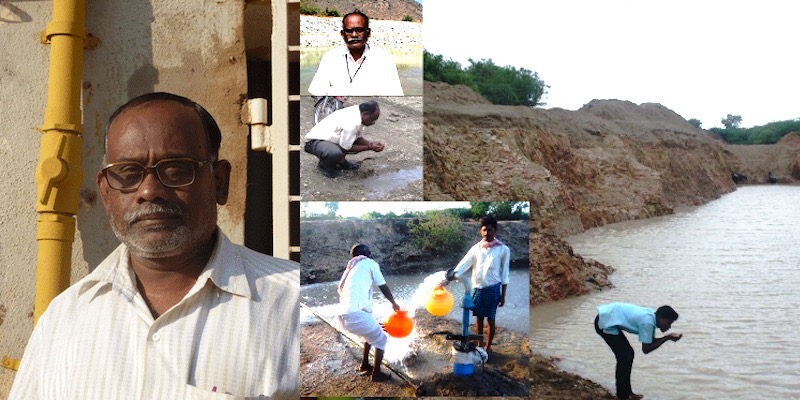
How farmers in North Kerala are using an age-old water system to beat the drought

Even as Kerala reels under severe drought, Gangadhar Rao never misses a day to irrigate thousands of areca nut trees, coconut trees and pepper plants on his 30 acres of farmland.

Rao is a farmer from Bedadka Panchayath in Kerala’s northernmost district of Kasaragod and depends on Suranga for all his water needs — irrigation and domestic — round the year.

Suranga is commonly found in the hilly regions of North Kerala and South Karnataka. It is estimated that Kasaragod district alone has over 5,000 Suranga.

Suranga in Kannada means tunnel. It is known as Thurangam, Thorapu and Mala in Malayalam.

Rao’s farmland has more than 30 Suranga, but a majority of them are dysfunctional. “We excavate new Suranga when water discharge from the old one goes down. Now I depend on just two Suranga,” says Rao.

“Crops in my land never faced the vagaries of summer thanks to Suranga that release copious amounts of water even at the peak of summer.”

A Suranga is constructed by the horizontal excavation of laterite hills until a good amount of water is struck. Water seeps out of the rock and flows out of the tunnel like a narrow stream. It is collected in a reservoir made of mud, known as Madhaka, just outside the Suranga. The water flows into the reservoir round the clock, and it doesn’t need electricity to pump.

A normal tunnel well is 500 cm to 700 cm wide and two metres high. The length varies between 200 and 300 metres. Longer wells contain many vertical shafts to ensure atmospheric pressure inside.

Digging a Suranga is a tedious task, combining traditional knowledge and the skills of a labourer.­ Of late, Kasaragod is facing a dearth of labourers with the technical knowledge to undertake the challenging job. The reluctance of youngsters to take it up as a profession has only worsened the situation. It is left to veterans such as Chaliyan Kunhambu to keep the tradition of Suranga excavation alive.

At 65 years, Kunhambu shows the energy and enthusiasm of a young man. He enjoys working from dawn to dusk, cutting the hard rocks with his pickaxe and never-say-die attitude.

He has dug more than 1,000 Suranga in different parts of Kasaragod and Southern Karnataka. Put together the length of all Suranga excavated by him and the total distance may exceed 45 km.

“Summer is the busiest season for me,” he says. “Because people begin to worry about water scarcity when summer sets in.”

Kunhambu has dug several of the Suranga on Rao’s farmland. So he visits the place occasionally to inspect the water flow. “Listening to the sound of flowing water in a Suranga makes me happy,” he remarks.

Last month, he took this correspondent to Rao’s farmland to show how a Suranga works.

Kunhambu slipped into a labourer’s attire and stepped into the tunnel with a pickaxe and a couple of lit candles. I held on to his hand.

After wading through for a few minutes, we reached the water source. “I dug this Suranga all alone,” he tells me, while shaving the laterite rock gently.

Kunhambu says Suranga provides the purest water because of the natural filtration process. “Trust me, it is pure and you can drink it anytime,” he says.


Ancient lifeline
Suranga is said to be similar to Qanat or Karez that existed in Mesopotamia and Babylon around 700 BC. Qanat is a deep well with a series of vertical access shafts that provides a reliable supply of water for human settlements and irrigation in hot, arid and semi-arid climates.

Suranga has many advantages compared to open well and borewell. It is easier as well as cheaper to dig in hilly regions such as Kasaragod. Kunhambu estimates the cost at Rs 1 lakh for a 60-metre long Suranga. “It is very low compared to the money needed to dig an open well or a borewell,” he says.

Suranga offers no less than a lifeline in a place where water scarcity is becoming more common. But because this old method of water extraction is poorly publicised outside the region, Shree Padre, a farm journalist and editor of Kannada magazine Adike Patrike, believes the Suranga is dying. “When I say it is dying, I mean further extension is diminishing.”

He believes that people have lost faith in traditional water resources with the advent of mechanical means of water extraction. “The excavation is labour-intensive and needs a lot of time. If you don’t strike water within a fixed time, the budget will inflate.”

Suranga, however, is highly sustainable, Padre says. “But we have to preserve it for future generations.”

Govindankutty, hydrogeologist and assistant professor at Government College in Chittur, Palakkad, can’t extoll the virtues of Suranga enough. “We can conserve a lot of water by reviving this age-old traditional water system. It is very important at a time when we face huge water scarcity.”

Cleaning up their act
Elsewhere in Kerala, the severe drought has made the people realise the need to conserve water bodies.

Budhanoor Grama Panchayat in Alappuzha district recently cleaned a 5-km stretch of Kuttamperoor river, a tributary of Pampa and Achankovil rivers. Water weeds and waste dumped into the waterway for over a decade were cleared out. “The river was blocked with plastic bottles, containers, and food waste. The panchayat spent Rs 72 lakh on the project,” the panchayat’s president Viswambhara Panicker tells Scroll.in.

The cleaning drive had a huge impact. “Water surged in the open wells in the vicinity. It gave us huge relief from drought. The panchayat has been distributing water through tanker lorries for the last two months in the area,” Panicker adds.

Anpodu Kochi, a non-profit organisation based in Kochi, has decided to clean 100 water bodies in Ernakulam district over 50 days. The innovative programme titled Ente Kulam Ernakulam (My Pond Ernakulam) was officially launched on March 23.

“The cleaning effort is to fight the severe drought and drinking water shortage in the district,” the organisation said in a Facebook post.

The revived ponds are being handed over to the public and reviews will be conducted once every two months to ensure proper maintenance.

Even political parties have joined the fight against drought. The Communist Party of India (Marxist), which leads the state’s Left Democratic Front government, has launched an ambitious plan to clean and conserve 1,500 water bodies across the state. CPI(M) State Secretary Kodiyeri Balakrishnan has said a social movement on the lines of the literacy drive and the people’s planning initiative is needed to protect drinking water sources. “All Keralites should join the mass movement,” he has appealed.

(Source: Scroll)

Monday, 27 February 2017

Meet India’s ‘water doctor’, who has turned 84 acres of barren land into a water bowl

Ayyappa Masagi has a simple message: “You want water? Call me!” Thousands have. And his phone rings dozens of times a day. There appears to be an endless supply of patients for the man nicknamed India’s “Water Doctor”. “I faced a lot of water problems in my childhood,” he said. “I used to go at 3am to fetch water from the stream. So I made an oath that when I grew up I would find a solution. So I quit my job as a mechanical engineer in 2002 to solve India’s water problem,” Ayyappa told BBC.

India is enduring a catastrophic water crisis. About 330 million people are suffering water shortages after the failure of the last two monsoons. Reservoirs are dry. Farmers have committed suicide. Thousands of drought-stricken villagers have flocked to cities, desperate for water, praying for rain. According to Ayyappa’s calculations, if just 30 per cent of India’s rainwater were captured and stored, “one year’s rain would sustain the nation for three years.”

To prove it, in 2014 Ayyappa bought 84 acres of barren land near Chilamathur, a famously drought-prone region of Andhra Pradesh, 110km northeast of Bangalore. “The wind here was like a firewind. I told my partners, ‘Within one year I will make this land a water bowl.'” Today, a network of 25,000 sand-filled pits and four new lakes capture and store any rainwater that falls here. No drop is allowed to escape into rivers and run off to the sea. It stays on and in the land, keeping the subsoil charged with water which, when needed, is drawn from five shallow bore-wells.

The topsoil from digging out the lakes has helped level the land, which has been planted with trees and crops. Roughly 60 per cent of the trees will form dense forest, while 40 per cent will be fruit trees to generate income. Grains and vegetables have also been planted, and next year there will be a dairy here too. The plan is to make this a sustainable organic farm, totally self-sufficient for all its water needs.

Through his Water Literacy Foundation, Ayyappa is training “water warriors” to spread his message. He’s already written seven books and trained more than 100 interns from India and abroad, including Germany, Japan and the US. “If you only talk, nothing will happen. You have to do something and prove it. Governments are coming forward to take up my service, replicating my model. Once the community attitude changes, our political attitudes change, we can replicate this concept throughout the world.” Earlier, in 2013, Yourstory had published a story on Ayyappa.

(Source: Your Story)

Wednesday, 22 August 2012

Drought wreaks havoc on Indian farmers

A punishing drought in western India is hurting livestock farmers as the region experiences water shortages.

She is 11 years old and lives in Bonewadi, a small town in Maharashtra, with her mother, two sisters and one brother. She is in grade six and walks 3km to attend school. In the evening, she walks 7km to feed her cattle at a camp. Meet Asha, a young girl born in a farmer's family that owns 11 acres of land, which is usually sufficient to earn enough money to make a living under normal conditions.

Then there is Digambar Pandurang Atpadkar, a 70-year-old farmer who owns 60 acres of land and four wells in Vartuke Malwade, a small village, also in Maharashtra, India's second most populous state. He and his wife have walked 10km to reach the cattle camp, which offers emergency food and shelter, to save their eight animals.

Asha and Atpadkar are just two among the many who have been hit by drought in India. And surprisingly, majority of the farmers and cattle taking refuge in the cattle camp are from Mann taluk in Satara district - that has 21 cattle camps this year - which is under the parliamentary constituency of Union Agriculture Minister Sharad Pawar, who recently claimed to have spent millions of rupees supporting irrigation facilities in Maharashtra.

Moreover, Mann taluk is also adjacent to the sugar belt - sugarcane is an infamously water-intensive crop - which politicians consider their stronghold, having poured in a lion's share of Maharashtra's development funds here. Yet, the region, popularly known as Manndesh in local folklore, continues to remain at the mercy of whimsical rains.

Triggering concerns of poor farm output and higher inflation, the India Meteorological Department (IMD) has predicted less rain from June to September. "We expect 15 per cent shortfall in the seasonal rains," LS Rathore, the director general of the IMD, told reporters.

Read more here.

Drought revisits India


She is 11-year-old, lives in Bonewadi, a small town in Maharashtra, with her mother, two sisters and one brother. She is in Class 6 and walks 3km to reach her school. In the evening, she walks 7km to feed the cattle at a cattle camp. Her day starts at 7am and goes on till 10 pm. Meet Asha, a young girl born in a farmer’s family that owns 11 acres of land, the land which is usually sufficient to earn enough money to make a living under normal conditions.
Then, there’s Digambar Pandurang Atpadkar, a 70-year-old farmer who owns 60 acres of land and four wells in Vartuke Malwade, a small village, also in Maharashtra. He and his wife have walked 10 km to reach the cattle camp to save their eight animals.
Asha and Atpadkar are just two among the many who have been hit by drought in India. And surprisingly, majority of the farmers and cattle taking refuge in the cattle camp are from Mann taluk in Satara district, which is under the parliamentary constituency of Union Agriculture Minister Sharad Pawar, who had recently claimed to have spent millions of rupees supporting irrigation facilities in Maharashtra.
Moreover, it is also adjacent to the sugar belt - not to forget the fact that sugarcane is infamously a water-intensive crop - which politicians consider their stronghold, having poured in a lion’s share of Maharashtra’s development funds here. Yet, the region, popularly known as Manndesh in Marthi folklore, continues to remain at the mercy of whimsical rains.
Triggering concerns of poor farm output and higher inflation, India Meteorological Department (IMD) has predicted less rain in June-to-September, which would be 15 per cent below the seasonal average.  "We expect 15 per cent shortfall in the seasonal rains," LS Rathore, director general, IMD, told reporters.
Agricultural sector output which accounts for 20 per cent of the gross domestic product (GDP), would be hit considerably due to the deficient rainfall. “The prevailing drought conditions could affect the crop prospects and may have its impact on the prices of essential commodities, such as shortfall in domestic supplies relative to demand,” Food Minister KV Thomas had said in a written reply to the Rajya Sabha.
Cattle camp
Four states - Karnataka, Rajasthan, Gujarat and Maharashtra - are facing drought-like situation and Between June 1 and August 5, the monsoon rain has been 17 per cent lower, according to the IMD. Satara district in western Maharashtra has 21 cattle camps, including the biggest Mann Deshi Cattle Camp, a makeshift camp set up at Mhaswad, 190km west of Pune, this year; the last such camps were in 2003 and 2009 when drought was severe in this sugar belt.
“We are here because there is no water in our village. Neither for the animals, nor for us. Our cattle get sugarcane, corn, fodder, dry fodder, green fodder. We get rice and pulses,” said Atpadkar who has left behind his house and land to save the lives of his cattle, the invaluable assets he owns.
The Mann Deshi Camp has rescued over 11,000 animals from going to butcher shops. People are migrating to other places in search of not occupation, but in search of water for their animals. In 2003, there was water, but this year, there’s no water. “Farmers here are ready to buy fodder, pledging their gold, but ask us how and where to buy water?” Chetna Gala-Sinha, the founder-president of the Mann Deshi Mahila Bank, the only women’s bank in rural Maharashtra, which has set up the cattle camp, said.  
Women walk 5-10km every day to fetch drinking water. When men migrate in search of better opportunities for their animals, women turn to the cattle camps and now the camp also gives shelter to more than 3,500 families. Looking like a small township in itself, the cattle camp, which is spread across the five acres of land, originally meant for the housing colony for villagers, provides nearly 3.5-4 lakh litres of water and 140 tonnes of fodder to the animals every day.
“Each big animal gets 15kg of dry grass, sugarcane and corn every day and three kg of processed cattle feed every week. People carry water stored in the big tanks, in buckets, around the camp and four water tankers make five trips a day to a pipeline 11km away to fetch the required four lakh litres of water daily,” said Sinha. 
All the wells in the region have dried up due to the “mismanagement of water”. The lake in Dhakani has water, but is not suitable for drinking. When asked Atpadkar why he left behind such a vast land and his house and took shelter in the camp, he says: “Why? What do we eat there? Soil? There’s no food, no water… There’s no option. We take this as our home. Death is inevitable, here or there. No food, no water… If our animals die, what are we left with?”
Crops hit
The drought, India's first since 2009, will not bring a shortage of staples as the nation's grain stores are overflowing with rice and wheat, and sugar output is set to exceed demand for a third straight year. (If the rainfall records below 90 percent of the 50-year average, it is considered deficient or "drought" in layman's parlance.) But it will deal a devastating blow to grain crops used for animal feed. That would badly hit the vast majority of the country's farmers who - with cattle and small landholdings their only assets - struggle to survive at the best of times.
“The cattle population would be adversely affected due to marginal availability of green fodders. Due to the damage of khariff crops, food grain production would be affected. But the food grains will be supplied through the Public distribution systems to the families below poverty lines, which would help the families living in poverty to cope with the situation,” said Amar Nayak, Knowledge Hub Leader, Land and Livelihood, Action Aid.
According to the data placed before Parliament, retail prices of some pulses, sugar, edible oil and tomato have risen in the last three months and prices of rice, wheat and atta have remained stable. In New Delhi, the retail price of gram dal has increased to Rs 67 per kg from Rs 53 per kg, tur dal from Rs 70 to Rs 74 per kg and masoor dal by Rs 8 to Rs 61/kg and sugar to Rs 39 per kg from Rs 35 per kg three months back.       
Drought prone
India is naturally drought prone. “Particularly in the areas removed from the core monsoon - that is in the Northwest of the country, the average recurrence time of droughts is 8 to 10 years. Severe droughts occur about every 30 years. The 2009 drought was not a major event,” Upmanu Lall, the director of Columbia Water Centre at Columbia University's Earth Institute, said.
And women like Sheelabai Digambar  Atpadkar, 60, has no other go but to find some source to save her family assets, who walked 16km with her animals to reach the camp. When asked about the situation in her village, she said: “The water tanker comes to our village once in 15 days. My six cows need more than 200 litres of water every day. Where can we store this? If I sell my cattle, I will lose my lifetime savings.”
Meanwhile, there are also reports putting the blame on IMD for not alerting the public about the failure of monsoon in advance. Even though in recent years, the IMD’s greater computer modelling capacity  has improved its ability to make seasonal forecasts of rainfall and help authorities and people with early drought warnings, “it is very difficult for climatologists to develop an accurate seasonal forecast, the one with a high degree of certainty,” Andrew Robertson, scientist, the International Research Institute for Climate and Society, Columbia University, said.
Moreover, predicting the time and intensity of the rainfall accurately is not that easy. It involves significant uncertainties - looking decades into the future or even a few months. “It’s very tricky,” Andrew Robertson, scientist, the International Research Institute for Climate and Society, Columbia University, Robertson said. "It’s not an easy task to predict in May whether the monsoon will be weak in a given year."
There is a correlation between monsoon strength and El Nino, generally. If sea surface temperatures rise due to an El Nino in the Pacific, monsoon rains may be weaker in that year and the weak El Nino this year may be playing a role in the current drought, according to Robertson.
Chances of recovery
Not all such episodes of severe drought correlate with El Nino-Southern Oscillation events, although there have been instances of El Nino-related droughts implicated in periodic declines in Indian agricultural output in the past.
Why is there such a scarcity of water in the country then? The general scarcity of water in the country - apart separate from the drought this year - is very closely related to the mismanagement of water in the country, most grievously in the agricultural sector. “The irrigation technologies employed do not promote conservation. Much canal water is wasted or lost to unaccountable use. The situation is quite tragic,” says Lall, adding: “The investments in agricultural improvements for the Green revolution lifted the country out of the problems... However, the cost of the complacency that set in subsequently, and the inability to continue to assess the implications of the trajectories that were put in place has led to the resulting problems today."
Not everything looks so bleak. “Still there are chances of recovery in the worst hit regions, monsoon rains may come, but again it’s another prediction, another probability. Everything is unpredictable when it comes to monsoons, especially in a country like India,” Robertson said.
Moreover, farmers have their own robust adaptation to climate variation. “We came across inspiring examples as how farmers used traditional seeds, how they have preserved seeds, adjusting the sowing periods as per the forecast of rain, managing the water harvesting systems,” said Nayak.
Maybe such adaptations, promoted with adequate resource and policy support by the government, can help the future generations like Asha to fulfill her “dream of becoming a doctor”.

Drought wreaks havoc on Indian farmers

A punishing drought in western India is hurting livestock farmers as the region experiences water shortages.


She is 11 years old and lives in Bonewadi, a small town in Maharashtra, with her mother, two sisters and one brother. She is in grade six and walks 3km to attend school. In the evening, she walks 7km to feed her cattle at a camp. Meet Asha, a young girl born in a farmer's family that owns 11 acres of land, which is usually sufficient to earn enough money to make a living under normal conditions.

Then there is Digambar Pandurang Atpadkar, a 70-year-old farmer who owns 60 acres of land and four wells in Vartuke Malwade, a small village, also in Maharashtra, India's second most populous state. He and his wife have walked 10km to reach the cattle camp, which offers emergency food and shelter, to save their eight animals.
Asha and Atpadkar are just two among the many who have been hit by drought in India. And surprisingly, majority of the farmers and cattle taking refuge in the cattle camp are from Mann taluk in Satara district - that has 21 cattle camps this year - which is under the parliamentary constituency of Union Agriculture Minister Sharad Pawar, who recently claimed to have spent millions of rupees supporting irrigation facilities in Maharashtra.
Moreover, Mann taluk is also adjacent to the sugar belt - sugarcane is an infamously water-intensive crop - which politicians consider their stronghold, having poured in a lion's share of Maharashtra's development funds here. Yet, the region, popularly known as Manndesh in local folklore, continues to remain at the mercy of whimsical rains.

Triggering concerns of poor farm output and higher inflation, the India Meteorological Department (IMD) has predicted less rain from June to September. "We expect 15 per cent shortfall in the seasonal rains," LS Rathore, the director general of the IMD, told reporters.

Read more here...