Showing posts with label Texas. Show all posts

Tuesday, 14 January 2020

Teenager having seizure saved by online gamer - 5,000 miles away in Texas

The parents of a teenager who suffered a seizure while chatting online have thanked his friend who called emergency services from 5,000 miles away.

Aidan Jackson, 17, was talking to an American gamer from his bedroom in Widnes on 2 January when he had a fit.
His friend, 20-year-old Dia Lathora, from Texas, alerted police in the UK.

The first Aidan's parents knew of the emergency was when police and an ambulance appeared at their front door, the Liverpool Echo reported.

Caroline and Steve Jackson then rushed upstairs to find their son "extremely disorientated".

Ms Jackson, 48, said: "We were at home watching TV and Aidan was upstairs in his room. The next thing we noticed was two police cars outside with flashing lights.
Caroline Jackson was downstairs and unaware of son Aidan's seizure

"I assumed they were in the area for another reason and then they ran up to the front door.

"They said there was an unresponsive male at the address. We said we hadn't called anyone and they said a call had come from America. I immediately went to check on Aidan and found him extremely disorientated."

Aidan had a seizure in May 2019 and is waiting for a new appointment following the latest incident.

"We are extremely thankful for what Dia did and shocked that we could be downstairs and not know anything was happening," Ms Jackson added.

"Dia had our address but didn't have any contact numbers, so it was amazing she managed to get help from so far away.
"I've spoken to her and expressed our thanks - she's just glad she could help.

"Aidan is a lot better and hopefully everything is OK when he has his appointment at the hospital but he's doing well."

Ms Lathora told the Liverpool Echo: "I just put my headset back on and I heard what I could only describe as a seizure, so obviously I started to get worried and immediately started asking what was going on and if he was OK.

"When he didn't respond I instantly started to look up the emergency number for the EU. When that didn't work I just had to hope the non-emergency would work, it had an option for talking to a real person...and I can't tell you how quickly I clicked that button."


(Source: BBC)

Wednesday, 20 March 2019

For the first time, mathematics' most prestigious prize has been awarded to a woman

Karen Uhlenbeck, a mathematician and professor at the University of Texas, has been awarded this year's Abel Prize, a mathematics prize modeled after the Nobels. It's the first time the prize has gone to a woman.

The Abel Prize is awarded by the King of Norway to mathematicians who have greatly influenced their field, and includes a cash award of 6 million Norwegian kroner (about $700,000). The first prize was awarded in 2003.

Uhlenbeck, 76, is known for her work with partial differential equations. However, her decades-long career spans multiple disciplines, including physics, geometry and quantum theory.


"Uhlenbeck's research has led to revolutionary advances at the intersection of mathematics and physics," Paul Goldbart, dean of the University of Texas' College of Natural Sciences said in a release. "Her pioneering insights have applications across a range of fascinating subjects, from string theory, which may help explain the nature of reality, to the geometry of space-time."

One of Uhlenbeck's most famous contributions was her theories of predictive mathematics inspired by soap bubbles. The thin, curved surface area of a soap bubble is an example of a "minimal surface," a surface that forms itself into a shape that takes up the least amount of area. Examining how these surfaces behave can help researchers better understand a wide amount of phenomena across a wide array of scientific studies.

"Her theories have revolutionized our understanding of minimal surfaces, such as those formed by soap bubbles, and more general minimization problems in higher dimensions," Hans Munthe-Kaas, chair of the Abel Committee said in a release.

(Source: CNN)

Friday, 16 November 2018

How Texas oil fracking boom tore a 'highway of death' through this small town

Every day, about 10,000 cars, trucks, and oil tankers race along U.S. Route 285 through Loving, home to just 134 people. The two-lane road has become so dangerous that Sheriff Chris Busse won’t drive it unless he’s in his police cruiser. He calls it the “highway of death.”

The county’s 400 percent increase in traffic accidents since 2015 is just one of the complaints town officials and longtime residents sitting atop the Permian Basin — a petroleum-rich area of southeast New Mexico and West Texas — have about the oil industry’s effects on their rural towns.

"How can the least populated county [in the contiguous U.S.] still have 7,000 to 15,000 cars going up and down our roadways?” Asked Busse. “The state needs to do something."

Before the historic oil boom brought on by fracking technology, these were largely wide-open desert spaces criss-crossed by dry arroyos, dotted with mesquite bushes, and scattered with ranches, farms, and small towns. Now, the once-barren landscapes are peppered with nodding pumpjacks, fracking sites, wastewater disposal sites, and tank batteries — which sometimes get struck by lightning, causing explosions and fires.

And the influx of workers, which has doubled some towns’ populations, has exploded housing markets and driven up the cost of living beyond what’s affordable to many of those not working in the oil industry.

And then there’s the stench: Fracking, a process that releases oil and gas deposits from shale rock, also releases a chemical that smells like rotten eggs.

But the past few years of fracking in the Permian has helped push the U.S. to its highest oil production since it began keeping records in the 1920s, according to the Brookings Institute, which said the boom is likely to stay in play for at least the next decade.

And the job market has brought new people and opportunities to the communities, including six-figure salaries and customers for small businesses that might not survive without the increased population.

Still, in some counties, leadership and locals says they’ve seen relatively few benefits from the boom, while watching their infrastructure strain under the weight of thousands of newcomers.

Loving County is home to only 134 people at last count. Five years ago, Busse said, residents might have seen just a few cars pass each hour on the highway. Now, they find themselves on the main drag for the thousands of people commuting to work in the oil fields, as well as transporting the goods and infrastructure.

The county, without its own EMS, police, or fire services, is ill-equipped to handle the traffic boom. They get help from the nearby city of Pecos and the state public safety department, but since the department covers such a wide and heavily trafficked area, it can often take an hour for them to get to an accident site, Sheriff Busse said.

There have been seven fatalities from crashes this year alone, according to Busse. He cited inattention, fatigue, speeding, and illicit drugs as the main causes of accidents, which he says occur daily.

Towns and cities across the basin are also facing challenges. So, while most leadership has been welcoming to the workers and the revenue they bring, there’s a sense that Southern hospitality is nearing its limit.

In Jal, a small town in Lea County, the oil workers have nearly doubled the population, bursting from the town’s limited housing stock into parked trailers, RVs and hotels.

“We’re a little community of 2,000 people,” said Mayor Stephen Aldridge. “It’s going to change the face of the community. And in small communities, change can be difficult.”

Eddy County Fire Services Director Joshua Mack said he’s seen two explosions at tank batteries, with four fatalities, since he took the job in March 2017. Dozens of tanks will often be grouped together on the side of the road, Mack said.

“When lightning strikes, it’ll be a fire,” Mack said, adding that he’s seen up to 15 tank battery fires in a single night. The county is 4,900 square miles, with four paid staff for fire and

In Eddy County’s largest city, Carlsbad, where population spiked from 55,000 in 2010 to almost 80,000 now, every campground within 30 miles is full of oil workers living in trailers, RVs and even tents. Hotel rates average around $400 a night.

Calling Carlsbad the “epicenter” of the boom, Mayor Dale Janaway said by email that “with this much rapid growth have come many challenges, especially with traffic, housing, and infrastructure.”

Valen Martinez, a real estate agent in Carlsbad, said her agency rarely has many listings because houses sell so quickly. “Anything that’s on the market is usually gone within a day or two,” Martinez said. Marketing and open houses have become a thing of the past.

Housing costs have been driven up by saturation and the high oil field wages — and so has the cost of living, including food and services by local businesses, residents said. A truck driver working in the oil fields can make around $100,000 per year, whereas the median household income for Carlsbad is about $58,000.

“I worked in the area for 10 years and could no longer sustain my family because I didn’t make oil field wages,” said Diana Thomas, who lived in Carlsbad until 2017. Thomas, who worked as a quality assurance coordinator for Landsun Homes, a retirement community, before moving to Moore, Idaho, said her family also stopped visiting because hotels in the area were unaffordable.

The lack of housing has also caused a teacher shortage in Carlsbad, according to the Associated Press — there’s simply nowhere to live, and the prices are prohibitive for most, residents told VICE News. A two-bedroom apartment can average $1,500 a month — comparable to rent in major cities but out-of-reach for many in a city where the average household makes about $58,000 per year.

A truck on U.S. Route 285. (Photo by Renee Lewis)
Another thing that has dampened Carlsbad’s appeal is the hydrogen sulfide in the air — a colorless, flammable and highly toxic gas that is released as part of oil and gas production and refining.

At best, it smells of rotten eggs, and it’s particularly potent in the early mornings. At worst — at high levels — it causes unconsciousness and death by respiratory paralysis.

The effects of the gas at low levels hasn’t been well studied — although a 2004 U.S. Fish and Wildlife study on the impacts of the oil and gas industry in Southeastern New Mexico found that it’s been reported to cause flu-like symptoms and eye and respiratory irritation at low levels. The U.S. Department of Labor also warns that prolonged exposure to low levels of the hydrogen sulfide can cause nausea, tearing of the eyes, headaches, and airway problems.

“I’ve never used an inhaler before in my life. I’m 38, and suddenly the last few years I’ve had to use one,” said Carlsbad resident Miro Doporto, who blames the oil and gas industry for his sudden breathing problems.

Meanwhile, state tax revenue is soaring, and about 70 percent of that is thanks to the oil boom centered in Eddy — where Carlsbad is located — and Lea counties. But town leadership said they don’t feel the state is allocating enough resources for infrastructure issues resulting from the population boom.

Eddy County Sheriff Mark Cage said his department is forced to pick and choose their battles due to understaffing and the unsafe roads that need repair. He’s created a new traffic department in response to the increase in accidents. Cage said he has “the best of the best” working for him and that has allowed them to make do with limited resources — for now.

But the state should allocate more resources to Eddy and Lea County — the state’s “golden goose” — so they can continue bringing in the oil revenue, Cage said.

“Why not invest to ensure that the revenue continues unimpeded?” he added.

New Mexico State Senator Cathrynn Brown, a Carlsbad native, said she “cannot overemphasize how much of a public safety issue” roads in the oil-producing areas have become.

Brown said that while at the outset of the 2019 legislative session the state is predicted to have a $2 billion revenue surplus, mostly thanks to Eddy and Lea counties, there is no easy mechanism to direct extra funds to southeast New Mexico.

“The astronomically large surplus comes at the expense of Southeast regional infrastructure, particularly roads and highways,” Brown added. She said she plans to sponsor legislation to invest a large part of the surplus back into the Permian Basin’s towns and cities.

New Mexico State Senator Carroll Leavell, who is from Jal, said he’ll also be working to make sure the state budget allocates more resources to southeast New Mexico.

In response to the increased accidents, the state has made a 22-mile stretch of Highway 285 a safety corridor, doubling traffic violation fines and setting aside $25 million for repairs.
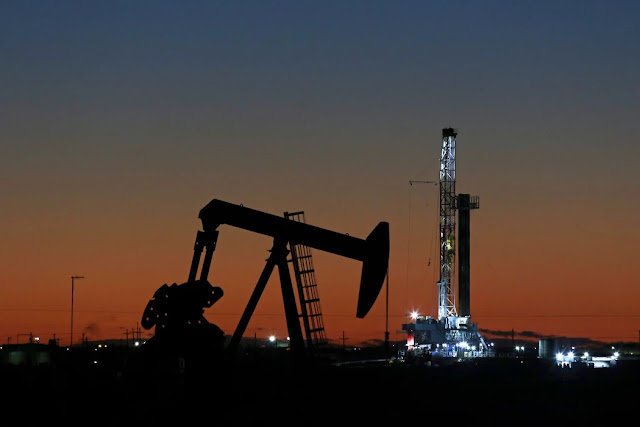
In this Tuesday, Oct. 9, 2018, photo, an oil rig and pump jack are at work as seen from the roadside of FM 1788 in Midland, Texas. (Jacob Ford/Odessa American via AP)
And the New Mexico Department of Transportation already has long-term plans in place for fixing the state’s roads more generally. But the way their resources are allocated depends on lawmakers, said Kimberly Gallegos, the department spokesperson.

Brown said one of her top priorities is legislation to achieve a “special needs” funding for roads, highways and bridges.

During rush hour, the stretch on 285 from Carlsbad to Pecos is backed up for miles with semis and trucks. Impatient drivers sometimes try to pass long lines of vehicles in the oncoming traffic lane.

Halfway to Texas there’s a cluster of gas stations that serve oil field workers hot food, good coffee, and snacks. Welder Michael Cortez was grabbing lunch there.

He said drivers passing in no-passing zones and ending up stuck in the lane for oncoming traffic, unable to merge, is so common on 285 that he’s already planned to drive off onto the road’s shoulder if he ends up in this type of chicken situation.

Nine people were killed on Highway 285 in Eddy County last year, according to the sheriff’s department. Forty-six people were killed in accidents this year in the Permian Basin area of Texas on Highway 285 and other roads trafficked by workers.

The Texas Department of Transportation has $100 million in projects currently under contract on Highway 285 from the New Mexico state line to Pecos, Texas, said Veronica Beyer, director of media relations. Over the next 10 years, the state will invest $3.4 billion for the entire Permian Basin region to pay for safety improvements, such as wide roads and stronger pavement.

But in the meantime, in the town of Pecos, some elderly residents have given up driving altogether because the roads are so dangerous, Mayor Venetta Seals said.

Pecos — the county seat of Reeves County, with a 2017 population of about 9,000 — used to feel like a neighborly and intimate town, but Seals said she doesn’t even know exactly how many people are living there these days.

And while she appreciates the opportunities brought by the oil boom, the extra burden of thousands of transient workers living in the city is taking a toll.

“We kind of feel like the redheaded stepchild,” Seals said.

(Source: Vice News)

Tuesday, 5 June 2018

Texas teenager catches life-threatening illness from working out too much

A Texas teen was recently diagnosed with a life-threatening illness reportedly linked to a lengthy weightlifting session at his local gym.

Speaking to KTRK, 17-year-old Jared Shamburger explained that he spent 90 minutes lifting weights in a session spent training with other family, after which he says he felt "super duper sore".

So far, so normal - right? Not in this case. The pain and swelling ceased to subside, leading his mother, Judy, online in a hunt for the problem.

After searching various websites, she called her paediatrician and claimed that she thought her son had 'rhabdo', otherwise known as rhabdomyolysis, which occurs when muscle in the body has been damaged and broken down.

Photo: iSTOCK / takoburito
There are numerous potential causes for the ailment, which range from lightning strikes to mere heatstroke, but one particular trigger is excessive exercise.

Judy claims that her hunt for the problem was triggered by the 'mama bear' inside her; luckily, her discovery led to Jared being hospitalised for five days. In a statement to KTRK, she described her relief:

If he hadn't caught it, if he hadn't told me, if we had just gone out of town about our way, I can't even imagine, and I don't want to, what could have happened.

In worst-case scenarios the illness can lead to death, but there are ways of reducing the risk of contracting it.

Earlier this year, VeryWellFit published a series of guidelines for exercising whilst also keeping risk of over-exertion low, some of which include monitoring fluid intake and avoiding gruelling exercise whilst on low-calorie diets.

Jared's family hope that his case will act as a cautionary tale for other enthusiastic gym-goers, but he is expected to make a full recovery and hopes to return to the gym soon.

(Source: Indy100)

Tuesday, 30 January 2018

Law firm buys a $3 million plane to fly its people from Texas

San Francisco rent is so expensive that a law firm bought a $3 million plane to fly its people in from Texas instead of having them live there, writes Tanza Loudenback in BI. Read on: 

Rent and home prices in the Bay Area are so high that one Houston-based law firm is using an alternative to hiring expensive local talent: a private jet.

Patterson and Sheridan, an intellectual-property law firm headquartered in Houston, bought a nine-seat plane to shuttle its patent lawyers to clients in the Bay Area once a month.

Though the jet cost $3 million, the Houston Chronicle's L.M. Sixel reports, it's cheaper than hiring local lawyers, and even less expensive than relocating the Texas lawyers with business in Silicon Valley to the area.

"The young people that we want to hire out there have high expectations that are hard to meet," Bruce Patterson, a partner at the firm, told The New York Times. "Rent is so high they can't even afford a car."


According to Zillow, the median rent in San Francisco is $4,450, while the median home price is just under $1.2 million. Rent in San Jose, a nearby city popular among Silicon Valley workers, while lower, is still more than double the median rent in Houston.

Each flight for the firm costs about $1,900 a passenger — adding up to $2,500 an hour in operating costs — but since the lawyers are working in-flight, the three-to-four-hour ride is billable, the Chronicle described Todd Patterson, a managing partner, as saying. Plus, private flights protect any confidential work and save the firm's lawyers about 36 collective hours they would spend arriving early, waiting in security, and checking bags on a commercial flight.

The firm says it's "still able to offer companies and inventors lower costs because most of the patent work is done in Houston, where commercial real estate is 43% cheaper, salaries 52% lower, and competition for technical talent far less fierce," according to Sixel, who rode on the jet last summer while reporting the story.

"We fly it full," Patterson said. "It's not a luxury item."

It's also "a selling point to recruit young lawyers" who want to work with top tech companies but can't afford Silicon Valley's cost of living, Sixel reported. The firm's frequent visits to California have also brought in new clients including Intuit, Western Digital, and Cavendish Kinetics.

Perhaps some companies looking for talent in Los Angeles, Silicon Valley's neighbor to the south, could benefit from this strategy.

A report from the University of Southern California and the Los Angeles Business Council published earlier this year found that exorbitant housing costs in Los Angeles were inhibiting employers from attracting "high performers" or top talent to their companies.

About 60% of the employers surveyed said Los Angeles' high cost of living affects employee retention, with 75% naming housing costs as a specific concern. And nearly all said they viewed high housing costs as a barrier to hiring new mid- and upper-level employees.

Friday, 4 August 2017

The inviting but deadly swimming spot – Jacob’s Well In Texas

We all love water, swimming in lakes, the sea, rivers, and pools, at Outdoor Revival we try to get into the water as much as possible but we’re also cautious, if we weren’t we might not be here to give you all this lovely information each day!

Sometimes some caution needs to be applied to the most beautiful looking pools, rivers, and seas…

Jacob’s Well is a deep spring some hours drive southwest of the Texan city of Austin. It is a popular destination for Texans seeking some relief from the often punishing summers.

Swimmer in Jacobs Well

There are others, adventure-seekers, who like to explore the 100 foot deep cavern and underwater caves equipped with goggles and swimsuits.

The waters are certainly beautiful and inviting to both casual swimmers and serious divers. However, whatever the motive, swimming in Jacob’s Well can be dangerous.


Jacob’s Well is fed by the Trinity Aquifer and its water spills over into Cypress Creek. Its cool waters have benefited many a hot and tired traveler for over a hundreds of years.

8 or 9 – the exact figure is difficult to judge – people have perished in them as well. One man’s body was flushed out of the well in 1981, two years after his disappearance. Another, who died around the same time, was only recovered in 2000.

Even experienced scuba divers have labeled the well a ‘challenging, unforgiving environment’ (Jacob’s Well Exploration Project), and it has been called one of the most dangerous diving spots in the world.

It is surprisingly easy to get yourself into a life-threatening situation. One diver, 21-year-old Diego Adame, lost a flipper in one of the caves and had to cut away his weight belt in order to surface – all the while holding his breath! ‘I thought of death and myself dying that day,’ he said.

‘Well, then,’ you might say. ‘I just won’t dive. I’ll swim on the surface.’ But even surface swimming can be treacherous. Some swimmers jump from the overhanging rocks, the well only being 13 feet wide. This makes the possibility of a horrific accident very real, a misjudgment, and the result is broken bones or worse.

The Hays County Park Department now forbids swimming and diving in Jacob’s Well. But when the temperature reaches 97 degrees or more for a good stretch of summer, a lot of people just don’t seem to care.

(Source: Outdoor Revival)