Friday, 9 April 2021

No life, no hobbies, burnout, lost childhood — the price students pay for a prized IIT seat

 Last year, 1.5 million students took the JEE to qualify for 13,000 seats in 23 IITs across the country – in other words, for each seat there were 115 aspirants.

They are the country’s premier engineering institutes and getting into them is internationally considered more difficult than admission into Princeton, America’s Ivy League university.


Last year, 1.5 million students took the Joint Entrance Examination (JEE) to qualify for 13,000 seats in 23 IITs across the country — in other words, for each seat there were 115 aspirants.


So intense is the pressure and so gruelling is the preparation required that students as young as 14 start the process, often missing out on the simple joys of adolescence. Most give up extra-curricular activities, relationships with friends and peers, and all forms of entertainment to achieve the goal. By the time they achieve their aim, if they do, many realise they have lost out on social skills, ability to communicate easily with others (an attribute now known as soft skills), and of course, some part of their youth.


An IIT Delhi professor who has been teaching for the last two decades underlines this reality, saying when students come to them after two or three years of prep, they don’t even know how to behave socially.


“They have been cut off from society, they are unaware of current affairs, and are desperately in need of our induction programme for freshers where we try to re-orient them to society and the institute,” the professor said on the condition of anonymity.


Students appearing for the JEE Mains in Kolkata in September 2020 (representational image) | ANI


This skill gap haunts them even when they graduate. Despite all the hard work engineering students put in, a survey conducted in 2019 found that 80 per cent of engineers “are not fit for any job in the knowledge economy and only 2.5 per cent of them possess technical skills in Artificial Intelligence (AI) that industry requires”. The skill gap between what they learn and what is required of them in their workspaces makes them unemployable. 


Yet, in India’s shortage economy, where everything of value is kept in limited supply, there is no end to this annual exercise of competing in the JEE.


Like a 23-year-old machine learning engineer based out of Florida, who started his JEE preparation as early as Class 8, because his peers had started as early as Class 6. The engineer says he was so engrossed in his prep that he ignored basics such as good hygiene, good grooming, or even making friends.


“It took me an entire gap year before undergraduation to recognise and overcome these shortcomings,” he now says.

Or 29-year-old Shivam Narang, now working as a procurement manager with a prominent firm in Mumbai, who spent three years preparing for JEE. An “above average student”, he had to work 12-14 hours a day to crack one of the toughest exams in the world, making him lose out on much of his teenage years.


A basketball player in high school, Narang had to quit the sport after Class 10, once he started preparing for the engineering entrance, moving to Kota from Delhi, the coaching college magnet for all IIT aspirants.


“There is no room for hobbies – even playing your favourite sport for 30 minutes comes with a feeling of guilt,” Narang says. “Add to that the shift to an alien city with a competitive environment, which is so difficult to adjust to.”


The constant pressure and fear of losing out led him to leave Kota. He took a break and took admission into a National Institute of Technology (NIT).


“The loss of my values is what affected me the most. I am still very competitive and don’t feel comfortable working in a team. My personality changed, as did my body. I gained 35 kilos in a matter of months and my weight went up to 120 kilos,” Narang remembers.


School, coaching, weekly exams

Some students such as Narang start preparing for the JEE at the age of 16, but others start as early as 12. These students, along with attending regular school, also go to coaching sessions and take weekly examinations. In the routine of coaching, school and tests, students claim that they miss out on important life skills, networking and overall personality development.


The National Eligibility cum Entrance Test (NEET) for medical college admission, which has become a political hot potato in Tamil Nadu, so much so that the Dravida Munnetra Kazhagam (DMK) has promised to scrap it, is only marginally less difficult. In 2020, more than 1.5 million students appeared for it, a 15 per cent rise from the number of applicants in 2018. 


Of them, under 800,000 students were able to qualify for one of the 82,026 seats at 541 medical colleges across the country. After the introduction of the examination in 2017, several students committed suicide after failing to clear it.  

The DMK has promised to do away with the examination and put back in place the previous system of admission to medical colleges in the state, based on results of the state Class 12 board exam. The All India Anna Dravida Munnetra Kazhagam (AIADMK), meanwhile, has offered to provide additional training to NEET aspirants.   


According to coaching institutes, an average student spends 16 hours a week attending these extra classes, in addition to their regular school and studies. The annual financial cost of attending these sessions goes up to Rs 2 lakh.


Pragya Bhardwaj, 35, who now practises as a gynaecologist in Bengaluru, took a three-year break after school to prepare for her medical entrance test.  


“I could not get an MBBS seat in the first attempt and it required two more attempts. Finally, after the third attempt, I got a seat in a reputed medical college in Karnataka. But the journey to get there was gruelling and took a toll on my personality, my health, mental well-being and social connections, almost everything,” Bhardwaj recalls.


Students are allowed two attempts at JEE, but there is no cap for the number of NEET attempts — there is, however, an age bar of 25. 


The problem is not individual but systemic. As Dr Soumitra Pathare, director of the Pune-based Centre for Mental Health Law and Policy, puts it: “If you create a scarcity for something and push young students to try and get that scarce product in a restricted environment, it is bound to affect them mentally.


“Premier institutes in our country have an admission rate of about 0.1 per cent, so what kind of outcome can you expect? No matter how resilient an individual is, when the system is rigged against them, it is criminal when the individual breaks down.”  


Parents go to the extent of disconnecting their children from the outer world to “help them focus”. Activities such as watching television, surfing the Internet, and participating in social events, sports and hobbies are placed at the bottom of the list of priorities. Shweta Garg, 50, a homemaker based out of Ahmedabad, says the two years her son spent preparing for the JEE meant the entire family put a pause on normal life.  


“Those two years were not only difficult for my son but for the entire family as well. To ensure that he was able to focus on boards and competitive exams, we removed the cable connection so that there were zero disturbances for him. Family vacations and social events were given a skip and a serious environment was created in the house,” she told ThePrint.  


Yet, her son was unable to make it to an IIT. Garg sidesteps that, saying she thinks her son matured during the period. Although he missed meeting his friends and cousins, he knew he had to prioritise.  


The role of coaching classes

Coaching institutes make things worse for aspirants. Kishore Kumar, an IIT Kharagpur alumnus based out of Delhi, who has been coaching JEE and NEET students for the past 11 years, says the institutes create an atmosphere where students are divided into batches based on their performance.


If a student spends five years training in a ‘low-performing’ batch, it conditions the child to not think of himself/herself beyond a low-performing student. He/she will then hesitate to take part in group activities or anything else to assist his/her personality growth.


Anand Kumar of ‘Super 30’ fame says he ensures the focus of his students is on enhancing their creativity so that they don’t become another cog in the wheel.


“Most of my students are from rural backgrounds with poor financial stability,” he said. “Whoever shows a flair for scientific learning turns up for coaching. My focus largely remains on enhancing the ability of students to grasp concepts. They need to learn about real-life applications of their studies to ensure success even after getting into an IIT.”

Speaking about the types of skills he imparts, Kumar said, “Instead of just going by textbook examples, I try to relate the concepts with their real life situations. This helps students understand things better. I also need to prepare them for a massive shift, from a rural setting to a college, and then a formal workplace. To do so, we pick examples of world leaders with humble beginnings and read from their biographies.”


Of the 510 students he has trained over 19 years, 410 have got into IITs, NITs and other notable engineering colleges.   

Some experts even question the necessity of coaching classes. Meeta Sengupta, founder of the Centre for Education Strategy, a Delhi-based think tank dealing in education policy issues, said: “Although experts say that coaching helps students take the exams, it is not healthy for children. They lose the space for discovery and innovation during the course of such training.” 


Several students, because of the lack of an outlet and no mindspace for anything other than studies, experience a burnout by the time they reach a university. This leads to several mental health problems.


A mental health expert with an IIT, who chose to remain anonymous, said, “The most common problem among IIT students, who have all their lives been seen as high achievers, is the sense of a vacuum. It can also be called an ‘existential crisis’. After years of rigorous training, students start searching for a deeper meaning in life. This can either happen because of anxiety issues or depression, or exacerbate them as well.” 


(Source: The Print)

Thursday, 8 April 2021

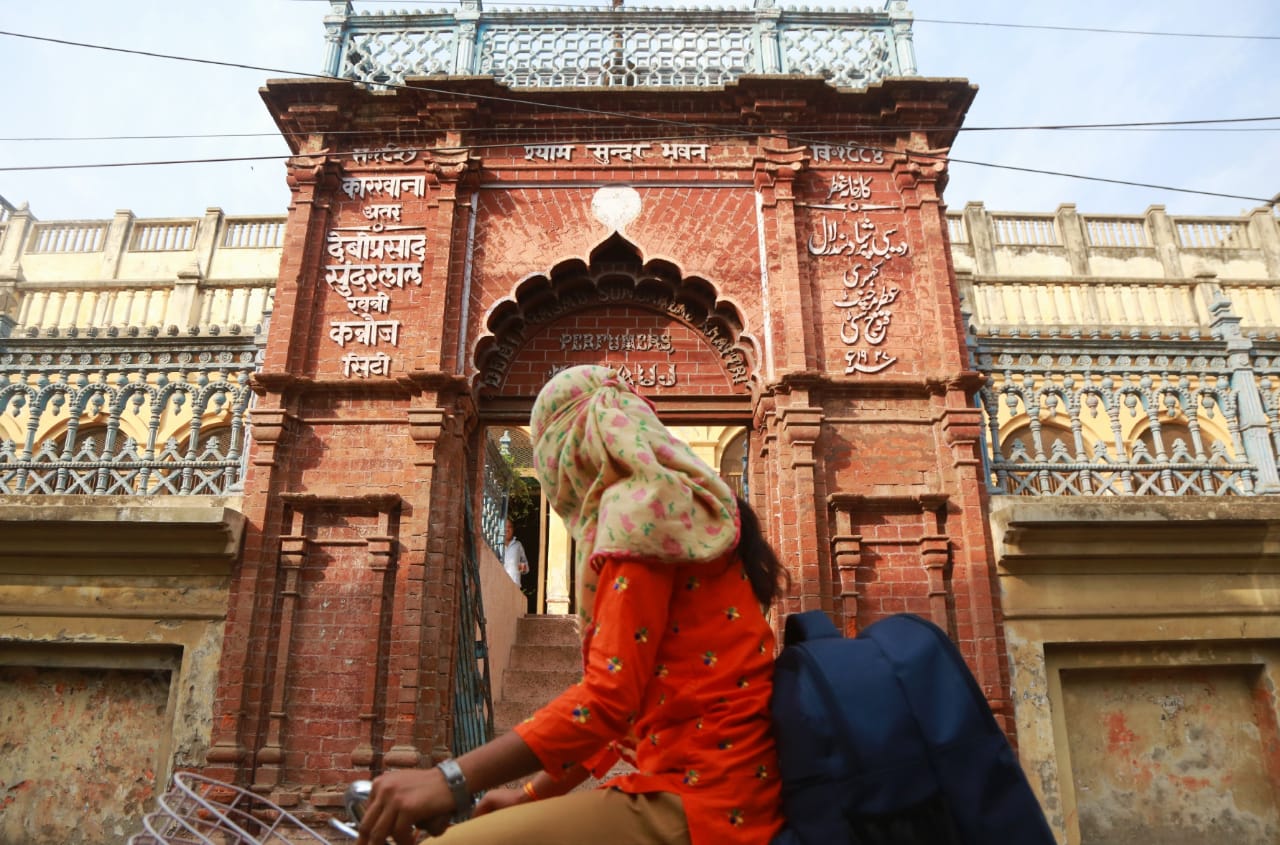
Where even drains smell of roses — inside India’s perfumery Kannauj

 Ancient city of Kannauj traces its perfume-making history to Mughal empress Nur Jahan. It continues the legacy of making ‘attar’ through hydro-distillation technique.

It is said that perfume flows through the drains of the ancient city of Kannauj in Uttar Pradesh. And this is no exaggeration.


In the perfume capital of India, which is home to about 300 small, medium and large distilleries, a pleasant fragrance constantly lingers in the air and the remnants of roses and other flowers are strewn across the city, including in the drains.


Pink roses being prepared for extraction of essential oils through hydro-distillation in Kannauj | Photo: Manisha Mondal | ThePrint


The centuries-old tradition of distilling perfumes or ‘attar’, also pronounced itr, in Kannauj dates back to the Mughal courts, and this legacy continues. The old-world perfumery still uses the traditional method of distilling perfumes that are based on essential oils and not alcohol.


Woodsy, floral, musky and androgynous, attars are markedly different from alcohol-based perfumes. They’re made from essential oils extracted from flowers and other ingredients, which are dissolved in water or oil rather than alcohol. And this makes them more fragrant and easily absorbent.


On World Fragrance Day, 21 March, here’s a look inside Kannauj, the perfume capital of India.


Raw materials

India grows 31 of 300 naturally fragrant raw materials required to manufacture perfumes, and is also a leading supplier of essential oils like mint, jasmine, sandalwood, tuberose and spices in the global market.


Pink roses being plucked from a field on the outskirts of Kannauj | Photo: Manisha Mondal | ThePrint


At present, pink roses are in full bloom on the outskirts of Kannauj, which are cultivated by several farmers. These roses are considered to be the most fragrant, and the oil extracted from them the most expensive. Farmers sell them to agents at approximately Rs 35 per kg, who, in turn, supply them to the city.


Mohammed Shakir, 23, a local flower farmer, said he grows about 15-16 kg of roses within two days. “I have to pluck roses only thrice a week and they can fetch me up to Rs 80 per kg, depending on the season,” he told ThePrint.


Other popular flowers are bela or arabian jasmine, champa (plumeria), marigold and kewda. Roots of plants like henna are also used to make attars.


Nur Jahan’s legend and geographical proximity

For many in Kannauj, perfume-making is their primary profession, but there is a web of rich history and mythology around the occupation.


According to local legend, the business of perfume making in the city started with Mughal empress Nur Jahan, wife to emperor Jahangir, in the early 17th century.


A perfumery in Kannauj | Photo: Manisha Mondal | ThePrint


The empress used to bathe in a pool with rose petals and once noticed that the flowers would leave oil behind in the water and concluded that the fragrant oil could be extracted from flowers.


Nur Jahan was an avid enthusiast of fragrances and therefore, Jahangir encouraged research on their extraction and development. The legend states that some men (the exact number is unclear), who happened to be from Kannauj, managed to extract the fragrant oil from the flowers for the queen.


According to Pranjal Kapoor, who heads M.L. Ramnarain perfumers in the city, founded in 1888, Kannauj’s position as the perfume capital of India also developed because of its geographical position.


“Kannauj is located near big cities like Agra, Kanpur and Lucknow, and isn’t too far away from Delhi either. Its soil is fertile with the Ganga nearby, so it was probably developed as this perfume industrial hub by the emperors,” Kapoor said.


Traditional methods of distilling

In Kannauj, the traditional way of hydro-distillation is still widely in use instead of the newer and faster method of steaming.

Perfumers in the city believe that this traditional method gives unmatched fragrance.


“The scent profile of the traditional method is unique and unmatched, which is why we stick to it, and this is what makes Kannauj’s attars truly special,” T.N. Tandan, a perfume distiller, told ThePrint. Tandan owns Devi Prasad Sunder Lal Khatri perfumers, which was founded in 1870.


Almost everyone in the city is engaged in attar-making in one way or another. The first part of the process starts at the break of dawn when farmers and labourers go to their fields to pluck flowers of the season.


These flowers are then transported to distilleries located in the city. They’re put into huge vessels called deg made of copper. An average vessel can hold 100kg of flowers of varying sizes. The tightly packed deg is then capped with clay so that air can’t escape.


These are connected to a bhapka, another receiver made of copper, which acts as a condenser and is placed in a water tank. The deg is put on fire on a furnace and the bhapka distills the steam.


This process is extremely laborious. “On an average, one will extract 180 gm of rooh gulaab from 400 kg of flowers,” Kapoor said.

The traditional method of perfume-making using hydro-distillation | Photo: Manisha Mondal | ThePrint


Famous attars

Kannauj manufactures essential oils, attars, floral water and floral absolutes. Among the unique and popular attars offered by the city is shamama, which is made from the roots of henna.


“Shamama is a popular, unique attar of Kannauj. It is a concoction of over 41 natural ingredients including herbs, spices and essential oils and every family has a unique recipe of its own here,” Kapoor said.


Mitti attar is another popular offering, which was an attempt to capture the smell of rain (petrichor) in a bottle.


“Mitti attar is made by co-distillation of earthen clay pots with sandalwood oil or other oils. It is quite soothing and calming. Other than that, it is also used in other creations of perfumery wherein it is used as an ingredient which brings out an earthy foundation to the concoction,” he added.


The essential oils from Kannauj can range from Rs 25 for a small 1 gm bottle to over Rs 20 lakh per kg.


“We’ve divided our products into 3 categories: Rs 10,000 per kg, Rs 60,000 per kg and Rs 1,60,000 per kg across all our fragrances,” added Tandan.


“The two most expensive products are agarwood oil (from aquilaria trees in Assam) that can cost up to Rs 25 lakh a kilo and absolute oil of rooh gulab (from pink roses) that sells for up to Rs 8 lakh a kilo,” he said.


(Source: The Print)

Wednesday, 7 April 2021

Why can't Britain handle the truth about Winston Churchill?

 Nothing, it seems, can be allowed to tarnish the national myth – as I found when hosting a Cambridge debate about his murkier side

A baleful silence attends one of the most talked-about figures in British history. You may enthuse endlessly about Winston Churchill “single-handedly” defeating Hitler. But mention his views on race or his colonial policies, and you’ll be instantly drowned in ferocious and orchestrated vitriol.


In a sea of fawningly reverential Churchill biographies, hardly any books seriously examine his documented racism. Nothing, it seems, can be allowed to complicate, let alone tarnish, the national myth of a flawless hero: an idol who “saved our civilisation”, as Boris Johnson claims, or “humanity as a whole”, as David Cameron did. Make an uncomfortable observation about his views on white supremacy and the likes of Piers Morgan will ask: “Why do you live in this country?”


Winston Churchill speaking at Wolverhampton football field in 1949. Photograph: Mark Kauffman/The LIFE Picture Collection/Getty Images


Not everyone is content to be told to be quiet because they would be “speaking German” if not for Churchill. Many people want to know more about the historical figures they are required to admire uncritically. The Black Lives Matter protests last June – during which the word “racist” was sprayed in red letters on Churchill’s statue in Parliament Square, were accompanied by demands for more education on race, empire and the figures whose statues dot our landscapes.


Yet providing a fuller picture is made difficult. Scholars who explore less illustrious sides of Churchill are treated dismissively. Take the example of Churchill College, Cambridge, where I am a teaching fellow. In response to calls for fuller information about its founder, the college set up a series of events on Churchill, Empire and Race. I recently chaired the second of these, a panel discussion on “The Racial Consequences of Mr Churchill”.


Even before it took place, the discussion was repeatedly denounced in the tabloids and on social media as “idiotic”, a “character assassination” aimed at “trashing” the great man. Outraged letters to the college said this was academic freedom gone too far, and that the event should be cancelled. The speakers and I, all scholars and people of colour, were subjected to vicious hate mail, racist slurs and threats. We were accused of treason and slander. One correspondent warned that my name was being forwarded to the commanding officer of an RAF base near my home.

The college is now under heavy pressure to stop doing these events. After the recent panel, the rightwing thinktank Policy Exchange, which is influential in government circles – and claims to champion free speech and controversial views on campus – published a “review” of the event. The foreword, written by Churchill’s grandson Nicholas Soames, stated that he hoped the review would “prevent such an intellectually dishonest event from being organised at Churchill College in the future – and, one might hope, elsewhere”.


It’s ironic. We’re told by government and media that “cancel culture” is an imposition of the academic left. Yet here it is in reality, the actual “cancel culture” that prevents a truthful engagement with British history. Churchill was an admired wartime leader who recognised the threat of Hitler in time and played a pivotal role in the allied victory. It should be possible to recognise this without glossing over his less benign side. The scholars at the Cambridge event – Madhusree Mukerjee, Onyeka Nubia and Kehinde Andrews – drew attention to Churchill’s dogged advocacy of British colonial rule; his contributing role in the disastrous 1943 Bengal famine, in which millions of people died unnecessarily; his interest in eugenics; and his views, deeply retrograde even for his time, on race.


Churchill is on record as praising “Aryan stock” and insisting it was right for “a stronger race, a higher-grade race” to take the place of indigenous peoples. He reportedly did not think “black people were as capable or as efficient as white people”. In 1911, Churchill banned interracial boxing matches so white fighters would not be seen losing to black ones. He insisted that Britain and the US shared “Anglo-Saxon superiority”. He described anticolonial campaigners as “savages armed with ideas”.


Even his contemporaries found his views on race shocking. In the context of Churchill’s hard line against providing famine relief to Bengal, the colonial secretary, Leo Amery, remarked: “On the subject of India, Winston is not quite sane … I didn’t see much difference between his outlook and Hitler’s.”


Just because Hitler was a racist does not mean Churchill could not have been one. Britain entered the war, after all, because it faced an existential threat – and not primarily because it disagreed with Nazi ideology. Noting affinities between colonial and Nazi race-thinking, African and Asian leaders queried Churchill’s double standards in firmly rejecting self-determination for colonial subjects who were also fighting Hitler.


It is worth recalling that the uncritical Churchill-worship that is so dominant today was not shared by many British people in 1945, when they voted him out of office before the war was even completely over. Many working-class communities in Britain, from Dundee to south Wales, felt strong animosity towards Churchill for his willingness to mobilise military force during industrial disputes. As recently as 2010, Llanmaes community council opposed the renaming of a military base to Churchill Lines.


Critical assessment is not “character assassination”. Thanks to the groupthink of “the cult of Churchill”, the late prime minister has become a mythological figure rather than a historical one. To play down the implications of Churchill’s views on race – or suggest absurdly, as Policy Exchange does, that his racist words meant “something other than their conventional definition” – speaks to me of a profound lack of honesty and courage.


This failure of courage is tied to a wider aversion to examining the British empire truthfully, perhaps for fear of what it might say about Britain today. A necessary national conversation about Churchill and the empire he was so committed to is one necessary way to break this unacceptable silence.


Priyamvada Gopal is an academic and author of Insurgent Empire: Anticolonial Resistance and British Dissent


(Source: The Guardian)

Tuesday, 6 April 2021

Charlie Phillips: why did it take so long for one of Britain's greatest photographers to get his due?

 His photographs of Muhammad Ali and Jimi Hendrix sold around the world. Cartier-Bresson was a fan, while Fellini liked him so much he put him in a film. Yet in the UK, Phillip’s work was ignored for decades

Charlie Phillips never planned to become a photographer. His childhood dream was to be an opera singer, or a naval architect. But then a camera fell into his lap. It was 1958. The 14-year-old had arrived from Jamaica two years earlier and was living in Notting Hill, west London, at that time the first port of call for many Caribbean immigrants. The area was also a destination for African American soldiers stationed at nearby military bases, who didn’t feel so welcome in central London’s white venues.


Charlie Phillips: There has been a m missing section in our history’. Photograph: Aliyah Otchere/ The Guardian


“On Saturdays, if you had a basement flat, you’d move the furniture to one side and make a party,” says Phillips. “And these GIs used to bring their rhythm-and-blues records and cigarettes. They’d come to have a good time and, you know, dance … and the young Afro-Caribbean women would come to meet them.” Phillips’s family often befriended these GIs. “One of them got legless one night and couldn’t get back to his base, so he had to borrow 15 shillings from my dad. He left behind a Kodak Retinette camera, but he never came back to pick it up. So I kept it.”


That camera became Phillips’s passport to a career that took him across Europe and into contact with notable figures including Jimi Hendrix, Federico Fellini, Muhammad Ali and Henri Cartier-Bresson. At the same time, Phillips was one of the few people minded and able to document London’s African-Caribbean community. His images, many of which were gathered together in the book Notting Hill in the Sixties, capture the richness and complexity of the landscape. 


Children play on litter-filled streets; young Black people show off their fashionable attire outside rundown houses.


A group of children on Basing Street in west London, 1969. Photograph: Charlie Phillips/Getty Images


This was an era marked by regular racist assaults on the African-Caribbean community, and the 1958 Notting Hill “race riots”. Phillips’s images show hand-scrawled adverts for rooms to let, spelling out “No coloured”, and graffiti on walls reading “Keep Britain white”. But his work also captures black and white Londoners socialising together, laughing, drinking, kissing. One of his best-known photographs, known as Notting Hill Couple, has come to symbolise that spirit. Taken at a party in 1967, it depicts a young Black man with his arm around a young white woman. Both look into the camera with serious expressions that could be interpreted as hopeful, innocent, perhaps even defiant.


Phillips chronicled African-Caribbean funerals in London over several generations, in all their passion, style and sartorial exuberance. This was his own community, and his images speak of an insider’s intimacy and familiarity. “As far as I’m concerned, we haven’t been given a proper platform to show our culture, our side of the story,” he says. “It’s not Black history; this is British history, whether you like it or not. And we’ve been sidestepped. I feel that personally.”

Portobello Road in the late 60s. Photograph: Charlie Phillips/Getty Images


Phillips has good reason to feel excluded. As well as that fateful camera, his career has been shaped to some extent by British attitudes towards race. Like many Windrush-era immigrants, his family did not come to Britain because they were poor but because they were invited. In Jamaica, his parents ran a business making tourist souvenirs, employing six other people. “The mother country called, so we answered,” he says. “But we never had any welcoming party; we had to fend for ourselves.” The now-gentrified Notting Hill was “a ghetto” at that time, populated not only by Caribbean but also Irish and Hungarian immigrants. Phillips’s first accommodation was a boarding house in Blenheim Crescent, where he slept three to a bed with other recent arrivals. Later, his parents would move into a room, then two rooms in a shared house.


At school, Phillips’s mostly white classmates were less hostile than curious, he says. “They would call me ‘Curly’ and sometimes feel your hair. There were rumours that we had tails on our backs.” Phillips was surprised by their ignorance. “I’d say: ‘I’m from Jamaica.’ They’d say: ‘What part of Africa is that?’ The British empire was all over the world, and yet some of the local population was so ignorant about the colonies. It was unbelievable.” His teachers were equally surprised that Phillips knew how to read, write, draw, do geometry and even sing Ave Maria in Latin. He had a good voice, he says. He also had a fascination with ships; in his free time he would take the bus to Victoria Docks to watch them. But as a Black child in 50s Britain, Phillips’s dreams of designing ships or singing opera were not considered realistic. “They laughed at me. The youth employment officer said: ‘Why don’t you get a job with London Transport? That’s more security. Or join the RAF or get a job with the post office.’”


Notting Hill Couple, 1967. Photograph: Charlie Phillips/Getty Images


To pass the evenings in his family’s one-bedroom flat, Phillips began to take an interest in the camera. With money from his paper round, he bought a do-it-yourself photography book from the local chemist. He began developing his prints at night in the bath after everyone else had gone to bed. His first photographs were of friends and family in the neighbourhood, who would pay for a photo to send to relatives back home. “I used to take ‘snaps’ of people,” he says. “We never called them ‘photographs’ in them days. It was just for fun, as an amateur, because we only thought we’d spend five years in England.” After leaving school in 1960, he bought a better camera and continued his DIY photography education. He never had any formal training. “It was just common sense. This is how I picked up my trade.”


By the mid-60s Phillips’s parents were running a Caribbean restaurant in Portobello Road where he would help out. In his free time he snapped other aspects of local life: people and scenes on the street, events such as the Jamaican Independence Day celebrations in 1962. He would take his camera along to student protest marches against nuclear weapons, apartheid and the Vietnam war. In solidarity with the student uprising of 1968, he decided to take a boat to France to see what was going on in Paris. “I’ll always remember, I was outside the Gare du Nord, and it was a big student riot and the police were there, and a student got his head busted in. I saw the blood spurting, and I got panicky. It still shakes me up.” He decided to hitchhike around Europe, and ended up in Rome.


Waiting for the Tube, 1967. Photograph: Charlie Phillips/Getty Images


The term “paparazzo” had been coined eight years earlier by Fellini in the movie La Dolce Vita, which mapped a postwar Rome of frenetic modernity and celebrity culture. Phillips found himself living that life for real, hanging around with genuine paparazzi in cafes or outside film studios, waiting for a tip or a sighting of a passing star to snap: Marcello Mastroianni, Omar Sharif, Gina Lollobrigida, John Mills, Peter O’Toole, spaghetti western actors – Phillips got them all. Claudia Cardinale was especially friendly, he says. She once gave him tickets to the premiere of Oliver!. Lesser-known actors would pay to be photographed for their own portfolios.


It was an exciting, if hand-to-mouth lifestyle. “An agency would take some of my work. You’d get two or three quid, which was survival.” He even met Fellini himself, who cast him as an extra in his 1969 film Satyricon. Easygoing and conversational, Phillips seems to have made friends wherever he went. “Sometimes in my travels, people took a liking to me,” he acknowledges. “That’s how I survived. Seeing as I was the only person of colour, everybody was curious: who’s this Black guy taking photographs?”


Portobello Road, 1966. Photograph: Charlie Phillips/Getty Images


Phillips still harboured dreams of opera, despite living in a commune with Italian revolutionaries who considered it “borghese”, or bourgeois. He often worked as an extra at La Scala, an opera house in Milan. But as a photographer, he was doing pretty well. He sold work to Italian magazines including Vogue, Harper’s Bazaar and Life. He would travel to ski resorts or to the south of France as a paparazzo. And he was travelling back and forth to England. “This is when I started photographing my community in a more serious fashion,” he says. As well as the streets and the Caribbean funerals, he visited the pubs, the shebeens (illegal drinking clubs) and nightclubs such as the Cue Club in Paddington, a venue for soul and bluebeat (early ska music), which was frequented by Black celebrities and rock stars. “I was in the alternative culture of London at the time,” he says. “The sex, drugs and rock’n’roll era, the free love era.” He captured rock stars such as Hendrix and Eric Clapton visiting the head shops and fashion boutiques in Portobello Road. He spent more time with Hendrix and others at the Isle of Wight festival in 1970. “I managed to get backstage. I had photographs with Hendrix, Joan Baez, Tiny Tim, I think some of the Who were there, Sly and the Family Stone.”

Silchester Road, demolished to make way for the Westway flyover, 1967. Photograph: Charlie Phillips/Getty Images


In 1972 Phillips held his first solo exhibition – on Notting Hill life – in Milan. To his surprise, the show was visited by Cartier-Bresson, the godfather of street photography and one of Phillips’s idols. “As a matter of fact, I used to dress like Cartier-Bresson. I used to wear a beret at the time. Some of my Italian friends used to compare my work with his.”

By 1974, Phillips was getting homesick and decided to return to England, but again, there was no welcoming party. 


Showing his photographs to editors and galleries in London, “people would say: ‘Did you really take this?’ Nobody believed I took them. I used to get fobbed off all the time. I couldn’t get any assignments.” One gallery even had a photograph of Muhammad Ali, taken by Phillips, on the wall (taken in Zurich in 1971, during Ali’s bout with German champion Jürgen Blin; Phillips went on to meet Ali on numerous occasions) yet refused to believe Phillips was the photographer. “This is how absurd it was.” Did the fact that Phillips was Black have a bearing on his treatment? “I can’t comment on that,” he says. “I think that’s a question you should ask the institutions.”


Ali on Boxing Day ... Muhammad Ali in Zurich before his fight with Jurgen Blin, 1971. Photograph: Charlie Phillips/Getty Images


Phillips grew demoralised. “I became homeless. And I became kind of destitute. I ended up washing up dishes and working in a cafe and restaurant and I put the photography aside.” From 1974 until 1991, Phillips didn’t take a single photograph. Making matters worse, moving between various squats and bedsits, he lost many of his photographs. His images of Hendrix, Cartier-Bresson, the Paris 1968 protests, the Dolce Vita movie stars and so many others are now missing. “If anyone can find my Jimi Hendrix collection, that’s my pension fund.”


In 1988 Phillips opened a Caribbean diner, Smokey Joe’s, in south London, which he ran for 11 years. During that time, his previous career underwent a process of rediscovery. A music magazine contacted him in 1991, seeking to use his photographs from the bluebeat era, he says. By chance, when a courier returned Phillips’s photographs to his diner, one of his customers was Ben Bousquet, a local Labour councillor. Bousquet, originally from St Lucia, had also grown up in 60s Notting Hill. He was amazed when he discovered Phillips’s archive of London immigrant life, which had lain forgotten in a box under his bed. “He said: ‘Bloody ’ell. You mean you have all these photographs sitting there? This is history here!’”


At the ‘Piss House’ pub on the Portobello Road, 1969. Photograph: Charlie Phillips/Getty Images


That led to the Notting Hill in the Sixties book, and a steady career rehabilitation. In 2003, the Museum of London exhibited Phillips’s work, and it has featured regularly in exhibitions since then. His photograph of the young Notting Hill couple is now part of the V&A’s collection. Simon Schama included Phillips’s work in his book and TV series The Face of Britain, describing him as “one of Britain’s great photo-portraitists”. Just last year, Steve McQueen requested Phillips take his portrait when he guest-edited the Observer. Phillips is somewhat ambivalent about his newfound recognition, however, especially when he is pigeonholed as Black culture, rather than just culture. “I feel sometimes I’m being used as political propaganda when they talk about multicultural Britain. I’m sorry, I don’t want to play the colour game. I’m tired of ticking the boxes, because they only call you in Black History Month to show images of Black people, and I’m fed up of it.”


Charlie Phillips: ‘I feel sometimes I’m being used as political propaganda.’ Photograph: Aliyah Otchere/The Guardian


Phillips still takes pictures, he says, but just for himself, “as a hobby”. Occasionally he travels down to the coast to photograph ships. He loves photographing horses. “I still haven’t taken the perfect photograph yet,” he says. “I still make a lot of mistakes.” He now lives in Mitcham, just outside London. “Nothing happens over here. Everything finishes after the News at 10,” he jokes. “All I wanted to do was to spend more time in my allotment and catch up on my reading. I’ve been reading War and Peace for about the last 20 years and I still haven’t finished it yet. But they took me out of retirement because people think I’ve got an interesting life.”


In 2015, he received a Heritage Lottery Fund grant to manage his archive. “This is the only thing that keeps me going. I’ve got lots of young volunteers who say: ‘Uncle Charlie, you’ve got to keep your legacy alive, because we don’t see this in schools. We don’t see this in exhibition centres.’ I think we’re not well-represented within the culture of England how we should be. There has been a missing section in our history. Most of our records have been destroyed or weren’t there in the first place … I’m just here to document our side of the story.”


(Source: The Guardian)

Monday, 5 April 2021

Bhagat Singh wasn’t just hanged, but was chopped and stuffed in sacks

 In ‘The Execution of Bhagat Singh’, Satvinder Singh Juss writes how Bhagat Singh’s hanging was ‘one of the bloodiest deeds ever undertaken by the British Labour Government’.

The time for execution was unusual. It was not at dawn but at 7.30 p.m. in the cool, crisp evening of 23 March 1931, just as twilight was setting in. This was when the Chief Superintendent of Central Lahore Jail, Major P. D. Chopra, escorted a lean, sinewy young man of twenty-three years to the raised scaffold in the grounds of the jail. Looking on, a bewildered Deputy Jail Superintendent, Khan Sahib Mohammad Akbar Khan, struggled in vain to choke back his tears. The lush green trees outside the jail swayed in the gentle wind. Bhagat Singh was the condemned man. The most famous man in India. He grasped at the rope as it was brought near. Despite the deprivations of prison life, his face was still handsome. Undaunted and undeterred by the fate that awaited him, his hands dug deep into the fibrous strands of the braided, twisted piles of yarn which were about to extinguish his life. Bhagat Singh kissed the hangman’s noose. It was an occasion he had longed for, waited upon, and even planned. Calmly, assuredly, and with a wry smile on his face, he took a quick glance sideways in both directions. He then airily placed the noose around his neck. Before he knew it, the noose drew in and fastened tight around his throat. The trapdoor fell open under his feet. His body cascaded. The plunge snapped his neck in two. Bhagat Singh was hanged. 


File photo | Bhagat Singh at 21, 1929 | Wikimedia Commons


Two of his comrades, Sukhdev and Rajguru, met with a similar fate at the same time in what became known as the Lahore Conspiracy Case. They too went to their deaths defiantly. All three had requested that they be executed by firing squad due to their status as political prisoners, and not hanged by the neck as common criminals; this had gone unheeded. Bhagat Singh had walked in the middle, with Sukhdev on his left and Rajguru on his right. It was not too difficult to see why they felt so elated, because as they had walked the path to the gallows Bhagat Singh sang out a verse. The other two joined in: ‘Dil se niklegi na marker bhi watan ki ulfat / Meri mittee se bhi Khushbue watan aegi’ (‘When we are dead there would be still patriotism left in us / Even my corpse will emit the fragrance of my motherland’). On the scaffold, Sukhdev and Rajguru also kissed the hangman’s noose. They too tumbled down the trapdoor with a heavy thud, dying instantly. It was all over so quickly. 


Afterwards, their bodies were hurriedly taken down from the gallows. They were dragged along the dirty passageway, chopped into pieces and stuffed into sacks, which were then whisked out of the jail compound surreptitiously. Outside the jail, the remains were unceremoniously stacked on a truck. The truck made haste, speeding northwards from Lahore to Kasur, some two hours’ drive away. There, on the banks of the River Sutlej, two holy men awaited. The harried men, dressed in full priestly garb, clutched their prayer books for solace. One was Sikh and the other Hindu.


The priests read out the final prayers over the dismembered bodies, which were quickly loaded onto a funeral pyre to burn fiercely in the eerie silence of the night. Before the pyre had fully burnt out, and as dawn threatened to break over the silent waters of the Sutlej, the roaring fires were hastily put out. The charred remains were then hurled into the river. The precise spot was to be later identified as Post No. 201. Once the priests and the policemen had departed, villagers who had been looking on with suspicion went into the water. They retrieved the body parts and set about cremating them properly. Having always been of the people, it was the people who gave Bhagat Singh, Sukhdev and Rajguru the dignity in death they already had in life. 


Public outrage erupted on the streets as news of the hangings swept the country like wildfire the next day. Unbeknown to everyone, the time of the execution had been secretly brought forward by eleven hours. The three young men had been due to be hanged the next day, at dawn on 24 March 1931. The public, which had expected a commutation of the death sentence, felt doubly cheated. The result was immense anger everywhere. In New York, on the other side of the world, the Daily Worker denounced Bhagat Singh’s hanging as ‘one of the bloodiest deeds ever undertaken by the British Labour Government’. Gandhi, visiting Karachi at the time, was blamed for not intervening. 


As his train slowly shunted in at the railway station and he disembarked, inflamed protesters thrust clusters of black flowers into his hands – not the usual red or white flowers used to commemorate the arrival of a much awaited dignitary. He was branded with ignominy for not demanding commutation of the sentence of death from the Governor-General, Lord Irwin, as a condition of any further talks on the future of India. This ultimate stain of dishonour was one Gandhi never succeeded in removing during his lifetime. 


In faraway London, a month earlier, a tenacious forty-four-year-old British lawyer by the name of Dennis Nowell Pritt had taken a taxi to Downing Street on a dank, misty February morning. He had gone there to argue the appeal against the sentence and conviction of Bhagat Singh and his two comrades. It was the last straw. All else had failed in India before then. The appeal was made before the Judicial Committee of the Privy Council, the highest court in the realm. The Privy Council was used to hearing appeals from thousands of miles away in the far-flung corners of the British Empire, from the Caribbean to Australia. It was the British Empire’s court of last resort. Situated just off Whitehall, and a few minutes’ walk from the Houses of Parliament, it was within shouting distance of the Prime Minister’s office at 10 Downing Street, where Ramsay MacDonald, the first Labour Party politician to become Prime Minister, now resided.


When Pritt strode into Downing Street he knew what was at stake. If he could not persuade the Judicial Committee of the Privy Council that Bhagat Singh, Sukhdev and Rajguru had been wrongly tried and convicted, they would most certainly hang in India. Pritt knew he faced an uphill struggle. The judges were not going to be sympathetic. Their demeanour before him vacillated from giving the appearance of apoplectic outrage at the temerity of Pritt’s audacious submissions to falling asleep. In the Privy Council (as with what was then the Judicial Committee of the House of Lords but is now Britain’s Supreme Court), a single lawyer must face five judges who may interrupt, harangue or cajole him at any time to throw him off balance. He must possess immense lawyerly legal skill and presence of mind to have any chance of winning on his arguments.


In Bhagat Singh v. The King-Emperor the Judicial Committee of the Privy Council did everything in its power to break Pritt’s resolve as he heroically attempted to defend what the judges considered to be the indefensible. Together with Sukhdev and Rajguru, Bhagat Singh had been charged with conspiracy against the King. Pritt was not yet a veteran of defending conspiracy trials, but this case ensured that he would soon become one. His reputation would span the length and breadth of the British Empire. Bhagat Singh’s case was going to be his baptism of fire. 


Pritt was defending someone who had shot a twenty-one-year-old probationary police officer, John Saunders, as he came out of a police station in Lahore. He had been mistaken for James Scott, the police superintendent whom the alleged conspirators blamed for the beating to death of Lala Lajpat Rai on 17 November 1928 after he led a protest march against the Simon Commission in Lahore barely three weeks earlier. The cold-blooded assassination of the young Saunders was hard to defend. As fate would now have it, Pritt’s name was to be forgotten. Bhagat Singh was to be forgotten. That there was ever such a case in the heyday of the British Empire, testing its commitment to the rule of law, was to be forgotten. Almost everyone associated with the case has been forgotten. 


This excerpt from ‘The Execution of Bhagat Singh: Legal Heresies of the Raj’ by Satvinder Singh Juss has been published with permission from HarperCollins India.


(Source: The Print)