Showing posts with label independence. Show all posts

Thursday, 27 January 2022

Taiwan invites Indian researchers to its National Archives to rediscover the legacy of Netaji Subhas Chandra Bose

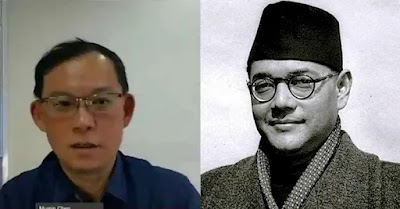
 Taipei Economic and Cultural Centre’s deputy representative Mumin Chen urged Indian researchers and historians to study the disappearance of Netaji and his legacy at the country’s National Archive.

The Taipei Economic and Cultural Center in Delhi, also known as the Taiwanese Embassy, has announced that the Taiwan govt has decided to open up its National archives to study and rediscover the legacy of Netaji Subash Chandra Bose. While speaking at the 125th Birthday Celebration of Netaji Subash Chandra Bose organized by FICCI on Saturday, deputy representative Mumin Chen urged Indian researchers and historians to study information about Netaji and also his legacy which has had a huge influence over Taiwan in the 1930s and 40s.


While speaking at the event, Chen elaborated on the link of the Indian Independence struggle and its attempts in Taiwan which was then under Japanese occupation. Speaking about the Indo-Taiwan historical connections, he mentioned, “With India and Netaji, we have historical connections” that Taiwanese did not know…In the 1940s, Chiang Kai-shek (Former President of the Republic of China) wrote about Netaji in his diary. He felt sympathy…

decision to cooperate with Japanese fight for independence is understandable.” Chiang Kai-shek who ruled Taiwan until 1975 is known for his strong resistance to Japanese forces during World War II. While it is also known that Netaji had asked Japanese help to overthrow British rule in India with the Indian National Army. Chen, while narrating incidences of Netaji on the Taiwanese soil said, “Taiwan before 1945 was a Japanese colony, that is why Netaji stepped on Taiwan in 1943, and then in 1945, he came to Taiwan for the second time.”   


The Taiwanese diplomat in Delhi then urged that the National Archives and other databases of information are open for Indian scholars and historians to study. He asserted that a lot of young historians interested in studying South-East Asia and India are in Taiwan. “A lot of historical documents and evidence on Netaji, and the Indian Independence movement are in Taiwan. Right now, very few Indian scholars know about it,” he added. Mumin Chen also elaborated on the bilateral need for India and Taiwan to “re-examine and re-discover the common history of Indo-Pacific” through shared common connections.


The controversy over the suspense of Netaji’s death refuses to die down. It is known that Netaji, after the plane crash in August 1945 was taken to Army Hospital in Taipei where he breathed his last. The interesting development comes when the Prime Minister of India, Narendra Modi is all set to unveil the hologramic statue of Netaji Subhas Chandra Bose at the India Gate on the occasion of his 125th Birth Anniversary.


(Source: OpIndia)

Wednesday, 7 April 2021

Why can't Britain handle the truth about Winston Churchill?

 Nothing, it seems, can be allowed to tarnish the national myth – as I found when hosting a Cambridge debate about his murkier side

A baleful silence attends one of the most talked-about figures in British history. You may enthuse endlessly about Winston Churchill “single-handedly” defeating Hitler. But mention his views on race or his colonial policies, and you’ll be instantly drowned in ferocious and orchestrated vitriol.


In a sea of fawningly reverential Churchill biographies, hardly any books seriously examine his documented racism. Nothing, it seems, can be allowed to complicate, let alone tarnish, the national myth of a flawless hero: an idol who “saved our civilisation”, as Boris Johnson claims, or “humanity as a whole”, as David Cameron did. Make an uncomfortable observation about his views on white supremacy and the likes of Piers Morgan will ask: “Why do you live in this country?”


Winston Churchill speaking at Wolverhampton football field in 1949. Photograph: Mark Kauffman/The LIFE Picture Collection/Getty Images


Not everyone is content to be told to be quiet because they would be “speaking German” if not for Churchill. Many people want to know more about the historical figures they are required to admire uncritically. The Black Lives Matter protests last June – during which the word “racist” was sprayed in red letters on Churchill’s statue in Parliament Square, were accompanied by demands for more education on race, empire and the figures whose statues dot our landscapes.


Yet providing a fuller picture is made difficult. Scholars who explore less illustrious sides of Churchill are treated dismissively. Take the example of Churchill College, Cambridge, where I am a teaching fellow. In response to calls for fuller information about its founder, the college set up a series of events on Churchill, Empire and Race. I recently chaired the second of these, a panel discussion on “The Racial Consequences of Mr Churchill”.


Even before it took place, the discussion was repeatedly denounced in the tabloids and on social media as “idiotic”, a “character assassination” aimed at “trashing” the great man. Outraged letters to the college said this was academic freedom gone too far, and that the event should be cancelled. The speakers and I, all scholars and people of colour, were subjected to vicious hate mail, racist slurs and threats. We were accused of treason and slander. One correspondent warned that my name was being forwarded to the commanding officer of an RAF base near my home.

The college is now under heavy pressure to stop doing these events. After the recent panel, the rightwing thinktank Policy Exchange, which is influential in government circles – and claims to champion free speech and controversial views on campus – published a “review” of the event. The foreword, written by Churchill’s grandson Nicholas Soames, stated that he hoped the review would “prevent such an intellectually dishonest event from being organised at Churchill College in the future – and, one might hope, elsewhere”.


It’s ironic. We’re told by government and media that “cancel culture” is an imposition of the academic left. Yet here it is in reality, the actual “cancel culture” that prevents a truthful engagement with British history. Churchill was an admired wartime leader who recognised the threat of Hitler in time and played a pivotal role in the allied victory. It should be possible to recognise this without glossing over his less benign side. The scholars at the Cambridge event – Madhusree Mukerjee, Onyeka Nubia and Kehinde Andrews – drew attention to Churchill’s dogged advocacy of British colonial rule; his contributing role in the disastrous 1943 Bengal famine, in which millions of people died unnecessarily; his interest in eugenics; and his views, deeply retrograde even for his time, on race.


Churchill is on record as praising “Aryan stock” and insisting it was right for “a stronger race, a higher-grade race” to take the place of indigenous peoples. He reportedly did not think “black people were as capable or as efficient as white people”. In 1911, Churchill banned interracial boxing matches so white fighters would not be seen losing to black ones. He insisted that Britain and the US shared “Anglo-Saxon superiority”. He described anticolonial campaigners as “savages armed with ideas”.


Even his contemporaries found his views on race shocking. In the context of Churchill’s hard line against providing famine relief to Bengal, the colonial secretary, Leo Amery, remarked: “On the subject of India, Winston is not quite sane … I didn’t see much difference between his outlook and Hitler’s.”


Just because Hitler was a racist does not mean Churchill could not have been one. Britain entered the war, after all, because it faced an existential threat – and not primarily because it disagreed with Nazi ideology. Noting affinities between colonial and Nazi race-thinking, African and Asian leaders queried Churchill’s double standards in firmly rejecting self-determination for colonial subjects who were also fighting Hitler.


It is worth recalling that the uncritical Churchill-worship that is so dominant today was not shared by many British people in 1945, when they voted him out of office before the war was even completely over. Many working-class communities in Britain, from Dundee to south Wales, felt strong animosity towards Churchill for his willingness to mobilise military force during industrial disputes. As recently as 2010, Llanmaes community council opposed the renaming of a military base to Churchill Lines.


Critical assessment is not “character assassination”. Thanks to the groupthink of “the cult of Churchill”, the late prime minister has become a mythological figure rather than a historical one. To play down the implications of Churchill’s views on race – or suggest absurdly, as Policy Exchange does, that his racist words meant “something other than their conventional definition” – speaks to me of a profound lack of honesty and courage.


This failure of courage is tied to a wider aversion to examining the British empire truthfully, perhaps for fear of what it might say about Britain today. A necessary national conversation about Churchill and the empire he was so committed to is one necessary way to break this unacceptable silence.


Priyamvada Gopal is an academic and author of Insurgent Empire: Anticolonial Resistance and British Dissent


(Source: The Guardian)

Monday, 5 April 2021

Bhagat Singh wasn’t just hanged, but was chopped and stuffed in sacks

 In ‘The Execution of Bhagat Singh’, Satvinder Singh Juss writes how Bhagat Singh’s hanging was ‘one of the bloodiest deeds ever undertaken by the British Labour Government’.

The time for execution was unusual. It was not at dawn but at 7.30 p.m. in the cool, crisp evening of 23 March 1931, just as twilight was setting in. This was when the Chief Superintendent of Central Lahore Jail, Major P. D. Chopra, escorted a lean, sinewy young man of twenty-three years to the raised scaffold in the grounds of the jail. Looking on, a bewildered Deputy Jail Superintendent, Khan Sahib Mohammad Akbar Khan, struggled in vain to choke back his tears. The lush green trees outside the jail swayed in the gentle wind. Bhagat Singh was the condemned man. The most famous man in India. He grasped at the rope as it was brought near. Despite the deprivations of prison life, his face was still handsome. Undaunted and undeterred by the fate that awaited him, his hands dug deep into the fibrous strands of the braided, twisted piles of yarn which were about to extinguish his life. Bhagat Singh kissed the hangman’s noose. It was an occasion he had longed for, waited upon, and even planned. Calmly, assuredly, and with a wry smile on his face, he took a quick glance sideways in both directions. He then airily placed the noose around his neck. Before he knew it, the noose drew in and fastened tight around his throat. The trapdoor fell open under his feet. His body cascaded. The plunge snapped his neck in two. Bhagat Singh was hanged. 


File photo | Bhagat Singh at 21, 1929 | Wikimedia Commons


Two of his comrades, Sukhdev and Rajguru, met with a similar fate at the same time in what became known as the Lahore Conspiracy Case. They too went to their deaths defiantly. All three had requested that they be executed by firing squad due to their status as political prisoners, and not hanged by the neck as common criminals; this had gone unheeded. Bhagat Singh had walked in the middle, with Sukhdev on his left and Rajguru on his right. It was not too difficult to see why they felt so elated, because as they had walked the path to the gallows Bhagat Singh sang out a verse. The other two joined in: ‘Dil se niklegi na marker bhi watan ki ulfat / Meri mittee se bhi Khushbue watan aegi’ (‘When we are dead there would be still patriotism left in us / Even my corpse will emit the fragrance of my motherland’). On the scaffold, Sukhdev and Rajguru also kissed the hangman’s noose. They too tumbled down the trapdoor with a heavy thud, dying instantly. It was all over so quickly. 


Afterwards, their bodies were hurriedly taken down from the gallows. They were dragged along the dirty passageway, chopped into pieces and stuffed into sacks, which were then whisked out of the jail compound surreptitiously. Outside the jail, the remains were unceremoniously stacked on a truck. The truck made haste, speeding northwards from Lahore to Kasur, some two hours’ drive away. There, on the banks of the River Sutlej, two holy men awaited. The harried men, dressed in full priestly garb, clutched their prayer books for solace. One was Sikh and the other Hindu.


The priests read out the final prayers over the dismembered bodies, which were quickly loaded onto a funeral pyre to burn fiercely in the eerie silence of the night. Before the pyre had fully burnt out, and as dawn threatened to break over the silent waters of the Sutlej, the roaring fires were hastily put out. The charred remains were then hurled into the river. The precise spot was to be later identified as Post No. 201. Once the priests and the policemen had departed, villagers who had been looking on with suspicion went into the water. They retrieved the body parts and set about cremating them properly. Having always been of the people, it was the people who gave Bhagat Singh, Sukhdev and Rajguru the dignity in death they already had in life. 


Public outrage erupted on the streets as news of the hangings swept the country like wildfire the next day. Unbeknown to everyone, the time of the execution had been secretly brought forward by eleven hours. The three young men had been due to be hanged the next day, at dawn on 24 March 1931. The public, which had expected a commutation of the death sentence, felt doubly cheated. The result was immense anger everywhere. In New York, on the other side of the world, the Daily Worker denounced Bhagat Singh’s hanging as ‘one of the bloodiest deeds ever undertaken by the British Labour Government’. Gandhi, visiting Karachi at the time, was blamed for not intervening. 


As his train slowly shunted in at the railway station and he disembarked, inflamed protesters thrust clusters of black flowers into his hands – not the usual red or white flowers used to commemorate the arrival of a much awaited dignitary. He was branded with ignominy for not demanding commutation of the sentence of death from the Governor-General, Lord Irwin, as a condition of any further talks on the future of India. This ultimate stain of dishonour was one Gandhi never succeeded in removing during his lifetime. 


In faraway London, a month earlier, a tenacious forty-four-year-old British lawyer by the name of Dennis Nowell Pritt had taken a taxi to Downing Street on a dank, misty February morning. He had gone there to argue the appeal against the sentence and conviction of Bhagat Singh and his two comrades. It was the last straw. All else had failed in India before then. The appeal was made before the Judicial Committee of the Privy Council, the highest court in the realm. The Privy Council was used to hearing appeals from thousands of miles away in the far-flung corners of the British Empire, from the Caribbean to Australia. It was the British Empire’s court of last resort. Situated just off Whitehall, and a few minutes’ walk from the Houses of Parliament, it was within shouting distance of the Prime Minister’s office at 10 Downing Street, where Ramsay MacDonald, the first Labour Party politician to become Prime Minister, now resided.


When Pritt strode into Downing Street he knew what was at stake. If he could not persuade the Judicial Committee of the Privy Council that Bhagat Singh, Sukhdev and Rajguru had been wrongly tried and convicted, they would most certainly hang in India. Pritt knew he faced an uphill struggle. The judges were not going to be sympathetic. Their demeanour before him vacillated from giving the appearance of apoplectic outrage at the temerity of Pritt’s audacious submissions to falling asleep. In the Privy Council (as with what was then the Judicial Committee of the House of Lords but is now Britain’s Supreme Court), a single lawyer must face five judges who may interrupt, harangue or cajole him at any time to throw him off balance. He must possess immense lawyerly legal skill and presence of mind to have any chance of winning on his arguments.


In Bhagat Singh v. The King-Emperor the Judicial Committee of the Privy Council did everything in its power to break Pritt’s resolve as he heroically attempted to defend what the judges considered to be the indefensible. Together with Sukhdev and Rajguru, Bhagat Singh had been charged with conspiracy against the King. Pritt was not yet a veteran of defending conspiracy trials, but this case ensured that he would soon become one. His reputation would span the length and breadth of the British Empire. Bhagat Singh’s case was going to be his baptism of fire. 


Pritt was defending someone who had shot a twenty-one-year-old probationary police officer, John Saunders, as he came out of a police station in Lahore. He had been mistaken for James Scott, the police superintendent whom the alleged conspirators blamed for the beating to death of Lala Lajpat Rai on 17 November 1928 after he led a protest march against the Simon Commission in Lahore barely three weeks earlier. The cold-blooded assassination of the young Saunders was hard to defend. As fate would now have it, Pritt’s name was to be forgotten. Bhagat Singh was to be forgotten. That there was ever such a case in the heyday of the British Empire, testing its commitment to the rule of law, was to be forgotten. Almost everyone associated with the case has been forgotten. 


This excerpt from ‘The Execution of Bhagat Singh: Legal Heresies of the Raj’ by Satvinder Singh Juss has been published with permission from HarperCollins India.


(Source: The Print)
Friday, 6 March 2020

The shameful final grievance of the Declaration of Independence

The revolution wasn’t only an effort to establish independence from the British—it was also a push to preserve slavery and suppress Native American resistance.

“We hold these truths to be self evident.” Say these words, and many Americans will be able to recite what follows: “that all men are created equal, that they are endowed by their Creator with certain unalienable Rights, that among these are Life, Liberty and the pursuit of Happiness.” The opening words of the Declaration of Independence—and easily its most remembered part—are widely celebrated as signifying the beginning of an exceptional American history, one characterized, despite setbacks, by a progressive expansion of rights.

The closing words of the Declaration are far less known. The last of a list of 27 grievances against King George III, they read as follows: “He has excited domestic insurrections amongst us, and has endeavored to bring on the inhabitants of our frontiers, the merciless Indian savages whose known rule of warfare, is an undistinguished destruction of all ages, sexes, and conditions.” These words call attention to hard truths about America’s founding that have often been brushed aside.

The 27th grievance raises two issues. The first, the king’s incitement of “domestic insurrections,” refers to slave revolts and reveals a hard truth recently brought to the public’s attention by The New York Times Magazine’s 1619 Project: Some of those who sought independence aimed to protect the institution of slavery. This was particularly true for Virginia slave owners, who were deeply disturbed by a proclamation issued in November 1775 by Virginia Governor Lord Dunmore, which promised enslaved people held by revolutionaries freedom in exchange for joining the British army. Virginians and other southerners feared that it would provoke widespread slave revolts. Edward Rutledge, who later became the governor of South Carolina, declared that Dunmore’s proclamation would do more than any other effort to “work an eternal separation between Great Britain and the Colonies,” and George Washington called Dunmore “that arch-traitor to the rights of humanity.”
DUNCAN1890 / GETTY / THE ATLANTIC

A second hard truth exposed by the 27th grievance—and its racist depiction of Native Americans as “merciless Indian savages”—has generated much less public discussion. In indicting the king for unleashing Indians on the “inhabitants of our frontiers,” the Declaration was not referring to a specific event but rather to the recent escalation of violence, which was caused by colonists invading Native lands west of the Appalachian Mountains. In response, a confederation of Senecas, Shawnees, Delawares, Ottawas, Cherokees, and other Native nations exercised a right of self-defense and attacked new colonial settlements. Although the Native nations had British support, they were acting on their own and not at the instigation of the Crown. Nonetheless, Thomas Jefferson, the Declaration’s primary drafter, hoped that by fanning the flames of settlers’ anti-Indian racism and implicating George III, he could ignite a general conflagration against the British in the West. In this way, the 27th grievance helped lay the foundation for an American nationalism that would demonize the continent’s indigenous people, especially when they resisted American aggressions.

Although the reference to the “merciless Indian savages” appealed to the “inhabitants of our frontiers,” Jefferson and others who signed the Declaration had their own reasons for detesting British policies relating to Native Americans and their lands. More than a decade earlier, in order to end a costly war to suppress an indigenous resistance movement led by the Ottawa war leader Pontiac, the king issued the Proclamation of 1763, which recognized indigenous ownership of lands west of the Appalachian mountains’ crest and prevented colonists from settling there. At first glance, ordinary settlers might be expected to  have been the proclamation’s major opponents. Some settlers did object, but the most potent source of opposition came from colonial elites, especially in Virginia and Pennsylvania, who had invested in companies with claims to lands west of the boundary set by the proclamation. Unless those lands could be legally settled, land companies could not gain secure title to their claims. Investors would be left with nothing but the debts they had incurred to bet on getting rich.

In 1767, George Washington, one of the era’s most passionate land speculators, predicted that the proclamation “must fall … in a few years.” British imperial officials made some adjustments to the 1763 boundary, but despite Washington’s hopes, and those of other speculators such as Thomas Jefferson, British policy continued to restrict colonists’ perceived liberty to obtain indigenous lands. Colonists found the 1774 Quebec Act—one of the Intolerable Acts—particularly odious. Not only did the Quebec Act grant legal protection to Catholicism, a religion Protestants despised, but it extended Quebec’s boundary south to the Ohio River and blocked settlement in the Ohio Valley. At the First Continental Congress, Richard Lee, a delegate from Virginia, called the Quebec Act the “worst grievance” of them all. Two years later, when Virginia broke with Great Britain, its state constitution claimed lands west of the Mississippi River, thus nullifying the Proclamation of 1763 and the Quebec Act.

Even as colonists declared their independence from Britain, indigenous people were preparing to defend their own freedom. Long experience had led Native Americans to believe that colonists intended not only to take their lands, but to kill them all. In the summer of 1776, an unnamed Shawnee, part of a delegation of Mohawks, Shawnees, Ottawas, and Delawares, urged Cherokees to join a confederation to resist the colonists, warning that the “Virginians,” as he referred to all colonists, possessed “an intention to extirpate … the red people.” Similarly, after the Revolutionary War broke out, the Mohawk leader Joseph Brant declared that it was the intention of another group of colonists—the “Bostonians”—to “exterminate” the Mohawks and other members of the Six Nations (Haudenosaunee) confederacy. The term genocide did not yet exist, but their words conveyed the same idea. Native people were terrified that unshackled colonists would kill them wholesale.

This indigenous perspective returns us to the 27th grievance. Jefferson’s denigration of “merciless Indian savages” signaled that the war for independence from Great Britain would also be a brutal war to seize indigenous lands. From 1776 to 1783, U.S. troops and colonial militias destroyed more than 70 Cherokee towns, 50 Haudenosaunee towns, and at least 10 multiethnic towns in the Ohio Valley, killing several hundred people (including civilians) and subjecting refugees to starvation, disease, and death. In the decades to come, U.S. presidents, Washington and Jefferson included, would call for the extermination of Native Americans who fought against dispossession. Several U.S. armies would try to do precisely that.

The 1619 Project has made an enormous contribution to public understanding of slavery, often referred to as America’s “original sin.” Although critics of the 1619 Project have tried to minimize slavery’s importance, its centrality to the creation of America—and its disturbing legacies—is well established in the scholarly literature and becoming clear to the public. Even so, the 27th grievance reveals that the original sin at America’s founding was twofold. America was built by the labor of enslaved people. It was also built on stolen lands and the genocide of indigenous peoples. To understand where this country is now and to imagine a truly just future, America needs to reckon with both of these hard truths.


(Source: The Atlantic)

Thursday, 15 August 2019

At 12, this Odisha boat boy faced British bullets to become India’s youngest martyr

The 12-year old Baji Rout hailed from Odisha, where he stood up against the British and lost his life.

The year was 1926. In a small village in Dhenkanal, Odisha, was born Baji Raut. The boy would soon lose his father and would be brought up by his mother, who was earning a living through rice-husking in the neighbourhood.

At the time, the King of Dhenkanal was Shankar Pratap Singhdeo, infamous for fleecing poor villagers of their earnings. Even Baji’s mother was a victim.

Odisha was reeling under pressure, and the time was ripe for a revolt. It began due to the efforts of Baishnav Charan Pattanayak of Dhenkanal town. Veer Baishnav, as he was fondly known, raised a banner of revolt against the King, and founded Prajamandal, which had a Banar Sena wing composed of young children, which Baji joined, despite being of tender age, according to OrissaMatters.

Pattanayak had a good plan up his sleeve. He took up employment as a painter in the Indian Railways. His main motive was to move from place to place, using the Railway Pass. Through this plan, he was able to meet as many people as possible, instigating them against the King, and establishing contacts with leaders of the National Congress in Cuttack, drawing their attention to the sorry state of the oppressed people of Dhenkanal.

Pattanayak began educating himself in Marxist revolutionary theory and practices, and together with local intellectual Hara Mohan Pattanayak, founded the Prajamandala Andolan, which translates into the ‘Party of the People’.

The movement grew slowly but steadily, and seeing this, many other kings offered their cooperation to the King of Dhenkanal to suppress the people’s movement. Many rulers from adjoining provinces sent armed troops and reinforcements to Dhenkanal, to further oppress the people. Even the British contributed, sending a platoon of soldiers from Calcutta. The English sent 250 gunmen, and with all the bolstered support, the tyrannical King of Dhenkanal unleashed a reign of terror to quell the mass movement.

How better to further suppress the people than economic sanctions? Shankar Pratap placed a ‘Rajabhakta Tax’ or Loyalty Tax, and those who didn’t pay, had their houses razed to the ground by royal elephants, and all their property confiscated. This just incensed the Odisha people further, and the movement gained strength.

Fed up, the king decided to end this once and for all. Pressing his entire force against the leaders of the movement, he targetted Veer Baishnav directly and confiscated his ancestral properties.

On September 22nd, 1938, a surprise raid was planned where Hara Mohan Pattanayak and other leaders were arrested. Pattanayak was wilier than they thought, and he escaped.

The angry authorities kept searching for Pattanayak and stumbled upon news that he was in the Bhuban village, camping. The king and armed forces attacked the village on October 10th, 1938, for the third time, destroying houses and torturing people for information. But, no information on Pattanayak was forthcoming.

Stories started doing the rounds during the raid, including one which claimed that Pattanayak had escaped by jumping into the Brahmani river to swim to safety to villages on the other side. The troops immediately started a pursuit and were met by blockade of simple villagers, who refused to give up their local hero.

The authorities then opened indiscriminate fire, killing two people, Raghu Naik and Quri Naik on the spot, according to Odisha Sun Times. The crowd parted, and the troops ran to the nearest ferry, at Nilkanthapur on the Brahmani river.

A young Baji Rout, on guard at the Ghat at the time, was approached by these troops to ferry them across the river. It was the fateful night of October 11th, 1938. He was in charge of a country boat at the ghat and was sleeping when the troops approached him.

Baji Rout of Odisha fearlessly stood up to the British, at just 12 years of age. Image Credit: Uttam Sahu
Despite being just 12 years old, he refused. Incidentally, the boy had been asked by senior activists to keep an eye on the ghat, to ensure that cops didn’t get ferried across the river.

The angry Britishers ordered Baji to carry them across the river on his boat, and Baji remained stubborn. According to Orissa Matters, a soldier hit Baji on the head with the butt of his gun, fracturing the boy’s soft skull. Baji collapsed but continued raising his voice, warning villagers of the presence of the troop.

Another soldier pierced Baji’s skull with his bayonet, while a third shot him. Witnessing this cruelty, someone ran back and told the villagers, who were angered beyond measure.

The villagers rushed to the spot, and the British cops saw them and panicked. Instead of running after their original target Pattanayak, they got into Baji’s boat and tried to flee from the village. Even while fleeing they opened fire on their pursuers, killing four more, as well as young Baji.

Basihnav Pattanayak was the one to collect the corpses, bringing them to Cuttack by train. People rushed to receive them along with revolutionary slogans of Lal Salaam to the martyrs. Post-mortem tests on the martyr’s bodies were conducted in Cuttack. Eminent freedom movement leaders discussed with Pattanayak, and it was decided that the last journey of the boy Baji Rout and his co-martyrs to the crematorium would be through the lanes of Cuttack so that everyone could get a glimpse of the immortal sons of Odisha.

Thousands of people joined what was to be the largest funeral procession ever witnessed in the state. Baji Rout was carried to the crematorium ground with much fanfare, and the obituary procession was truly one of a kind.

It is only apt that famous poet Sachidananda Routray, Jnanpith Award Winner, wrote a poem about Baji Rout, which opens with the sentence

“It is not a pyre, O Friends! When the country is in dark despair, it is the light of our liberty. It is our freedom-fire.”

Thus, Baji Rout was laid to rest at the crematorium at the age of 12, as a Banar Sena member, giving up his life in the struggle for our freedom.

(Source: TBI)