Showing posts with label Netaji. Show all posts

Thursday, 27 January 2022

Taiwan invites Indian researchers to its National Archives to rediscover the legacy of Netaji Subhas Chandra Bose

 Taipei Economic and Cultural Centre’s deputy representative Mumin Chen urged Indian researchers and historians to study the disappearance of Netaji and his legacy at the country’s National Archive.

The Taipei Economic and Cultural Center in Delhi, also known as the Taiwanese Embassy, has announced that the Taiwan govt has decided to open up its National archives to study and rediscover the legacy of Netaji Subash Chandra Bose. While speaking at the 125th Birthday Celebration of Netaji Subash Chandra Bose organized by FICCI on Saturday, deputy representative Mumin Chen urged Indian researchers and historians to study information about Netaji and also his legacy which has had a huge influence over Taiwan in the 1930s and 40s.


While speaking at the event, Chen elaborated on the link of the Indian Independence struggle and its attempts in Taiwan which was then under Japanese occupation. Speaking about the Indo-Taiwan historical connections, he mentioned, “With India and Netaji, we have historical connections” that Taiwanese did not know…In the 1940s, Chiang Kai-shek (Former President of the Republic of China) wrote about Netaji in his diary. He felt sympathy…

decision to cooperate with Japanese fight for independence is understandable.” Chiang Kai-shek who ruled Taiwan until 1975 is known for his strong resistance to Japanese forces during World War II. While it is also known that Netaji had asked Japanese help to overthrow British rule in India with the Indian National Army. Chen, while narrating incidences of Netaji on the Taiwanese soil said, “Taiwan before 1945 was a Japanese colony, that is why Netaji stepped on Taiwan in 1943, and then in 1945, he came to Taiwan for the second time.”   
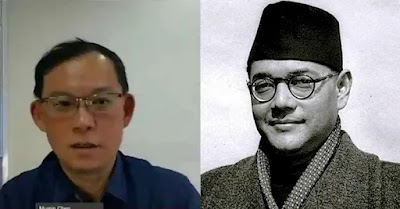


The Taiwanese diplomat in Delhi then urged that the National Archives and other databases of information are open for Indian scholars and historians to study. He asserted that a lot of young historians interested in studying South-East Asia and India are in Taiwan. “A lot of historical documents and evidence on Netaji, and the Indian Independence movement are in Taiwan. Right now, very few Indian scholars know about it,” he added. Mumin Chen also elaborated on the bilateral need for India and Taiwan to “re-examine and re-discover the common history of Indo-Pacific” through shared common connections.


The controversy over the suspense of Netaji’s death refuses to die down. It is known that Netaji, after the plane crash in August 1945 was taken to Army Hospital in Taipei where he breathed his last. The interesting development comes when the Prime Minister of India, Narendra Modi is all set to unveil the hologramic statue of Netaji Subhas Chandra Bose at the India Gate on the occasion of his 125th Birth Anniversary.


(Source: OpIndia)

Thursday, 25 January 2018

10 facts and mysteries from Netaji Subhash Chandra Bose's life

Colonized India had birthed not heroes, but superheroes – the kind that at times stared into the eyes of death and challenged it, like Bhagat Singh, and at times played hide-and-seek with it, like Netaji Subhash Chandra Bose would often do. He was that unsung hero who fought tooth and nail for India’s independence as long as he could and then disappeared mysteriously. How we wished, he came back one last time and shared his truth with us, but that never happened.

Netaji Subhash Chandra Bose in his Calcutta house, 1920 (Facebook)
Netaji was born on 23 rd January 1897. This being his 121st birth anniversary, Avantika D shares 10 interesting facts of his life on Yahoo. Read on:


  1. An exceptionally brilliant student who secured top ranks throughout his academic career, effortlessly got through the Indian Civil Service held in England in 1920. A government job was as dear to middle class India then as it is now, but Subhash resigned within a year to channel his energies toward India’s struggle for freedom.
  2. Bose started showing his strong leadership skills and radical element long before he formed the INA. His first heated encounter with a British happened during his college days when he took on an English professor for manhandling a fellow Indian student. As the altercation intensified Bose landed a tight slap on the gora. Yes, there were ramifications he was faced with after.
  3. Bose had also served as the leader of the radical wing of Indian National Congress in the late 1920s and early 1930s. Though he became Congress’ President in 1938, he was expelled from the position the very next year owing to his strong differences with Mohandas Karamchand Gandhi as his foreign and internal policies failed to amuse Bose.
  4. For his stand for absolute independence, Purna Swaraj , that didn’t sit well with the British, Netaji Subhash Chandra Bose was imprisoned eleven times for various durations between the periods 1921-1941.
  5. At the outset of World War II, he travelled across to countries like Soviet Union, Nazi Germany and Imperial Japan seeking alliance against the British government in India. Both Hitler and the Japanese government were impressed by Bose’s ambition. ” The Japanese are deeply moved by Bose’s strong will to have led the Indian independence movement from British rule.” told Shinzo Abe to Bose’s family during his visit to Kolkata in 2007.
  6. Later, he formed the Indian National Army (INA) or the Azad Hind Fauj with the Indian prisoners-of-war in Japanese jails, and plantation workers in Singapore, British Malaya, and other parts of Southeast Asia.
  7. Subhas Chandra Bose looked at the Bhagvad Gita not as a mere religious text but a mammoth source of unparalleled inspiration. He was greatly influenced by Swami Vivekananda’s vision on universal brotherhood, his nationalist opinions and his penchant for social reform.
  8. Our brave soldier had a romantic heart also, and he lost it to a beautiful German maiden Emilie Schenkl whom he had initially hired to take shorthand while Netaji was authoring the book The Indian Struggle. Bose is survived by a daughter named Anita Bose Pfaff.
  9. Many of Netaji’s relatives are active in the present political scene of India. His Nephew Sisir Bose is in the Indian National Congress, and Krishna Bose, his niece is a TMC member. Amiya Nath Bose is another nephew who has his affiliation towards the Janata Dal. Grand-nephew and grand-niece, Amit Mitra and Sugata Bose are TMC ministers, and Chandra Kumar Bose is a BJP candidate.
  10. His death remains a mystery till date. Though government documents speak of his death in a plane crash, many conspiracy theories have provided explanations of him being alive, returning to independent India and staying incognito as Gumnami Baba in a UP village. Many link his staged disappearance with the Nehru-Gandhi brigade as his return would have threatened Nehru’s candidature for the position of the Prime Minister of India. None of these conspiracy theories have been officially accepted so far.

Tuesday, 28 March 2017

'Netaji was responsible for India's independence from Britain and not Gandhi'

Files related to Netaji Subhas Chandra Bose was declassified recently by the Narendra Modi government.

Though the files led to revelation of certain facts related to Bose, it has also sparked off certain controversies, one of them being the need to rewrite modern Indian history.

As per a report in Mail Today, in a yet-to be-published book - Bose: An Indian Samurai - by military historian General GD Bakshi, it has been claimed that former British PM Clement Atlee had said that the role played by Netaji's Indian National Army was significant in India becoming independent.

The book also says that the non-violent movement led by Mahatama Gandhi was dismissed as having had minimal effect by then British PM.

Bakshi has reportedly cited a conversation between Atlee and then Governor of West Bengal Justice PB Chakraborty in 1956.

Attlee, who had signed the decision to grant independence to India, was in the country and had stayed in Kolkata as Chakraborty's guest.

Chakraborty was the then Chief Justice of the Calcutta High Court and was serving as the acting Governor of West Bengal.


As per the report, he had written a letter to the publisher of RC Majumdar's book - A History of Bengal.

The website quotes him as follows - "When I was acting governor, Lord Attlee, who had given us independence by withdrawing British rule from India, spent two days in the governor's palace at Calcutta during his tour of India. At that time I had a prolonged discussion with him regarding the real factors that had led the British to quit India. My direct question to Attlee was that since Gandhi's Quit India Movement had tapered off quite some time ago and in 1947 no such new compelling situation had arisen that would necessitate a hasty British departure, why did they had to leave? In his reply Attlee cited several reasons, the main among them being the erosion of loyalty to the British crown among the Indian Army and Navy personnel as a result of the military activities of Netaji."

He is further quoted as thus - "Toward the end of our discussion I asked Attlee what was the extent of Gandhi's influence upon the British decision to leave India. Hearing this question, Attlee's lips became twisted in a sarcastic smile as he slowly chewed out the word, 'm-i-n-i-m-a-l'."

The above conversation was first published by the Institute of Historical Review by author Ranjan Borra in 1982.

(Source: Zee News)