Showing posts with label Prince William. Show all posts

Sunday, 5 January 2020

Portrait of Queen and three heirs marks the start of a new decade

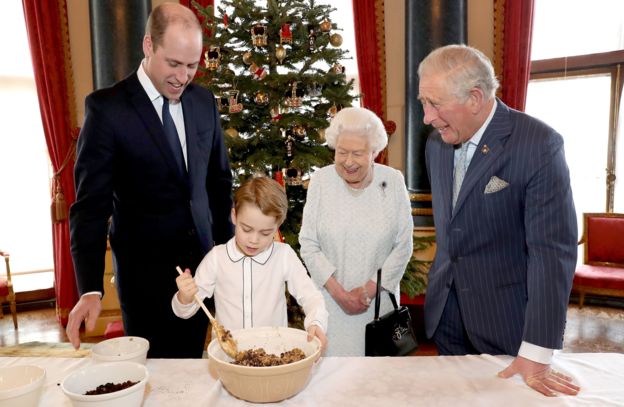
A portrait of the Queen with the next three heirs to the throne has been released to mark the start of the new decade.

It shows the Prince of Wales, the Duke of Cambridge and Prince George standing with the Queen at Buckingham Palace.


The new photograph was taken in the week before Christmas, but has not been published until now.

It is the second official portrait of the four generations of royals together.

The Queen, 93, standing at the front of her family, wears a white dress with a blue brooch and clutches a handbag.

Her son, Prince Charles, who is dressed in a pinstripe suit, stands on the first step behind her.
A portrait of the four royals was previously released in 2016 to mark the Queen's 90th birthday

His arm rests on the shoulder of his six-year-old grandson, who is wearing a pair of green and navy tartan trousers.

Prince William, wearing a dark suit and navy tie, stands with his hands together to the right of his grandmother.

The photograph was taken by Ranald Mackechnie, who was also responsible for the only other portrait of the four royals together.
The Queen, Prince Charles, Prince William and Prince George made Christmas puddings last month

It was released in 2016 to mark the Queen's 90th birthday and was printed on commemorative stamps.

The latest portrait was taken on December 18 - the same day the four royals were photographed making a Christmas pudding together at the palace.

The moment, captured in front of a Christmas tree decorated with miniature corgis and crowns, featured in the Queen's Christmas Day message.


(Source: BBC)

Monday, 26 August 2019

Royal Family: From costs to carbon, how do they travel?

The image of the Duke and Duchess of Cambridge stepping onto a budget flight contrasted somewhat with the Duke and Duchess of Sussex's travel this summer.

Prince William and Kate's cheap hop on Flybe from Norwich to Aberdeen was compared unfavourably by critics to Prince Harry and Meghan's trips by private jet.

But who decides how the Royal Family travels? And how much do they spend getting about?

Official v unofficial
While the costs of official royal trips are published online in annual reports, the amount the royals spend on unofficial travel is not.

Spending on official travel, which is paid for by taxpayers, was £2.7m overall last year. Of trips costing more than £15,000, Prince Charles spent the most.


Tradition dictates that what the royals spend in their own time is up to them and so we only know what gets reported, often by chance.

Kensington Palace would not comment on the cost of the Cambridges' personal travel after they were snapped boarding their budget flight this week. Reports said tickets cost as little as £73.

Meanwhile, Sir Elton John said he lent his private jet to Prince Harry and Meghan to ensure their privacy on a recent visit to his French estate.

Phil Dampier, who has written several books about the royals, said he expects that gifts of flights - which can total tens of thousands of pounds - may need to be disclosed in future.

"I think what will have to happen in future is that any flights given to them by the likes of Elton John or any benefactors they'll have to declare," he said.

Helicopters are preferred
When travelling in an official capacity, the royals make use of chartered helicopters far more than private jets.

Figures published by the royal household showed that 207 trips by helicopter were made last year, compared with 56 flights on specially-chartered planes.

The vast majority of the helicopter trips were short hops and cost less than £15,000 each, the accounts showed.

But the royals almost exclusively use chartered planes when travelling abroad.
The introduction of a royal helicopter operated by a civilian crew saved thousands of pounds

Among the more expensive trips taken was the Prince of Wales and Duchess of Cornwall's official visit to the Caribbean Islands and Cuba aboard RAF Voyager which cost £416,576.

Costs have plummeted
Despite the seemingly high costs, royal travel still costs a lot less than it did a few decades ago.

According to the National Audit Office (NAO), official royal travel costs declined by 76% in real terms between 1991-2 and 2011-12.

The NAO said that was because the household switched from using RAF helicopters to a civilian service and by taking fewer flights on more expensive planes.

Official royal travel is paid for by the Sovereign Grant, funded by the taxpayer.

This year, the grant - which also pays the Queen's household staff and upkeep of palaces - is expected to be £82.4m in total.

Last year, the money spent on official royal travel (£2.7m) was roughly the same as the previous two years. In 1997-98, the equivalent figure was £17.3m.

It's not all about money
The decision to charter a special plane or fly on a commercial flight is often taken by senior royal staff in conjunction with government, according to a former head of royal protection.

Dai Davies, who led palace police in the 1990s, told the BBC: "Convenience in terms of the routes, the number of the visits, the timings, and in some parts of the world the need for security [are all considered]".

Prince Charles and Camilla arrive in Vienna after a flight on a RAF Voyager plane
But the suggestion, made by celebrities who came to the defence of Prince Harry and Meghan, that the couple are not safe flying on a normal airliner was untrue, Mr Davies added.

"It's absolute nonsense in terms of security," he said.

'More Travelodge than palace'
For trips closer to home, the royal train is still used by senior members of the Royal Family, despite the current stock dating back to the 1970s and it costing more per mile than a plane.

The train was most recently used by the Queen in March 2019, when the monarch slept on it overnight before an early visit to Somerset. Her combined train and helicopter for that trip cost £21,230.

The interior of the royal train has been likened to a Travelodge
Yet the train costs much more per mile than chartered flights.

A September 2018 trip by the Prince of Wales from Aberdeen to Euston cost £22,086, around £40 a mile, but a similar journey by the Queen on a chartered flight in October 2018 cost £17,689, or £32 a mile.

Courtiers have argued that using the train reduces the need for costly and disruptive hotel stays.

The train has begun to show its age. Sir Alan Reid, the former keeper of the palace purse, told MPs in 2013 the interior of the train "is very G-Plan, which is either '60's or '70's".

"It is not luxurious by any stretch of the imagination, but it does offer a very safe, secure and effective way - particularly as the Queen has got older - of having her go up the country in order to do engagements first thing the next morning."

A reporter for The Daily Telegraph once said the décor was "closer to a Travelodge than a palace".

Mr Davies added: "In truth it is an antiquated system that costs a huge amount in terms of security and protection… I think there's a question mark as to whether it is justified."

Carbon controversy
Prince Harry and Meghan's recent flights to Nice generated an estimated 37.6 tonnes of carbon, which Sir Elton John said he paid to offset.

The couple had previously told their followers on social media that "every choice... every action makes a difference" to climate change.

Royal historian Caroline Aston told the BBC that the younger royals should practice what they preach.

"If you're going to create your own 'woke up' brand of greenness and ethical behaviour, then you do need to dot the 'i's' and cross the 't's' a little bit," she said.

Yet claims of hypocrisy when it comes to how senior royals travel are nothing new.

Ms Aston said history was "packed with examples of royalty who have been attracted to the glitzy lifestyle" of private jets only to find "the friend who extended the hand might just have been doing it for their own reasons".

"Now because we finance the Royal Family... they have to be seen to earn our respect. We don't give it anymore purely because of an accident of birth, it has to be earned."

Prince Charles faced claims of hypocrisy in 1991 after making a speech on "monstrous" motorcars only to have his favourite Bentley driven 800 miles to then-Czechoslovakia ahead of a visit.

Prince Charles' favourite Aston Martin runs on eco-friendly fuel
In 2015, he was accused of "double standards" by making an 80-mile journey by helicopter just days after urging people to save energy by turning off their lights.

Prince Charles, who takes on the lion's share of royal travel as heir to the throne, now lists measures his household takes to reduce his carbon footprint online, including the use of waste from the production of wine and cheese to fuel his prized Aston Martin.

Despite the measures, the royals' latest accounts revealed that the family's carbon footprint from official travel nearly doubled last year, to 3,344 tonnes of CO2.

It is unclear which members of the Royal Family engage in so-called carbon offsetting. The Foreign Office, which organises the royals' official trips abroad, spent £43,635 on offsetting the carbon created by international flights in 2017-18.

A Buckingham Palace spokeswoman told the BBC: "Travel arrangements for members of the Royal Family are made taking into consideration security, efficiency, cost, effective use of time and disruption to others.

"Official overseas travel undertaken by members of the Royal Family is done so at the request of government."

(Source: BBC)

Friday, 18 May 2018

How does the royal family make its money?

Most people make money from their day jobs. British royals are not most people.

Queen Elizabeth II and the British royal family have multiple sources of income, but they're still not as rich as you might expect.

Media reports have estimated the Queen's personal fortune is worth up to £360 million ($470 million). That's a nice chunk of change, but over 320 Brits are richer, according to the Sunday Times.

The Queen and the heir to her throne, Prince Charles, receive most of their income from the government and their private estates. Millions trickle down to the rest of the family, including Prince William and his wife Catherine, the Duchess of Cambridge. Prince Harry, who will wed American actress Meghan Markle on May 19, also receives royal funds.


Here's how the royal finances work:

Queen Elizabeth II
The Queen's three main sources of income are the Sovereign Grant, the Duchy of Lancaster estate and her personal property and investments.

The Sovereign Grant -- an annual lump sum from the government -- is essentially an expense account, covering the costs of travel, security, staff and the upkeep of royal palaces.

The Queen received £42.8 million ($58 million) free of tax from the Sovereign Grant in the 2016-2017 fiscal year. The payment was projected to balloon by 78% to £76.1 million ($103 million) in the latest fiscal year to help finance an extensive renovation of Buckingham Palace.

The Sovereign Grant is generated from the Crown Estate, a collection of UK properties and farms that generate hundreds of millions of pounds each year. The vast majority of earnings from the Crown Estate go into government coffers, but a portion of the profits -- between 15% to 25% -- are given to the Queen in the form of the Sovereign Grant.

Queen Elizabeth II receives an annual income from public and private sources.
Another important source of income for the monarch is the Duchy of Lancaster, a private estate of commercial, agricultural and residential properties that dates back to 1265. It produced £19.2 million ($26 million) in income for the Queen during the most recent fiscal year. The Queen uses this money to pay for official and private expenses, including some costs incurred by other members of the royal family who undertake official engagements on her behalf.

The Queen also has her own personal assets, including Balmoral Castle in Scotland, and the Sandringham Estate in the east of England. Both were inherited from her father and are beloved family retreats.

But her wealth extends far beyond real estate. The Queen also owns a valuable stamp collection, numerous works of art and a stock portfolio.

Other assets closely associated with the Queen, including the Crown Jewels and many works of fine art, are actually owned by the Royal Collection Trust, a charity.

The Queen' husband -- Prince Philip, the Duke of Edinburgh -- also receives an annual payment worth £359,000 ($488,000) to finance his official duties. He retired last year after more than six decades of public service.

Prince Charles and his clan
Prince Charles and his wife Camilla, known formally as The Prince of Wales and The Duchess of Cornwall, rely on a a mix of public and private money.

Over 90% of their income comes from a private estate, the Duchy of Cornwall, which was established in 1337 to provide an income to the heir to the throne. The Duchy of Cornwall owns and operates land in rural and urban areas, a collection of islands and rental cottages in places like Wales and Cornwall.

In the most recent financial year, the couple made £20.7 million ($28 million) from the estate.

The couple also received £1.3 million ($1.8 million) from the Queen's Sovereign Grant and another £461,000 ($627,000) from various UK government departments.

The Sovereign Grant is used to pay the couple's official travel and property expenses. The government cash goes toward some official overseas trips and the salaries of members of the military who protect the family.

Roughly half of their annual income is spent on official duties and travel, while a quarter goes to the tax man. The remaining £6.6 million ($8.9 million) goes to Charles' children, "non-official" purchases and a royal savings account.

Meghan Markle is set to wed Prince Harry on May 19.
When Markle officially joins the clan, Prince Charles has the discretion to give the couple more money.

Prince William, Kate and Prince Harry are also reimbursed for costs when they perform official duties on behalf of the Queen.

Prince William and Prince Harry have private, inherited wealth from their mother, Princess Diana.

The rest of the family
There is limited public information about how the rest of the royal family make their money. The Queen has three other children aside from Prince Charles, and they too have children, spouses and grandchildren.

The Queen's two youngest children, Andrew, the Duke of York, and Edward, the Earl of Wessex, work full-time to support the monarchy, which involves appearing at public engagements on behalf of their mother.


The Queen pays her children for these duties through her income from the Sovereign Grant and Duchy of Lancaster.

The next generation of royals is expected to forge their own careers and required to be more independent. For example, Andrew's daughters -- Princess Beatrice and Princess Eugenie -- have full time jobs in the business and art worlds, respectively. But they also receive some financial support from their father.

(Source: CNN)

Monday, 7 May 2018

The mysterious life of James Middleton, Kate's party-loving little brother

Everyone knows Kate Middleton because of her dreamy royal wedding to Prince William. And everyone knows her younger sister, Pippa, because of the scene-stealing bridesmaid dress she wore to that wedding.

But fewer people know about the youngest Middleton: 29-year-old James, who's making his way in the business world as the head of a 100% serious, personalized marshmallow company called Boomf.

The youngest Middleton sibling leads an interesting life. Reuters/Max Rossi
Here's a look at James's life both before and after his family became quasi-royalty.

James, 29, is the youngest Middleton sibling. He grew up with Kate and Pippa in Bucklebury, Berkshire and attended the boarding school Marlborough College.

James in 2011. Getty/Ian Gavan
It was around this that time news outlets were first reporting Kate and Prince William's budding romance — and James took extreme measures to minimize rumors and chatter.

"I used to be first up in the morning to make sure I could get to the papers and rip out any stories about my sister, so nobody would see them and there would be no conversations about them," he recently told the Daily Mail.

But school was never James's strong suit. He's dyslexic, and knew that college wasn't for him. So he dropped out of Edinburgh University after one year.

James in 2012. Getty/Clive Rose
"I knew that that mouthful of academic prescription was not going to do it for me," he told British GQ. "My dream, which came to me when I was flying back up to Edinburgh after a weekend home, was to build a cake empire."

In 2007, he launched the Cake Kit Company, which provided customers with DIY kits for festive party cakes.

A web archive screenshot of the now-defunct Cake Kit Company website. thecakekitcompan.com
Sadly, James's "cake empire" wasn't to be: The company would eventually dissolve in May 2015.

In the meantime, his older sister Kate got married to Prince William in a ceremony watched by an estimated two billion people worldwide.

James and his mother Carole Middleton at Kate's wedding. Associated Press
James was just 23 years old on the day of the wedding.


Suddenly, he and sister Pippa were getting lots more attention from the media — and not all of it was good.

Pippa and James celebrate Queen Elizabeth II's Diamond Jubilee in 2012. Getty/Chris Jackson
After the wedding, a number of compromising photos of James were leaked online. Outlets that published the photos got threatening legal emails demanding the photos be taken down — but it turned that the "lawyer" who sent those emails was just James himself.

The photo scandal didn't look good — especially since it wasn't James's first embarrassing brush with the media. British GQ reported that he was photographed drunkenly stumbling out of a club on his 21st birthday a few years earlier.

But James continued working and making public appearances.

James attends a movie premiere in 2012. Joel Ryan/Invision/AP
He and Pippa frequently stepped out as a pair, since they shared an apartment together. Here they are at Wimbledon in 2013.

Pippa and James at Wimbledon 2013. Getty/Clive Brunskill
In 2013, James was first photographed with British media personality Donna Air.

James and Donna Air at a party in June 2013. Jon Furniss/Invision/AP
Air was married once before and has a 13-year-old daughter, Freya. "I love Donna very much and Freya is very much part of Donna," James told the Daily Mail. "I love them both equally."

James and Donna Air at a party in 2013. Jon Furniss/Invision/AP
2014 brought about a major style evolution for James: He grew a beard.

Pippa and James participate in the Race Across America in June 2014. Getty/Larry French
"My mother looks at it and says, 'When are you going to get rid of it?'" he told the Daily Mail. "But then that's because she wants me to be her little boy."

More importantly, he'd finally rebounded after the shutdown of his cake business. In 2014, he appeared on "Good Morning America" to promote his new venture, Boomf.

James during an appearance on "Good Morning America" in 2014. RW/MediaPunch/IPX
It's a service that allows you to print graphics and personal photos on marshmallows. He's raised "£1.5 million of recent investment," which is around $1.9 million at today's conversion rates.

"When you see yourself on a marshmallow, or your loved one or your pet, you have a little moment with that little marshmallow. There aren't many products in the world like that," he told the Cut. "I'm very much surrounded by [marshmallows], but I still love them [...] Marshmallows are sort of like an essential candy. They're pillows of sweetness."

James has told reporters that Boomf is doing well financially. He's also described himself as a "new age Willy Wonka."

When he's not working, he pursues an interesting set of hobbies: He keeps bees, restores old tractors and Land Rovers, and breeds dogs.

Michael Middleton, Pippa's fiancé James Matthews, and James Middleton
attend church on Christmas day 2016. Reuters/Andrew Matthews, Pool
He has even said that "vintage tractor magazines" are his guilty pleasure.

He also spends time with his nephew and niece, Prince George and Princess Charlotte.

The royal family dog Lupo, pictured here, was a wedding gift from
James to Kate and Will. Facebook/The Royal Family
"I just want to be the best uncle possible," he once told "Good Morning America." "Like any uncle wants to be, I want to be the cool uncle. The fun uncle. That's what sort of I'll always try and be."

And his relationship with Air appears to be going strong. They were most recently photographed together in November 2016.

James and Donna Air on a red carpet in 2015. Getty/Tim P. Whitby
Mostly it seems like James Middleton wants to forge an identity separate from his famous sisters.

Pippa and James at Wimbledon 2016. AP/Alastair Grant
"I work incredibly hard — just like every other person in business," he told digital magazine TYD in 2015. "Aside from the fact that yes, I am the brother of someone very important, I am, at the end of the day, just James."

(Source: BI)

Royal wedding: The main differences between American and British ceremonies

Will Prince Harry and Meghan Markle incorporate any American traditions into their big day?

Weddings are embedded in tradition, from the bride throwing the bouquet into a frenzied crowd to the happy couple driving off into the sunset with cans on strings in tow.

We may have many things in common with our pals across the pond, but when it comes to weddings, American and British ceremonies can differ greatly.

With the royal wedding between Prince Harry and Meghan Markle just a little over two weeks away, some are speculating over how the couple will incorporate American culture into the ceremony considering the fact that Markle grew up in California.

From personalised vows to a food-filled afterparty, here are the main differences between American and British weddings.


Personalised vows
While many of us have watched countless weddings on film and TV where individuals getting married have exchanged beautiful, heartfelt vows, it’s apparently less common for Brits to personalise their vows during the ceremony.

According to Inside Weddings, many British couples will recite the vows outlined by the Church of England.

The royal family is no different, although slight alterations have been made to the vows in recent times

In the traditional vows that the Queen repeated during her 1947 wedding to Prince Phillip, he stated that he would “love and cherish till death do us part”, while she said that she would “love, cherish and obey.”

Princess Diana decided to omit the word “obey” when marrying Prince Charles in 1981, with the Duchess of Cambridge following suit in 2011.

The Common Worship book of the Church of England, which was introduced in 2000, didn’t include the word “obey” in the updated wedding vows.

Some have speculated that Prince Harry and Markle will write their own vows in keeping with American tradition, in addition to the traditional vows of the church.

Bridesmaids
In the UK, it’s supposedly very common for brides to pay for the dresses of their bridesmaids, according to BBC America.

However, this differs in America, where bridesmaids will often have to foot the bill for their attire.

While many brides in the UK may choose a selection of friends and family to take on the role of bridesmaids, royal weddings are of course a slightly different story.

The bridesmaids at royal weddings usually consist of children, with the maid of honour and best man the only adult members of the wedding party.

However, with Markle hailing from California, rumours are rife about the friends that she may have chosen to be her bridesmaids on the day.

While close friend Priyanka Chopra, who wrote an excerpt about Markle for Time 100's list of most influential individuals of 2018, has confirmed that she won’t be a bridesmaid and the Daily Express has stated that Kate Middleton is unlikely to be one as well, some believe that TV producer and author Lindsay Roth may be named maid of honour for the bride-to-be.

Roth and Markle met during their first year at Northwestern University, with Markle taking on the role of maid of honour for Roth’s wedding in 2016.

Wedding toasts
One of the biggest differences between American and British weddings is the toasts given during the meal, according to Vogue fashion news editor Emma Elwick-Bates.

“Americans always give such emotional and touching speeches, but in Britain, the best man - or woman - generally sets out to mortify the groom with much hilarity,” she explained.

Prince Harry reportedly decided to go easy on his brother when giving his best man speech at Prince William and Kate’s evening wedding reception, telling him that he was the perfect brother.

However, in true Prince Harry style, he used his good sense of humour to take the mick out of the newlyweds, doing impersonations of both the bride and groom much to the delight of their guests.

Cake
Wedding cakes are incredibly extravagant creations, although they may not always taste as good as they look.

While some may be a fan of fruit cake, those who prefer slightly more indulgent flavours will probably not be too drawn to the traditional British wedding cake, which Inside Weddings states is typically fruit cake.

On the other hand, wedding cakes in America display more variety with their choice of flavours.

In March, Kensington Palace revealed that Prince Harry and Markle had chosen Claire Ptak, a pastry chef from east London, to make their wedding cake.

The couple opted to divert from the traditional fruit cake of British weddings. Their lemon and elderflower wedding cake will be inspired by spring, covered in buttercream and decorated with fresh flowers.


Afterparty
Prince Harry took his role of best man at his brother’s wedding to heart by appointing himself as “master of ceremonies”, which involved organising for the guests to enjoy a delicious breakfast at 6am following the night of festivities.

The culture of enjoying early morning food following a night of frivolity is more common in America than in the UK.

However, this could be something that Markle will be keen to include during her wedding.

According to Hayley Bloomingdale, communications director at Moda Operandi, Markle will want to stay true to her American roots with her choice of afterparty nourishment.

“She needs to get this right. People don’t want posh food on silver platters at 1am,” Bloomingdale told The Sunday Times.

“They want grilled cheese, hot dogs, hamburgers, a taco truck, a doughnut wall, something lowbrow. That’s very American."

(Source: Independent)

Sunday, 29 April 2018

Why ‘Louis’ has been chosen as the royal baby name

The baby’s full royal title will be His Royal Highness Prince Louis of Cambridge

Today Kensington Palace announced that the Duke and Duchess of Cambridge have named their third child Louis Arthur Charles.

The prospect of naming a newborn child can be very daunting for parents, so one can only imagine how the royal couple felt with the world waiting in anticipation for the big reveal.

The name of any baby born into the royal family typically bears a lot of historical significance.

The eldest of Prince William and Kate’s children, Prince George, is likely to eventually become the seventh monarch of that name to reign the nation, following the Queen’s father King George VI and grandfather King George V.

As for their second born Princess Charlotte, the decision over her name may have been inspired by her grandfather Charles, Prince of Wales, in addition to being the middle name of Kate’s sister, Pippa Matthews.


The name Louis is often associated with the French monarchy, with the last King of France Louis XVI ruling from 1774 until 1791.

However, the name also has many connections with the Mountbatten family of Prince Philip, Duke of Edinburgh.

Prince Charles’ great-uncle and mentor, with whom he was particularly close, was called Lord Louis Mountbatten.

The royal baby’s father and brother both also share the name.

Louis was chosen as Prince William’s third middle name when he was born, while Prince George’s full name is George Alexander Louis.

It’s not just the royal baby's first name that’s been garnering attention.

At one point, Arthur was deemed as the most likely name for the baby with 2/1 odds.

However, it’s now been chosen as the baby’s middle name, followed by Charles in an obvious nod to his grandfather.

The legendary King Arthur obviously springs to mind when the name Arthur is mentioned.

Prince Charles, who also boasts Arthur as a middle name, was apparently so drawn to the name that he originally wanted to use it for his second son.

However, the late Princess Diana didn’t agree with his preference.

"Charles wanted to call his first son 'Arthur' and his second 'Albert', after Queen Victoria's consort. William and Harry were Diana's choices while her husband's preferences were used in their children's middle names," it states in the book Diana: Her True Story in Her Own Words.

The two monikers ended up being used as middle names for Prince Harry and Prince William respectively.

Prior to 2012, the second son of Prince William and Kate would have been given the title of “Lord”.

However, an official ruling made by the Queen on December 31 2012 meant that all of the royal couple’s children would be named princes and princesses.

(Source: Independent)

Wednesday, 25 April 2018

Kate Middleton's womb is public property – and that's wrong

Gone are the days when, as with Anne Boleyn, a woman’s failure to produce the right sort of heir could become her death warrant. Still, as long as power is transmitted down the bloodline, a royal woman’s womb is public property, says Glosswitch in Independent. Read on: 

Early this morning, the Duchess of Cambridge was admitted to hospital in the early stages of labour (she has of course now given birth to a boy). Along with my fellow commoners I can only guess what “early stages” means.

Had the waters broken? How many inches dilated? How far down the birth canal are we at this point in time? And why, given how intimate, unpredictable and frightening any labour can be, do I think I have the right to know?

Of course, I know the answer to this already. We’re all invested in this baby, whether we like it or not. From the most devoted royal watcher to the most ardent republican, each of us has a take on what this baby means.


For some it’s a cause for celebration. For others, a third child to the second in line to the throne, at a time when child tax credits have been withdrawn for third children of low-income families, can only symbolise the gross inequality pervading Britain in 2018.

As for me, I feel sorry for Kate. For all her privilege, I cannot imagine what it must be like to have the entire country focused on your performance in childbirth (and I write this as someone who’s given birth in a car park, next to a Portakabin. I know all about going public with this sort of thing, but there have to be limits).

We are told that “as with her older children, the duchess is hoping for a natural birth”. I am not sure why we need to know this, other than for reassurance that even the poshest of women should not consider themselves “too posh to push”. Given what we know about both vaginal and caesarean births – that neither are all aromatherapy and whale music, that there is pain, fear and indignity – it seems cruel to place this pressure on another human being. What’s more, does “natural” include having an epidural? What about gas and air? How much agony will this woman have to endure? The public must know!

In addition to the pain, there is also the risk. When I rang the hospital in labour with my third child, I was told (unhelpfully, in my view) that “third ones are notoriously difficult”. Looking back, I suppose it may have been to stop me getting ideas above my station and deciding I was now an expert at this labour business. Giving birth safely once or twice provides no guarantee that a third time will go to plan.

While wealthy white women and their children are least likely to be put at risk, we shouldn’t be casual about what labour means. It’s an extreme, traumatic event and while for most of us it leads to a happy ending, we should not be creating scenarios in which a tragic ending could be read as a failure. Headlines such as “Royal baby to celebrate birthday on Saint George’s Day” and “This is how long the Duchess of Cambridge will likely be in labour for – and it’s shorter than you think”, which appeared before the baby has even arrived, were presumptuous. What if the nation’s best-loved vessel failed to deliver the goods? What if in doing so she suffered harm?

You may be thinking “so what if she does? She has luxury medical care the rest of us are denied.” I’d argue that we cannot separate the Duchess of Cambridge’s privilege from the misogyny lurking behind royal labour watch. Under our system of hereditary monarchy, her children are considered more important and valuable than yours or mine. They’re also more important and valuable than she is. Kate Middleton does not have royal blood. In this case it’s her husband’s contribution that matters.


Gone are the days when, as with Anne Boleyn, a woman’s failure to produce the right sort of heir could become her death warrant (or, as with Anne’s successor, the delivery of such an heir stood a high chance of killing her anyway). Still, as long as power is transmitted down the bloodline, a royal woman’s womb is public property. What this shows is not just the sheer irrationality and mystic thinking behind our idea of royalty, but the way in which, as a principle, it can override the humanity of a royal family’s own members. Female bodies have been used up and spat out in pursuit of eternal rule.

Like any birth, I’m glad this one went well – or so we’ve been told. How soon will they tell us? Do we need to wait for the placenta to be out as well?). I also hope that someday we can progress to a more respectful, even awestruck understanding of what giving birth means for each and every woman. Whatever the outcome, however well known the woman, it’s a highly personal experience, and one that should never be taken for granted.

Thursday, 28 December 2017

Mum hopes royal photo can pay for university

A mother who snapped a lucky photograph of four smiling royals is hoping its sale will help her fund her daughter's university education.

Karen Anvil, 39, from Watlington in Norfolk captured a beaming Duke and Duchess of Cambridge, Prince Harry and Meghan Markle at Sandringham.

The image, which was posted on Twitter, was liked almost 4,000 times and stoked mainstream media interest.

Ms Anvil told the BBC reaction to the picture has been "bizarre and bonkers".

The picture everyone wanted...
Ms Anvil and her 17-year-old daughter, Rachel, have been to spot the Royals at their annual Christmas Day service a couple of times before.

She said that, while suffering from an illness last year, she promised her daughter they would go to St Mary Magdalene Church in Sandringham this Christmas.

She said: "Sky News was on and we were looking at the crowds. My daughter said 'I'd love to do that'.

"'I said 'next year, when I'm better we'll go'. And so I took her."

Asked how she got the Royals to look at the camera and capture the shot every photographer dreamt of, Ms Anvil admitted her secret was attracting their attention,

"I'm just very bubbly by nature and I was with my daughter and I got a bit excitable, I suppose.

"I was just sort of shouting and I just went 'Merry Christmas!' like an idiot. I was fan-girling.

"That's all I said and got them to look."

Ms Anvil posted the image on Twitter at about 11:00 GMT and got thousands of likes. Her previous record was just five likes.

Ms Anvil admitted she had a "fan-girl" moment while with her daughter Rachel, 17
Four hours later she was still receiving messages asking for permission to use the picture - and advice from other Twitter users telling her to negotiate a price.

She said: "At first I said oh yeah sure. Have the photo. I know nothing about that."

But soon afterwards she was flooded with suggestions to copyright the photograph and earn some Christmas Day cash.

"The thing is - and I hate to play the single mum card - I'm a single parent, I work two jobs, which I'm proud of and I've always worked.

"Now I want to save money for my daughter for uni and if I can do that, and can get that opportunity that's amazing."

(Source: BBC)

Monday, 11 December 2017

14 rules that make a princess’s life less than easy

Every girl dreams of being a princess from the moment she first sees a Disney movie. A fairy-tale castle, a charming prince, and a kingdom as well — what could be better? However, the life of real princesses is not as easy as it may seem.

Bright Side collected a list of things that princesses, unlike ordinary girls, are forbidden to do. Read on:

14. Sign autographs


Kate is allowed to be photographed with her fans and shake their hands, but she must not sign autographs. According to royal rules, she can put her signature only on official documents. The reason for this rule is Queen Elizabeth’s fear that someone might forge the signatures and use them against her family.

13. Work in an office


Before her marriage, Kate worked for her parents’ business for some time. The firm dealt with delivering goods and organizing events. Now Kate’s work is visiting charity dinners, schools, and hospital openings.

It is believed that the Duchess doesn’t like such events much and tries to avoid them. For this reason, she was, perhaps rather unkindly, given the nickname "Lazy Kate" as some say she is the one who skips such meetings the most among all the royals.

12. Eat mussels or oysters


It’s unknown how upset Kate was when she was asked to refuse oysters. The ban is connected to the fact that oysters can cause allergies and become poisonous when stored incorrectly. Hence, the Duchess and other members of the royal family are forbidden to risk their health.

11. Wear a bright manicure


No rhinestones, chevrons, or broken glass on the nails. According to the dress code, the Duchess of Cambridge can use only nude-colored shades. Kate’s manicure usually consists of 2 shades: a tender pink (#28 Rose Lounge by Bourjois) and a sophisticated nude (#423 Allure by Essie).
Of course, it’s a universal option, but it would be great if a classical French manicure was allowed too. Otherwise, it’s slightly boring.


10. Have a profile page on social media


There is a strict ban on using social media in the royal family. This rule applies because personal information can become public.

There are official pages for the royal family on Twitter and Instagram, but they are controlled by professionals who carefully select photos and prescribe the text for publications.

It’s a pity not to have a chance to post even a small bouquet on Instagram when you have such a busy life and so many professional photo sessions.


9. Kiss in public


Queen Elizabeth II considers it inappropriate to express feelings in public and insists that her grandchildren behave properly. Due to this rule, there were rumors about disturbances between Kate and William because they always keep a distance in public.


8. Go shopping alone


Kate likes shopping as much as any other girl. However, she cannot do it alone. The Duchess is allowed to visit supermarkets and modern London boutiques only with protection officers.
Well, it’s convenient to some extent because there is always someone available to ask if a dress suits you or not.


7. Wear fur


Before her marriage, Kate loved to wear fur. You can see many photos of her wearing fur coats and fur hats on the internet.

Now the Duchess can wear fur occasionally but only of animals that died of natural causes.


6. Vote


The Duchess, as well as other members of the royal family, is forbidden to vote or run for parliament. All monarchs undertake to keep neutrality and not spoil their reputation through politics.


5. Wear ambiguous dresses


Kate once loved bright and youthful styles. Now she must wear modest and elegant outfits. Her styles are carefully planned by stylists to avoid ambiguous and controversial statements.


4. Play Monopoly


According to royal protocol, there is a ban on Monopoly because the game is considered to be vicious and senseless.

It seems that Kate was not too upset by this. The main thing is that she can still play hockey, which she simply adores.


3. Travel with the whole family


This rule appeared in the last century when it was very dangerous to fly on planes. This ban helps to protect the royal lineage should anything happen to the plane.

This rule is often neglected nowadays because there is much less danger when flying.


2. Sit in the wrong place


It is just like in the fairy tale: "Who sat on my chair? Who ate from my plate?" All members of the royal family must follow a special order when seated and occupy only their places. Also, when the Queen finishes her meal, everyone else should stop eating as well.

What if you are still hungry? Where is the justice?!


1. Visit beauty salons less than 3 times a week


The Duchess should always look elegant and have a perfect hairdo. That’s why she should visit beauty salons not less than 3 times a week. Of course, all the transformations of Prince William’s wife happen behind closed doors and are carefully hidden from the public.

Saturday, 9 December 2017

Does Meghan Markle becoming a British royal make her fair game?

Middleton and Markle’s royal job is a jobless sort of job, like many jobs acquired through nepotism and family connections, writes  Nisha Susan in The Ladies Finger. Read on: 

When you marry into a family, often you have no idea what’s coming. But Meghan Markle is in the unusual position of just having to buy a few school-level textbooks. Markle and Kate Middleton can also look back at a long line of their female royal predecessors and see that it hasn’t been mostly laissez les bon temps rouler but mostly heads rolling. You don’t have to go all the way back to Anne Boleyn, though. Most recently, the two women India TV once called Kate ki asli saas (Diana Spencer) and Kate ki doosri saas (Camilla Parker Bowles) have had their varying shares of public misery.

One of the first things I thought when I heard of actor Meghan Markle’s engagement to Prince Harry was, “What is Hilary Mantel thinking now?” Double Booker-winner and all-round literary marvel, Mantel has grappled with the complications of women in the British royal family over and over again. In her 2005 novel Beyond Black, Diana makes an appearance as a cheerful and confused ghost. In the first two books of her Cromwell series Wolf Hall and Bring Up the Bodies, the fascinating Anne Boleyn soars and crashes. In 2013, soon after her second Booker, Mantel gave a lecture at the British Museum about Anne Boleyn, the nature of monarchy and the media circus around Kate Middleton, and particularly her body. She said, “Cheerful curiosity can easily become cruelty. It can easily become fatal. We don’t cut off the heads of royal ladies these days, but we do sacrifice them, and we did memorably drive one to destruction a scant generation ago.” In this and other ways, Mantel argues in favour of kindness to the “nicely brought up young woman” with the “dead eyes”, aka Middleton.

Mantel added, “Kate seems to have been selected for her role of princess because she was irreproachable: as painfully thin as anyone could wish, without quirks, without oddities, without the risk of the emergence of character.”

I am not sure how to say that it was astonishingly brave of Mantel to make these remarks without sounding like I, in turn, am being bitchy to Mantel. So here it is – to be an overweight woman and call Kate Middleton too thin was to invite the guillotine. The Daily Mail immediately called Mantel venomous and vicious and reminded everyone that Mantel was infertile and “dreamt of being thin”. Mantel’s discussion of the latest version of Royal watch was pushed under the bus even by those with greater intellectual claims than The Daily Mail coz, you know, Mantel is a fatty. And this, as everyone who is not living under a rock knows, is what it is in this millennium to live in the public eye as a woman.

Meghan Markle. Photo courtesy Meghan Markle Instagram
So I wonder what Mantel makes of Meghan Markle, a thoroughly modern creature with biographical details that would have made her a royal no-no until even fairly recently. Her biographical and anatomical details have been simultaneously lauded by a section of observers and fans as a sign that the royals are getting woke-ish. What details? That Markle is American, Catholic, divorced, biracial and has a solid career. A career that she is reportedly quitting to be part of a household that costs $368 million a year, $48 million of which comes from the British government, an annual payment made to the Royals for nothing more than being already gloriously rich and well-dressed. It’s as if the nation of UK had figured out Instagram a few hundred years before everyone else and, having figured it out, continues to throw millions of pounds at it to retain a proto-Kardashian household to provide pageantry, fashion, anxiety, affection and rage. I mean, Instagram is free, Brits, you can still choose to exit (ahem) this arrangement.

Why is it considered all right to be particularly brutal to the young women of the British royal family? The British press has helpfully told its readers that Markle’s ancestors were slaves when her fiancé’s were kings and earls. It has retrieved astonishing anachronisms like ‘saucy divorcee’ to describe her. ‘Saucy divorcee’ was already dated back when the name ‘Hotmail’ made middle-aged Brits giggle. The media harassment escalated to a point that the Palace had to issue a statement claiming that “a line has been crossed” and the press should back off Markle. For its full impact, this statement should be read alongside what Harry said in a documentary made on the 20th anniversary of his mother’s death: “She’d had a severe head injury. Those that had caused the accident were then taking photographs. Instead of helping, [they] were taking photographs of her dying on the backseat. And then those photographs…made their way back to news desks in this country.”

It’s tough enough to be just about any kind of woman in the public eye, as one story about a husband-and-wife pair of reporters in The Washington Post demonstrated (short version: she got trolled, he didn’t). And it’s not like fame protects you from private assaults, as the Weinstein epic has taught us. The particular nature of their celebrity throws Middleton and Markle under the juggernaut of global rage and a profound lack of empathy.

When Kim Kardashian was held at gunpoint and robbed in a Paris hotel last year, she faced heavy trolling, disbelief and online comments that wished she had been killed. Many of the celebrities who did offer Kardashian solidarity felt it necessary to remind the world that she was a wife and a mother of two. A year later Taylor Swift, sister suffragette, made a reference to the robbery in her new song Look What You Made Me Do, also mocking her.

Middleton and Markle are likely to gain even less sympathy in a similar situation. In 2012 photographs of Middleton sunbathing topless in France were taken from nearly a kilometre away using special lenses and published in tabloids. I found myself in heated arguments with friends, even feminist friends, who felt that these are just rich people problems and Middleton deserved no sympathy. Are they really?

This week American television journalist Matt Lauer was fired for serial sexual harassment and at least one complaint of sexual assault. Now we can draw lines connecting the dots between his alleged assaults to his edging out female colleagues to his giving Hilary Clinton a hard interview and Trump a soft one in 2016, all the way to his asking incredibly malicious questions to Anne Hathaway about paparazzi taking upskirt photos of her. The same logic that makes the royal women fair game made Anne Hathaway fair game back then. Even now, some would argue that Lauer’s sexism to Hilary Clinton more geopolitically significant, and hence more deserving of indignation, than his sexism to Anne Hathaway, aka frivolous Hollywood type, who shouldn’t feel bad about any public invasions of her body.

Prince William, Kate Middleton. Photo courtesy Kate Middleton Facebook
As Rebecca Onion points out in this post-Weinstein essay gloriously titled, We’ve Got the ’70s-Style Rage. Now We Need the ’70s-Style Feminist Social Analysis, most capitalist institutions are death to female ambition and encourage male domination. Which makes me think, aren’t the stories of Lauer’s systemic edging out of female colleagues as horrific as the stories of his sexual assault? As Onion writes, “Beyond creating a climate where harassment could thrive, capitalism reaped the benefits of this dynamic, since many women left male-dominated fields with higher-paying jobs for lower-paying positions in teaching, nursing, or social work where they would be less likely to have to deal with a harasser… Are men still taught to dominate, and to respect those who perform dominance? You betcha. And the behavior continues to function as a check on women’s ambitions.”

Does Onion’s dose of feminist theory seem far away from our lives? Not so much. Just this week Scroll reported on economist Girija Borker’s study that has shown how women applicants often pick lower-ranked Delhi colleges if they are considered to be a ‘safer’ commute.

All this is to say that Middleton and Markle’s royal job is a jobless sort of job, like many jobs acquired through nepotism and family connections. But it’s not without some of the risks taken on by women in the public eye everywhere, and a tiny bit of the risks taken by a spectrum of working women. So a little kindness won’t hurt anyone. It isn’t as if they are going to stop bringing up the bodies, Markle’s, Middleton’s, yours or mine.

Tuesday, 5 September 2017

The princess myth: Hilary Mantel on Diana

The Wolf Hall novelist on the 20th anniversary of the death of the Princess of Wales, an icon ‘only loosely based on the young woman born Diana Spencer’.

Royal time should move slowly and by its own laws: creeping, like the flow of chrism from a jar. But 20 ordinary years have jog-trotted by, and it’s possible to have a grownup conversation with someone who wasn’t born when Diana died. Her widower is long remarried. Her eldest son, once so like her, shows signs of developing the ponderous looks of Philip, his grand-father. Diana should be as passe as ostrich plumes: one of those royal or quasi-royal women, like Mary of Teck or Wallis Simpson or the last tsarina, whose images fade to sepia and whose bones are white as pearls. Instead, we gossip about her as if she had just left the room. We still debate how in 1981 a sweet-faced, puppy-eyed 20-year-old came to marry into the royal house. Was it a setup from the start? Did she know her fiance loved another woman? Was she complicit, or was she an innocent, garlanded for the slab and the knife?

For some people, being dead is only a relative condition; they wreak more than the living do. After their first rigor, they reshape themselves, taking on a flexibility in public discourse. For the anniversary of her death, the princess’s sons remember her for the TV cameras, and we learn that she was “fun” and “very caring” and “a breath of fresh air”. They speak sincerely, but they have no news. Yet there is no bar on saying what you like about her, in defiance of the evidence. Private tapes she made with her voice coach have been shown in a TV documentary, Diana: In Her Own Words. They were trailed as revealing a princess who is “candid” and “uninhibited”. Yet never has she appeared so self-conscious and recalcitrant. Squirming, twitching, avoiding the camera’s eye, she describes herself hopefully as “a rebel”, on the grounds that she liked to do the opposite of everyone else. You want to veil the lens and explain: that is reaction, not rebellion. Throwing a tantrum when thwarted doesn’t make you a free spirit. Rolling your eyes and shrugging doesn’t prove you are brave. And because people say “trust me”, it doesn’t means they’ll keep your secrets.

Yet royal people exist in a place beyond fact-correction, in a mystical realm with rules that, as individuals, they may not see; Diana consulted psychics to work out what was going on. The perennial demand for them to cut costs and be more “down to earth” is futile. They are not people like us, but with better hats. They exist apart from utility, and by virtue of our unexamined and irrational needs. You can’t write or speak about the princess without explicating and embellishing her myth. She no longer exists as herself, only as what we made of her. Her story is archaic and transpersonal. “It is as if,” said the psychotherapist Warren Colman, “Diana broadcast on an archetypal frequency.”

Though she was not born royal, her ancestors were ancient power-brokers, dug more deeply into these islands than the Windsors. She arrived on the scene in an era of gross self-interest, to distract the nation from the hardness of its own character. As she correctly discerned, “The British people needed someone to give affection.” A soft-eyed, fertile blond, she represented conjugal and maternal love, and what other source did we have? Until Tony Blair took office as a fresh-faced Prince Charming we had female leaders, but they were old and their cupboards were bare of food and love: a queen who, even at Diana’s death, was reluctant to descend from the cold north, and a prime minister formerly known as Maggie Thatcher, Milk Snatcher.

Little Princess. Lady Diana Spencer (1961 - 1997)
Photograph: Fox Photos/Getty Images
The princess we invented to fill a vacancy had little to do with any actual person. Even at the beginning she was only loosely based on the young woman born Diana Spencer, and once she was engaged to the Prince of Wales she cut adrift from her modest CV. In the recent documentary Diana, Our Mother, her son Harry spoke of her as “an ordinary 20-year-old”; then checked himself, remembering she was an aristocrat. But in some ways his first thought was right. Like a farmer’s daughter, Diana married the boy across the hedge – she grew up near the queen’s estate at Sandringham. As the third daughter born to Viscount Althorp, she was perhaps a disappointment. The family’s previous child, a son, had died within hours of birth, and Spencer and his wife Frances had to try again for an heir. The Jungian analyst Marion Woodman posits that unwanted or superfluous children have difficulty in becoming embodied; they remain airy, available to fate, as if no one has signed them out of the soul store. By Diana’s cradle – where the witches and good fairies do battle – stood a friend of the Queen Mother, her maternal grandmother Ruth Fermoy. When Diana was six, Frances left her young family. Fermoy took sides against her daughter and helped Spencer get custody of his four desolate children. Later, promoted to his earldom, he remarried without telling them. Diana is said to have expressed her views by pushing her stepmother downstairs.

 Lady Diana Spencer, November 1980 Photograph: Alan Davidson/Silverhub/REX/Shutterstock
Diana’s private education implanted few cultural interests and no sense of their lack. She passed no public exams. But she could write a civil letter in her rounded hand, and since she didn’t have to earn a living, did it matter? In Diana: In Her Own Words, she speaks of her sense of destiny. “I knew … something profound was coming my way … I knew I was different from my friends …” Like Cinderella in the kitchen, she served an apprenticeship in humility, working as an upper-class cleaner, and in a nursery mopping up after other people’s babies. Then the prince came calling: a mature man, with a history of his own.

By her own account, Diana was not clever. Nor was she especially good, in the sense of having a dependable inclination to virtue; she was quixotically loving, not steadily charitable: mutable, not dependable: given to infatuation, prey to impulse. This is not a criticism. Myth does not reject any material. It only asks for a heart of wax. Then it works subtly to shape its subject, mould her to be fit for fate. When people described Diana as a “fairytale princess”, were they thinking of the cleaned-up versions? Fairytales are not about gauzy frocks and ego gratification. They are about child murder, cannibalism, starvation, deformity, desperate human creatures cast into the form of beasts, or chained by spells, or immured alive in thorns. The caged child is milk-fed, finger felt for plumpness by the witch, and if there is a happy-ever-after, it is usually written on someone’s skin.

In a TV interview before the marriage – the “ghastly interview,” as Diana called it – Charles wondered quizzically, “whatever ‘in love’ means”. He has been blamed ever since for destroying the simple faith of a simple maid. But off-camera, Diana was preparing. Her choice of hymn makes the marriage a patriotic duty, like signing up for a war:

The love that asks no question, the
         love that stands the test,
That lays upon the altar the dearest
         and the best;
The love that never falters, the love
         that pays the price,
The love that makes undaunted the
         final sacrifice.

By Diana’s later account, the wedding day was “the worst day of my life”. But at the time – July 1981 – she looked dazed with happiness. Even for republicans there was much to enjoy. A great city en fête. The oily reverence of the commentators with their peculiar word order: “For the first time through the centre gateway of Admiralty Arch arrives Lady Diana …” Best of all, the outfits: Princess Anne dressed as an Easter egg, wearing a furious scowl. Diana’s entrance into legend prompted a national gasp, as she tumbled from her coach like a bride in a bag. Her gown unfolded perfectly, like a paper flower. But some palace lackey had erred; the vehicle was too cramped for a tall flouncing lassie and her frock.

It takes a lot a lot of know-how and behind-the-scenes sweat to transform Cinderella from dust-maid to belle. Fairytales do not describe the day after the wedding, when the young wife lost in the corridors of the palace sees her reflection splinter, and turns in panicked circles looking for a mirror that recognises her. Prince Charles’s attitude of anxious perplexity seems to have concealed an obtuseness about what the marriage meant to his bride. The usual young woman of the era had a job, sexual experience, friends who stayed within her circle – her wedding was simply a big party, and she probably didn’t even move house. But Diana’s experience as daughter of a landed family did not prepare her for Buckingham Palace, any more than Schönbrunn prepared the teenage Marie Antoinette for Versailles. It was Diana’s complaint that no one helped her or saw her need. Fermoy had expressed doubts before the marriage. “Darling, you must understand that their sense of humour and their lifestyle are different …” The bathos is superb. “Mind how you go,” say the elders, as they tip off the dragon and chain the virgin to the mossy rock.

Advertisement

What would have happened to Diana if she had made the sort of marriage her friends made? You can picture her stabled in the shires with a husband untroubled by brains: furnishing a cold house with good pieces, skiing annually, hosting shoots, stuffing the children off to board: spending more on replenishing the ancestral linen cupboard than on her own back. With not too much face-paint, jacket sleeves too short for her long arms, vital organs shielded by a stout bag bought at a country show, she would have ossified into convention; no one would have suspected her of being a beauty. Like many women in mid-life, she would have lived in a mist of discontent, struggling to define something owing, something that had eluded her. But in her case the “something” would have been the throne.

Even in childhood photos Diana seems to pose, as if watching her own show. Her gaze flits sideways, as if to check everyone is looking at her. One “friend” told a TV crew that as a teenager, “whenever you saw her alone she would have picked up some trashy romantic novel”. Leave aside the casual denigration of women’s taste: if Diana imagined herself – the least and youngest daughter – as magnificent, all-conquering, a queen, she had a means of turning her daydream into fact. Diana claimed that she and the prince met only 13 times before their wedding. Did she keep a note? She lacked self-awareness, but had strong instincts. It must have been child’s play – because she was anxious to please, or because she was crafty – to seem to share his visions and concerns. An earnest look, a shy silence, job done. Chaste maids were not too plentiful in the 1980s. The prince took advice: snap her up, sir.

Diana was no doubt really shy, and certainly unused and unformed: a hollow vessel, able to carry not just heirs but the projections of others. After marriage she had power that she had not sought or imagined. She had expected adulation, but of a private kind: to be adored by her prince, respected and revered by her subjects. She could not have imagined how insatiable the public would be, once demand for her had been ramped up by the media and her own tactics. In her circle there were no solid witnesses to the nature of reality – only those who, by virtue of their vocation, were fantasists, exalting sentiment, exploiting the nation’s infantile needs, equating history with the history of a few titled families. She had a sense of her own fitness to be princess, and unfitness for any other role. But she had no sense of the true history in which she was now embedded, or the strength of the forces she would constellate. At first, she said, she was afraid of the crowds who gathered to adore her. Then she began to feed on them.

When Diana became the most famous woman in the world, it is not surprising that less popular members of the Firm were miffed. The queen herself had been a beauty, but may have thought it vulgar to be too interested in one’s looks. Diana was allowed to interest herself in little else. Her dealings with the press and photographers were not innocent. The images had to be carefully curated – her good side, so to speak. There were unacceptable angles. And when an image is created by the lens it can fuzz and slip and blur. Unsure of her boundaries, the princess starved herself, as if her healthy frame could pare away to the elfin proportions of the models and dancers who fascinated her. She threw up her food, hacked at herself with a blade. In Diana: In Her Own Words she sneers at her young self – her tone contemptuous, punitive. She cannot forgive that girl, naive heroine of a gothic novel – whose fate is to be locked in a keep by a man of dubious intentions, and to be practised upon by older women who have secrets she needs to know.

Prince Charles and Princess Diana, 18 November 1983 Photograph: Manchester Daily Express/SSPL via Getty Images
In 1992 Charles and Diana separated. In 1996 the dead marriage was buried. This was not what had been negotiated, in the 13 encounters. The prince resumed his old narrative, with the woman he should have married in the first place. Another story had begun to tell Diana. Cut loose, she opened the doors of her identity and all the dead princesses floated in, those deposed and exiled, beheaded and shot. With them came the screen idols and the spoiled glamour girls – Monroe naked and dead, Garbo who wanted to be alone. As we grow up, we aim to be “self-possessed”, not taken over by others. But as the novelist Ivy Compton Burnett says, “People have no chance to grow up. A lifetime is not long enough.”

Isolated by the pique and indifference of the other royals, neglected, crossed in love and bested by Mrs Parker Bowles, she found “affinity”, she said, with the rejected. To her credit, she had begun to work actively to lessen the amount of pain in the world. She visited the sick, and stopped just short of claiming the healing touch that custom bestows on the divinely anointed; had she become queen, she would surely have gone about raising the dead. Legend insists she showed the world that it was safe to shake hands with a person with Aids. Even in the unenlightened days of 1987, only the bigoted and ignorant thought casual contact would infect them, but any gesture from Diana was worth years of public education and millions in funding. She hung around with Mother Teresa, and did it while wearing couture; she moved towards suffering, rather than swerving from it. “When people are dying,” she said, “they’re much more open, more vulnerable, much more real than other people, and I appreciate that.” Among the weak she recovered her strength – transformed from peely-wally puking maid to an Amazon heading to battle. She knew dread diseases would not kill her. Like Joan of Arc, protected by her own magic, she walked unscathed. Campaigning against landmines, she passed through explosive terrain. Her armoured vest was inscribed, “the HALO Trust”. Her blond head gleamed like a fell invitation, inviting a bolt from the blue.

The divorce was a sour one. It is difficult to extract sober truth from the bitching of the sycophants on either side. Diana won the War of the Waleses because she was ruthless, and had better legs. Her withdrawal from public life, dramatically announced, suggested that she would emerge as a new model. Possibly this transformation was under way, but it failed to complete, till death completed it. Instead she behaved like a daffy celebrity, and her fans began to laugh at her attempts to hoover up a hero. What kind of mate fits the bill, if your first has been a future king? The chance of an ordinary life of trial and error was what she had rejected long ago – when, as her sisters put it, they printed her face on the souvenir tea towels. But though her sheen was smudged a little by her failures in love, the marks could be polished away. It was possible for the public to hold two views of her simultaneously, and perhaps they were not contradictory: goddesses are not known for propriety. It’s no use saying to a super-being, “Keep your hands off my husband.” She takes and consumes, and spits out the tough bits.

By the time of her Panorama interview, late in 1995, Diana had developed a habit of speaking of herself in the third person. Sphinx-like, unsmiling and with mater dolorosa makeup, she presented herself as both a victim and a person of great power, and though she spoke plainly enough, it was with the mysterious air of one forced to communicate in riddles.

When she referred to herself as a 'queen of hearts', the blood chilled. She seemed to be reading from her own obituary.
She was too much for the royal family, she said: wasted on them. She saw nothing good for Charles. “Who knows what fate will produce?” It was not a question. In her polite duchessy way, she was cursing him.

But the end of royal status had stripped away Diana’s protection, both practically and mystically. After the Panorama broadcast there was a buzz in the air: a doomy feeling, as if her options were running out. She still played games with the press, but they knew a dirtier game. They spat at her, insulted her to try to draw a reaction. She teased them, and they chased her down, not killing her yet. She is supposed to have feared sinister forces, anticipated that her end was prepared. As every fortune-teller knows, such hints assume precision in retrospect.

A deathbed, once, was a location dense with meaning, a room packed with the invisible presences of angels, devils, ancestors. But now, as many of us don’t believe in an afterlife, we envisage no final justice, no ultimate meaning, and have no support for our sense of loss when “positivity” falters. Perhaps we are baffled by the process of extinction. In recent years, death narratives have attained a popularity they have not held for centuries. Those with a terminal illness scope it out in blogs. This summer the last days of baby Charlie Gard riveted worldwide attention. But what is the point of all this introspection? Even before the funeral, survivors are supposed to flip back to normal. “Keeping busy” is the secret, Prince William has advised.

Grief is exhausting, as we all know. The bereaved are muddled and tense, they need allowances made. But who knows you are mourning, if there is nothing but a long face to set you apart? No one wants to go back to the elaborate conventions of the Victorians, but they had the merit of tagging the bereaved, marking them out for tenderness. And if your secret was that you felt no sorrow, your clothes did the right thing on your behalf. Now funeral notices specify “colourful clothing”. The grief-stricken are described as “depressed”, as if sorrow were a pathology. We pour every effort into cheering ourselves up and releasing balloons. When someone dies, “he wouldn’t have wanted to see long faces”, we assure ourselves – but we cross our fingers as we say it. What if he did? What if the dead person hoped for us to rend our garments and wail?

When Diana died, a crack appeared in a vial of grief, and released a salt ocean. A nation took to the boats. Vast crowds gathered to pool their dismay and sense of shock. As Diana was a collective creation, she was also a collective possession. The mass-mourning offended the taste police. It was gaudy, it was kitsch – the rotting flowers in their shrouds, the padded hearts of crimson plastic, the teddy bears and dolls and broken-backed verses. But all these testified to the struggle for self-expression of individuals who were spiritually and imaginatively deprived, who released their own suppressed sorrow in grieving for a woman they did not know. The term “mass hysteria” was a facile denigration of a phenomenon that eluded the commentators and their framework of analysis. They did not see the active work the crowds were doing. Mourning is work. It is not simply being sad. It is naming your pain. It is witnessing the sorrow of others, drawing out the shape of loss. It is natural and necessary and there is no healing without it.

 Princess Diana during a visit to The Royal Botanical Gardens in Melbourne, Australia.
Photograph: Tim Graham/Getty Images
It is irrelevant to object that Diana alive bore no resemblance to Diana dead. The crowds were not deluded about what they had lost. They were not mourning something perfect, but something that was unfinished. There was speculation that Diana might have been pregnant when she died. Was something of startling interest evolving beneath her skin – another way of living? The question was left hanging. Her death released subterranean doubts and fear. Even those who scorn conspiracy theories asked, what exactly is an accident? Why, on the last night of her life, did Diana go below ground to reach her destination? She need not have gone that way. But she didn’t choose – she was driven. Her gods wanted her: she had been out too late.

From her first emergence in public, sun shining through her skirt, Diana was exploited, for money, for thrills, for laughs. She was not a saint, or a rebel who needs our posthumous assistance – she was a young woman of scant personal resources who believed she was basking with dolphins when she was foundering among sharks. But as a phenomenon, she was bigger than all of us: self-renewing as the seasons, always desired and never possessed. She was the White Goddess evoked by Robert Graves, the slender being with the hook nose and startling blue eyes; the being he describes as a shape-shifter, a virgin but also a vixen, a hag, mermaid, weasel. She was Thomas Wyatt’s white deer, fleeing into the forest darkness. She was the creature “painted and damned and young and fair”, whom the poet Stevie Smith described:

In the TV broadcast last month, Prince William said, “We won’t be doing this again. We won’t speak openly or publicly about her again …” When her broken body was laid to rest on a private island, it was a conscious and perhaps superfluous attempt to embed her in national myth. No commemorative scheme has proved equal or, you might think, necessary. She is like John Keats, but more photogenic: “Here lies one whose name was writ in water.” If Diana is present now, it is in what flows and is mutable, what waxes and wanes, what cannot be fixed, measured, confined, is not time-bound and so renders anniversaries obsolete: and therefore, possibly, not dead at all, but slid into the Alma tunnel to re-emerge in the autumn of 1997, collar turned up, long feet like blades carving through the rain.

(Source: The Guardian)