Showing posts with label Prince Charles. Show all posts

Sunday, 5 January 2020

Portrait of Queen and three heirs marks the start of a new decade

A portrait of the Queen with the next three heirs to the throne has been released to mark the start of the new decade.

It shows the Prince of Wales, the Duke of Cambridge and Prince George standing with the Queen at Buckingham Palace.


The new photograph was taken in the week before Christmas, but has not been published until now.

It is the second official portrait of the four generations of royals together.

The Queen, 93, standing at the front of her family, wears a white dress with a blue brooch and clutches a handbag.

Her son, Prince Charles, who is dressed in a pinstripe suit, stands on the first step behind her.
A portrait of the four royals was previously released in 2016 to mark the Queen's 90th birthday

His arm rests on the shoulder of his six-year-old grandson, who is wearing a pair of green and navy tartan trousers.

Prince William, wearing a dark suit and navy tie, stands with his hands together to the right of his grandmother.

The photograph was taken by Ranald Mackechnie, who was also responsible for the only other portrait of the four royals together.
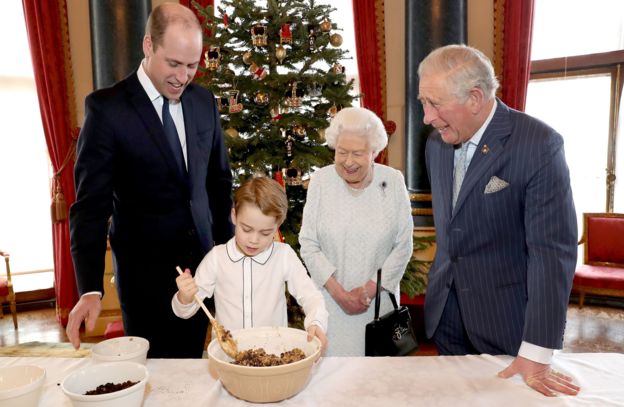
The Queen, Prince Charles, Prince William and Prince George made Christmas puddings last month

It was released in 2016 to mark the Queen's 90th birthday and was printed on commemorative stamps.

The latest portrait was taken on December 18 - the same day the four royals were photographed making a Christmas pudding together at the palace.

The moment, captured in front of a Christmas tree decorated with miniature corgis and crowns, featured in the Queen's Christmas Day message.


(Source: BBC)

Monday, 26 August 2019

Royal Family: From costs to carbon, how do they travel?

The image of the Duke and Duchess of Cambridge stepping onto a budget flight contrasted somewhat with the Duke and Duchess of Sussex's travel this summer.

Prince William and Kate's cheap hop on Flybe from Norwich to Aberdeen was compared unfavourably by critics to Prince Harry and Meghan's trips by private jet.

But who decides how the Royal Family travels? And how much do they spend getting about?

Official v unofficial
While the costs of official royal trips are published online in annual reports, the amount the royals spend on unofficial travel is not.

Spending on official travel, which is paid for by taxpayers, was £2.7m overall last year. Of trips costing more than £15,000, Prince Charles spent the most.


Tradition dictates that what the royals spend in their own time is up to them and so we only know what gets reported, often by chance.

Kensington Palace would not comment on the cost of the Cambridges' personal travel after they were snapped boarding their budget flight this week. Reports said tickets cost as little as £73.

Meanwhile, Sir Elton John said he lent his private jet to Prince Harry and Meghan to ensure their privacy on a recent visit to his French estate.

Phil Dampier, who has written several books about the royals, said he expects that gifts of flights - which can total tens of thousands of pounds - may need to be disclosed in future.

"I think what will have to happen in future is that any flights given to them by the likes of Elton John or any benefactors they'll have to declare," he said.

Helicopters are preferred
When travelling in an official capacity, the royals make use of chartered helicopters far more than private jets.

Figures published by the royal household showed that 207 trips by helicopter were made last year, compared with 56 flights on specially-chartered planes.

The vast majority of the helicopter trips were short hops and cost less than £15,000 each, the accounts showed.

But the royals almost exclusively use chartered planes when travelling abroad.
The introduction of a royal helicopter operated by a civilian crew saved thousands of pounds

Among the more expensive trips taken was the Prince of Wales and Duchess of Cornwall's official visit to the Caribbean Islands and Cuba aboard RAF Voyager which cost £416,576.

Costs have plummeted
Despite the seemingly high costs, royal travel still costs a lot less than it did a few decades ago.

According to the National Audit Office (NAO), official royal travel costs declined by 76% in real terms between 1991-2 and 2011-12.

The NAO said that was because the household switched from using RAF helicopters to a civilian service and by taking fewer flights on more expensive planes.

Official royal travel is paid for by the Sovereign Grant, funded by the taxpayer.

This year, the grant - which also pays the Queen's household staff and upkeep of palaces - is expected to be £82.4m in total.

Last year, the money spent on official royal travel (£2.7m) was roughly the same as the previous two years. In 1997-98, the equivalent figure was £17.3m.

It's not all about money
The decision to charter a special plane or fly on a commercial flight is often taken by senior royal staff in conjunction with government, according to a former head of royal protection.

Dai Davies, who led palace police in the 1990s, told the BBC: "Convenience in terms of the routes, the number of the visits, the timings, and in some parts of the world the need for security [are all considered]".

Prince Charles and Camilla arrive in Vienna after a flight on a RAF Voyager plane
But the suggestion, made by celebrities who came to the defence of Prince Harry and Meghan, that the couple are not safe flying on a normal airliner was untrue, Mr Davies added.

"It's absolute nonsense in terms of security," he said.

'More Travelodge than palace'
For trips closer to home, the royal train is still used by senior members of the Royal Family, despite the current stock dating back to the 1970s and it costing more per mile than a plane.

The train was most recently used by the Queen in March 2019, when the monarch slept on it overnight before an early visit to Somerset. Her combined train and helicopter for that trip cost £21,230.

The interior of the royal train has been likened to a Travelodge
Yet the train costs much more per mile than chartered flights.

A September 2018 trip by the Prince of Wales from Aberdeen to Euston cost £22,086, around £40 a mile, but a similar journey by the Queen on a chartered flight in October 2018 cost £17,689, or £32 a mile.

Courtiers have argued that using the train reduces the need for costly and disruptive hotel stays.

The train has begun to show its age. Sir Alan Reid, the former keeper of the palace purse, told MPs in 2013 the interior of the train "is very G-Plan, which is either '60's or '70's".

"It is not luxurious by any stretch of the imagination, but it does offer a very safe, secure and effective way - particularly as the Queen has got older - of having her go up the country in order to do engagements first thing the next morning."

A reporter for The Daily Telegraph once said the décor was "closer to a Travelodge than a palace".

Mr Davies added: "In truth it is an antiquated system that costs a huge amount in terms of security and protection… I think there's a question mark as to whether it is justified."

Carbon controversy
Prince Harry and Meghan's recent flights to Nice generated an estimated 37.6 tonnes of carbon, which Sir Elton John said he paid to offset.

The couple had previously told their followers on social media that "every choice... every action makes a difference" to climate change.

Royal historian Caroline Aston told the BBC that the younger royals should practice what they preach.

"If you're going to create your own 'woke up' brand of greenness and ethical behaviour, then you do need to dot the 'i's' and cross the 't's' a little bit," she said.

Yet claims of hypocrisy when it comes to how senior royals travel are nothing new.

Ms Aston said history was "packed with examples of royalty who have been attracted to the glitzy lifestyle" of private jets only to find "the friend who extended the hand might just have been doing it for their own reasons".

"Now because we finance the Royal Family... they have to be seen to earn our respect. We don't give it anymore purely because of an accident of birth, it has to be earned."

Prince Charles faced claims of hypocrisy in 1991 after making a speech on "monstrous" motorcars only to have his favourite Bentley driven 800 miles to then-Czechoslovakia ahead of a visit.

Prince Charles' favourite Aston Martin runs on eco-friendly fuel
In 2015, he was accused of "double standards" by making an 80-mile journey by helicopter just days after urging people to save energy by turning off their lights.

Prince Charles, who takes on the lion's share of royal travel as heir to the throne, now lists measures his household takes to reduce his carbon footprint online, including the use of waste from the production of wine and cheese to fuel his prized Aston Martin.

Despite the measures, the royals' latest accounts revealed that the family's carbon footprint from official travel nearly doubled last year, to 3,344 tonnes of CO2.

It is unclear which members of the Royal Family engage in so-called carbon offsetting. The Foreign Office, which organises the royals' official trips abroad, spent £43,635 on offsetting the carbon created by international flights in 2017-18.

A Buckingham Palace spokeswoman told the BBC: "Travel arrangements for members of the Royal Family are made taking into consideration security, efficiency, cost, effective use of time and disruption to others.

"Official overseas travel undertaken by members of the Royal Family is done so at the request of government."

(Source: BBC)

Friday, 18 May 2018

How does the royal family make its money?

Most people make money from their day jobs. British royals are not most people.

Queen Elizabeth II and the British royal family have multiple sources of income, but they're still not as rich as you might expect.

Media reports have estimated the Queen's personal fortune is worth up to £360 million ($470 million). That's a nice chunk of change, but over 320 Brits are richer, according to the Sunday Times.

The Queen and the heir to her throne, Prince Charles, receive most of their income from the government and their private estates. Millions trickle down to the rest of the family, including Prince William and his wife Catherine, the Duchess of Cambridge. Prince Harry, who will wed American actress Meghan Markle on May 19, also receives royal funds.


Here's how the royal finances work:

Queen Elizabeth II
The Queen's three main sources of income are the Sovereign Grant, the Duchy of Lancaster estate and her personal property and investments.

The Sovereign Grant -- an annual lump sum from the government -- is essentially an expense account, covering the costs of travel, security, staff and the upkeep of royal palaces.

The Queen received £42.8 million ($58 million) free of tax from the Sovereign Grant in the 2016-2017 fiscal year. The payment was projected to balloon by 78% to £76.1 million ($103 million) in the latest fiscal year to help finance an extensive renovation of Buckingham Palace.

The Sovereign Grant is generated from the Crown Estate, a collection of UK properties and farms that generate hundreds of millions of pounds each year. The vast majority of earnings from the Crown Estate go into government coffers, but a portion of the profits -- between 15% to 25% -- are given to the Queen in the form of the Sovereign Grant.

Queen Elizabeth II receives an annual income from public and private sources.
Another important source of income for the monarch is the Duchy of Lancaster, a private estate of commercial, agricultural and residential properties that dates back to 1265. It produced £19.2 million ($26 million) in income for the Queen during the most recent fiscal year. The Queen uses this money to pay for official and private expenses, including some costs incurred by other members of the royal family who undertake official engagements on her behalf.

The Queen also has her own personal assets, including Balmoral Castle in Scotland, and the Sandringham Estate in the east of England. Both were inherited from her father and are beloved family retreats.

But her wealth extends far beyond real estate. The Queen also owns a valuable stamp collection, numerous works of art and a stock portfolio.

Other assets closely associated with the Queen, including the Crown Jewels and many works of fine art, are actually owned by the Royal Collection Trust, a charity.

The Queen' husband -- Prince Philip, the Duke of Edinburgh -- also receives an annual payment worth £359,000 ($488,000) to finance his official duties. He retired last year after more than six decades of public service.

Prince Charles and his clan
Prince Charles and his wife Camilla, known formally as The Prince of Wales and The Duchess of Cornwall, rely on a a mix of public and private money.

Over 90% of their income comes from a private estate, the Duchy of Cornwall, which was established in 1337 to provide an income to the heir to the throne. The Duchy of Cornwall owns and operates land in rural and urban areas, a collection of islands and rental cottages in places like Wales and Cornwall.

In the most recent financial year, the couple made £20.7 million ($28 million) from the estate.

The couple also received £1.3 million ($1.8 million) from the Queen's Sovereign Grant and another £461,000 ($627,000) from various UK government departments.

The Sovereign Grant is used to pay the couple's official travel and property expenses. The government cash goes toward some official overseas trips and the salaries of members of the military who protect the family.

Roughly half of their annual income is spent on official duties and travel, while a quarter goes to the tax man. The remaining £6.6 million ($8.9 million) goes to Charles' children, "non-official" purchases and a royal savings account.

Meghan Markle is set to wed Prince Harry on May 19.
When Markle officially joins the clan, Prince Charles has the discretion to give the couple more money.

Prince William, Kate and Prince Harry are also reimbursed for costs when they perform official duties on behalf of the Queen.

Prince William and Prince Harry have private, inherited wealth from their mother, Princess Diana.

The rest of the family
There is limited public information about how the rest of the royal family make their money. The Queen has three other children aside from Prince Charles, and they too have children, spouses and grandchildren.

The Queen's two youngest children, Andrew, the Duke of York, and Edward, the Earl of Wessex, work full-time to support the monarchy, which involves appearing at public engagements on behalf of their mother.


The Queen pays her children for these duties through her income from the Sovereign Grant and Duchy of Lancaster.

The next generation of royals is expected to forge their own careers and required to be more independent. For example, Andrew's daughters -- Princess Beatrice and Princess Eugenie -- have full time jobs in the business and art worlds, respectively. But they also receive some financial support from their father.

(Source: CNN)

Wednesday, 20 December 2017

How Princess Diana’s 'Revenge Dress' revolutionized royal fashion standards

It’s quite obvious that we all like finding out dirt or information on the royal family. We like keeping up with them. We just can’t seem to get enough.

There’s just that allure about the royals. Although some people might consider them a tad stodgy, the younger breed of royals has been known to be more vibrant, outgoing and sufficiently philanthropic and tend to keep themselves up dated on current issues.

When news broke of Prince Harry’s engagement to Meghan Markle, the world had mixed reactions but all the same we were excited for the couple.


It feels like only yesterday Harry was a young boy but now he is a grown man, ready to start his family soon. It’s hard to believe that it’s been 20 years since his mother, Princess Diana was laid to rest.

Princess Diana might as well have been the most influential royal of her time. The late princess had impeccable taste when it came to all things fashion from her gowns to accessorizing.

I think she might have changed the fashion sense and perspective for the royal family and the general population as well.

The most particularly talked about outfit which still fascinates the world to date is the ‘Revenge Dress.’

But nonetheless, Princess Diana had to make a public appearance and she had to show that she was unfazed by the news and she made quite the statement.


Instead of wearing something modest and retiring to keep a low profile, Diana wore a little black, body hugging, shoulder less dress! She was a daring woman, I got to give her props for that!

The dress showed a significant amount of skin and Diana never seemed to mind at all. She wore a smile the whole night and I guess she was happy that she was finally free of the royal rules that were restraining her.


The revenge dress wasn’t the first nontraditional outfit Diana wore. She was a sucker for the mini dress.

When starting out, Diana used to wear classy teenager outfits like chiffon blouses and sweaters but she realized that could express herself more by creating stylish fashion trends.


As a young bride and mother, everyone’s expectations would be she would have to dress a certain way that reflected her youth and also as a mother.

As you may well know, Diana was one individual who was used to doing things big. She always exceeded people’s expectations!

When she attended an event in the US, the late Diana rocked a striking floor-length black gown. It nothing short of breath-taking. It oozed elegance and class.

Diana was quite comfortable showing off a little skin. She was beautiful and she did not find any shame in flaunting what she had.

This was in the 1980s, and even wearing certain clothes was considered scandalous among the royals but for Diana, it was never that serious! She would be seen donned in strapless or low cut dresses in formal events.

When she was not executing her royal duties, the late princess would go all casual from head to toe.

When she was out having fun with her sons, Princess Diana wouldn’t mind slipping into something comfortable. She was a dear mother to her sons and she wanted to play with them and, still be comfortable while doing it.


Boy did Diana love her khakis and jeans! She never had any qualms being photographed while she was in casual wear.

Diana was a circle in a court full of royal squares. Unlike the royals before her, Diana never shied away from wearing pants. As a matter of fact, she made history as the first female royalty to wear a pair of trousers to an evening occasion.

The Princess also loved to exercise and paparazzi did manage to get a few shots of the late princess wearing her workout clothes.


The late Princess Diana was a symbol of strength for many women. Despite the scandal that plagued her personal life, she still managed to hold her head high up.

Her fashion sense has inspired women the world over and wearing a ‘revenge dress’ has become a trend among female celebrities who have been caught up in the middle of highly publicized breakups and divorces.

I think the statement that the revenge dress tries to put across is, “Your Loss Boo. I’m Still Freaking Awesome Even Without You!”

(Source: Small Joys)

Tuesday, 5 September 2017

The princess myth: Hilary Mantel on Diana

The Wolf Hall novelist on the 20th anniversary of the death of the Princess of Wales, an icon ‘only loosely based on the young woman born Diana Spencer’.

Royal time should move slowly and by its own laws: creeping, like the flow of chrism from a jar. But 20 ordinary years have jog-trotted by, and it’s possible to have a grownup conversation with someone who wasn’t born when Diana died. Her widower is long remarried. Her eldest son, once so like her, shows signs of developing the ponderous looks of Philip, his grand-father. Diana should be as passe as ostrich plumes: one of those royal or quasi-royal women, like Mary of Teck or Wallis Simpson or the last tsarina, whose images fade to sepia and whose bones are white as pearls. Instead, we gossip about her as if she had just left the room. We still debate how in 1981 a sweet-faced, puppy-eyed 20-year-old came to marry into the royal house. Was it a setup from the start? Did she know her fiance loved another woman? Was she complicit, or was she an innocent, garlanded for the slab and the knife?

For some people, being dead is only a relative condition; they wreak more than the living do. After their first rigor, they reshape themselves, taking on a flexibility in public discourse. For the anniversary of her death, the princess’s sons remember her for the TV cameras, and we learn that she was “fun” and “very caring” and “a breath of fresh air”. They speak sincerely, but they have no news. Yet there is no bar on saying what you like about her, in defiance of the evidence. Private tapes she made with her voice coach have been shown in a TV documentary, Diana: In Her Own Words. They were trailed as revealing a princess who is “candid” and “uninhibited”. Yet never has she appeared so self-conscious and recalcitrant. Squirming, twitching, avoiding the camera’s eye, she describes herself hopefully as “a rebel”, on the grounds that she liked to do the opposite of everyone else. You want to veil the lens and explain: that is reaction, not rebellion. Throwing a tantrum when thwarted doesn’t make you a free spirit. Rolling your eyes and shrugging doesn’t prove you are brave. And because people say “trust me”, it doesn’t means they’ll keep your secrets.

Yet royal people exist in a place beyond fact-correction, in a mystical realm with rules that, as individuals, they may not see; Diana consulted psychics to work out what was going on. The perennial demand for them to cut costs and be more “down to earth” is futile. They are not people like us, but with better hats. They exist apart from utility, and by virtue of our unexamined and irrational needs. You can’t write or speak about the princess without explicating and embellishing her myth. She no longer exists as herself, only as what we made of her. Her story is archaic and transpersonal. “It is as if,” said the psychotherapist Warren Colman, “Diana broadcast on an archetypal frequency.”

Though she was not born royal, her ancestors were ancient power-brokers, dug more deeply into these islands than the Windsors. She arrived on the scene in an era of gross self-interest, to distract the nation from the hardness of its own character. As she correctly discerned, “The British people needed someone to give affection.” A soft-eyed, fertile blond, she represented conjugal and maternal love, and what other source did we have? Until Tony Blair took office as a fresh-faced Prince Charming we had female leaders, but they were old and their cupboards were bare of food and love: a queen who, even at Diana’s death, was reluctant to descend from the cold north, and a prime minister formerly known as Maggie Thatcher, Milk Snatcher.

Little Princess. Lady Diana Spencer (1961 - 1997)
Photograph: Fox Photos/Getty Images
The princess we invented to fill a vacancy had little to do with any actual person. Even at the beginning she was only loosely based on the young woman born Diana Spencer, and once she was engaged to the Prince of Wales she cut adrift from her modest CV. In the recent documentary Diana, Our Mother, her son Harry spoke of her as “an ordinary 20-year-old”; then checked himself, remembering she was an aristocrat. But in some ways his first thought was right. Like a farmer’s daughter, Diana married the boy across the hedge – she grew up near the queen’s estate at Sandringham. As the third daughter born to Viscount Althorp, she was perhaps a disappointment. The family’s previous child, a son, had died within hours of birth, and Spencer and his wife Frances had to try again for an heir. The Jungian analyst Marion Woodman posits that unwanted or superfluous children have difficulty in becoming embodied; they remain airy, available to fate, as if no one has signed them out of the soul store. By Diana’s cradle – where the witches and good fairies do battle – stood a friend of the Queen Mother, her maternal grandmother Ruth Fermoy. When Diana was six, Frances left her young family. Fermoy took sides against her daughter and helped Spencer get custody of his four desolate children. Later, promoted to his earldom, he remarried without telling them. Diana is said to have expressed her views by pushing her stepmother downstairs.

 Lady Diana Spencer, November 1980 Photograph: Alan Davidson/Silverhub/REX/Shutterstock
Diana’s private education implanted few cultural interests and no sense of their lack. She passed no public exams. But she could write a civil letter in her rounded hand, and since she didn’t have to earn a living, did it matter? In Diana: In Her Own Words, she speaks of her sense of destiny. “I knew … something profound was coming my way … I knew I was different from my friends …” Like Cinderella in the kitchen, she served an apprenticeship in humility, working as an upper-class cleaner, and in a nursery mopping up after other people’s babies. Then the prince came calling: a mature man, with a history of his own.

By her own account, Diana was not clever. Nor was she especially good, in the sense of having a dependable inclination to virtue; she was quixotically loving, not steadily charitable: mutable, not dependable: given to infatuation, prey to impulse. This is not a criticism. Myth does not reject any material. It only asks for a heart of wax. Then it works subtly to shape its subject, mould her to be fit for fate. When people described Diana as a “fairytale princess”, were they thinking of the cleaned-up versions? Fairytales are not about gauzy frocks and ego gratification. They are about child murder, cannibalism, starvation, deformity, desperate human creatures cast into the form of beasts, or chained by spells, or immured alive in thorns. The caged child is milk-fed, finger felt for plumpness by the witch, and if there is a happy-ever-after, it is usually written on someone’s skin.

In a TV interview before the marriage – the “ghastly interview,” as Diana called it – Charles wondered quizzically, “whatever ‘in love’ means”. He has been blamed ever since for destroying the simple faith of a simple maid. But off-camera, Diana was preparing. Her choice of hymn makes the marriage a patriotic duty, like signing up for a war:

The love that asks no question, the
         love that stands the test,
That lays upon the altar the dearest
         and the best;
The love that never falters, the love
         that pays the price,
The love that makes undaunted the
         final sacrifice.

By Diana’s later account, the wedding day was “the worst day of my life”. But at the time – July 1981 – she looked dazed with happiness. Even for republicans there was much to enjoy. A great city en fête. The oily reverence of the commentators with their peculiar word order: “For the first time through the centre gateway of Admiralty Arch arrives Lady Diana …” Best of all, the outfits: Princess Anne dressed as an Easter egg, wearing a furious scowl. Diana’s entrance into legend prompted a national gasp, as she tumbled from her coach like a bride in a bag. Her gown unfolded perfectly, like a paper flower. But some palace lackey had erred; the vehicle was too cramped for a tall flouncing lassie and her frock.

It takes a lot a lot of know-how and behind-the-scenes sweat to transform Cinderella from dust-maid to belle. Fairytales do not describe the day after the wedding, when the young wife lost in the corridors of the palace sees her reflection splinter, and turns in panicked circles looking for a mirror that recognises her. Prince Charles’s attitude of anxious perplexity seems to have concealed an obtuseness about what the marriage meant to his bride. The usual young woman of the era had a job, sexual experience, friends who stayed within her circle – her wedding was simply a big party, and she probably didn’t even move house. But Diana’s experience as daughter of a landed family did not prepare her for Buckingham Palace, any more than Schönbrunn prepared the teenage Marie Antoinette for Versailles. It was Diana’s complaint that no one helped her or saw her need. Fermoy had expressed doubts before the marriage. “Darling, you must understand that their sense of humour and their lifestyle are different …” The bathos is superb. “Mind how you go,” say the elders, as they tip off the dragon and chain the virgin to the mossy rock.

Advertisement

What would have happened to Diana if she had made the sort of marriage her friends made? You can picture her stabled in the shires with a husband untroubled by brains: furnishing a cold house with good pieces, skiing annually, hosting shoots, stuffing the children off to board: spending more on replenishing the ancestral linen cupboard than on her own back. With not too much face-paint, jacket sleeves too short for her long arms, vital organs shielded by a stout bag bought at a country show, she would have ossified into convention; no one would have suspected her of being a beauty. Like many women in mid-life, she would have lived in a mist of discontent, struggling to define something owing, something that had eluded her. But in her case the “something” would have been the throne.

Even in childhood photos Diana seems to pose, as if watching her own show. Her gaze flits sideways, as if to check everyone is looking at her. One “friend” told a TV crew that as a teenager, “whenever you saw her alone she would have picked up some trashy romantic novel”. Leave aside the casual denigration of women’s taste: if Diana imagined herself – the least and youngest daughter – as magnificent, all-conquering, a queen, she had a means of turning her daydream into fact. Diana claimed that she and the prince met only 13 times before their wedding. Did she keep a note? She lacked self-awareness, but had strong instincts. It must have been child’s play – because she was anxious to please, or because she was crafty – to seem to share his visions and concerns. An earnest look, a shy silence, job done. Chaste maids were not too plentiful in the 1980s. The prince took advice: snap her up, sir.

Diana was no doubt really shy, and certainly unused and unformed: a hollow vessel, able to carry not just heirs but the projections of others. After marriage she had power that she had not sought or imagined. She had expected adulation, but of a private kind: to be adored by her prince, respected and revered by her subjects. She could not have imagined how insatiable the public would be, once demand for her had been ramped up by the media and her own tactics. In her circle there were no solid witnesses to the nature of reality – only those who, by virtue of their vocation, were fantasists, exalting sentiment, exploiting the nation’s infantile needs, equating history with the history of a few titled families. She had a sense of her own fitness to be princess, and unfitness for any other role. But she had no sense of the true history in which she was now embedded, or the strength of the forces she would constellate. At first, she said, she was afraid of the crowds who gathered to adore her. Then she began to feed on them.

When Diana became the most famous woman in the world, it is not surprising that less popular members of the Firm were miffed. The queen herself had been a beauty, but may have thought it vulgar to be too interested in one’s looks. Diana was allowed to interest herself in little else. Her dealings with the press and photographers were not innocent. The images had to be carefully curated – her good side, so to speak. There were unacceptable angles. And when an image is created by the lens it can fuzz and slip and blur. Unsure of her boundaries, the princess starved herself, as if her healthy frame could pare away to the elfin proportions of the models and dancers who fascinated her. She threw up her food, hacked at herself with a blade. In Diana: In Her Own Words she sneers at her young self – her tone contemptuous, punitive. She cannot forgive that girl, naive heroine of a gothic novel – whose fate is to be locked in a keep by a man of dubious intentions, and to be practised upon by older women who have secrets she needs to know.

Prince Charles and Princess Diana, 18 November 1983 Photograph: Manchester Daily Express/SSPL via Getty Images
In 1992 Charles and Diana separated. In 1996 the dead marriage was buried. This was not what had been negotiated, in the 13 encounters. The prince resumed his old narrative, with the woman he should have married in the first place. Another story had begun to tell Diana. Cut loose, she opened the doors of her identity and all the dead princesses floated in, those deposed and exiled, beheaded and shot. With them came the screen idols and the spoiled glamour girls – Monroe naked and dead, Garbo who wanted to be alone. As we grow up, we aim to be “self-possessed”, not taken over by others. But as the novelist Ivy Compton Burnett says, “People have no chance to grow up. A lifetime is not long enough.”

Isolated by the pique and indifference of the other royals, neglected, crossed in love and bested by Mrs Parker Bowles, she found “affinity”, she said, with the rejected. To her credit, she had begun to work actively to lessen the amount of pain in the world. She visited the sick, and stopped just short of claiming the healing touch that custom bestows on the divinely anointed; had she become queen, she would surely have gone about raising the dead. Legend insists she showed the world that it was safe to shake hands with a person with Aids. Even in the unenlightened days of 1987, only the bigoted and ignorant thought casual contact would infect them, but any gesture from Diana was worth years of public education and millions in funding. She hung around with Mother Teresa, and did it while wearing couture; she moved towards suffering, rather than swerving from it. “When people are dying,” she said, “they’re much more open, more vulnerable, much more real than other people, and I appreciate that.” Among the weak she recovered her strength – transformed from peely-wally puking maid to an Amazon heading to battle. She knew dread diseases would not kill her. Like Joan of Arc, protected by her own magic, she walked unscathed. Campaigning against landmines, she passed through explosive terrain. Her armoured vest was inscribed, “the HALO Trust”. Her blond head gleamed like a fell invitation, inviting a bolt from the blue.

The divorce was a sour one. It is difficult to extract sober truth from the bitching of the sycophants on either side. Diana won the War of the Waleses because she was ruthless, and had better legs. Her withdrawal from public life, dramatically announced, suggested that she would emerge as a new model. Possibly this transformation was under way, but it failed to complete, till death completed it. Instead she behaved like a daffy celebrity, and her fans began to laugh at her attempts to hoover up a hero. What kind of mate fits the bill, if your first has been a future king? The chance of an ordinary life of trial and error was what she had rejected long ago – when, as her sisters put it, they printed her face on the souvenir tea towels. But though her sheen was smudged a little by her failures in love, the marks could be polished away. It was possible for the public to hold two views of her simultaneously, and perhaps they were not contradictory: goddesses are not known for propriety. It’s no use saying to a super-being, “Keep your hands off my husband.” She takes and consumes, and spits out the tough bits.

By the time of her Panorama interview, late in 1995, Diana had developed a habit of speaking of herself in the third person. Sphinx-like, unsmiling and with mater dolorosa makeup, she presented herself as both a victim and a person of great power, and though she spoke plainly enough, it was with the mysterious air of one forced to communicate in riddles.

When she referred to herself as a 'queen of hearts', the blood chilled. She seemed to be reading from her own obituary.
She was too much for the royal family, she said: wasted on them. She saw nothing good for Charles. “Who knows what fate will produce?” It was not a question. In her polite duchessy way, she was cursing him.

But the end of royal status had stripped away Diana’s protection, both practically and mystically. After the Panorama broadcast there was a buzz in the air: a doomy feeling, as if her options were running out. She still played games with the press, but they knew a dirtier game. They spat at her, insulted her to try to draw a reaction. She teased them, and they chased her down, not killing her yet. She is supposed to have feared sinister forces, anticipated that her end was prepared. As every fortune-teller knows, such hints assume precision in retrospect.

A deathbed, once, was a location dense with meaning, a room packed with the invisible presences of angels, devils, ancestors. But now, as many of us don’t believe in an afterlife, we envisage no final justice, no ultimate meaning, and have no support for our sense of loss when “positivity” falters. Perhaps we are baffled by the process of extinction. In recent years, death narratives have attained a popularity they have not held for centuries. Those with a terminal illness scope it out in blogs. This summer the last days of baby Charlie Gard riveted worldwide attention. But what is the point of all this introspection? Even before the funeral, survivors are supposed to flip back to normal. “Keeping busy” is the secret, Prince William has advised.

Grief is exhausting, as we all know. The bereaved are muddled and tense, they need allowances made. But who knows you are mourning, if there is nothing but a long face to set you apart? No one wants to go back to the elaborate conventions of the Victorians, but they had the merit of tagging the bereaved, marking them out for tenderness. And if your secret was that you felt no sorrow, your clothes did the right thing on your behalf. Now funeral notices specify “colourful clothing”. The grief-stricken are described as “depressed”, as if sorrow were a pathology. We pour every effort into cheering ourselves up and releasing balloons. When someone dies, “he wouldn’t have wanted to see long faces”, we assure ourselves – but we cross our fingers as we say it. What if he did? What if the dead person hoped for us to rend our garments and wail?

When Diana died, a crack appeared in a vial of grief, and released a salt ocean. A nation took to the boats. Vast crowds gathered to pool their dismay and sense of shock. As Diana was a collective creation, she was also a collective possession. The mass-mourning offended the taste police. It was gaudy, it was kitsch – the rotting flowers in their shrouds, the padded hearts of crimson plastic, the teddy bears and dolls and broken-backed verses. But all these testified to the struggle for self-expression of individuals who were spiritually and imaginatively deprived, who released their own suppressed sorrow in grieving for a woman they did not know. The term “mass hysteria” was a facile denigration of a phenomenon that eluded the commentators and their framework of analysis. They did not see the active work the crowds were doing. Mourning is work. It is not simply being sad. It is naming your pain. It is witnessing the sorrow of others, drawing out the shape of loss. It is natural and necessary and there is no healing without it.

 Princess Diana during a visit to The Royal Botanical Gardens in Melbourne, Australia.
Photograph: Tim Graham/Getty Images
It is irrelevant to object that Diana alive bore no resemblance to Diana dead. The crowds were not deluded about what they had lost. They were not mourning something perfect, but something that was unfinished. There was speculation that Diana might have been pregnant when she died. Was something of startling interest evolving beneath her skin – another way of living? The question was left hanging. Her death released subterranean doubts and fear. Even those who scorn conspiracy theories asked, what exactly is an accident? Why, on the last night of her life, did Diana go below ground to reach her destination? She need not have gone that way. But she didn’t choose – she was driven. Her gods wanted her: she had been out too late.

From her first emergence in public, sun shining through her skirt, Diana was exploited, for money, for thrills, for laughs. She was not a saint, or a rebel who needs our posthumous assistance – she was a young woman of scant personal resources who believed she was basking with dolphins when she was foundering among sharks. But as a phenomenon, she was bigger than all of us: self-renewing as the seasons, always desired and never possessed. She was the White Goddess evoked by Robert Graves, the slender being with the hook nose and startling blue eyes; the being he describes as a shape-shifter, a virgin but also a vixen, a hag, mermaid, weasel. She was Thomas Wyatt’s white deer, fleeing into the forest darkness. She was the creature “painted and damned and young and fair”, whom the poet Stevie Smith described:

In the TV broadcast last month, Prince William said, “We won’t be doing this again. We won’t speak openly or publicly about her again …” When her broken body was laid to rest on a private island, it was a conscious and perhaps superfluous attempt to embed her in national myth. No commemorative scheme has proved equal or, you might think, necessary. She is like John Keats, but more photogenic: “Here lies one whose name was writ in water.” If Diana is present now, it is in what flows and is mutable, what waxes and wanes, what cannot be fixed, measured, confined, is not time-bound and so renders anniversaries obsolete: and therefore, possibly, not dead at all, but slid into the Alma tunnel to re-emerge in the autumn of 1997, collar turned up, long feet like blades carving through the rain.

(Source: The Guardian)

Wednesday, 2 August 2017

Diana tapes reveal Queen’s reply to sobbing plea over loveless marriage

Twenty years after her death, princess will be heard on television describing life with Charles and her mystery romance

Intimate revelations – direct from the mouth of Diana, Princess of Wales –about her courtship and married life to Prince Charles are to be aired on British television next month after years of dispute about the recordings. Speaking to a video camera four years before her death, Diana will tell of Charles’s early unexpected attempts to woo her as a teenager and of the sorrow that enveloped her soon after her wedding day in July 1981.

In the documentary Diana: In Her Own Words, to be shown on Channel 4 in the run-up to the 20th anniversary of her death in a car crash on 31 August, the princess reveals that five years into her marriage she went “sobbing” to the Queen once she believed she had “confirmation” that her marriage was loveless. “So I went to the top lady and said: ‘I don’t know what I should do’. She said: ‘I don’t know what you should do.’ And that was it. That was ‘help’.”

Charles and Diana at Balmoral before their honeymoon in May 1981. Photograph: Bryn Colton/Rex/Shutterstock

Diana also tells of the impact of an illicit romance with a mystery man. The unconsummated affair dominated her thoughts for a while, she says, until it was suspected by the royal household.

“At 24, I fell deeply in love with someone who was part of all this and that was all found out and he was chucked out and then he was killed. And that was the deepest blow in my life I must say,” she says. Diana is widely thought to have been speaking of her feelings for Barry Mannakee, an officer in the royal protection squad who later died in a motorcycle accident.

In the video tapes, recorded at Kensington Palace in 1993 by her public speaking coach, Peter Settelen, Diana claims that the man would “mentally kick me out and make me go to my engagements because I used to sort of scream in his room”.

She tells Settelen that the royal family knew about her infatuation. “But there was never any proof,” she adds. “I should never have played with fire, but I did and I got very burnt. Three weeks after he left, he was killed in a motorbike accident. And he was the greatest fun I have ever had.”

Ralph Lee, the commissioning editor of factual at Channel 4, said: “This film gives Diana a voice and places it front and centre at a time when the nation will be reflecting on her life and death. It is her account of events both private and public and is an important contribution to the historical record.”

The footage at the core of the new documentary has been contentious since 2001, when the tapes were unearthed in a police raid on the home of Paul Burrell, the former royal butler. The Spencer family made a legal claim on the tapes but they were returned to Settelen in 2004. Already shown in part on the American television network NBC, the tapes were then to have been part of a BBC documentary marking the 10th anniversary of the princess’s death. Sir Teddy Taylor, the Tory MP for Rochford and Southend East at the time, called for a ban on broadcasting the tapes in any form while the couple’s sons, Princes William and Harry, were alive. No ban was imposed, but the programme was still pulled from the schedule despite having cost more than £100,000 to make.

The new Channel 4 documentary gives fresh insights from Diana’s private secretary, Patrick Jephson, and from her close friend, Dr James Colthurst. It also contains the first public comments from Anne Allan, the dance teacher who instructed the princess in private. Allan speaks of Diana’s “huge shyness” and of her decision to ask Camilla Parker Bowles to leave her husband alone.


Diana candidly confirms she had met Charles just 13 times before they married and she describes her early ambitions in life. “I wasn’t academically interested at all,” she says. “I just wanted to be with people and have fun and look after people,” she says, rolling her eyes in self-parody. “But the rebel thing was always there. It was underlying. It didn’t come out. Or they didn’t see it.”

The princess describes being “unimpressed” with Charles in her youth, yet after the killing of Lord Mountbatten in 1979 she thought it would be nice to meet him again. “He chatted me up. He was all over me like a bad rash. Later at a barbecue we were sitting on this bale of hay together and we were chatting about his girlfriend and Mountbatten and I said: ‘You must be so lonely.’”

Expressing sympathy for the solitary figure Charles cut as he followed Mountbatten’s coffin, Diana says she suggested he needed someone “beside” him: “Whereupon he leapt upon me! He was all over me for the rest of the evening. He followed me like a puppy.”

At 19, Diana admits the attentions of such a prominent older man were flattering. She was “seriously” wooed, she tells Settelen, and sensed Charles was intrigued when she stood up to him. Invited to come to Buckingham Palace to visit while he worked, she remembers thinking: “Well, bugger it, I do mind sitting there while you do your work. I said that, and that sort of lit up something in him. I was quite a challenge.”

The infamous engagement interview on television in early 1981, in which Charles questioned the meaning of the phrase “in love”, threw her “completely”, she confesses. She had answered that, yes, she was in love “like the fat Sloane Ranger that I was” and was then “absolutely traumatised” by his response.

(Source: The Guardian)