Saturday, 1 June 2019

Living off-grid for almost 80 years

Margaret Gallagher has lived off-grid for almost 80 years.

When she was was born - near the Irish border in County Fermanagh in 1942 - it was not unusual for families to live without electricity and running water.

Margaret's neighbours only began to update their homes in the late 1940s and 1950s.

But her family missed the opportunity to join the trend due to her mother's death, when Margaret was 10, and her father's ill health.

Now aged 77, she is one of few elderly people in the UK and Ireland who have lived their entire lives off-grid.
Margaret's family missed the opportunity to go "on-grid" when it became fashionable in the 1950s
"I am doing it because I like doing it, not because I'm a hippy, that I think it's new and fashionable," she said.

"My childhood was over at 10. My father took to the bed with severe arthritis, so it never was feasible for us to do anything.

'There were no finances'
"I didn't have the will, he didn't have the will to do it and there were no finances if we were very keen to do it so it just didn't come onto the radar."

Margaret has lived alone in the family's 18th century thatched cottage since her father's death in 1980.

Living without modern amenities requires physical strength - she must cross a field to collect water in a bucket from a well up to 10 times a day and needs to stoop to cook over an open fire, which she lights every morning from a stack of turf and logs.
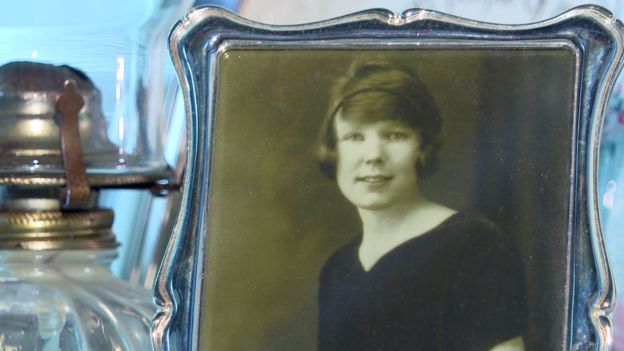
Margaret Gallagher said her childhood ended abruptly when her mother died
Her daily routine begins at 05:30 BST when she heats water in a kettle over the fire for washing and tea - milk and perishables are stored in a wheelie bin. She keeps up-to-date with news on a wind-up radio.

Lamps decorate the thick stone windowsills of her tiny two-bedroom home, but paraffin is expensive so Margaret's schedule is governed by daylight - she is usually in bed by 18:30 BST.

'People are entitled to live as they want'
Margaret said her lifestyle meant she grew up with "the seasons being the master of us all."

She recalled her father taking her outside as a child on Halloween night to gauge the wind direction.

The prevailing wind would, according to local lore, determine the severity of the winter ahead.

She loves summer and is less keen on winter when she uses a long fishing pole to push snow off her roof to prevent damage to the thatch.
Margaret Gallagher cooks over an open fire
Despite the difficulties of a cold winter in a house without central heating, Margaret said the compensations of her life could not be overstated.

"You have the birds in the morning nesting in the house, you have the views, the tranquillity and peace, you have the clock ticking - all those things that you couldn't put a price on," she said.

"I am living the way my forefathers lived, who left the footprint for me. It was good enough for my people, for my parents, my grandparents, who bought the house in 1887 - it is a tribute to them."

'I am not going to change for anyone'
Margaret said visitors were often surprised that she does not fit the stereotype of an elderly woman living off-grid.
The red shoes Margaret wore when she was presented with an MBE by the Prince of Wales
They expect to find her, she said, "sitting in the corner wearing a long black dress and a white apron."

Instead, if they take a peek in her bedroom, they will find this sprightly woman likes modern fashion - evident from her long ear rings and the red high-heeled shoes stored beside her bed, bought for the time she received an MBE for community work from the Prince of Wales.

"I don't know of anyone living like me, without electricity, without running water without any of the amenities. But then I am not interested in how people live. People are entitled to live as they want," she said.

"I am my own person, I have my own identity, this house embodies who I am and what I am. I am not going to change for anyone."

'Absolutely no regrets'
While she has "absolutely no regrets" about her life off-grid, Margaret realises her unusual lifestyle is disappearing.

"Everyone likes to come and look at this house but if you asked them to stay they couldn't wait to get out of it, particularly younger people," she said.

Yet, she believes young people could learn from the simplicity of her choices, instead of seeking "everything big and shiny and better".

Margaret makes soda bread over an open fire
She said her message to those starting out in life was to "be aware of who they are and where they come from. Live as they mean to go on".

"Be content with what you have," she added.

As she approaches 80, and following a serious accident eight years ago, Margaret fears she may not always be fit for the physical demands of living off-grid.

"I loved everything I did. It was a great lifestyle. But there is always the fear, will I have to leave it?

"If I won the lottery, I would still live here. I am a rural rooted spinster."

(Source: BBC)

Why are some places gay-friendly and not others?

When Taiwan became the first place in Asia to legalise same-sex unions, hundreds of gay people marked the occasion by registering to marry.

It marked a significant change on the island, where the majority of people only relatively recently became supportive of same-sex relationships.

In many other places there has also been a shift - often a rapid one - towards more liberal attitudes.

For example, in 2007, one in five South Koreans said homosexuality should be accepted, -but, by 2013, that figure had doubled.


Attitudes among the public also appear to have softened in other places including Argentina, Chile, the US, Australia, India and many in Western Europe.

But these changes do not always mean full equality. In Taiwan, for example, the government stopped short of granting full adoption rights.

Elsewhere, some nations are bringing in stricter anti-gay laws and same-sex relationships remain illegal in about 69 countries. On Friday, Kenya's High Court upheld a law banning gay sex.

Pockets of opposition
In some countries, opposition towards gay relationships is deeply entrenched and may be growing.

For example, in Ghana, where gay sex can be punished with a prison sentence, attitudes have become even less accepting.

In 2013, a poll suggested 96% of Ghanaians believe society should not accept homosexuality.

Elsewhere, official punishments for gay sex may provide insights into how residents, or at least their leaders, view homosexuality.

For example, Brunei recently made sex between men punishable with death through stoning, although it has since backtracked on this.

Another issue is that while laws and perceived attitudes may appear to have become more relaxed in some countries, the reality may be very different for the LGBT community there. For example, while Brazil's Supreme Court has recently voted in favour of making homophobia and transphobia crimes illegal, it did so in response to a large number of killings of LGBT people.


So, why does support for gay and lesbian people vary so much around the world?

Studies suggest the reasons are often linked to three factors - economic development, democracy and religion.

One theory is that a nation's economy shapes the attitudes of its people - including how they feel about LGBT rights.

Often, poorer nations tend to be less supportive, partly because cultural values tend to focus more on basic survival.

When people are concerned about things like clean water, food, shelter and safety, they can become more reliant on others.

This dependency tends to promote strong group loyalty - increasing support for its norms, including "traditional" heterosexual family structures.

People living in richer nations, by contrast, tend to have a lot more security.

As a result, they are more likely to have freedom to make the decisions that suit them, and to believe in self-expression.

Not everyone in richer countries is more tolerant of gay relationships, but the data we have indicates they tend to be more supportive.

Democracy is also thought to play a role.

In democracies, principles like equality, fairness, and the right to protest are more likely to form part of the actions of government and residents.

As a result, people who are sometimes seen as different, like gay and lesbian individuals, may be more likely to gain acceptance.

But people can need time to adapt to democracy.

Compared with longer-term democracies, former communist nations such as Slovenia and Russia appear to have been slower to develop more tolerant attitudes.

Another factor is the role of religion.

Western Europe, with its relatively low levels of religious belief, has been at the forefront of legalising same-sex marriage. Denmark, Belgium, Norway, Spain and Sweden were among the first countries to do so.


Some Middle Eastern and African nations, where Islam or conservative Protestant religious faiths are most commonly practised, have some of the least tolerant attitudes.

Gay sex is illegal in almost half of the countries in Africa and Asia, with between 60% and 98% of people there saying that religion is "always important". This is much higher than in Europe, where gay sex is legal in all countries.

But while richer, more democratic and less religious nations tend to be more tolerant, there are many exceptions.

China, for example, has low levels of religious beliefs, but polls suggest its people are a lot less supportive of gay rights than their Taiwanese neighbours.

Shift in attitudes
Nations have always differed in terms of economic development, democracy and religion. So, why have attitudes and policies changed so much over the last 20 years?

One suggestion is that attitudes change as older generations pass away and are replaced by younger, more liberal people.

Another is that people of all different age groups may change their views and some research does suggest this has been the case.

In the US and many other nations, popular culture and the media appear to have played a role in the rapid liberalisation of attitudes.

Ellen DeGeneres (r) with wife Portia de Rossi, presents a talk show viewed by millions
From the 1990s onwards, some highly likeable gay and lesbian television characters - such as Will from Will and Grace - and TV personalities like Ellen DeGeneres began to appear. Popular culture makes it possible for people who would not necessarily know an openly gay individual to know one in a virtual sense.

Real life contact is also important, as it's more difficult to dislike a gay or lesbian person who is a friend or family member.

In the US, 22% of people in 1993 said they had a close friend or family member who was gay or lesbian. By 2013, 65% said that they did.

In this way the "coming out" movement, which encourages people to self-disclose their sexual or gender identity, has been highly successful.

Nevertheless, it cannot be assumed that all countries will, sooner or later, introduce laws that are more gay-friendly.

Some view being gay as a Western import, and may feel that the US and Europe are using economic power to impose their will on them.

For example, in 2009 Uganda considered a bill which would have made gay sex punishable with death in some circumstances. In response, several nations threatened to cut their funding, and the World Bank postponed a $90m (£70.7m) loan.

Similarly, Turkey has struggled to walk a thin line between supporting conservative Islamic views and maintaining policies that the EU would support.

There is also an argument that Brunei's initial decision to introduce the death penalty for gay sex may be an attempt to appeal to Muslim tourists and investors.

Elsewhere, political candidates may back harsh laws as a way to generate publicity and gain public support.

Attitudes and policies in many nations have clearly been shifting.

But the suggestion that more will follow in their footsteps is not a foregone conclusion.

(Source: BBC)

Philippines passes law requiring students to plant 10 trees if they want to graduate

Legislation formalises existing tradition and could result in 175 million new trees each year if properly adhered to

A new Filipino law requires all graduating high school and college students to plant at least 10 trees each before they can graduate.

The law formalises a tradition of planting trees upon graduation, which is also hoped to simultaneously combat global climate change.

The proponents of the law say the legislation could result in as many as 525 billion trees planted in a generation if it is properly adhered to.

The Philippines’ Magdalo Party representative Gary Alejano, who was the principal author of the legislation, said: "With over 12 million students graduating from elementary and nearly five million students graduating from high school and almost 500,000 graduating from college each year, this initiative, if properly implemented, will ensure that at least 175 million new trees would be planted each year.

“In the course of one generation, no less than 525 billion can be planted under this initiative,” Mr Alejano said in the bill's explanatory note.

“Even with a survival rate of only 10 per cent, this would mean an additional 525 million trees would be available for the youth to enjoy, when they assume the mantle of leadership in the future.”

The trees will apparently be planted in mangroves, existing forests, some protected areas, military ranges, abandoned mining sites and selected urban areas, according to CNN's Philippines news service.

The government said the species selected for planting must be appropriate to each location, climate and topography of the area and there will also be a preference for indigenous species.

In addition to the immediate carbon-absorbing impact of the trees, it is hoped the legislation will help bring environmental understanding to future generations and lead to further ecological initiatives.

The country's Department of Education and the Commission on Higher Education will together implement and ensure compliance with the bill.

The Philippines is one of the world’s most severely deforested countries with total forest cover dropping from 70 per cent to just 20 per cent during the 20th century. Illegal logging remains a problem for the country and the lack of trees in some areas has exacerbated the risk and the impacts of floods and landslides.

(Source: Independent)

Banned bread: Why does the US allow additives that Europe says are unsafe?

China, Brazil and members of the EU have weighed the potential risks and outlawed chemicals found in US loaves

Give us this day our daily foam expander. It may sound odd, but in America, your loaf of bread can contain ingredients with industrial applications – additives that also appear in things like yoga mats, pesticides, hair straighteners, explosives and petroleum products.

Some of these chemicals, used as optional whiteners, dough conditioners and rising agents, may be harmful to human health. Potassium bromate, a potent oxidizer that helps bread rise, has been linked to kidney and thyroid cancers in rodents. Azodicarbonamide (ACA), a chemical that forms bubbles in foams and plastics like vinyl, is used to bleach and leaven dough – but when baked, it, too, has been linked to cancer in lab animals.

Other countries, including China, Brazil and members of the European Union, have weighed the potential risks and decided to outlaw potassium bromate in food. India banned it in 2016, and the UK has forbidden it since 1990. Azodicarbonamide has been banned for consumption by the European Union for over a decade.

But despite petitions from several advocacy groups – some dating back decades – the US Food and Drug Administration (FDA) still considers these to be Gras or “generally recognized as safe” to eat, though plenty of experts disagree.

“The system for ensuring that ingredients added to food are safe is broken,” said Lisa Lefferts, senior scientist at the consumer advocacy group Center for Science in the Public Interest. Lefferts, who specializes in food additives, said that once a substance was in the food supply, the FDA rarely took further action, even when there was evidence that it isn’t safe.

The Center for Science in the Public Interest petitioned the FDA to ban potassium bromate two decades ago due to cancer concerns, but the FDA’s response, according to a letter from the agency, was that it couldn’t examine the issue due to “limited availability of resources and other agency priorities”.
 In America, you may find in a loaf of bread ingredients with industrial applications. Photograph: Getty Images
That has spurred consumers to take matters in their own hands. Bowing to pressure from a petition started by Vani Hari, author of the popular blog FoodBabe.com, numerous chains including Subway, Wendy’s, McDonald’s and White Castle dumped azodicarbonamide in 2014. That same year, the not-for-profit Environmental Working Group (EWG) released a list of more than 500 products containing ACA. Today, that number is about 200.

EWG has also found potassium bromate, sometimes appearing on food labels as bromated flour, in at least 100 items sold in the US, including Swanson’s chicken pot pie, Goya’s chorizo croquettes and Nathan’s pepperoni and provolone stromboli.

Reached for comment, Conagra Brands, which recently acquired Swanson foods, said the company intended to phase out potassium bromate in their chicken pot pies.

As more American consumers become savvy to these ingredients, more companies are phasing them out – but not everyone. Arby’s still has ACA in its croissants, French bread sticks, and sourdough breakfast bread while Pillsbury includes it in tubes of breadstick dough. The Guardian contacted these companies for comment and will update this article upon receiving a response. Pillsbury did reply, saying it complied with all FDA regulations.

Those regulations allow only very small amounts of ACA and PB in bread – just 45 and 75 parts per million respectively. The FDA says those amounts make the risk of exposure to toxic byproducts negligible.

“If [an additive] really is a carcinogen in humans, then no amount would be considered ‘safe’,” said Ryan Marino, an emergency medical toxicologist at the University of Pittsburgh.

According to Marino, part of the reason data is scarce on this topic is that the industry itself can determine if chemical additives are safe. The FDA does not review every additive that makes its way into food. Instead, companies can rely on their own experts to determine what’s safe and what isn’t. And once something was determined as Gras, Marino said, “there is not often any financial incentive for additional testing”.

ACA is a good example. First discovered around 1959, the chemical entered the bread supply only three years later. By 1980, the bright yellow crystals were linked to asthma in workers exposed to the chemical while manufacturing plastics. But the concern for bread-eaters comes from what happens to ACA when it’s heated or baked, breaking down into two chemicals: semicarbazide and urethane. Urethane is “reasonably anticipated” to be a human carcinogen, according to the US Department of Health and Human Services, while semicarbazide has shown toxicity in some animals, but not yet humans.

The FDA told the Guardian that consumers had no reason to be concerned. “All food additives are carefully regulated by federal authorities and various international organizations to ensure that foods are safe to eat and are accurately labeled,” a spokesperson said via email. “As part of FDA’s overall commitment to ensure the safety of the food supply, the agency uses an extensive, science-based process to evaluate the safety of food additives. Further, FDA continues to monitor the science on food ingredients and is prepared to take appropriate action if there are safety concerns.”

It’s not just so-called dough conditioners in bread. Two preservatives, BHA and BHT, subject to strong restrictions in the EU, are widely used in baked goods in the US. These emulsifiers keep fats and oils from spoiling, but the International Agency for Research on Cancer suggests there is sufficient evidence that BHA causes tumor growth in lab animals, with more limited evidence for the same in BHT.

The data on humans is lacking, but the FDA has allowed these ingredients in small amounts since before the 1950s. “The FDA has studied the use of BHA and BHT in foods for decades and has determined that at the very low levels at which they are used, they do not pose safety concerns,” the agency spokesperson said.

While some companies are removing controversial ingredients, their replacements aren’t necessarily much better or all that different. “A number of other companies have switched from potassium bromate to potassium iodate in their bread, but potassium iodate is not well tested and may also pose a slight cancer risk,” Lefferts said. “It might also lead to excessive iodine intake. While iodine is an essential trace element that the body needs, too much can be harmful.”

The World Health Organization has recommended against adding potassium iodate to flour since 1965, yet the EWG lists more than 600 products that include potassium iodate, including Sara Lee hot dog buns, Safeway’s Signature Select whole wheat bread and Oroweat Italian bread.

But some replacements carry fewer risks. Many of the companies that removed ACA, including Subway, replaced it with ascorbic acid, also known as vitamin C. For many companies, these additives simply come down to cost: they’re cheaper than the alternatives.

What can bread consumers do other than diligently check the ingredients? Olga Naidenko, senior science adviser at EWG, suggested supporting independent bakeries that nix these additives or even baking at home. But that assumes time and money, which Naidenko doesn’t think should be necessary.

“In EWG’s view, it is important for companies to start removing chemicals associated with health risks, so that shoppers don’t have to have a chemistry degree in order to decipher food labels,” said Naidenko. “Due to the Gras loophole and insufficient FDA oversight, there really has been a lag on generation of toxicity and safety data for chemicals used in foods.”

For the past two years, the Environmental Defense Fund has been challenging the Gras rule in federal court, seeking to have the regulatory process declared “unlawful”. As of April 2019, the request is awaiting a judge’s ruling. In the meantime, consumers concerned about additives in bread may have to resort to Hari’s strategy: petition the companies themselves.

(Source: The Guardian)

How Sydney's pools became the envy of the world

Sydney's outdoor pools are loved by residents and visitors alike. With one iconic swim spot getting a much-debated upgrade, Gary Nunn revisits how the city's pool culture came about.

Beyond the famous opera house and bridge, Sydney harbours somewhat of a secret.

Its lesser-known claim to fame is that it has more ocean pools (35) than any other city in the world. Cape Town is its closest rival, boasting 19.

The iconic ocean pool at Sydney's Bondi is a favourite spot for photographers
"Sydney's big collection of ocean pools in one city is unique," says Dr Marie-Louise McDermott, an expert who has written on the subject.

She defines ocean pools as man-made public seawater pools situated on a surf coast, so waves can wash over the sides.

One of Australia's most famous pools, Bondi Icebergs, celebrates its 90th anniversary this year
Sydney's ocean pools, she says, came about as a result of "rips, sharks and respectability".

In the 19th Century, swimming costumes weren't commonplace - people bathed nude or in clothes they didn't care about getting wet.

"Public bathing was illegal in daylight hours, but you could bathe in private baths," Dr McDermott says.

This led to gender-segregated bathing hours or pools. It's why Coogee, a beachside suburb, still has McIver's Ladies Baths, built in 1876.

Sophia Day, 27, says the ladies' baths, where she often swims with her mother, are a space they feel safe "especially if we want to swim topless - much more liberating".

Australian beaches often have rips - dangerous narrow currents - so ocean pools were built to improve safety before there was a surf lifesaving culture - where volunteers trained in life saving techniques patrol the beaches.

In 1911, gender segregation ended and around the same time, the public bathing ban was lifted.

This led to a higher risk of drowning, especially for women and girls who hadn't had the same access to swimming schools as men.

Sydney has 35 ocean pools built along its coastline
"Ocean pools were an affordable way to provide safe bathing places," Dr McDermott says.

"It was also a place to train up new surf lifesavers. The community would raise half the money, the council the other half. They were often the first community facility created for men, women and children to all use together."

It remains a unique experience, she adds: "There can be fish, seaweed, bluebottles [jellyfish-like creatures] or a resident octopus in there with you - you have to share with them."

What about other countries?
Dr McDermott notes Cape Town has a similar set-up to Sydney - a city within "a colonised country with a surf coast, rips and sharks".

But many nations haven't developed the same sea pool culture.

"The English seaside was more about being beside the sea than in it," Dr McDermott says.

"A 'bathing machine' carriage would take people into the sea so they weren't seen in a state of undress. In Australia, you couldn't take a horse and cart into a fairly violent surf."

In North America, meanwhile, there wasn't the same resident-push for such aquatic public infrastructure: "Their waters were colder, not as many people used the water recreationally and there were less sharks."

The city also has numerous artificial outdoor pools
Hannah Lewi, a professor of architecture at the University of Melbourne, says Sydney's coastline "lent itself to carving out of cliff edges, unlike Melbourne or Perth".

She also cites Australia's competitive swimming success as a factor. Dr McDermott agrees: "After Australia did wonderfully well at swimming in the 1956 Olympics, lots of pools made themselves Olympic sized - some got bigger, some shrank."

Residents who love them
Ben Jordan, 37, and Lauren Hockey, 30, often visit pools since they moved to Sydney from the UK.

Ms Hockey says: "There's no comparison - you can swim in saltwater in a sheltered spot, often with stunning vistas. Before I moved here I rarely swam. Now I try to make it weekly - often daily in summer."

They're also great "for those who don't want to contest waves or worry about what lurks beneath", she adds.

Bronte Baths
Sydney resident Andrew Ward founded Head Above Water, a group which uses pools to help manage the negative effects of poor mental health.

"I had significant issues last year with my mental health and the swimming community at [northern suburb] Collaroy were remarkably supportive," he says.

"Any exercise is good to manage mild depression, but... there's something about being by the sea. The rhythm helps your state of mind, makes all your senses alive."

Sydney does have its artificial and indoor pools too.

It was recently announced that the iconic outdoor North Sydney Olympic Pool will get a $A57.9m (£32m; $41m) upgrade.

The pool, sitting beside the Sydney Harbour Bridge, was opened in 1936 and used in the British Empire Games two years later.

It's often seen on Instagram these days, sparkling in the sun. But below the sheen, it's leaking and the floor is raising.

The North Sydney Olympic Pool is to undergo renovations
Urgent renovations are afoot; North Sydney mayor Jilly Gibson says the finished product will be "a stunner - an interweaving of historic elements and contemporary design".

But not all residents are happy.

Chris Bowden, 39, says: "I love the shabbiness and old school charm of the pool as it stands today. It has a long history, by Sydney standards.

"You can feel it as you enter the old wooden changing rooms and admire its unique art deco features. So much of Sydney is polished; it's refreshing to retain a space which holds onto some history. Not every surface has to shine."

(Source: BBC)