Only one more day left in Meghalaya. We had our breakfast at Ashutosh Inn and left the place to see the Living Root Bridge at Riwai. It was a long journey from Shillong. We started with deep gorges and smooth plateaus with clear blue skies on our left. One side of the road hugged the cliffs while the other side was the brim of a deep ravine. Just as we started feeling dizzy, the scenery changed to our right and was equally breathtaking.
 |
| The bridge before reaching Riwai |
 |
| Welcome board |
 |
| Green, green everywhere... |
 |
| Play time... |

A signboard with Jing Kieng Jri welcomed us to the village.
 |
| A Khasi woman at Riwai village |
 |
| Children return from the village school |
 |
| Vij with a Khasi woman and her daughter |
After reaching the village, we bought entrance tickets. A village teen issued us the tickets and it was Rs 10 per person, as the place is managed by the village authorities. The guy was selling some cool drinks and biscuits. Nearby, there was also a school, yes, a school in the forest!
 |
| Government school at Riwai |
 |
| Children return home |
 |
| The guy who collects entrance fee |
 |
| Stone pathway |
To reach the lower regions of the forest, there was a footpath on the steep hill slopes. The first part of the footpath had concrete steps. The village that we passed was picturesque and the footpath through the jungle looked so neat that it almost seemed as if we were walking in a botanical garden.
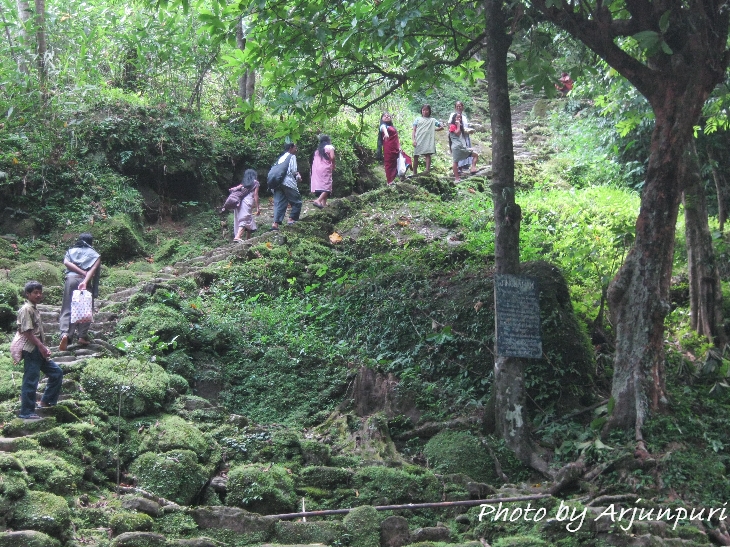
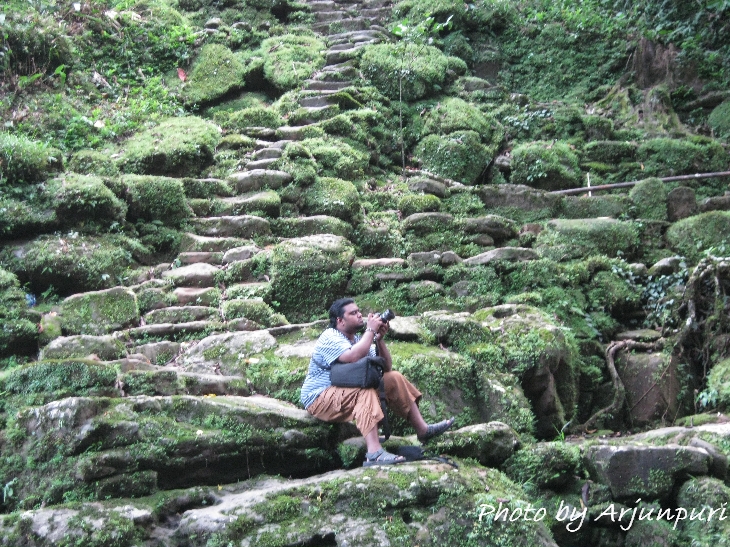
After a while, the concrete steps ended and a path made up of stones started. All Khasi villages are connected by this kind of network of stone pathways known as the King’s Way which traditionally kept the local betel nut trade alive with Shillong. Throughout the network, hundreds of living root bridges form the bridleways over the myriad of water channels that criss-cross the area.
This pathway had its own charm, but I wonder how they walk on these stone steps during monsoon, as they can be very slippery, as the water flows rapidly from the upper part of the forest.
We could feel the density of the forest and the intricacy of its design as we moved further. Tall trees intertwining with each other like a romantic couple. The ground was a canopy of green, slightly damped, because the density of the forest seldom allowed the rays of the sun to kiss the ground, almost providing a mystical atmosphere. The biodiversity was mind-boggling. In absolute wilderness, there will be either nothing to do, or there will be possibilities of doing things that we have never done before. There were very few people around, maybe less than 10 and the denseness of the jungle solidified that notion. Less people, more freedom!

I often wonder how does it feel to live in a place with plenty of greenery and a waterfall behind your house at your expense! We relished the experience as we walked into the stream that flowed with full vigour.

The first time I heard about Living Root Bridge was through a documentary on BBC’s Human Planet where a Khasi tribal was teaching his little daughter how to use roots and make them a bridge. I was curious to see it in real. The place in the documentary looked so fascinating and under explored. It was not just a log across a small brook, a sight I had seen many times in the jungles, but was different.
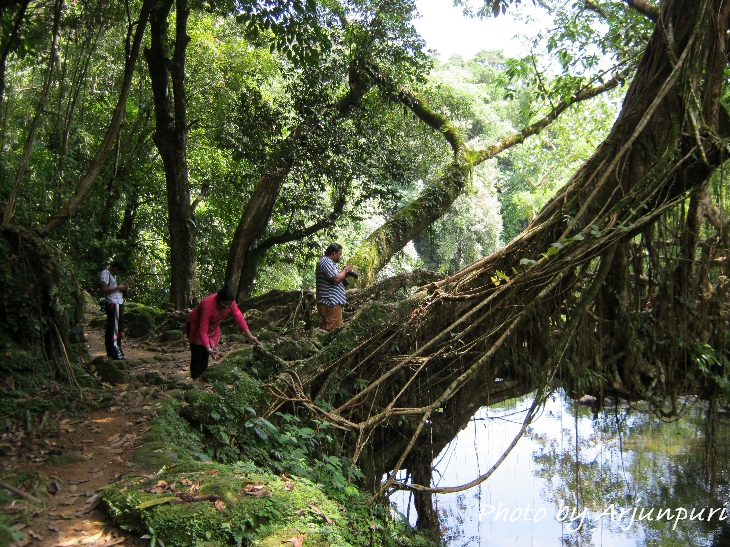
When we saw the bridge, we were awestruck at the natural engineering marvel. It was like the one we see in a beautiful illustrated fairy tale book. It was just marvellous. Using knotted roots across a gurgling stream was no less than a wonder. The roots were entwined in such a manner that over years they had grown elaborately and strongly so that they could help people to cross the gushing stream during monsoon. As an unwritten rule if any villager noticed a new root, he weaved it into the mesh, making the bridge much stronger.

We saw some Khasi women washing their clothes and taking bath there.
 |
| Living root bridge at Riwai |
 |
| Warning signboard |
 |
| Women going to Nohwet village |
 |
| A Khasi woman going to Nohwet village |
 |
| Wah Thyllong river |
A view from above the bridge revealed the majesty of the masterpiece. Over the years, stones were lodged between the gaps of the roots to form a beautiful pathway and underneath, the ancient organic mesh work weaved its beauty. The bridge connects Riwai village to Nohwet village. We came across a few Khasi women using the bridge to cross the Wah Thyllong river, which flows down to Bangladesh, to reach Nohwet village.
 |
|


 |
|


 |
|
The rubber tree Ficus Elastica had exuberant root growth from all parts -- base, trunk and upper limbs. By strategic planting and training of this tree the Khasi, Jaintia and Garo tribals had perfected a solution to safe access to their villages all year round. The development and upkeep of bridges is a sort of community affair. Initially, a length of bamboo pipes or betel nut trunks were secured, creating root-guidance systems, across a river divide and a plant was planted on each bank. The thin, tender roots of the tree, prevented from fanning out by the betel nut trunks or bamboo pipes, grew straight out. When they reached the other side of the river, they were allowed to take root in the soil. The roots perched atop huge boulders along the riverbanks and even in the middle of the rivers themselves.
 |
|


 |
|

At later stages in the evolution of the bridge, stones were inserted into the gaps and eventually become engulfed by the plant forming the strong walkways. No timber constructed bridge would have survived the seasonal battering of the water courses or the depredations of the ubiquitous white-ant colonies living in these jungles. The guard rails were high and intricately woven. These routes were the only access for all materials going up or down. If a worker carries a load of 40 kg there should be good substantial hand rails and root tendrils from the higher canopy were trained down as suspension arms. These bridges may have a life-span of over 150 years and no steel bridge can supersede the security and longevity of these living constructions!

The roots used in the bridge were very thick -- about 18 inches broad and about 6 inches thick. These bridges are not just built, but are grown. Whenever and wherever there is a need, all they need is simply grow their own bridges! Khasis also use living root ladders to climb the cliffs.

Unfortunately we couldn’t see the Umshiang Double-Decker Root Bridge, known to be the only one of its kind in the world. It has two bridges stacked one over the other.
 |
| A Khasi woman |
Next, we went to Mawlynnong, the Cleanest Village in Asia.

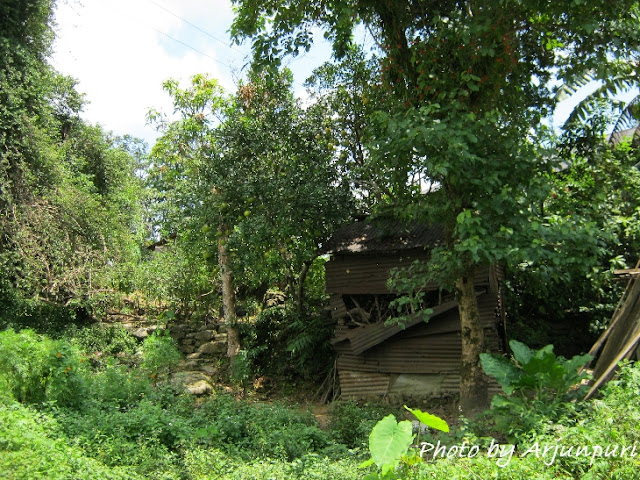


 After reaching the village, we bought entrance tickets. A village teen issued us the tickets and it was Rs 10 per person, as the place is managed by the village authorities. The guy was selling some cool drinks and biscuits. Nearby, there was also a school, yes, a school in the forest!
 To reach the lower regions of the forest, there was a footpath on the steep hill slopes. The first part of the footpath had concrete steps. The village that we passed was picturesque and the footpath through the jungle looked so neat that it almost seemed as if we were walking in a botanical garden.


 A view from above the bridge revealed the majesty of the masterpiece. Over the years, stones were lodged between the gaps of the roots to form a beautiful pathway and underneath, the ancient organic mesh work weaved its beauty. The bridge connects Riwai village to Nohwet village. We came across a few Khasi women using the bridge to cross the Wah Thyllong river, which flows down to Bangladesh, to reach Nohwet village.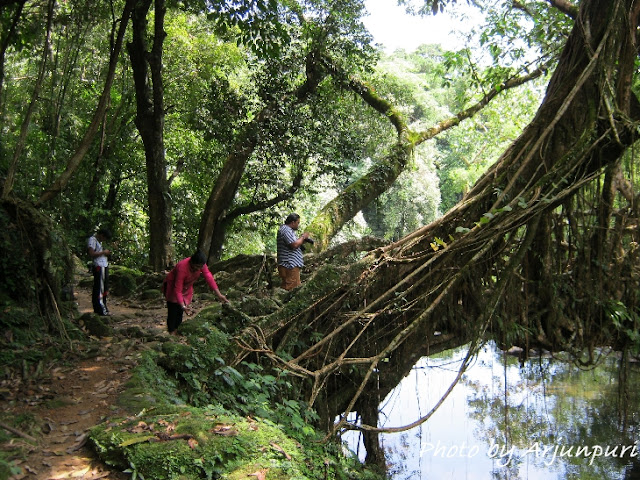


 A signboard with Jing Kieng Jri welcomed us to the village.








 Unfortunately we couldn’t see the Umshiang Double-Decker Root Bridge, known to be the only one of its kind in the world. It has two bridges stacked one over the other.


