Showing posts with label yemen. Show all posts

Saturday, 16 October 2021

Hyderabad’s distinct Chaush community has roots in Yemen

 The Chaush, a diasporic group that has roots in the Hadramawt region of Yemen, came to Hyderabad to work as soldiers in the Nizam’s military, in private militias or as tax collectors.

At a time when Muslims in India are constantly asked to display their nationalism and explain their choices of food, love and profession, it is important to remember that identity is not a monolith. It is historically constructed and multidimensional. Neither can it be restricted by visa and passport regimes on printed paper, nor can it be defined by legal definitions of nationalism and citizenship. It is lived everyday as memories and connections between multiple local, regional and universal contexts.


The Chaush, a distinct diasporic group in Hyderabad that has roots in the Hadramawt region of Yemen, exemplify the possibilities of inhabiting translocal identities, as this essay shows. Chaush is an Ottoman Turkish word that denotes a junior military rank indicating the predominance of soldiers and mercenaries in the early Hadrami migration to Hyderabad centuries ago, from Hadramawt valley or wadi in South Yemen. The scholars and traders of the wadi are subjects of legends and it occupies an important place in early Islamic history. Hadrami Arabs were instrumental in the spread of Islam in the Indian Ocean through complex networks of kinship and economic relationships along its port cities. Through centuries, Hadramis have travelled as religious scholars, traders and mercenaries. Their presence is still written across the Indian Ocean from Comoros Islands to Kerala to Singapore and Indonesia.


Most Hadrami Arabs came to Hyderabad to work as soldiers in the Nizam’s military, irregular forces, in private militias or as jamadars/tax collectors. They also occupied high ranking military positions as officers in the Hyderabad Army. For example, General El Edroos, a Hadrami, was the Commander-in-Chief of the Hyderabad forces when they surrendered to the Indian forces in 1948.


But, as scholars have noted, Arab mercenaries were already a part of the multiple armies, especially Maratha armies, across the Deccan before the British and the Mughal empires started competing for dominance. For example, the Gaikwad Maharaja of Baroda employed many Arab soldiers, including Ja‘far al-Kathiri, whose successors later came to work for the Nizam of Hyderabad and financed the Al Kathiri Sultanate in Hadramawt with the profits they earned in Hyderabad. Another prominent Hadrami family is the Al Quaiti family, a part of Hyderabad’s nobility, which established the important Al Quaiti Sultanate in Hadramawt.


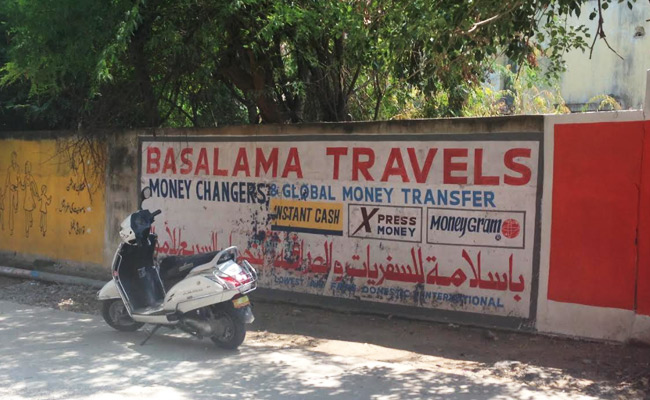
In Hyderabad city, Barkas and Chandrayangutta are both predominantly Chaush neighbourhoods. Names of shops, hospitals and schools in these areas announce this community’s claim on this space. Restaurants serving Mandi and Kahwa (cuisine unique to the community) line all main streets. Chaush men can be identified by their sartorial choices. They wear geometrically patterned lungis or wraps under kurtas. These wraps are available in shops in Barkas, Lad Bazaar and Shehran. These are popularly referred to as sarung, a word that has etymological roots in Indo-Malay and is now a part of the Arabic language. These are popular items that are bought as gifts by relatives or family when they visit Hyderabad from abroad. It is common knowledge among the Chaush that these sarungs are produced in Malaysia and Indonesia, then supplied to the Gulf, from where they are marketed elsewhere.


The garment also allows one to locate the Hadrami diaspora in the larger matrix of global capitalist production and supply chains. During the late colonial period, Hadramis in South East Asia, especially Indonesia, acted as intermediaries in the cloth business. The local batik industry there still remains a site from where the sarung cloth is produced. Similarly, the open ‘Arab style’ sandals have become very popular amongst the Chaush community in the last three decades. These are produced in South East Asia and then supplied from Dubai to Yemen and elsewhere in the Indian Ocean region.


For a Chaush, the distinction between Arab and Hadrami identity is blurred – Arab being a meta-identity that subsumes the Hadrami identity. However, Hyderabadi Hadramis primarily associate themselves with the creolised Chaush identity and as Syed/Mashiekh/Qabail – social stratification systems of Hadramawt. Therefore, Chaush identity is truly translocal – diasporic yet stratified on traditional lines. It is regional – Arab and Hadrami at the same time. Most importantly, Chaush identity is also universal – most are members of Shafi’i Maddhab (Sunni sect) yet in Hyderabad it is not uncommon for various Sunni sects to pray together.


Modern Yemeni and Indian nation-states complicate the Chaush identity because the homogenising narratives of these postcolonial nation-states affirm ideas of fixed borders and reified identities. However, for the Chaush, the links with Hadramawt as a geographic entity or a socio-political imaginary allows for demarcation of boundaries of their identity. Yet, state-centric definitions of ‘host society’ and ‘home country’ are too limited to capture or understand these meanings.
Hadrami naming patterns can be witnessed across Chandrayangutta and Barkas


The word watan comes closest to the idea of a homeland for the Chaush.  Watan does not mean a nation-state, but it is an interplay of translocal geographies of origin/s, that is, regions, cities or villages. For the Chaush, members born in Hadramawt or watan are called Wilayati (literally foreign born; a person born in Hadramawt ‘the homeland’ is still a foreigner to the creole) and those born outside the homeland (diasporic) are called Muwalladin (foreign born creole/of mixed parentage, hence non-pure), denying the possibility of authentic or the stress to retain a ‘pure’ core or a ‘syncretic’ present – in practices, customs, traditions or language. Hadramis born in India are called Mawlluwd-e-Hind. Chaush means both Wilayati as well as Muwallad. A Chaush never belongs.


The movement of the muwalladin as a historic diaspora also gets reflected in the current trends of migrating to the Gulf within the Chaush community in Hyderabad. Post police action, most Chaush found themselves stripped of their normative privileges and status, and ended up participating in the informal sectors of the postcolonial Indian State. 


Today, the community finds it difficult to compete with those who have more social capital in terms of access and education. Almost all Chaush households have one or more members working in the Gulf. Economic migration to the Gulf began in the 1960s, however, it intensified in the 1970s with relaxed passport and visa regimes.


Migrating to the Gulf is preferable to working in Hyderabad for most Chaush, not only because it offers better economic opportunities, but also because there is a relative ease with the idea of moving within the Indian Ocean area. Therefore, given the high demand for labour in the Gulf markets and the established networks that this community has, it is easier to transcend the disadvantages it faces at ‘home’ by migrating. Interestingly, many Chaush women – young and old – who have not been to newer malls and markets in Hyderabad, know street names and malls in Dubai and Jeddah.

The Chaush identity defies notions of authenticity. This diaspora affirms that a ‘lived everyday’ is located in between historically contingent local/s and universal. For them translocal mobility is normal. It opens up questions regarding different ideas of assimilation and integration that have prevailed in the non-west, specifically in the Indian Ocean region. And offers new frames for understanding concepts like homeland, host society, and notions of belonging.


The point above cannot be emphasised enough in a time when within India, many intellectuals – public and otherwise – are trying to ‘defend’ Indian Muslims by pitting a limited local syncretic South Asian Islam against the universal barbaric global Islam. This practice is not only intellectually dangerous for it presents a part of Indian Muslims identity as its whole, but also because it is laced with the remains of orientalised ideas of Islam. The idea that universal Islam is the other of the modern world has been witnessed in multiple guises since enlightenment – sometimes as racism, sometimes as development and sometimes as a defence of human rights. The work of South Asianists, which implicitly borrows from this dichotomy of a bad revivalist global Muslim versus a Good Indian syncretic Muslim, only reinforced Islamophobic tropes and suspicions against an already vulnerable population. Hence, the Indian Ocean region, Deccan and Hyderabad offer a methodological possibility for us to develop a more inclusive approach to identity formation.


Author: Khatija Khader completed her PhD at Jawaharlal Nehru University and currently teaches at the Centre for International Relations, Islamic University for Science and Technology (IUST) in Kashmir. Views expressed are the author’s own.


(Source: TNM)

Monday, 28 May 2018

Oman cyclone brings three years' rainfall in single day, leaves 11 dead

A cyclone more powerful than any previously recorded in southern Oman has slammed into the Gulf country and neighbouring Yemen, deluging a major city with nearly three years' worth of rainfall in a single day and leaving 11 people dead.

Eight people were also missing as Cyclone Mekunu caused flash flooding that tore away whole roadways and submerged others in Salalah, Oman's third-largest city, stranding drivers.


Rushing waters from the rain and storm surges flooded typically dry creek beds.


The holiday destination's now-empty tourist beaches were littered with debris and foam from the churning Arabian Sea.

India's Meteorological Department said the storm packed maximum sustained winds of 170 to 180 kilometres per hour with gusts of up to 200kph.

It called the cyclone "extremely severe".


Branches and leaves littered the streets. Several underpasses became standing lakes and cars were left abandoned on the road.


The Port of Salalah — a key gateway for the country and for Qatar amid a regional diplomatic dispute — remained closed, its cranes secured against the pounding rain and winds.

Salalah Port Services said it would take a minimum of 72 hours to "make the port safe".


Omani forecasters said Salalah and the surrounding area would get at least 200 millimetres of rain, over twice the city's annual downfall.

It actually received 278.2mm, nearly three times its annual rainfall.


The country's Labour Ministry declared a three-day holiday for companies and establishments in the private sector in the Dhofar region, state news agency ONA reported.

The central bank, meanwhile, issued a circular announcing a three-day holiday starting on Sunday for money exchange houses, banks, finance and leasing companies in Dhofar.

(Source: ABC)

Socotra, the Galapagos of Yemen, becomes a disaster zone

The island chain of Socotra, famed for unique plants and animals found nowhere else on the planet, is coping with the aftermath of a powerful cyclone.

The archipelago was struck by Cyclone Mekunu on Wednesday night, leaving at least 17 people missing and forcing its native population to flee floodwaters.

Socotra is part of Yemen, which is embroiled in a lengthy civil war - something from which the four islands have largely been spared.

But after two boats capsized during the cyclone, and at least three cars were washed away by powerful floods, the government has declared Socotra a disaster zone.


Coastal areas "were submerged by floods causing heavy damage to homes," a spokesman told AFP.

Hundreds have been evacuated from villages, but rescue workers are reportedly unable to reach many people in isolated parts of the main island.

Officials have appealed to international aid agencies for help.

Home of the blood dragon
Socotra is famed for its natural beauty.

Its startling biodiversity has earned it the nickname "Galapagos of the Indian Ocean" - a nod to Ecuador's famous Pacific island chain whose ecosystem is so unique it inspired Charles Darwin's theory of evolution.


The link to the famed Galapagos is not purely marketing either. Since it was first surveyed by United Nations' biologists in 1997, Socotra has been considered one of the most biologically diverse and distinct places on Earth.

It's estimated that 37% of its plants and 90% of its reptiles (along with almost all of its snails) are found nowhere else on earth, and the entire island chain is a registered Unesco World Heritage site.

One of the most iconic of its native species is the blood dragon tree - a striking, umbrella-shaped tree with a thick trunk.


It gets its name from the deep red sap within, which is gathered as a resin - and has a wide range of uses including as a dye, as incense, and in traditional medicine.

Inaccessible island beauty
The island's status as an ecological gem, however, has caused some problems for its residents.

As its population battles the torrential floods left behind by Cyclone Mekunu, reaching those in need is a major problem - partly because Socotra has few roads stretching into its biodiversity areas.


A 2007 travel article in the New York Times said a journey in a four-wheel-drive vehicle with an expert local driver as guide was "a struggle to the death", covering five miles in an hour and a half. It was, the author writes, worth it.

But plans to build and expand access roads on Socotra's main island have been controversial for years. Unesco considers the building of roads in the protected areas "a serious threat" to the island's value, and no improvements have been made since 2010.


Unesco had also expressed concern about how exactly humanitarian funds were being spent, amid reports they could be used to build "residential cities, ports, hotels, and roads".

But some construction work is sorely needed - because this week's cyclone is the third in recent years.

Chapala and Megh
Two cyclones - the name given to hurricanes when they form in the South Pacific and Indian Oceans - battered Socotra in November 2015.

Cyclone Chapala brought powerful winds similar to a category four hurricane, damaging homes, vehicles, and injuring dozens.

Cyclone Chapala, seen from the International Space Station in 2015
Less than a week later, Cyclone Megh passed directly over the main island, triggering flash floods and killing another two people. Thousands were displaced from their homes.

The damage was not limited to buildings and infrastructure. Soil erosion and habitat damage were also probable, and Unesco approved $75,000 (£56,000) in assistance last year to help mitigate the impact on threatened plants.

Yemen's wider crisis
Socotra remains under the control of the internationally-backed government, whose President Abedrabbo Mansour Hadi is in exile in Saudi Arabia.

His government called for all "urgent aid" possible for the people of Socotra.

But the mainland continues to be plagued by a complex civil war involving several regional titans.

The result is that mainland Yemen is suffering the worst humanitarian disaster on Earth, according to the United Nations.

Since March 2015, 9,559 people have been killed and 55,616 injured in the conflict.


The vast majority are men, but 791 children are reported among the dead - and the UN believes the actual numbers of the dead, including those not formally recorded, "are likely to be much higher".

Cyclone Mekunu could hit the mainland this weekend near the border with neighbouring Oman, and could gain strength before making landfall.

(Source: BBC)

Sunday, 27 May 2018

The wonder land of Socotra in Yemen

The road to the forest of frankincense trees, on the Yemeni island of Socotra, is a rough one. From the passenger seat of a battered Toyota Land Cruiser, it looked like pure rock pile, on and on, up, down, over. Ahmed Said, my driver and guide, wrestled the wheel like a man engaged, surely and calmly, in a struggle to the death. When at last, after 90 minutes, he stopped and got out, we had traveled perhaps no more than five miles.

We stood on a rise overlooking a riverbed rushing with water. The ground underfoot was a rubble of granite boulders and chunks of sharp limestone karst. Small trees — short and gnarled, resembling mesquite — surrounded us. Ahmed approached one and pointed to an amber drop of sap oozing from its trunk: the essence of frankincense. Until that moment I’d had no clear idea what exactly frankincense was; nor that it derives from the sap of a tree; nor that, as Ahmed explained, Socotra is home to nine species of the tree, all unique to the island. I caught the drop of sap on my finger and inhaled a sharp, sweet fragrance; then I put it to my tongue. The torture of the drive was forgotten, and for the briefest moment, under the hot Yemeni sun, I tasted Christmas.

Situated 250 miles off the coast of Yemen, Socotra is the largest member of an archipelago of the same name, a four-island ellipsis that trails off the Horn of Africa into the Gulf of Aden. A mix of ancient granite massifs, limestone cliffs and red sandstone plateaus, the island brings to mind the tablelands of Arizona, if Arizona were no bigger than New York’s Long Island and surrounded by a sparkling turquoise sea.

Some 250 million years or more ago, when all the planet’s major landmasses were joined and most major life-forms were just a gleam in some evolutionary eye, Socotra already stood as an island apart. Ever since, it has been gathering birds, seeds and insects off the winds and cultivating one of the world’s most unusual collections of organisms. In addition to frankincense, Socotra is home to myrrh trees and several rare birds. Its marine life is a unique hybrid of species from the Red Sea, the Indian Ocean and the western Pacific. In the 1990s, a team of United Nations biologists conducted a survey of the archipelago’s flora and fauna. They counted nearly 700 endemic species, found nowhere else on earth; only Hawaii and the Galapagos Islands have more impressive numbers.


Lately Socotra has begun to attract a new and entirely foreign species — tourists. A modest airport went up in 1999. (Before then, the island could be reached only by cargo ship; from May to September, when monsoon winds whip up the sea, it could be cut off entirely.) That year, 140 travelers visited. The annual figure now exceeds 2,500: a paltry number compared with, say, the Galapagos, but on an island with only four hotels, two gas stations and a handful of flush toilets, it’s a veritable flood.

They — I should say “we” — constitute an experiment. Encouraged by a United Nations development plan, Socotra has opted to avoid mass tourism: no beachfront resorts; instead, small, locally owned hotels and beachfront campsites. The prize is that rarest of tourists, eco-tourists: those who know the little known and reach the hard to reach, who will come eager to see the Socotra warbler, the loggerhead turtle, the dragon’s blood tree — anything, please, but their own reflection.

Riding with Ahmed, it was immediately evident that, though the island is small in size, it cannot possibly be seen without a hired driver and guide, for the simple reason that there are few proper roads, fewer road signs and no road maps.

The first paved roads were built by the Yemeni government only two years ago: wide, open scabs on the landscape that stretch across the island yet see virtually no traffic. The new roads, it turned out, were a sore spot with Ahmed and the United Nations Socotra Archipelago Conservation and Development Programme. “The experience is so different if you spend 45 minutes on a road versus three or four hours,” Paul Scholte, the program’s technical adviser in Sana, Yemen’s capital, said to me. “The whole perception of the island changes due to the road.” Then there was the matter of placement. Only at the last minute did the S.C.D.P. manage to convince the government not to send the road through a stretch of coastline designated as a nature preserve. It’s fair to say that Socotra’s future may be read in the lines of its roads: how many, how wide, where they lead and who is encouraged to travel on them.

Ahmed took me to the beach that would have been paved over: shimmering blue water, powdery white sand and not a soul in sight. A ghost crab, pure white, with just its pin-stalk eyes peeking above the water like twin periscopes, drifted by on a current in the shallows. I watched it watch me and then bury itself in the sandy floor.

According to Scholte, roughly half of Socotra’s tourists are Italians, who seem mainly interested in the beaches: “Italians go because it’s new, it’s cheap, but not because it’s special.” The French and Germans, in contrast, go for special: they come to hike, visit the island’s nature preserves, maybe rent camels and spend several days trekking as a group across the Haghier mountain range at the center of the island.

As for Americans, well, there weren’t many. I could understand: a conservative Arab country hardly seems like a good first choice for a vacation, much less the country where, in 2000, Al Qaeda forces bombed the U.S.S. Cole; where, in 2006, tribesmen kidnapped a group of French tourists; and where (according to my guidebook) a Kalashnikov can be had for only a little over $100. But whatever Yemen’s troubles, Socotra is far removed from them. Everyone I met was garrulous and open, and seemed genuinely excited, at least for the moment, at the prospect of foreign visitors.

In devising its eco-tourism plans, Socotra aims to follow in the footsteps of the Galapagos. Unlike the Galapagos, however, Socotra is significantly inhabited, and has been for some 2,000 years. More than 40,000 people now live there: many in Hadibu, the island’s main town, the rest scattered in small stone villages, working as fishermen and semi-nomadic Bedouin herders. Nature and culture are longstanding neighbors.

Late one afternoon Ahmed and I drove to a Bedouin village high on the plateau, where we would stay the night. Just before sundown, we arrived at a small cluster of low-ceilinged stone structures, home to an extended family and their herd of goats. After removing our shoes and entering, we were given the best pillows to recline on and served tea. Dinner followed: goat’s-milk yogurt, drunk from a communal bowl; a thin, freshly baked flatbread; and a large plate of rice cooked in goat’s milk, which we ate with the fingers of our right hands.

Ahmed led the conversation, which involved goats and water projects. It proceeded not in Arabic but in Socotri, a language that is unique to the island and related to some of the oldest of the Near East. Socotri describes 24 months in its calendar, each roughly 13 days long, including the Month of the Cow’s Breath, when heavy winds turn the sea to foam, and the Month of Crabs, when ghost crabs crowd the beaches by the thousands. By the light of a kerosene lamp I cajoled our host into teaching me several Socotri phrases. The most handy was the one for “I’m full.” No, thank you, no more goat’s milk, goat’s-milk yogurt or fricasseed goat, I’m full — kheapaak!

Blankets and mats were offered to sleep on. But mosquitoes, born from a nearby rainwater tank, had found me, so I stepped outside and set up my tent. The sky was thick with stars. Lying on the rocky ground, with the scent of frankincense fresh in memory, I felt as though I had stumbled into a chapter of the Old Testament. Well before dawn I woke to the sound of the family patriarch’s voice warbling a long, mournful prayer. He finished after a few minutes, and the night closed over the sound. I listened awhile longer to the holy darkness, then fell again to sleep.

The next morning we made for the forest of dragon’s blood trees. The dragon’s blood tree, Dracaena cinnabari, is Socotra’s flagship species. With a vertical trunk and arching canopy, the tree resembles a parasol that’s been blown inside out. When its trunk is cut, it oozes a red sap that gives rise to cinnabar, a resin with famous medicinal qualities. We had seen the trees scattered here and there on the plateau, but the highest concentration was in a nature reserve tucked high in the Haghier Mountains. We would drive to the base of the range and hike in.

Rare dragon’s blood trees, found only on the island, which can grow for 300 years. Credit Harf Zimmermann
On the drive up, Ahmed stopped to chat with a Bedouin man herding cattle with his young son. Through the open window, he and Ahmed gently pressed their foreheads and noses together, the customary greeting among men on Socotra. For the equivalent of $10, the man agreed to be our foot guide. He hopped into the back seat and left his son, who looked no older than 7, to tend the cattle.

The Haghiers are the original, uplifted core of the island, all worn and crumbling granite. Our path led upward invisibly from boulder to boulder, through low shrubs and aloes and amid the omnipresent droppings of goats and cattle. The United Nations conservation plan in 2000 divided Socotra into usage zones; more than 70 percent of the island is national park, off limits to development. Even here, though, livestock grazing is permitted, and well into the distance I could see stone walls marking tribal grazing ranges. I wondered aloud at what stage the conservation plan would begin to restrict the livestock.

“We have to be careful with the local communities,” Ahmed said. “We can’t just say, ‘Stop, stop, stop.’ They need to see a benefit first.” Our $10 guide, I understood, was one step in the education process.

After two hours we reached the peaks, a couple thousand feet up. I could see the coast below and the outline of Hadibu pressed against it. Ahmed handed me his binoculars and pointed a few yards away to a bird foraging on the ground: the Socotra bunting, with a rosy breast and black-and-white striped head. It is among the rarest of the island’s endemic species and is threatened by predation from feral, non-native cats. Birders come from around the world to catch sight of it. And here, Ahmed said, I’d seen it with no effort at all! I pictured men and women traveling thousands of miles to tick names off a life list and suddenly wasn’t sure whether it was absurd to keep such a list or shameful that I did not.


The forest of dragon’s blood trees, when we at last reached it, did not much resemble a forest, at least not the dense, dark sort associated with giant reptiles of myth. It was open and sparse, as though a light rain of broken umbrellas had fallen on the hillside. Recent years have seen a troubling decline in the tree’s numbers. Although many older examples are present on the island (they can grow for 300 years or more), the younger generation is all but absent, with saplings found growing only on cliff sides and in the most inaccessible highlands. The entire species may well be headed for extinction.

Scientists are unsure why. Grazing could be one cause; as development projects have brought a more steady supply of water to Bedouin villages, the herds of livestock have grown larger and more stable. A more important factor may be climate change: the island has seen a reduction in cloud and mist cover, which may affect the ability of dragon’s blood seeds to germinate.

After a lunch of wild oranges, we began the long hike out. I was tired and more than a little sun-dazed. My gaze slipped from the vista and became entranced by the rise and fall of the guide’s feet in front of me; I marveled at the upright, unlabored grace with which he moved, and the fact that he was barefoot. My thoughts coalesced around the fuzzy notion that all the dramatic landscapes I’d ever seen — Socotra, the Galapagos, Cape Breton, Yosemite Valley — in fact were one and the same and all visible here before my eyes. Then I would focus again on the guide’s bare feet and remember that I was not everywhere in the world but in fact somewhere like nowhere else. I invented a quiet little song:

I’m in Yemen, I’m in Yemen,

I see many men in Yemen.

I drifted along to the rhythm of this internal chant and soon expanded it into an elaborate mantra involving anemones, anonymity, metonymy and my anomie. When Ahmed suddenly addressed me in English, I was taken by surprise.


“Why do people want to travel to Socotra?”

I was stumped. His question was pragmatic, I’m sure, but in my fugue state it sounded existential. Why do people travel? What are tourists, and what do they — we — hope to take home? Pleasure in seeing something new, of course, but also pride in being among the privileged few to see it, and the self-assurance (however delusional) that our presence has not yet altered the very thing we’ve come to experience. How long can that spell go unbroken? Already, Paul Scholte told me, Socotra’s few tourists have one consistent complaint: they see too many tourists.

Even more than the flora and fauna, it seemed to me, the most fragile aspect of Socotra is its way of life. Here are a people whose own idea of travel mostly entails the pursuit of goats — a people, in effect, whose ancestors had ended their travels here centuries ago, then ventured no farther. The most endangered way of life nowadays is the one that goes, if not nowhere, then somewhere very slowly, and a traveler must go to the ends of the earth to see it.

I was tempted to ask our guide, if he could travel, what in the world he would want to see. But I refrained; the question would have meant nothing to him. When at last we reached our truck, I offered him a piece of the snack bar I’d been saving to celebrate. He picked at it and waved his hand, the international sign for “Thanks, but no thanks.” Kheapaak.

ESSENTIALS

BEFORE YOU GO: The main Web site of the Socotra Archipelago Conservation and Development Programme (www.socotraisland.org) has good background information. Visas are required for American travelers; visit www.cdc.gov for information on recommended vaccinations and medications. Although the U.S. State Department currently maintains a travel warning for Yemen, most experts agree that travelers need not have safety concerns about Socotra. Organizing travel to Socotra is challenging, so a travel agent can be very helpful: try the excellent Poe Travel (800-727-1960; www.poetravel.com).


WHEN TO GO: October through April is best — especially March and April, when the sea is flat and ideal for snorkeling and diving. Avoid the windy monsoon season from May to September.

GETTING THERE AND GETTING AROUND: There are only two flights a week to the island, operated by Yemen Airways (www.yemenia.com); seats sell out well in advance. On the island, you need to hire a four-wheel-drive vehicle, as well as an English-speaking driver and guide. Expect to pay $250 to $350 for four days; be sure to negotiate in advance. These arrangements, as well as hotel reservations, can be made through the Socotra Ecotourism Society (ecosocotra@socotraisland.org).

HOTELS: The island’s few hotels are basic. Some have rooms with private bathrooms and flush toilets; all are inexpensive (about $10 a night). The Taj Socotra (no relation to the India-based chain) in Hadibu is simple and clean and has a popular outdoor restaurant; there’s also the newer Al Mohet and, outside of town near the airport, the Chalet Socotra. Camping is an ideal way to sleep, since the island’s main ecological sites are one or more hours’ drive away from Hadibu; you can arrange to rent gear on the island.

(Source: NYT)

Wednesday, 1 March 2017

Female genital mutilation is a sad reality in India, support the campaign to ban it

A group of 30 survivors of female genital mutilation (FGM), belonging to a particular community, has started an online campaign against the practice and to put pressure on the government to bring a law to ban it. The group, ‘Speak Out on FGM‘, has launched the petition on ‘Change.org’ website, and claimed to have received over forty thousand signatures already.

Female genital mutilation refers to several different harmful practices involving the cutting of the female genitals for non-medical reasons. In December 2012, the UN General Assembly unanimously voted to work for the elimination of FGM, reckoned as a violation of human rights.

The group is launching another campaign, ‘Each One-Reach One’, on February 6, observed as Female Genital Mutilation Day, to reach out to the people and raise awareness about it. “This is an effort to wipe out this custom from our community. I am happy that thousands of survivors are joining this campaign not only from India, but also from Canada, Australia, South Africa, Britain, etc,” A survivor told PTI.

She said, “At the age of seven, I was subjected to FGM in Mumbai in an unhygienic condition and clandestine manner. The shock and the physical and psychological trauma of that day are still fresh in my mind.” “We have also launched several WhatsApp groups and Facebook pages, which have received overwhelming response from across the globe,” said the survivor, who is now 53 and working with a publishing company.

Survivors maintained the reason for the tradition of FGM is to curb sexual drive of women and control them. They claimed FGM has nothing to do with religion and is more of a cultural practice. According to the World Health Organisation, between 100 million and 140 million women and girls across the world are thought to be living with the consequences of FGM.


“This is the first time that survivors in India have joined hands to publicly campaign against this horrific practice,” said Preethi Herman, Country Lead, change.org. The message of this campaign is loud and clear. FGM needs to be banned, she added.

Please sign the petition here.

At least 200 million females estimated undergo FGM globally
At least 200 million girls and women in 30 countries are estimated to have undergone female circumcision, half of them in Egypt, Ethiopia and Indonesia, the UN children’s agency has said in a report. The UNICEF statistical report said the global figure includes nearly 70 million more girls and women than it estimated in 2014. It said this is due to population growth in some countries and new data from Indonesia.

The UN General Assembly unanimously approved a resolution in December 2012 calling for a global ban on female genital mutilation, a centuries-old practice stemming from the belief that circumcising girls controls women’s sexuality and enhances fertility. One of the targets in the new UN goals adopted last September calls for the practice to be eliminated by 2030.

While there has been an overall decline in the prevalence of female genital mutilation over the last three decades, UNICEF said it isn’t enough to keep up with increasing population growth. If current trends continue, it warned that the number of girls and women undergoing FGM “will rise significantly over the next 15 years.” In the 30 countries, UNICEF said the majority of girls were circumcised before reaching their fifth birthdays. “In Yemen, 85 per cent of girls experienced the practice within their first week of life,” the agency said.

According to the data, girls under the age of 14 represent an estimated 44 million of those who have been cut, with the highest prevalence in this age group in Gambia at 56 per cent, Mauritania at 54 per cent and Indonesia where about half of girls aged 11 or under have undergone the practice.

(Source: Your Story)

Tuesday, 31 January 2017

Bel Air Police detain woman walking, question her immigration status

Police agencies in Harford County say they don't stop people just to check their immigration status, but the recent experience of a Bel Air woman raises questions about how clearly that's understood by officers on his streets, the town's police chief admits.

Bel Air Police Department Chief Charles Moore, who's led the agency since September 2015, said he's not sure if his department has a policy specifically dealing with questioning a person's immigration status, but added: "If there isn't one, there will be."

In the wake of President Trump's statements on Wednesday that federal grants may be withheld from so-called "sanctuary cities" that don't take enforcement actions against people who are in the United States illegally, Moore and other law enforcement leaders in the county could find they have to walk an even finer line between civil liberties and checking for undocumented aliens.

Trump also is expected to suspend issuing visas for people from several predominantly Muslim countries — Iran, Iraq, Libya, Somalia, Sudan, Syria and Yemen — for at least 30 days, according to a draft executive order obtained by The Associated Press, as reported Wednesday by Tribune News Service.

On the morning of Dec. 21, Aravinda Pillalamarri was walking in her Bel Air neighborhood, where she walks all the time, when she said she was stopped by a Bel Air Police Department officer.

When she responded to his question about what she was doing – that she was walking – Pillalamarri says the questions continued.

When she asked why the officer was asking her so many questions, he replied because someone had called police.

"Walking while brown?" Pillalamarri said she then asked the officer.

A police supervisor arrived and began to question Pillalamarri, more aggressively, she said, and told her she wasn't free to leave because she "was under criminal investigation."

He asked why she didn't have identification with her.

"Why don't you have ID?" she said the supervisor asked her. "Are you here illegally?"

Once the officers had run her name through their computer system, Pillalamarri said, she was allowed to leave and walked to her home, just a few doors away.

Pillalamarri, 47, has lived in Bel Air for more than 30 years and is a U.S. citizen. Her parents came to America from India when she was a baby. She went to Bel Air High School.

She walks in her neighborhood nearly every day, she said.
Aravinda Pillalamarri of Bel Air shares her story of being stopped by a Bel Air police officer the morning December 21 while walking in her neighboorhood and being questioned about her legal status as a citizen.

She related her story to members of the Bel Air Board of Town commissioners at their town meeting Jan. 17, not to get anyone in trouble, she explained, but to bring to their attention the need to uphold everyone's civil rights.

Color was not on her mind when she was first stopped, Pillalamarri told the commissioners.

"Only when the supervisor asked 'are you here illegally' did my sense of color, and of being unequal, come forth and my interest in my civil rights take a back seat to get out of the situation safely," she said.

"Public safety does not need to come at the cost of civil rights," she continued. "I am sharing this incident here not to ask anyone here to find fault or take sides. We are all on the same side and can use this as an opportunity to learn and improve. The responsibility to uphold civil rights is one that all of us share, and we need to do our part and also expect the police to do their part."

Moore, who was present at the meeting, said his officers do not ask someone's immigration status, particularly during a routine call.

"That's not a concern of ours," Moore said Wednesday. "That's just not the proper protocol that I would take. And my officers, from what I've seen from their performance, I don't see that from them either."

Immigration status could come into play when someone is arrested, Moore said, but he added that would more likely be when they're taken to the Harford County Detention Center.

The Harford County Sheriff's Office, which runs the detention center and is the chief law enforcement agency for most of the county, does not ask for proof of citizenship when stopping or detaining someone. Deputies only ask for identification, according to Cristie Kahler, spokesperson for the agency.

"We do not have a policy that specifically requires deputies to ask for proof of citizenship," Kahler explained via email. "We do ask to see identification as a regular course of action during a motor vehicle or personal stop. Once they provide ID, we query the info through multiple databases. Should one of those databases provide an alert regarding the status of the individual, and indicate they have been flagged by immigration or federal authorities, we then contact that agency. That agency then provides direction on how to further handle the individual and whether or not to detain for further investigation."

"It doesn't matter to me where you're from, who you are, anything else. If you live in the town of Bel Air or you're in my jurisdiction, my position is to protect and serve everyone," the Bel Air PD's Moore said. "I'm not going to question who you are or where you came from. My job is to maintain and build trust among everyone."

In Pillalamarri's case, there had been a call about suspicious activity and the officers responded, he said.

"There could have been more sensitivity on the part of the officer," Moore told the town commissioners.

Pillalamarri said she was uncertain of what her rights were when the officers stopped her.

"Police are training in dealing with people when they stop them on the street, but ordinary people are not necessarily training in interacting with the police," she said to the commissioners. "I did not know when I was stopped whether I had the right to remain silent, whether I was being legally detained or what information I was required to give."

Pillalamarri has since met with Moore, as well as Town Administrator Jesse Bane, who was formerly county sheriff and a career police officer, about the incident.

Moore said at the town meeting the police department could hold an open forum with the community.

"The community needs to be aware of what police are doing. They have to investigate fully," he said. "And on the officer's part, there has to be sensitivity, so it doesn't escalate to the point of being wrong, of things being said they way they're said."

The community needs to be able to trust the police, and work with them, he said.

"That's not going to be the norm to ask someone if they're illegal, or if they're legal. That's not what we want. When you start doing that to people of color, of different origin, different cultures, you start to develop a level of mistrust among those people," Moore said. "That's not what we want in the Town of Bel Air. We want to build trust and a level of cooperation among all our citizens.

(Source: The Baltimore Sun)

Wednesday, 13 November 2013

7 ridiculous restrictions on women’s rights around the world

Found an interesting topic on the Washington Post.

With Saudi Arabian women behind the wheel since Saturday to protest their country's refusal to grant driver's licenses to women, they’re challenging not only long-standing restriction, but also a the larger system of Saudi Arabian gender-based laws, some of the harshest in the world.

According to one measurement, though, there are actually several countries that rank lower on women;s rights than Saudi Arabia. The World Economic Forum, which publishes the preeminent ranking on gender gap issues, ranked Saudi Arabia 10th from the bottom in its 2013 report -- ahead of Mali, Morocco, Iran, Cote d’Ivoire, Mauritania, Syria, Chad, Pakistan and Yemen. Women’s rights abuses are by no means limited to North Africa, West Africa or the Middle East, though that’s where we tend to hear such stories most frequently.

“A lot of the most severe stuff comes out of legal or de facto guardianship systems,” said Rothna Begum, a researcher who tracks women’s rights in the Middle East and North Africa for the advocacy group Human Rights Watch.

But she adds that, especially in Saudi Arabia, “things are modernizing.”

Here are nine other remarkable legal restrictions against women, from Asia to Latin America :

1. India (some parts): Road safety rules don’t apply to women. In some states of India, women are excepted from safety rules that mandate motorcycle passengers wear helmets -- an exemption that kills or injures thousands each year. Women’s rights advocates have argued the exemption springs from a culture-wide devaluation of women’s lives. Supporters of the ban say they’re just trying to preservewomen’s carefully styled hair and make-up -- which isn’t exactly a feminist response.

2. Yemen: A woman is considered only half a witness. That’s the policy on legal testimony in Yemen, where a woman is not, to quote a 2005 Freedom House report, “recognized as a full person before the court.” In general, a single woman’s testimony isn’t taken seriously unless it’s backed by a man’s testimony or concerns a place or situation where a man would not be. And women can’t testify at all in cases of adultery, libel, theft or sodomy.

3. Saudi Arabia and Vatican City: Women can’t vote... still. This is amazingly the case in Saudi Arabia, though a royal decree, issued in 2011, will let women vote in Saudi elections in 2015. Vatican City is the only other country that allows men, but not women, to vote.

4. Ecuador: Abortion is illegal, unless you’re an “idiot.” Begum says this is the policy in Ecuador, where abortions have long been outlawed for everyone but “idiots” and the “demented.” Politicians are considering a policy with the more politely worded term “mentally ill,” but that won’t change abortion’s legal status in Ecuador -- or, more importantly, the fact that the law is frequently used to criminalize miscarriages.

5. Saudi Arabia and Morocco: Rape victims can be charged with crimes. Many, many countries fail to protect the victims of rape, but some go a step further -- punishing women for leaving the house without a male companion, for being alone with an unrelated man, or for getting pregnant afterwards. The most infamous case may be Saudi Arabia’s “Qatif girl,” but a recent suicide in Morocco also made headlines -- 16-year-old Amina Filali killed herself after a judge forced her to marry her alleged rapist, in keeping with a policy that invalidates statutory rape charges if the parties marry.

6. Yemen: Women can’t leave the house without their husbands’ permission. Yemen, where this law remains in force, does allow for a few emergency exceptions, Begum says: if the woman must rush out to care for her ailing parents, for instance.

7. Saudi Arabia: Women can't drive. Read more about the ban and how women are challenging it here.
The good news? According to the World Economic Forum’s most recent gender gap report, equality has made “modest” gains in the Middle East. And Begum, of Human Rights Watch, says there’s lots of agitation for more change.

“Women in Saudi Arabia are highly educated and qualified,” she said. “They don’t want to be left in the dark.”