Showing posts with label bank. Show all posts

Saturday, 6 July 2019

How much pocket money should we give our kids?

If parents can afford to give pocket money to their children, then much more often than not they will pay them in cash.

One survey suggests that 84% of British parents give notes and coins to their children, typically an allowance - including some discretionary spending - of £7 a week.

Yet, by 2028, banks predict that for every 10 occasions when adults buy something, they will only use notes and coins once. For the rest, we will mostly use cards or digital payments.


So what will that mean for the nation's children? Will today's youngsters be learning about money using currency that is close to obsolete? Will parents have to find a new way of paying pocket money, or decide not to bother paying at all?

Experts say that paying a small amount, however infrequently, can help youngsters learn about money and budgeting.

It seems that the children themselves agree, especially if pocket money depends on completing chores.

Nine-year-old Yusuf says: "It is making you feel like when you are older and get a job - when you do stuff and get paid for it.

"But obviously you are going to get more when you are older, rather than just 50p a day."

Pocket money surveys rarely agree on the going rate for children's allowances. The Halifax, part of Lloyds Banking Group, has been running such a survey since 1987, which is one of the most well-established.

Its latest findings suggested a wide range of average amounts in different parts of Britain. Others suggest the Halifax estimate of the typical weekly payment is rather high, but there is general agreement that cash is currently the preferred choice.


Research has suggested that money habits are set by the age of seven. At a meeting of head teachers and authorities on Wednesday, some will call for better financial education in primary schools.

Whatever children are taught at school, a few pennies at home - starting in cash - can go a long way, according to Sarah Porretta, of the government-backed but independent Money and Pensions Service.

Her advice for parents includes:


  • Get children started with money as young as possible
  • Don't worry how much to give in pocket money, or how often
  • Parents who have no money at the end of the week should still talk to their children about the financial choices they make

For those parents who no longer carry cash - just using payment cards and smartphones - the mother-of-two says: "The trick is to go and get some coins, just so your children have the opportunity to interact with them.

"Then talk about what you are doing with money. If you are paying with a card or with a phone talk to children about that and link it back to those coins they have handled."

A growing band of pocket money smartphone apps suggest a different answer.

"The way we interact with money has changed. Pocket money is changing. We pay for things with the touch of a button," says Will Carmichael, father-of-two and chief executive of one of those apps - RoosterMoney.

"Traditionally pocket money sits in a jar at home, you add your coins, you can see it build up, and then you take that down to the sweet shop. That is no longer the case. You may use it for [video game] Fortnite online. You might use it to pay for a pair of trainers from an online shop.

"We are bringing pocket money online and making it more tangible again."

The RoosterMoney app allows youngsters to set savings goals
The app starts for four year-olds with an online reward chart, it moves on to a pocket money tracker which allows youngsters to set savings goals. Top of that list, according to the company's data, is Lego, followed by phones, and holiday money.

Eventually, it allows them to move on to spending with a pre-paid card. Data shows most pocket money is still spent on sweets, although books are second. The app also allows them to donate some of the money they have saved to charity.

However, the more advanced features cost a fee - an extra expense not suffered by parents who pay their children in cash.

Mr Carmichael argues that the charge costs parents far less than swimming or music lessons, but still teaches youngsters a practical life skill.

Bank basics
The next step for most youngsters is opening a bank account. Savings accounts can be opened from the age of seven, and current accounts from the age of 11.

"These are a great way of introducing your children to the world of banking, allowing them to use 'grown up' features like ATMs to get cash, or increasingly to make contactless payments, and even mobile payments if they have a smartphone," says Brian Brown, head of insight at data analysts Defaqto. "They also make it easier for family members to gift them money.

"Some of the accounts also pay interest, although not at high rates, allowing young people to get into the savings habit from an early age.

"By setting up standing orders you can pay children their pocket money regularly, with no moaning over missed or late payments - or even worse, each parent giving them their pocket money and paying them twice."

(Source: BBC)

Saturday, 20 October 2018

Why Margaret Thatcher deserves to be the face of the new polymer £50 note

We are quick to whitewash the ‘great men’ of our history, while forgetting women altogether

The Bank of England has confirmed the creation of a polymer £50 note, and the competition for its new face is already on. One of the most prominent petitions has been for the note to bear the likeness of former Conservative prime minister Margaret Thatcher.

Thatcher is well qualified for the spot. She is already deceased, and of course she had an important effect on our society and culture. In the words of her former aide Nile Gardiner: “Lady Thatcher was one of the greatest leaders in British history, and a figure who transformed Britain’s standing in the world.” While her “greatness” may be a matter of ongoing political debate, Thatcher’s significance is absolutely not.

Born a grocer’s daughter in 1925, Thatcher earned a chemistry degree at Oxford. After graduating in 1947, she applied for a job at International Chemical Industries from which she was rejected because, in their words, “this woman is headstrong, obstinate and dangerously self-opinionated”.

She qualified as a barrister aged 28, less than five months after her twin children were born. As an MP, Thatcher was one of very few Conservatives to vote for the legalisation of abortion, and support the decriminalisation of male homosexuality. Her lambaste of the Soviet Union in 1976 earned her the epitaph “Iron Lady”.

Unlike the Queen, who will automatically feature on the other side of the £50 note, Thatcher fought hard to claim her position on the national and international stage ( PA )
In 1979, Thatcher became Britain’s first female prime minister. She proved a brutal but – for better or worse – incredibly effective leader. Her refusal to concede during the miners’ strikes saw tens of thousands of people lose their jobs and crushed the workers’ unions. She won the Falklands War, and survived an assassination attempt when her Brighton hotel was bombed by the IRA in 1984. In the face of (merited, I would argue) opposition to many of her policies, she forebore.

Unlike the Queen, who will automatically feature on the other side of the £50 note, Thatcher fought hard to claim her position on the national and international stage. On the basis of tenacity and impact alone, Margaret Thatcher is no less entitled to a place on our banknotes than many figures who have gone before her. But it is unlikely that she will get one.

Feminist activist, author and journalist Caroline Criado-Perez, who campaigned for and won female representation on the new £10 note, which features Jane Austen, told me: “There is simply no case for Thatcher to be on the £50. She is too divisive, and that goes against Bank of England guidelines. It is a non-discussion; it won’t be her."

There are indeed many excellent arguments against Thatcher’s candidacy for the £50 note, not least the suffering of working classes under her tenure. However if a case is to be made against her on the basis of the painful memories and emotions she inspires (and that seems reasonable), then we ought also to pay closer scrutiny to other figures marked on bank notes who, by comparison, get off rather easily.

Currencies across the world are covered with impressions of men with murky histories. The first president of the US, George Washington, whose face is on the American $1 bill, inherited 10 slaves at the age of 11. By his death in 1799, 314 slaves lived on his Mount Vernon estate. President Andrew Jackson, who stares listlessly from the $20 bill, was a plantation slave owner.

Winston Churchill, who is repeatedly deified by the British public, believed in eugenics and racial hierarchies; he has also been accused of Islamophobia and antisemitism. His export policies exponentially aggravated the Bengal famine, which cost millions of lives. When his £5 polymer banknote entered into circulation in 2016, Mark Carney marked the occasion with a favourite Churchill quote: ‘“A nation that forgets its past has no future”.

If men like this deserve to be honoured, then so does Margaret Thatcher.

Maybe there's a third option: is the relaunch of the £50 an opportunity to choose a lesser-known character from our country’s past. What about Noor Inayat Khan, the Indian princess who spied for the allies during World War Two? Or Edith Garrud, the jiu jitsu suffragette, who taught women to defend themselves against the aggressive police force? Or Mary Seacole, the Jamaican-Scottish nurse who set up the British Hotel behind the lines during the Crimean War, and treated soldiers to considerably less acclaim than her white counterpart, Florence Nightingale?

We are quick to whitewash the “great” men of our history, while forgetting women altogether. Margaret Thatcher, flaws and all, is well remembered. She has as much right to a place on the £50 note as Churchill on the £5, but – like Churchill – she doesn’t need it.

Perhaps it's time to shift the focus to those who have so far remained outside the limelight.

(Source: The Independent)

Tuesday, 16 October 2018

Woman who spent £16m in Harrods revealed

A woman who spent £16m at Harrods in a decade can now be identified as Zamira Hajiyeva - the first target for the UK's new anti-corruption law.

Mrs Hajiyeva lost a legal battle to stay anonymous after the media argued the public should know the full facts.

Originally from Azerbaijan, she is the wife of an ex-state banker.

She risks losing her £15m home near the London store and a Berkshire golf course if she fails to explain the source of her wealth to the High Court.

Zamira Hajiyeva once spent £150,000 in a single day in Harrods, west London
Under the terms of the UK's first ever Unexplained Wealth Order, Mrs Hajiyeva, 55, must now provide the National Crime Agency with a clear account of how she and her husband, Jahangir Hajiyev, could afford to buy their large home in the exclusive London neighbourhood of Knightsbridge.

Mrs Hajiyeva's lawyers said the UWO "does not and should not be taken to imply any wrongdoing", by her or her husband. They have applied for permission to appeal against the order.

What is an Unexplained Wealth Order?
A UWO is a new power which has been designed to target suspected corrupt foreign officials who have potentially laundered stolen money through the UK.

Investigators from the National Crime Agency believe there are billions of pounds of dirty money invested in British property - but it is almost impossible to charge the owners with a crime or seize the assets because of a lack of evidence.

The new Unexplained Wealth Orders are an attempt to force the owners to disclose their wealth.

If a suspected corrupt foreign official, or their family, cannot show a legitimate source for their riches, then the National Crime Agency can apply to the High Court to seize the property.

Who are the couple at the centre of this first action?
Jahangir Hajiyev is the former chairman of the International Bank of Azerbaijan.

He was jailed in 2016 for 15 years after being convicted of being part of a major fraud and embezzlement that saw tens of millions of pounds disappear from the bank. Judges also ordered him to repay $39m.

Seven years earlier, a company based in the British Virgin Islands paid £11.5m for a large home, just minutes' walk from Harrods in west London. Its current market value is estimated at £15m.

Jahangir Hajiyev - husband of Zamira Hajiyeva
The High Court heard that the ultimate owners were Mrs Hajiyeva and her husband.

In 2013, another company controlled by Mrs Hajiyeva spent more than £10m buying Mill Ride Golf Club in Berkshire, a plush course and estate near Ascot.

The Home Office gave Mrs Hajiyeva permission to live in the UK under a visa scheme for wealthy investors.

How much money did the couple bring to the UK?
During a High Court hearing in July, in which the couple were known only as Mr and Mrs A, it was revealed that Mrs Hajiyeva had an enormous amount of disposable income.

Over ten years she spent more than £16m in Harrods - the equivalent of more than £4,000 a day.

Examples of her big spending, revealed to the court, included £150,000 spent on a single day on Boucheron - a luxury jewellery, perfume and watches brand.

The next day, the court heard, she topped up the wine cellar by spending £1,800.

On another occasion she spent £100,000 on Cartier jewellery and £20,000 on luxury men's goods.

Mrs Hajiyeva used three store loyalty cards and 35 credit cards issued by her husband's bank.

The couple's home in west London, a short walk from Harrods
In a ruling upholding the Unexplained Wealth Order, Mr Justice Supperstone said: "I agree with the NCA that this evidence is significant in the light of the reports of Mr A's trial that allegations made against him included abuse of his position at the Bank by issuing credit cards in the names of family members, through which large debts were run up against the Bank."

Official records reveal the couple also own two dedicated bays within the private Harrods car park and Mrs Hajiyeva also bought a $42m Gulfstream G550 jet.

Duncan Hames, director of policy at Transparency International UK, said the pressure group was "delighted" at the use of the Unexplained Wealth Order.

"UWOs should now be used more widely to pursue more of the £4.4 billion worth of suspicious wealth we have identified across the UK," he said.

Does Mrs Hajiyeva admit doing anything wrong?
No - she says she is innocent of the accusations and tried to challenge the Unexplained Wealth Order after it was imposed in February.

Lawyers for Mrs Hajieyva told the High Court that she and her husband are suffering a massive injustice.

"The decision of the High Court upholding the grant of an Unexplained Wealth Order against Zamira Hajiyeva does not and should not be taken to imply any wrongdoing, whether on her part or that of her husband," they said in a statement.

"The NCA's case is that the UWO is part of an investigative process, not a criminal procedure, and it does not involve the finding of any criminal offence."

Jahangir Hajiyev denies defrauding his bank - but has unsuccessfully appealed against his conviction. His lawyers say that he fell out with Azerbaijan's corrupt ruling family and paid the price.

He is asking the European Court of Human Rights to intervene in his case.

During her unsuccessful challenge to the Unexplained Wealth Order, Mrs Hajiyeva said her husband was a legitimate businessman who had become independently wealthy thanks to a string of successful businesses, before becoming a chairman at the bank.

But the National Crime Agency told the court that Mr Hajiyev had been a state employee between 1993 and 2015 - and as an official he would not have had the means to amass the wealth investigators have traced.

(Source: BBC)

Friday, 11 May 2018

Woman mortgages jewellery to ICICI bank, gets fake ornaments on loan repayment

Already in news for all the wrong reason, the ICICI bank has given one more shocker. The Saket Branch of ICICI bank tried to give artificial jewellery to one of its customer who had taken a loan of Rs 14 lakh against original jewellery of over Rs 40 lakh.

Mansi Singh, a resident of South Delhi has filed an FIR against ICICI bank with the Delhi Police in which she has alleged that the bank has stolen her original jewellery against which she took loan and after repayment of loan the bank handed over fake artificial jewellery.

"On March 3, I went to ICICI bank Saket branch to release my jewellery and deposited the complete loan amount with interest to the bank. Firstly bank tried to give me artificial and fake jewellery forcefully weighing approximately 660 gm (22 bangles and 9 chains) and the same jewellery was clearly denied by the bank's evaluator as well that he did not evaluate the jewellery and the jewellery is fake," reads the complaint letter by Mansi Singh, a copy which is available with India Today.


According to Mansi, while taking loan from the bank she handed over 21 bangles including two diamond-studded bangles having a value of approximately Rs 35-40 lakhs.

"The bank issued a sanction letter dated 28 February, 2017 in my name which contain 21 broad bangles and 16 chains have been against loan of Rs 14.07 lakh which was availed by me the tenure of 12 months," said Mansi Singh.

Upon the completion of tenure of loan, Mansi along with her sister on March 3, 2018 reached ICICI bank's Saket branch to close the loan and take back the jewellery.

"After completing all the formalities, the bank handed over a packet of articles. Upon checking the articles, I was surprised as the articles were not the same which were mortgaged by me, in fact the articles given to us were different in number as the sanction letter contained that 21 broad bangles and 16 chains whereas the bank of returned 22 bangles and 9 chains. I immediately pointed out the same and made a complaint to the bank officials however the bank official to convince us that it is the same packet of articles mortgaged by us. I refuse to accept the same immediately and informed Delhi police," said the complaint Mansi Singh.

A gold evaluative, present in the bank, after examining articles in the said packet declared the jewellery was indeed fake.

According to Mansi, bank asked for time to inquire. After no progress was made, she lodged an FIR with Delhi Police on May 2 against the bank. The bank has assured Mansi that they are looking into the case and said the jewellery might have been replaced.

(Source: India Today)

Sunday, 15 April 2018

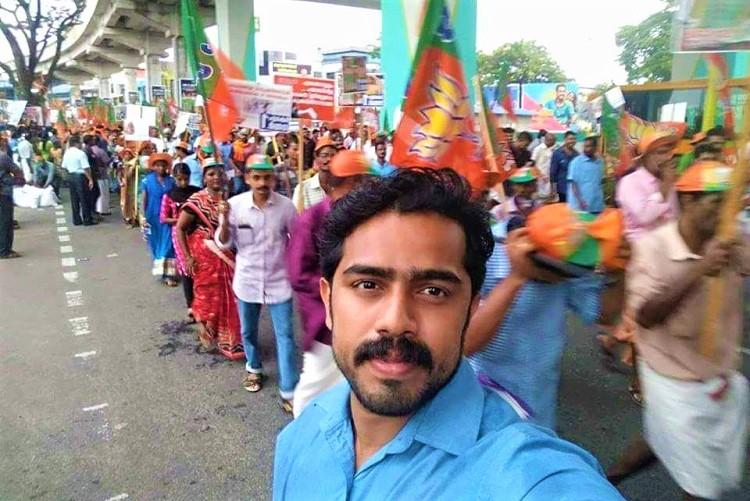
Kotak Mahindra sacks Kerala man for comment celebrating Kathua victim's death

Vishnu had written, "Good that she was killed at this age itself. Otherwise she would have grown up and come back as a suicide bomber against India."

As India is mourning the rape and murder of an eight-year-old from Kathua in Jammu, there are many who have been justifying the act or engaging in whataboutery. One such person who spewed venom on the young child's death is Vishnu Nandakumar from Kerala whose comment on a Facebook post has gone viral.

Vishnu had written, "Good that she was killed at this age itself. Otherwise she would have grown up and come back as a suicide bomber against India."

Soon after the comment by the assistant manager of the Palarivattom branch of Kotak Mahindra went viral, thousands of people wrote to the bank seeking his termination. People also began downgrading the bank's page on Facebook, giving them one star rating, thereby bringing their overall ratings down on the social media platform.

In fact, a post about debit cards put up by Kotak Mahindra on April 12, which at the time of writing this copy was the last post on their page, has more than 34,000 comments with the majority of them saying 'dismiss him'. Many had even posted pictures of Vishnu wearing the RSS uniform and told the bank that he was a blot on society.

Vishnu is the son of senior RSS leader EN Nandakumar, a close relative of BJP state general secretary, AN Radhakrishnan.

With the anger on the bank building up, people even said that they would close their accounts in the bank if Vishnu was not sacked.


On Friday, Kotak Mahindra said that Vishnu Nandakumar had been sacked. However, the reason for sacking was poor performance, the bank said. The bank also claimed that it had sacked him on April 11, a day before he had made the comment.

"We have terminated Vishnu Nandakumar from the services of the bank on Wednesday, April 11, 2018, for poor perfromance. It is extremely disheartening to see such comments being made in the aftermath of such tragedy by anyone including an ex-employee. We strongly condemn this statement," the bank said.


Almost immediately, congratulatory messages began poring in from hundreds of users on social media but many pointed out that it seemed the bank was reluctant to give away the real reason for the termination.

At the time of writing, Kotak Mahindra's FB page admin is busy posting their official statement as reply to every comment seeking the removal of Vishnu.

Some have called it a social media victory while others have asked the bank to open its review page so that they could give it five-star ratings.


(Source: TNM)

Saturday, 9 December 2017

Modi government's FRDI bill may take away all your hard-earned money

Here's how the Financial Resolution and Deposit Insurance Bill may help the banks take away all your hard-earned money. Without your consent!

Financial Resolution and Deposit Insurance Bill, 2017 is the new bomb that may be dropped on commoners by the Modi government.

What is this bill all about and how is it going to affect you?
In June 2017, the Central government approved the FRDI Bill which is intended to frame new rules for banks that are failing. It has created panic among savings account holders.

According to the Bill, if a bank is failing, may be allowed to use depositors' money to stay afloat. What this means is that the bank can reduce its liability of paying its depositors, that is you, by either locking your money for a longer time or asking you to take a hit on your deposits.

Currently, your deposit in the bank is insured up to a specified limit.According to the 1961 Deposit Insurance and Credit Guarantee Corporation Act, up to Rs 1 lakh of your money deposited in a bank is insured if a bank were to fail.

In practice, however, the Reserve Bank has ensured that this never happens. Failing, or weak banks, have been merged or allowed to be taken over by healthier banks including their liabilities.

But the proposed banking reforms bill will change that. That, some say, will give government banks, private banks and insurance agencies more power over your money.

FYI | What is a bail-in?
The Bill provides for "bail-in" powers to banks. A rescuing body known as Resolution Corporation has been proposed under the Bill which can use your money in case the bank sinks.This is different from a traditional bailout in which government's money helps bank tide over the crisis.

In case of a bail-in, it is the bank's own deposits (that is your money) that is used to rescue the bank or reduce its liabilities.


WHY IS IT IMPORTANT?
When you deposit money in a bank or invest in fixed deposits, you trust the bank with keeping your money safe, forever. Even a remote possibility of you having to lose it all or even part of it for no fault of yours is disturbing.

We take you through 10 steps which will help you understand the Bill:
TAKE A LOOK:


  • Under Section 52 of the FRDI Bill, the rescue body can cancel even the Rs 1 lakh insurance that you get under the current law. In this case, a bank can even declare that they don't owe you any money at all.
  • The same Section provides an option to the rescue body to modify a bank's liability. For example, if you deposit a certain amount of money for a certain period of time as savings (say, 5 or 10 years), the bank can keep the money in a locked-in period (in a FD) and change the time period without consulting you.
  • According to the bill, the bank may be exempted to fulfill its promises to depositors in extreme cases. This means you lose all your money.
  • This can happen in case of an economic downturn, when banks (who provide money to large corporations who are unable to repay the amount) ask for a bail-in option.
  • The bank may turn your savings into a fixed deposit without asking you and that too at a lower interest rate and you cannot even challenge it, unless, you challenge the law.

This is the first time that a Bill of this sort has been proposed in India. However, it has happened before in a few countries. A Deccan Chronicle report said a bail-in provision was used in Bank of Cyprus in 2013 which led to a loss of money of half of its depositors who were uninsured (the people who had deposited money over a certain limit).

It is going to challenge the rights of a commoner as ideally, the government should look for money held by big corporations in case of a bail-in but, that won't be the case once this Bill is passed.
It would not be an exaggeration to say that if this Bill is passed in the Parliament, the depositors' rights may go down the drain, that is if the bank is going down the drain.

Update: Finance Minister Arun Jaitley reiterates government's stance on the FRDI Bill saying it is still pending before the standing committee and that government's objective is to fully protect the interest of the financial institutions and depositors.

(Source: India Today)

Sunday, 12 November 2017

Mother Teresa's savings were so huge that it could have emptied the Vatican Bank

Saint Teresa of Calcutta had so much money that she could have emptied the entire Vatican Bank.

Who doesn't know Mother Teresa, an icon of selflessness and faith? Also known as Saint Teresa of Calcutta, she was loved and was an inspiration to many. But, many people don't know that Mother Teresa saved up an awful amount of money.

Mother Teresa had so much money in the Vatican Bank that if she had withdrawn the money, the entire Vatican Bank would have emptied. According to Italian journalist Gianluigi Nuzzi's book, 'The Original Sin', Mother Teresa was believed to have "by far the most cashed up account."

According to La Presse reports, if Mother Teresa had closed the accounts or transferred them, the institute would have risked default. In his book, Nuzzi talks about a block of power in the Vatican.


"There is a power block in the Vatican that obstructs Pope Francis' reforming action just as it did with Benedict XVI - it existed with Marcinkus and his parallel management of the IOR and it still exists today," he wrote in his book.

The book reveals the deepest secrets of the Vatican. Nuzzi also talks about the President of the Vatican Bank, Paul Marcinkus, an American archbishop.

"Her [Mother Teresa] account in the Vatican bank is proof that these gentlemen were and still are within the Curia and they trust them. They were also trusted by Mother Teresa, who, as is told, entered the Ior by a secondary door and was welcomed by Monsignor De Bonis, Marcinkus's right arm."

(Source: India Today)

Sunday, 22 October 2017

Aadhaar-bank a/c linking: RBI says never issued any order in this regard

Amidst banks and the government urging people to link their Aadhaar with bank accounts by December 31, an RTI query has revealed that the Reserve Bank of India (RBI) never issued any directions in this regard.

In reply to an RTI query filed by MoneyLife, the central bank said it "has not issued any instruction so far regarding mandatory liking of Aadhaar number with bank accounts." The RBI was responding to a specific query made for availing copy of the file along with file notings regarding mandatory linking of Aadhaar number with bank accounts.

An RTI query has revealed that the Reserve Bank of India never issued any directions regarding mandatory linking of Aadhaar and bank accounts
In a notification dated June 1, 2017, the government had said that bank accounts not linked to Aadhaar will be declared inoperable post December 31.

The RTI query also explicitly asked if the apex bank had taken permission from the Supreme Court for mandatory linking of bank accounts with Aadhaar. The RBI replied saying it has not filed any petition before the SC.

Aadhaar has been a huge point of debate in recent times and its validity has been questioned by many. The Supreme Court has restricted its usage for six schemes (banking services not being one of them). The apex court is also due to hear petitions questioning the validity of Aadhaar.

(Source: DC)

Friday, 11 August 2017

‘Learn Kannada in six months or lose your job,’ Kannada development body tells bank employees

The new rule will come into effect immediately, and many banks have already asked their employees to start learning Kannada.

After schools, it’s banks in Karnataka that have to mandatorily adopt Kannada.

The Kannada Development Authority, on Monday, issued a notice to the regional heads of nationalised, private and grameena banks, making it compulsory for bank employees to learn the language.

These banks employees are likely to lose their jobs if they do not learn Kannada in six months.

“We have given them six months to learn Kannada. We have directed the regional heads to relive those employees who do not know Kannada even after the six-month deadline,” KDA chairman SG Siddaramaiah told TNM.

According to the KDA Chairman, despite repeated notices sent to banks, they have not shown interest in implementing Kannada.

“None of these banks pay attention to this issue. Most of the people across the state know Kannada only. We have to think about them. The fact that these banks have not respected the local language cannot be ignored as it may lead to future conflicts. Banks have to take measure to ensure that their employees learn Kannada immediately,” Siddaramaiah said.

The banks have been directed to set up Kannada learning centres within the branch premises.

“Currently, they have forms and challans in Hindi and English. They have to ensure that the three-language formula is followed strictly even in advertisements and annual reports. People should be able to fill out forms in Kannada. This is very important in grameena banks as they cater to the rural population,” Siddaramaiah added.

“Banks have to follow the three-language policy according to the Reserve Bank of India. While hiring employees in Karnataka, banks must ensure that they know Kannada. If they do not, they have to learn the language within six months. If not, they will have to be relieved from duty. This rule must be followed strictly,” the KDA Chairman’s letter states.


SG Siddaramaiah also said regular visits will be conducted by KDA personnel to banks to supervise the progress.

“These banks lack the sense to take up initiatives. Regular supervision will be done to see if the banks are implementing the rule properly,” he added.

According to Ranjit* an employee at a bank based in Bengaluru, the employees were informed of the new policy on Tuesday morning.

“I don’t know Kannada. We have been informed that learning Kannada is compulsory. However, we still don’t know if they are going to arrange for classes or if we have to learn it ourselves. They should inform us soon enough. My wife is also a bank employee and she knows Kannada. I should be able to pick up the basics with her help,” Ranjit said.

(Source: TNM)

Tuesday, 7 March 2017

SBI will penalise you for keeping low balance in account; ATM charges revised

The country's largest bank will permit savings bank account holders to deposit cash three times a month free of charge and levy Rs 50 plus service tax on every transaction beyond that, reports India Today:

After a gap of five years, State Bank of India has decided to reintroduce penalty on non-maintenance of minimum balance in accounts from April 1, and revised charges on other services, including ATMs.

The country's largest bank will permit savings bank account holders to deposit cash three times a month free of charge and levy Rs 50 plus service tax on every transaction beyond that. In case of current account, the levy could go as high as Rs 20,000.

From March 1, private banks such as HDFC, ICICI and Axis had started levying a minimum charge of Rs 150 per transaction for cash deposits and withdrawals beyond four free transactions in a month.


HERE IS ALL YOU NEED TO KNOW ABOUT SBI's NEW RULES:
As per the list of revised charges of SBI, failure to maintain Monthly Average Balance (MAB) in accounts will attract penalty of up to Rs 100 plus service tax.

In metropolitan areas, there will be a charge of Rs 100 plus service tax, if the shortfall is below 75 per cent of the MAB of Rs 5,000. If the shortfall is 50 per cent or less of the MAB, then the bank will charge Rs 50 plus service tax. The charges and MAB varies according to the location of bank. It is minimum in case of rural branches.

A senior SBI official said the bank had suspended levying charges on breach of minimum balance requirements in 2012 to acquire new customers. The charges are now being reintroduced from April 1. The Reserve Bank has permitted banks to levy charges for breaching minimum balance limit.

Withdrawal of cash from ATMs will attract a charge of up to Rs 20 if the number of transactions exceeds three from other bank's ATMs in a month and Rs 10 for more than five withdrawals from SBI ATMs.

However, SBI will not levy any charge on withdrawals from its own ATMs if the balance exceeds Rs 25,000. In case of other banks' ATM there will be no charge if the balance exceeds Rs 1 lakh.

SBI will charge Rs 15 for SMS alerts per quarter from debit card holders who maintain average quarterly balance of up to Rs 25,000 during the three months period. There will be no charge for UPI/ USSD transactions of up to Rs 1000.