Each winter, balikbayan boxes—care packages from Filipinos living overseas—make the long journey home that their senders wish they could, writes Jason Reblando in the City Lab. Read on:
If you are Filipino, or have been to a Filipino household, you are probably familiar with one of the most recognizable symbols of the Filipino diaspora: the balikbayan box.
I grew up with these giant cardboard boxes. About the size of a microfridge, a box would take up an inordinate amount of space in my parents’ living room or garage for months at a time. My parents would slowly fill it with perfumes, children’s clothing, Spam, tins of butter cookies, and other non-perishable items. The unsightly box would eventually be bound for relatives in the Philippines, but for the most part it sat open for months, waiting to be packed and shipped.
 |
| An employee of T-Bar International in Quezon City handles a box sent from a Filipino family in Illinois. Jason Reblando |
The balikbayan shipping industry is predicated upon the roughly 10 percent of the population of the Philippines who live and work abroad as permanent migrants or as Overseas Filipino Workers (OFWs), contract workers who leave their families for years—sometimes decades—at a time to support their families back home. The boxes might simply be thought of as care packages, but to consider the nuances of this culturally specific shipping service is to reveal emotional and financial back stories we often take for granted. Also, they differ from care packages in an important way: whereas traditional care packages send loved ones reminders of home, balikbayan boxes are poignant reminders that the senders are perpetually away from home.
 |
| An employee of T-Bar International takes inventory of balikbayan boxes at a warehouse in Quezon City. (Jason Reblando) |
Although the boxes come in various sizes, common dimensions are 28 by 18 by 16 inches, the maximum outside dimensions of checked airline luggage, should the box be brought home by plane. For a box weighing up to about 100 pounds, it costs approximately $60 to ship to metropolitan Manila and $90 to ship to islands that require a ferry. The low cost of shipping is not only an incentive for families to use these services, but also to stuff boxes with so many items that the they bulge at the seams. (There is often so much duct tape used to secure the box, the package appears to be more tape than box.)
 |
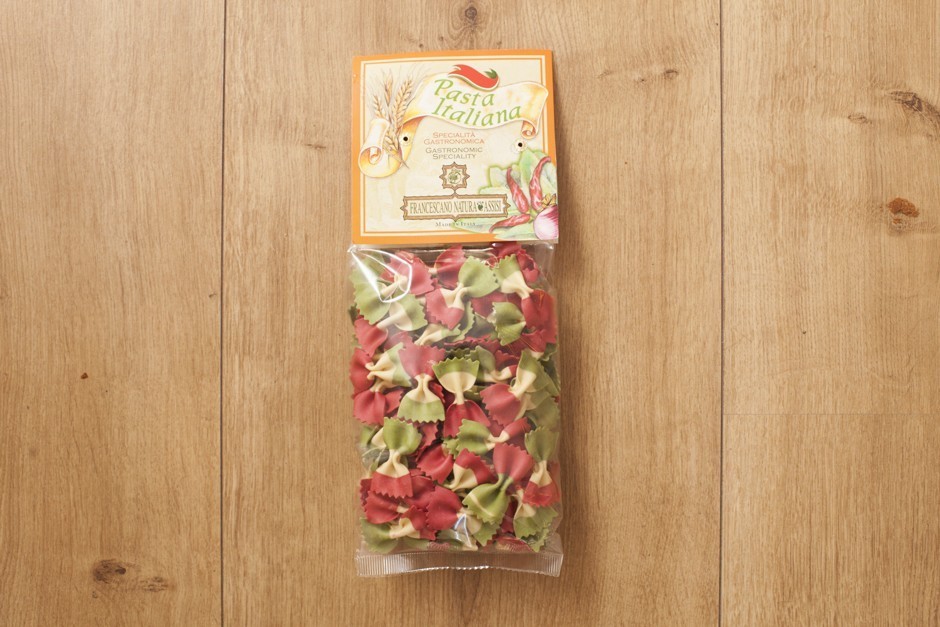
| Gifts such as pasta and sauce are common in balikbayan boxes originating in Italy, where more than a quarter-million Filipinos live and work, according to the Commission on Filipinos Overseas. (Jason Reblando) |
Shipping costs are low because there is very little, if any, automation involved. In the case of T-Bar International, a regional balikbayan-box shipping company in central Illinois, a sole driver collects boxes from Filipino families throughout the Midwest. Without the use of conveyor belts or heavy-duty forklifts, the boxes are processed and stored in a standard freight container at a modest warehouse in Joliet, Illinois, until the container is filled to capacity with other balikbayan boxes.
If you’re lucky, your box is the last package to fit in the container before it’s closed up and sent on its way. Otherwise, the box must wait for the container to be filled. However, families who employ balikbayan services prioritize volume and value over immediacy, so the boxes are mostly filled with sentimental non-urgent items.
 |
| Balikbayan boxes often contain non-perishable household items due to the long shipping routes they traverse. Pictured are boxes of Ariel dishwasher detergent ready to be shipped from Dubai to family back in the Philippines. Dubai is home to the largest population of Filipinos in the United Arab Emirates. (Jason Reblando) |
The container is then transported by train to California, by ship to Taiwan and Manila, and by truck to a warehouse in Quezon City. The boxes are sorted by hand, according to region of the Philippines, then transported by delivery truck to families in metro Manila and outwards to the rural provinces. The journey of the box can take as long as two months. So it isn’t unusual for people to complete their Christmas shopping for relatives in the Philippines by late September.
Similar to wiring money back home in the form of remittances, sending a balikbayan box is a way to stay connected with family. Some objects sent are souvenirs particular to the country of origin; other items have no particular cultural value except for the sender’s thoughtfulness. A Filipino in Milan may send pasta and jars of spaghetti sauce, but a Filipino in Dubai might pack the box with dishwasher detergent or tubes of toothpaste.
 |
| A can of Ensure received in a balikbayan box serves as a reminder that an absent daughter is still thinking about her elderly parents. (Jason Reblando) |
Many of these banal household items can be purchased in the Philippines. However, when a bag of Doritos arrives in a balikbayan box from abroad, it’s a way for a mother to indulge her son from thousands of miles away. When a grown daughter sends back a canister of Ensure protein drink, it’s a reminder that she is thinking about her elderly mother’s osteoporosis, and although she can’t take care of her in person, the goods are a surrogate for her presence.
When a bag of Doritos arrives in a balikbayan box from abroad, it’s a way for a mother to indulge her son from thousands of miles away.
 |
| Several boxes of shoes ready to be shipped in a balikbayan box from Dubai, labeled according to family member back in the Philippines (Jason Reblando) |
I knew that my parents were sending balikbayan boxes home to family we had back in the Philippines, but I never fully realized what the boxes represented. Then, during my first trip to the Philippines in 2005, a cousin whom I’d never met before called me a balikbayan.
 |
| Employees of T-Bar International load balikbayan boxes onto a truck in Quezon City, destined for other parts of the Philippines. T-Bar International, based in Joliet, Illinois, is just one of many balikbayan shipping companies. Filipinos from all around the world use the boxes to send goods back to their families. (Jason Reblando) |
I asked, “What do you mean? Like the box?” He patiently explained to me—a non-Tagalog-speaking Filipino-American—that balik means return and bayan means home. I was the relative who was returning home.
The word, then, has deep emotional resonance. It helps me to remember that Filipinos around the world are connected by the desire to return home, even if it takes a long time to get back.