Monday, 5 December 2011

Purple Island in Qatar


We were thinking of going to Purple Island aka Al Khor Island or popularly known as Jazirat Al-Ghanim for a while. But last Thursday when Umer took us on a long drive to Al Khor, we also went to see the island. And unfortunately, it was too dark and decided to get back there on some other day. The very next day we thought of going there, but it started raining and still we made an unsuccessful attempt of going there. But luckily, this Friday, weather was on our side and we headed towards the island again.
Towards Al Khor

Accident at Al Khor

Towards Purple Island

Towards Purple Island
We started around 12 noon and thought of having lunch in Al Khor. So I just packed some snacks and warm water and left home. After 30 minutes’ drive from Bin Omran, we reached Al Khor. Just before taking a right turn to the Purple Island saw an accident and cops enquiring both the parties.


Right turn after 5 km


Entrance of the Island
We reached Al Khor around 12.30 noon. From there we followed the signs to Al Thakhira. Then, we passed the second last roundabout that branched left to Ras Laffan, and went through the road to Al Thakhira. Then, we passed the first right turn where a signboard said Al Khor Hospital. We continue towards Al Thakhira and at the last roundabout, there was a road towards Al Khor Community. We just continued towards Al Thakhira and then took a right turn and went about 5 km following the asphalted road. Later, there was an intersection to the left and just after that we went further for another 70-80m and took a right turn which was leading to the island. We followed the firm and obvious track to the mangrove area. As we approached the island causeway, we could see a big building on to our left side. It was nearly two km from the asphalted road. After a bumpy ride for 10 minutes, we reached the Island. And no 4WD vehicle is required to reach the island as the road is firm sand, probably because heavy vehicles commute to and from the nearby sand processing plant. 
Purple Island


Breach in the causeway

Mangroves in the island


Purple Island


Breach in the Purple Island
We had to park the car at the edge of the causeway, as the vehicle cannot enter the island. Surprisingly, there were several tyre marks on the causeway till the first breach. Maybe people thought of entering the island on their vehicles and had to stop near the breach. 


Stepping stones

Tyre marks...

We saw two families enjoying their lunch at the entrance of the island. So totally, it was about 53 km from Bin Omran. The Island is in the shape of a fish and is linked to the mainland by a causeway. The walkway has been breached at two places, allowing the tidal access to the green salt-encrusted mangrove forest which encircles the walkway and the island. 


Tyre marks...


Though the island is very small, measuring only 600mx400 m, it has uncommon and interesting vegetation. The mangrove forest is not only home to fish, crabs and shellfish, but also to a wide range of birds. As we were walking, we could hear the chirping sound of several birds. Since it is winter, we could see some migratory birds. We came across some Kingfishers and some other purple and pink coloured winged beauties. Their strange, haunting calls echoed over the island creating a kind of aura in the otherwise silent island.   


Aerial roots


It was fun to slowly jump on stepping stones which were green and slippery. It was also amusing to see aerial roots of mangroves in the salt marsh. Not just that, we found so many shells scattered in the middle of island where low and high tide seawater could never reach! We saw some tiny fish playing in the sunlight and unfortunately, we didn’t come across any playful crabs, even though we expected some. 


The island is not a flat one and has several low limestone cliffs throughout. Qatar Archeology Project in 2000 confirms an intermittent human settlement on the island during the last 4,000 years. It bears the remains from a scatter of flints left by Neolithic hunter-gatherers down to the late Islamic pottery of fishing and pearling camps, and the concrete shack and abandoned vegetable garden left by a colony of Indian fishermen who inhabited the island until the late 1990s, when a series of exceptionally hot summers decimated the marine life of the area.
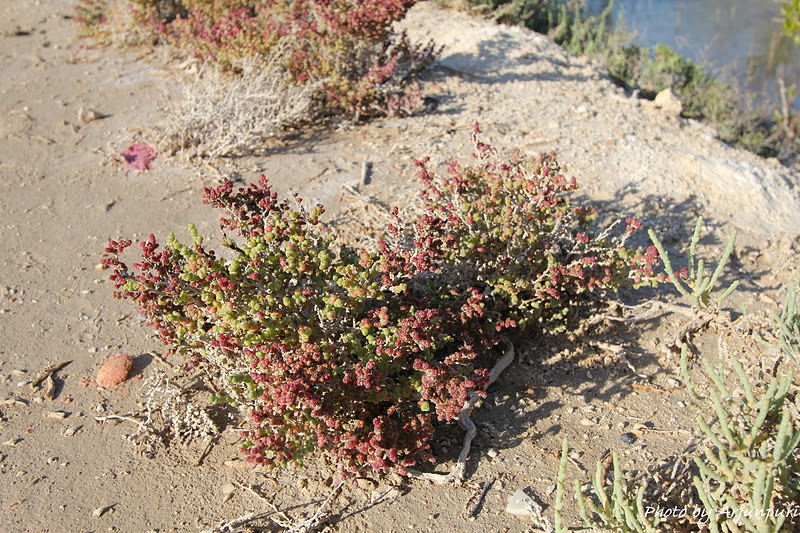
The Purple colour
Francis Gillespie, local author and coordinator of the Qatar Archeology Project, says that the archaeologists also found that 3,400 years ago, an industry was established on the island to supply one of the most valuable of ancient commodities - one more precious than gold. The rich, purple-red dye produced from a species of sea snail, used only for the robes of kings and the elite few whom they chose to honour. Red, the colour of blood, of fire, of the sun and therefore of life itself, was seen in many ancient societies as a symbol of power and strength. 
Producing the dyes
The dyes produced from sea snails ranged from a deep bluish-purple to the most brilliant scarlet, depending on the species used and the method of preparation. The earliest manufacturers of shellfish dyes were almost certainly the Phoenicians, a Mediterranean people originating in Lebanon. They are sometimes referred to as Canaanites, but the Greeks called them phoinikes - the red people - because of the red cloth they exported.
From the 9th to the 6th centuries BC they dominated trade in the Mediterranean, establishing colonies in Cyprus, Greece, Italy, Spain and N Africa. One of the great Phoenician cities in Lebanon, Tyre, was the home of the dye industry, which began around 1600 BC. But dye was produced all over the Phoenician empire. At Tarentum in Italy there is a small hill composed entirely of the remains of murex shells. 
The most commonly used sea snails were Murex trunculus, which yields a bluish-purple colour, and Murex brandaris which gives a red-purple. The dye is released when the hyperbranchial gland in the animal is crushed and reacts with a naturally present enzyme. 

In the case of Murex trunculus the presence of light is also necessary for the colour to develop, but not in the case of Murex brandaris. Many other species of sea snails yield the dye, among them Murex tribulus, still widely eaten in Spain today, as well as Thais purpura haemastoma and, on the little island off the coast of Qatar, Thais savignyi.

Pliny’s account
The Roman writer Pliny, writing in 70 AD, has left us a detailed description of the dye-extraction process.
The shellfish were harvested in the winter months. Murex are carnivores, living at depths of 5 to 15 metres and feeding on other shellfish by boring holes in their shells. According to Pliny, the shell-fishers used to lower baskets of shellfish bait, wait for murex to gather on them, and then quickly draw them up. The murex were then kept alive in tanks until a sufficient quantity had been gathered and dye production could begin. Ancient writers state that the dyers' hands were permanently stained red, and that the stench from centres of the trade, such as Tyre, was formidable! 
He says that the smaller shellfish (Murex trunculus) were crushed, shell and all, whereas the larger ones (Murex brandaris) were pierced and the hyperbranchial gland extracted. The crushed mass was macerated in heavily salted water for three days. This may have been to suppress the bacterial content of the vats, as the bacteria produced by rotten fish (Clostridium carnis ) are highly dangerous. The rotting shellfish were then rinsed thoroughly and boiled for ten days until reduced to a sixteenth of the original amount. Testing by dipping wool then began and boiling continued until the dye had reached the desired degree of brilliance.

The Kassite period
In Babylonia, a region in what is now Iraq, a mountain people called the Kassites invaded and took control of the country soon after 1595 BC, and the next three centuries saw a period of great economic prosperity in the region. Production of purple dye on Jazirat bin Ghanim (Al Khor island) in Qatar occurred as part of the take-over of the Dilmun trading civilisation by the Kassites between 1425 and 1225 BC.

Excavations
In the early 1980s an American archaeologist, Christopher Edens, working with the “Mission Francaise Archeologique à Qatar”, excavated a site on the island. The remains of pottery enabled it to be dated to around 1400 BC. It consisted of about five rectangular structures, several hearths and stone kists.
One pit contained the remains of around 38,000 shellfish, a species called Thais savignyi. There was also a shell midden measuring 10 by 15 metres. The top layer consisted of food remains -- shells and fish bones and debris from hearths -- but as the archaeologists dug down they came upon a deep, solid layer of shells of Thais savignyi.
The archaeologists calculated, to their astonishment, that the mound they had excavated contained the remains of almost 3 million shellfish! There were other mounds that appeared to contain similar quantities. Thais savignyi, which lives under rocks in the intertidal zone, produces a bright red dye. It requires light plus an enzyme to release the dye from the hyperbranchial gland. 

The archaeologists conducted experiments collecting the shellfish. They concluded that collecting 3 million snails would have taken 42,000 man-hours of labour: 20 people working one month a year for 7 years. There was only one possible conclusion: the site had been used for dye production.

It was unique - the first site of its kind in the entire Arabian Gulf and the only one found outside the Mediterranean. The pottery found on the site, which included the remains of huge, thick-walled vats, was clearly Kassite. Evidently the dye was being produced for use in Babylonia. Whether the workers in the little dye factory were local tribesmen, or slaves of the Kassites, or even Kassites themselves is not known. No contemporary graves have been found. 

Another site on the island is several hundred years earlier, dating to the first centuries of the second millennium BC. The presence of fragments of a distinctive red, ridged pottery known as Barbar ware identified it as belonging to the Dilmun period: the peaceful Bronze Age trading civilisation which was based in Bahrain but extended from Failaka Island off Kuwait as far south as the UAE.
Temporary settlement
Permanent settlement on the island never took place, owing to the absence of a convenient source of fresh water. The Barbar site was excavated by the French mission in the early 1980s and further investigated by a joint British-Qatari team of archaeologists in 2000. There were the remains of a number of rectangular stone-lined fire pits, and hearths. It appears to have been a temporary settlement, and is typical of a chain of small coastal sites, all featuring Barbar pottery, which run between Bahrain and the Emirates. 

Such sites, many of which are on small islands, may represent minor staging posts between Bahrain and the great trading centre at Tel Abraq in the UAE. They may have been regular stopping places, or perhaps they were visited only occasionally for mangrove wood or as shelter in poor weather. The one on the island in Qatar might even have been a fishing or pearl fishing camp. 
On the other side of the island the team in 2000 excavated a large circular dwelling hut with a sunken floor and what appeared to be stone windbreaks extending from it, perhaps erected to shelter the cooking area. Pottery from within the hut dates it to the Kassite period, but there is ample evidence of occupation in that area of the island during the Sasanian period in the early centuries AD, the final pre-Islamic period. Long after the hut had fallen into disuse, but before the coming of Islam, it was used to contain a human burial, of which a few skeletal fragments were found.

After an hour or so, we left the island. It was refreshing indeed. Maybe whenever we feel like seeing some water and listening to birds singing, we will head towards Purple Island. Oh, yes, to see some exotic flowers too! 
Private beaches in Al Khor

Old mosque in Al Khor

Boats in Al Khor


From there, we just made a trip to the beach and saw several private tents and Qataris with their families enjoying their weekend.

Sunday, 4 December 2011

Halala, another name for rape


I came across a shocking article on how Muslim women are exploited by men in India. For the first time I came across the word Halala and I had to google and see what it means. But what shocked me the most is, how can a man make his divorced wife to sleep with somebody else, so that he can remarry her. It is not just Halala, but known as Nikah Halala in Islam.

Here is what I found on Wikipedia: Shia and much Sunni jurisprudence of Sharia disallows a couple remarrying after having been through three divorces. 

Some Sunni schools view a triple talaq, when the husband saying "I divorce you" three times in a row, as equivalent to three single talaq. Other Sunnis and Shia treat that as a single divorce, arguing that the Islamic prophet Muhammad did so and Umar having no authority to change that (Muslim 3491, 3492).
Couples cannot remarry until the ex-wives marry another man, to ensure that divorce is not taken lightly. She cannot go back to this husband who has divorced her three times, unless she marries another person who out of his own free will divorces her. This rule is given by the Shari'ah to reduce the occurrence of three divorces and to protect the honor of the woman. Nikah halala cannot be done as a condition or intention to make her lawful to her ex-husband.

Shia use Nikah Mut'ah. After iddah is observed, the original couple may remarry. Nikah Halala is used mainly in countries that recognize the triple talaq.

The Qur’an expounds: “So if a husband divorces his wife (for a third time), he cannot, after that remarry her until after she has married another husband and he has divorced her. In that case, there is no blame on either of them if they re-unite, provided they can keep the limits ordained by Allah. Such are the limits ordained by Allah which He makes plain to those who know”. (2:230).

A man is entitled to take his wife back twice after two respective Talaqs and for a third time also before the expiry of her Iddat after he gives her a Talaq for the third time. But after that the separation is irrevocable. She is then free to be married to any other person of her choice. If then in the normal course of life a dispute between them develops leading to first Talaq by the second husband, she is again free to be married to any person of her choice including the second husband (by whom she has got the first divorce) and also including the first husband as well. The relevant point here is that a Halala cannot be planned in advance, as a Nikah between her and the second husband with an understanding of a divorce afterwards will not be valid. If she does so, it will be an illegitimate relationship with the second husband and with the first husband also with whom she comes to live after a pre-planned Halala. Muhammad has cursed both such men who perform Halala and for whom Halala is performed. The second Caliph Hazrat Umar ruled during his reign that he will punish with stoning to death those who perform a pre-planned Halala. Imam Sufian Sauri says: “If someone marries a woman to make her Halala (for her ex-husband) and then wants to keep her as wife, he is not permitted to do so unless he solemnises a Nikah afresh, as the previous Nikah was unlawful.” (Trimizi)

Watch the video where a victim has gone a step ahead and filed a complaint against her husband.

Even though a report on women countering triple talaq and halala, way back in March 2011 in Lucknow, had caught my attention, it was not for Halala, but for triple talaq. Here’s the news report published on The Times of India. But now again, The Times of India came up with a special article on the victims in its Crest Edition, and I couldn’t just keep quiet from posting about the issue. 

Another name for rape
Holding a placard that says 'Halala is nothing but the vilest of rapes', the frail and waif-like Rubaiya Ahmad shudders as she recalls the darkest night in 35 years of her life - when she allowed another man into her bed.

"I felt totally numb and dead inside. But that was the only option left to reclaim my two sons," she says. "Moreover, the maulvi sahib had warned me that no one would participate in my funeral procession and my family would be ostracised if I flouted the Shariat's command."

Jalal, Rubiya's "husband" for one night, was not particularly bothered about her turmoil. He was there for a purpose - to help his close friend salvage his marriage. A night after the nikah and the mandatory consummation, he divorced Rubaiya without a fuss.

It has been seven years since Rubaiya got back with her first husband, but the horror of halala has stayed on. "I feel as if the man I married died the day someone else defiled my body," she declares with vehemence. Her only concern now is to ensure somehow that her sons never get to know about the humiliation their mother faced, for "it would shatter them, or worse, they may blame me for the episode".

Last week's meeting held by the Bharatiya Muslim Mahila Andolan (BMMA) proved to be a catharsis of sorts for two dozen-odd victims of mental violence - namely halala and triple talaq. "Many who went through this could not gather enough courage to come out and face the world," says BMMA president Naish Hasan.

Last week, Naish created ripples in conservative Lucknow by dashing off a letter to the octogenarian president of the All India Muslim Personal Law Board. Pressing for inclusion of women's issues on the agenda in its next executive meeting, it pointedly demanded a ban on halala and triple talaq, apart from recommending a codification of the Shariat to escape misinterpretation. "The response from AIMPLB, was as anticipated - nil," says Naish.

In her letter, Naish mentioned seven victims who were subjected to halala an excruciating two to eight times. One of them is Zainab Rubaiya whose husband literally turned her into a prostitute "He would pronounce 'Talaq talaq talaq' when drunk, when annoyed, when fired from his job, when clubbed by the beat constable or when I stopped his mother from hitting me with a ladle," she says. "Any occasion was good enough to boot me out."

Zainab recollects that after every halala, her husband would weep, standing alongside their children. "I bore halala seven times. It's a terrible feeling to walk down the road, knowing that everyone in the mohalla keeps a count of your moles and curves," she says, teary-eyed. For women like Munni, whose brother-inlaw volunteered for halala, the situation is even more humiliating. "Imagine facing him every day and pretending to be normal," she says.

Contrary to the popular belief that halala is confined to the rural belt, Naish claims that she has listed 11 such cases in the last two months in Lucknow alone. "However, women in the city are turning rebellious," she says. "Some of them have walked out of the marriage after halala was ordered - in fact, one woman begs in the Imambara as she believes that begging is more respectable than getting raped every sixth months."

The number of halalas is on the rise, confirms Kamal Khan, a Lucknow-based journalist. Interestingly, halala is also fraught with risks for the men now - there are instances where the second husband has violated the terms of a fixed halala and refused to part with the woman, often because she was prettier than his own wife. "So caution is the key word now," claims Kamal, who is making a documentary on the practice and has even recorded details of a halala service run by maulvis in Ghazipur and Faizabad. "The cleric in Akbarpur has inherited a lucrative business from his father. He conducts the marriage and divorce ceremonies. The business is growing," he says.

According to Khan, halala-fixing is nowhere mentioned in Islam. The provision is made for "ittifaqan talaq" by the second husband - meaning the woman can remarry the first husband if the second husband genuinely divorces her and the move is not carried out under a well-calculated strategy. The way it is followed today, the practice is totally against the spirit of Islam," he says. 

Zainab has a suggestion that she is too timid to air publicly. "If a man divorces his wife and then wants her back, let him be flogged, skinned or even sodomised," she says. Why should the poor woman be made to suffer instead? What kind of justice is this? Even animals don't mate on order. "

What is Halala?
"After pronouncing talaq, the wife becomes haram for the husband. If he wants to remarry the same woman, the rules are set - once the mandatory iddat period of three months and 13 days gets over, the woman has to get married to someone else. This marriage has to be consummated. After the second husband divorces the woman, the first husband is free to marry her once again after three months and 13 days. However, halala-fixing is strictly prohibited in Islam." -Maulana Khalid Rashid Firangimahali

Children of the Hyphens, the Next Generation

After writing an article on how women should be allowed to retain their original surname after the wedding, a friend suggested me to read an article published on The New York Times. I found it interesting. Maybe it’s a new concept in India, but in the West, it’s quite often that children get both the surnames, surname of the father and the mother. Here’s the article, written by Rebecca Tuhus-Dubrow.

WHEN my parents married in 1977, women’s liberation was in full swing and my mother was a consciousness-raiser. She was about as likely to take my father’s name as she was to sport a veil at the wedding. She would remain Ms. Tuhus. Nine months later, the surname for their new baby (me) was self-evident. My parents yoked their names into a new one: Tuhus-Dubrow.

“I knew that was the best I could do,” my father told me. “As opposed to just Tuhus.”

Other parents, albeit a small minority, had the same idea. By the mid-1970s more women were keeping their maiden names, so hyphenating the names of the children seemed like the next logical raspberry to blow at the patriarchy, a stand against the family’s historical swallowing up of women’s identity.

Hyphenation has other pluses. The invented names are distinctive; I’ve never come across a Tuhus-Dubrow outside my immediate family. The inconveniences — blank stares, egregious misspellings — are outweighed by the blessing of never having to worry about a Google doppelgänger.

The problem, of course, is that this naming practice is unsustainable. (Growing up, I constantly fielded the question, “What will you do if you marry someone else with two last names? Will your kids have four names?”) Like many of the baby boomers’ utopian impulses, it eventually had to run up against practical constraints.

I don’t have children yet, but plenty of others in my cohort — the first in which nontrivial numbers were born hyphenated — do. And reproducing while hyphenated brings inevitable quandaries. I was curious to see how my peers have handled them. So I asked around. What I found was a whole gamut of solutions. The name-blending pioneers now have grandchildren whose names embody an intriguing mix of the traditional and the maverick.

I encountered several women who kept their own hyphenated names when they married, but gave their children the father’s surname. This scenario seems to deviate the least from the mainstream: after all, many other women with single surnames do the same.

Zoe Segal-Reichlin, 33, a lawyer for Planned Parenthood in New York, was typical in her approach to naming her son, now 10 months old. She said she flirted with alternatives: hyphenating three names, picking either Segal or Reichlin to link with her husband’s name. But ultimately, none felt quite right, and going with the father’s name won out as the most practical choice.

“It was the best of bad options,” she told me.

Same-sex couples face their own quandaries, since there is no tradition to follow. Cora Jeyadame (née Stubbs-Dame), 37, a first-grade teacher in Newton, Mass., was determined to share a name with her child, and to think ahead more than her own parents had.

“It’s a one-generation solution,” she said of hyphenation. She and her wife, whose surname was Jeyapalan, spliced their names together into an entirely new, hyphenless amalgam.

How did they decide on the name? “I actually put it out on Facebook,” she said: “ ‘I challenge you to come up with good combinations.’ ” The winning entry, Jeyadame, is the legal surname of Cora and her 4-month-old; her wife uses it socially.

Naming decisions raise novel questions for hyphenated men. There is little precedent of husbands changing their names at marriage or giving up the prerogative to pass their names on. Traditional practices grew out of a male-dominated culture and a need for simple rules. But there is another, less obvious motive: to hold men accountable for their offspring.

“How do you attach men to children?” said Laurie K. Scheuble, a senior lecturer at Pennsylvania State University who has done several studies on naming practices. Names are “a very functional and practical way” to do so.

But perhaps, in an age when men wear BabyBjorns, it is no longer always necessary. When Daniel Pollack-Pelzner, 32, an English professor who lives in Portland, Ore., married Laura Rosenbaum, he toyed with the idea of a creative synthesis.

But “Rosenpollackpelznerbaum sounded like a weapon of mass destruction,” he said. When they had a son, giving him Daniel’s last name seemed too complicated, so they gave the baby Laura’s.

Mr. Pollack-Pelzner initially worried that having a different name would arouse suspicions, leading to airport frisks and other indignities. But since his son was born, “I’ve hardly thought about it at all.” No one has ever challenged whether he is the toddler’s father: “The poor guy is cursed to look just like me.”

Nathan Lamarre-Vincent and his wife, Sarah Miller, went the opposite direction, giving their children Nathan’s hyphenated name. Mr. Lamarre-Vincent, a 34-year-old Harvard postdoctoral fellow in molecular biology, said it was a default decision: “We were both kind of go-with-the-flow,” he said, and simply hewed to tradition.

The irony is that the name is the product of his own parents’ defiance of that tradition. It is a little like following every step of an old-school Thanksgiving recipe, but starting out with a Tofurky.

In a 2002 paper, Ms. Scheuble and her husband, David R. Johnson, a Penn State professor, predicted that the importance of a family name could begin to decline. Thanks to more divorce, remarriage, same-sex unions and retention of maiden names, it is far from unusual for members of the same nuclear family to bear different surnames.

Nevertheless, the vast majority of families stick with custom. According to a 2009 study analyzing data from 2004, only 6 percent of native-born American married women had unconventional surnames (meaning they kept their birth names, hyphenated with their husbands’ names, or pulled a Hillary Rodham Clinton).

I know lots of women, including myself, who kept their birth names at marriage. But according to my anecdotal observations, which others seconded, rates of hyphenation seem to have fallen since my brother and I were born.

As Ms. Segal-Reichlin said, “At the time I think they thought they were going to be the wave of the future,” but it has not panned out that way. Still, hyphenated names are not entirely a relic of the ’70s, like sideburns and lava lamps: witness the Jolie-Pitts.

Based on my conversations, the verdict on hyphenation was mixed.

“When I was young I hated it,” said Sarah Schindler-Williams, a 32-year-old lawyer in Philadelphia. “It was long, it never fit in anything. I was always Sarah Schindler-Willi.”

But most, including Ms. Schindler-Williams, eventually grew to appreciate their cumbersome monikers. Names frequently convey information about their bearers: Weinberg or O’Malley gives you a hint about the person attached to it. But conjoined names, several people mentioned, also say something extra about your parents’ egalitarian values. (Unless you are British; then it means you’re posh.)

The irony is that the name is the product of his own parents’ defiance of that tradition. It is a little like following every step of an old-school Thanksgiving recipe, but starting out with a Tofurky.

In a 2002 paper, Ms. Scheuble and her husband, David R. Johnson, a Penn State professor, predicted that the importance of a family name could begin to decline. Thanks to more divorce, remarriage, same-sex unions and retention of maiden names, it is far from unusual for members of the same nuclear family to bear different surnames.

Nevertheless, the vast majority of families stick with custom. According to a 2009 study analyzing data from 2004, only 6 percent of native-born American married women had unconventional surnames (meaning they kept their birth names, hyphenated with their husbands’ names, or pulled a Hillary Rodham Clinton).

I know lots of women, including myself, who kept their birth names at marriage. But according to my anecdotal observations, which others seconded, rates of hyphenation seem to have fallen since my brother and I were born.

As Ms. Segal-Reichlin said, “At the time I think they thought they were going to be the wave of the future,” but it has not panned out that way. Still, hyphenated names are not entirely a relic of the ’70s, like sideburns and lava lamps: witness the Jolie-Pitts.

Based on my conversations, the verdict on hyphenation was mixed.

“When I was young I hated it,” said Sarah Schindler-Williams, a 32-year-old lawyer in Philadelphia. “It was long, it never fit in anything. I was always Sarah Schindler-Willi.”

But most, including Ms. Schindler-Williams, eventually grew to appreciate their cumbersome monikers. Names frequently convey information about their bearers: Weinberg or O’Malley gives you a hint about the person attached to it. But conjoined names, several people mentioned, also say something extra about your parents’ egalitarian values. (Unless you are British; then it means you’re posh.)


Thursday, 1 December 2011

No entry for men


As we fight for gender equalisation in India, here, in Qatar, women enjoy more freedom. What could be a better example than when some public spaces make it only for women?! Maybe it’s a kind of gender polarisation, but still I love the amount of freedom and space women enjoy here. Yes, the sort of space dedicated to women here, is amazing. Not to forget the point that women can see the whole world through her niqab and men cannot see who is the woman behind it ;) I think the abaya makes the access of males to female spaces harder than the access of females to male spaces here. 

What could be more and big space than finding numerous ladies’ rooms, which we can’t find them back home. Even during my school days, we preferred going home for lunch, not because the house was close by, but because we didn’t have sufficient number of ladies’ rooms. And the few which were there were never clean and the very fear of contracting some infection made many of us to either drink less water or go home or to friends’ home for lunch and come back. The scene was no different during my college days. The only relief being it was a women’s college. But there too, the number of toilets was only 4-5 and sometimes, there never used to be water. So, all we could do during lunchtime was run to a friend’s place whose house was near to the college. 

Plus, while travelling, many women, including me, avoid drinking sufficient amount of water, as it is very difficult to empty the bladder :( I have seen some lady conductors’ plight during long journeys in India. 

I realised the importance and strong space for women during the Doha Park festival. As I mentioned in one of my earlier posts, we bought some lovely perfumes from a Kuwait perfume stall and after reaching home, we realised that one of the bottle caps was loose and 3/4th of the perfume had been completely leaked. So we thought of exchanging the bottle and we went there on Saturday and as I was too tired, I stayed in the car parked in front of the Exhibition Centre. Vij went and he was denied entry to the Park, as Saturday was Women Only day! We had to go on the next day to exchange it for a new bottle of perfume.

Another lovely concept I loved about here is women are economically independent even if they work or not. During the wedding they get Mehr. As men get dowry in India, women get Mehr here, and trust me it is not just one or two lakhs, but millions and millions or rupees, house, cars, gold and other valuables. And on the other day, one of my friends Sakeena was telling me how Islam gives them the economic freedom to women. No man will ask his wife’s salary. All that she earns is her property and it is her wish to share it with him or not. But a man cannot claim his share in her earnings! Isn’t that a lovely concept? Not just that, she has all the rights to use the money for whatever she wants to buy or invest. So at the end of the day, she enjoys all privileges. If the man leaves her in between, or if he dies, still she is safe, safe economically and socially.

Now, imagine the plight of us, Indian women, on the other hand. Even Muslim friends back home are not that liberal when it comes to dowry and wife’s earnings. I have seen some of my friends who obediently handover all the earnings to their husband and borrow few bucks for monthly expenses. Not long before, a friend of mine rejected to marry a girl just because she didn’t want to work after the wedding. His six months of courtship came to a grounding halt when she openly confessed that she wants to be a housewife and doesn’t like to work. He didn’t bother about her feelings or emotions, as both had shared lot of dreams together for six months. Money mattered the most, and the rest went into oblivion. He easily went ahead and married a girl who is working and willing to work after the wedding! 

Even in one of my close friend's case, when things were getting worse and worse and she had a miscarriage due to work pressure, she thought of quitting the job. But her father-in-law created a hullabaloo telling her that if she quits the job, it would burden her hubby. Not just that, to her utter shock, he also revealed the fact that he agreed for their wedding only because she was working! 

I have even come across my hubby’s friends and relatives telling me that my hubby is lucky because he gets double salary, which means his salary plus my salary…  So everybody, including his parents and relatives, expect me to handover my entire salary to my hubby. He can keep an account of what I do, how much I spend, where I spend, blah blah blah , but I cannot ask what he does with the salary, strange, but true. This is how most of us -- Indian women -- face the issue when it comes to economic freedom after the wedding. 

I also remember how one my senior colleagues at the college used to tell us how bad it feels for her to handover all her salary to her husband. “I earn so much much, but I can’t buy nice sarees or jewellery. Sometimes, I feel why am I earning so much when all I have to do is give everything to my husband?” I used to feel bad for her. But her story was better until I came across another colleague’s story which used to make me feel very very sad. She had purchased an apartment by paying a whopping sum. She had put all her savings and earnings into it. And due to marital discord, when she wanted to separate from her husband, he agreed to sign the divorce papers only after she agreed to register the apartment in his name and sign the agreement paper that she would pay the rest of the EMIs for the loan she had taken to buy that house! 

Ok, back to the point of freedom enjoyed by women in the Middle East. As in India, even in Qatar, men are not allowed to enter ladies’ beauty saloons and at the entrance, every saloon dons the signboard restricting the entry of men. And funnily, there is no such sign that restricts women from entering men’s saloons!
Another place where men have limited access is gym. Though there might be mixed gyms, all the women’s gyms put a signboard that men are restricted from entering the place, whereas, I have not come across any gym for males where females are not allowed.

The same thing happens with swimming pools as well. There are some pools that are open only for females, other open for both males and females. Not to forget the fact that even some of the mixed pools dedicate about five hours a week for females only! 

There is a hospital here completely dedicated to women. Even at general hospitals, women have separate sections and men are not allowed. And wonder how would they understand everything. Please, Islam makes every woman to read and write and I don't think there's not a single woman who cannot read and write Arabic, as they have to read the Quran every day. And back home, we can't even imagine of such a kind of place for women. Not to forget the fact that many times, we have to literally fight to get a seat, reserved for women, occupied by men in the buses. Though the scene is changing, still there are holes...   

I was even more amused to read a news that in June 2011, the Aspire Zone Foundation opened a movie hall, making it the first cinema in the Middle East dedicated to women. There are about 50 cinema halls in Doha and Qatari women usually go with a relative to the cinema, especially theatres in shopping malls. Three films are shown every weekend on Thursday, Friday and Saturday. Shows begin at 3 pm, 5 pm and 7 pm. There will be special presentations for children every Saturday at 11 am, but the only condition is the children must be accompanied by a female relative!

Moreover, there are parks opened only for females and children, and the zoo too dedicates Tuesdays for women and children only. Where else do we get to see such a freedom and space for women?

But back home, we can’t even imagine such a kind of freedom for women. If we rebel against the system, we are blamed and abused. If we raise voice, we are thwarted in way or the other…And now, I realise how Kamala Das saw more space and freedom for herself in Islam, given the conservative Kerala society in which she was born and brought up. Everybody enjoys her works and nobody sees what made her to burst out through her poems and works. Had she enjoyed the freedom and equality as a woman, maybe we would have not seen such a great writer.