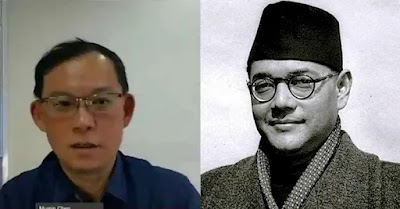
Taipei Economic and Cultural Centre’s deputy representative Mumin Chen urged Indian researchers and historians to study the disappearance of Netaji and his legacy at the country’s National Archive.
The Taipei Economic and Cultural Center in Delhi, also known as the Taiwanese Embassy, has announced that the Taiwan govt has decided to open up its National archives to study and rediscover the legacy of Netaji Subash Chandra Bose. While speaking at the 125th Birthday Celebration of Netaji Subash Chandra Bose organized by FICCI on Saturday, deputy representative Mumin Chen urged Indian researchers and historians to study information about Netaji and also his legacy which has had a huge influence over Taiwan in the 1930s and 40s.
While speaking at the event, Chen elaborated on the link of the Indian Independence struggle and its attempts in Taiwan which was then under Japanese occupation. Speaking about the Indo-Taiwan historical connections, he mentioned, “With India and Netaji, we have historical connections” that Taiwanese did not know…In the 1940s, Chiang Kai-shek (Former President of the Republic of China) wrote about Netaji in his diary. He felt sympathy…
decision to cooperate with Japanese fight for independence is understandable.” Chiang Kai-shek who ruled Taiwan until 1975 is known for his strong resistance to Japanese forces during World War II. While it is also known that Netaji had asked Japanese help to overthrow British rule in India with the Indian National Army. Chen, while narrating incidences of Netaji on the Taiwanese soil said, “Taiwan before 1945 was a Japanese colony, that is why Netaji stepped on Taiwan in 1943, and then in 1945, he came to Taiwan for the second time.”
The Taiwanese diplomat in Delhi then urged that the National Archives and other databases of information are open for Indian scholars and historians to study. He asserted that a lot of young historians interested in studying South-East Asia and India are in Taiwan. “A lot of historical documents and evidence on Netaji, and the Indian Independence movement are in Taiwan. Right now, very few Indian scholars know about it,” he added. Mumin Chen also elaborated on the bilateral need for India and Taiwan to “re-examine and re-discover the common history of Indo-Pacific” through shared common connections.
The controversy over the suspense of Netaji’s death refuses to die down. It is known that Netaji, after the plane crash in August 1945 was taken to Army Hospital in Taipei where he breathed his last. The interesting development comes when the Prime Minister of India, Narendra Modi is all set to unveil the hologramic statue of Netaji Subhas Chandra Bose at the India Gate on the occasion of his 125th Birth Anniversary.
In an interview to the BBC in February 1955, Babasaheb Ambedkar elucidated the reason why the British left India in 1947. Subsequently, Richard Attlee agreed Netaji was the toughest challenge the empire faced. Several defence and intelligence experts agreed, too.
Why even 70 years after Netaji Subhas Chandra Bose disappeared, the people of India are so keen on finding out the truth about him? A part of the answer has to do with what Netaji did for us.
Declassified records, testimonies of those who had a ringside view of events coupled with sheer commonsense make it quite evident that Netaji dealt a body blow to the British Raj. As such, for us to brush under the carpet the poignant issue of his fate — how and where he actually died — would constitute a gross affront to his memory and all those associated with him.
For reasons political, the authorities in India will never acknowledge the paramount role of Netaji in forcing the colonial British to transfer power in 1947. Perhaps, one has heard about it from someone in the family already. In a nutshell, there was not much freedom “fight” going on in India when the Second World War started in 1939. While Bose saw in it the opportunity of a lifetime and he wanted the Congress to serve a six-month ultimatum on the British to leave India, the party under Mahatma Gandhi’s leadership would not do anything to increase pressure on the colonial rulers.
Ousted from the Congress, Bose left India and became the head of the Indian National Army (INA). Many in India still scoff at the INA, contrasting it with the professional, well-trained, much bigger Indian Army, ignoring the odds Bose had overcome to organise it in such a short time.
As the INA geared up to take on the British Indian Army in the battlefields, Gandhi launched the Quit India movement in 1942, which was similar to what Bose had demanded in 1939. The movement was launched in the right earnest. But, unfortunately, it was crushed within three weeks and, in a few months, it was all over.
That Gandhi did wonders for India is true. But to say that the Quit India movement led to Independence would be stretching it too far. So what really clicked? A most logical explanation was given by Babasaheb B R Ambedkar.
In a no-holds-barred interview with BBC’s Francis Watson in February 1955, Babasaheb Ambedkar elucidated the reason why the British left India in 1947.
“I don’t know how Mr Attlee suddenly agreed to give India Independence,” wondered Ambedkar, recalling then British prime minister’s decision to agree to the transfer of power in 1947. “That is a secret that he will disclose in his autobiography. None expected that he would do that,” he added.
In October 1956, two months before Ambedkar passed away, Clement Richard Attlee disclosed in a confidential private talk that very secret. It would take two decades before the secret would trickle into the public domain.
Babasaheb Ambedkar would not have been surprised with Attlee’s admission, for he had foreseen it. He told the BBC in 1955 that from his “own analysis” he had concluded that “two things led the Labour party to take this decision” (to free India).
Ambedkar continued: “The national army that was raised by Subhas Chandra Bose. The British had been ruling the country in the firm belief that whatever may happen in the country or whatever the politicians do, they will never be able to change the loyalty of soldiers. That was one prop on which they were carrying on the administration. And that was completely dashed to pieces. They found that soldiers could be seduced to form a party — a battalion to blow off the British.”
Today, as we assess the other data on record and factor in the views of experts ranging from National Security Advisor Ajit Doval to Major General GD Bakshi, Babasaheb Ambedkar’s words couldn’t be more true.
Sir Norman Smith, director, Intelligence Bureau, noted in a secret report of November 1945: “The situation in respect of the Indian National Army is one which warrants disquiet. There has seldom been a matter which has attracted so much Indian public interest and, it is safe to say, sympathy… the threat to the security of the Indian Army is one which it would be unwise to ignore.”
Lt General S K Sinha, former Governor of Jammu and Kashmir and Assam, one of the only three Indian officers posted in the Directorate of Military Operations in New Delhi in 1946, made this observation in 1976. “There was considerable sympathy for the INA within the Army… It is true that fears of another 1857 had begun to haunt the British in 1946.”
Agreeing with this contention were a number of British MPs who met Clement Attlee in February 1946. “There are two alternative ways of meeting this common desire (a) that we should arrange to get out, (b) that we should wait to be driven out. In regard to (b), the loyalty of the Indian Army is open to question; the INA have become national heroes…”
Even in his ‘defeat’, Netaji delivered a massive blow to the British rule in India. And then when India needed him the most, he ‘disappeared’.
Don’t we owe it to Subhas Chandra Bose to know what became of him, now that we know so much that the previous generations did not?
(Below is Ambedkar’s interview to the BBC, where he talks about Bose and the INA 09:40 onwards)
For more than a decade, Anuj Dhar has devoted himself to resolving the mystery surrounding the disappearance of Subhash Chandra Bose. His 2012 bestselling book India's Biggest Cover-up (Netaji Rahasya Gatha in Hindi) triggered the demand for declassification of the Bose files. (Source: Swarajya)