Thursday, 20 February 2014


Saturday, 15 February 2014
On a houseboat in Kumarakom
The funniest part in the reception was a priest requesting the guests to give gifts to the couple. After the photo session, we had a sumptuous lunch, as usual, boiled rice, non-veg items.
After the lunch, we rushed to the hotel for a siesta, before heading towards Kumarakom. Rajeshattan told us to take rest for 1 hour, but we had a nap for over 2 hours. We checked out of the room in the evening and went to Rajeshattan’s house in Kottayam. His mother and sister at home made us feel comfortable. Tall, good looking and elegant, Rajeshattan’s mother didn’t look like a Mallu! Neither his sister did, may be because of the accent which was polished.
Later, we went to the club to inform the staff that we were going to the cottage. What I observed after travelling for two days was the roads were very narrow and maneuvering them needs skill.
The road leading to the cottage was so narrow that even if a two-wheeler came from the opposite direction, it was very difficult for both motorists.
By the time we reached the place, it was dark and couldn’t see the backwaters. The moment we stepped in, the staff informed us that there was only one room, which enraged Rajeshattan. He started shouting at the staff for not reserving the rooms, as the rooms were booked one month ago.
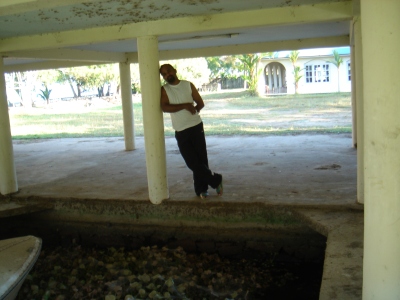
Rajeshattan had confirmed and re-confirmed the booking several times before we went there. After an hour’s shouting and making several calls, the staff had no other go but to give the room booked for someone else! His anger was legitimate. What if someone from other state visits and comes to know that the reserved rooms were given to someone else? If they don’t have any acquaintance in the place, it is very difficult to find accommodation in the night in a new place.
Though a tiring journey, the men sat for a drink and later, Rajeshattan’s friend Benny joined them.
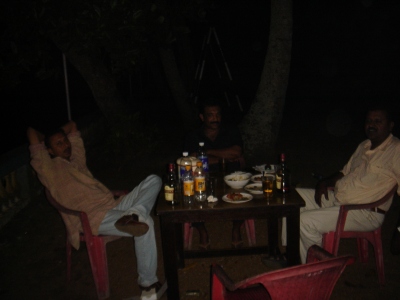
- Benny, Rajeshattan and Paapi
Viji and me shared our past sitting on a swing. Cool breeze from the backwaters gave a nice company for us.
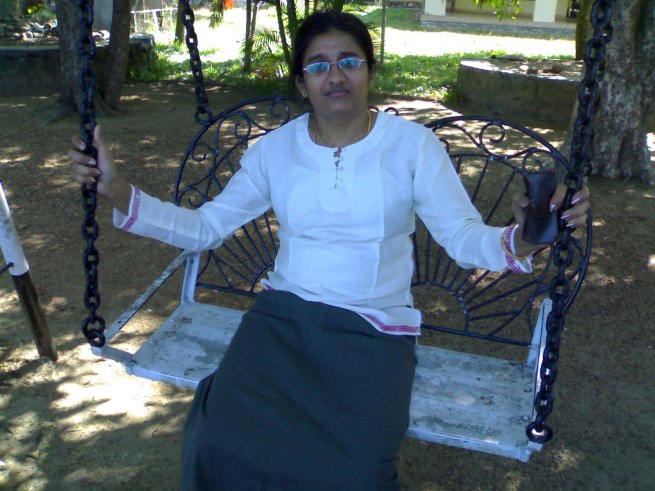
- On the swing
After eating Kerala Paratha with chicken curry, we slept off planning to get up early.
I woke up at 6 am to see the lake and it was like Oh My God! I was speechless for a moment. It looked like an ocean rather than a lake, water water every where…
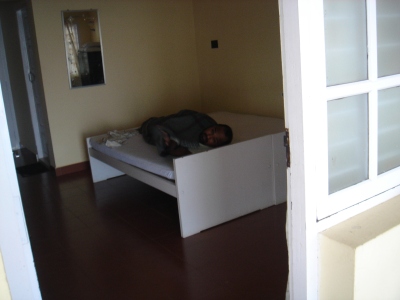
- Vij looks at kayal from the room
I woke up Vij and he didn’t mind to come out of the room even though the hangover had not gone completely. He was taken aback to see the vastness and beauty of the lake.
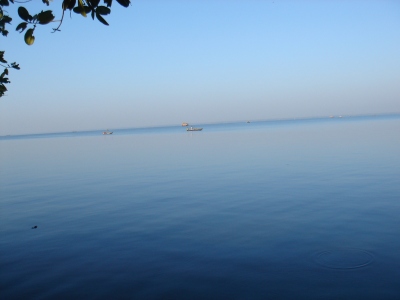
- Vembanad Lake
Both watched the serene lake and a few houseboats moving before capturing the beauty in the camera.
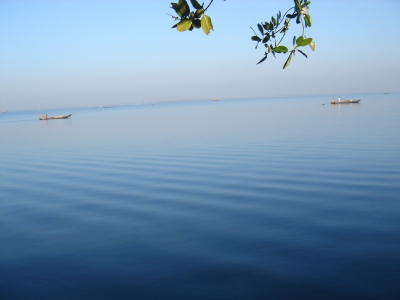
Our room in Kumarakom was a fabulous private cottage. From the wonderful location overlooking the backwaters, clean and spacious room, good cuisine, cheery, polite and attentive staff made the stay most memorable one.

The cottage was meant for club members and was not given for outsiders.
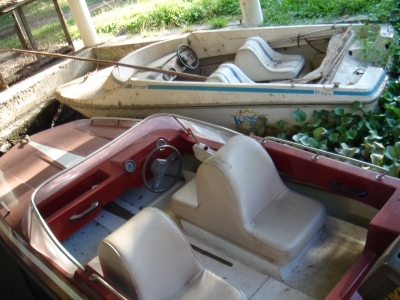
- old motor boats
There were few old motor boats anchored in the cottage.
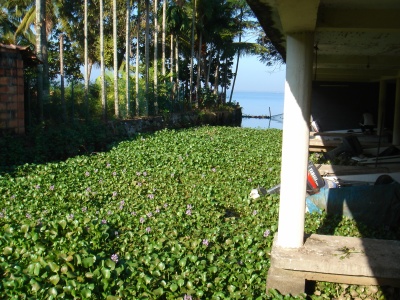
- water hyacinth (water lilies)
Water lilies completely covered the surface and we were unable to see the depth of the lake near the cottage.
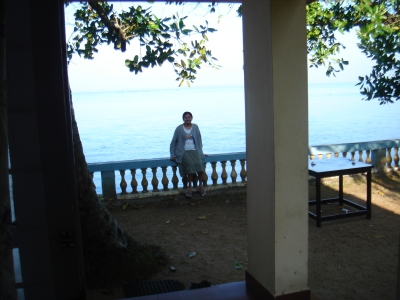
- The vast lake behind me
I was badly in need of drinking water and I remembered how sweet our Cauvery water is and I missed it there. The water didn’t taste good and I was feeling thirsty not for any water, but for our water! No other go, I asked the staff if I could get a tender coconut (red one in particular) and the person got me not one but two. It tasted so delicious that I felt like taking the other with me for the boat journey, but I didn’t.
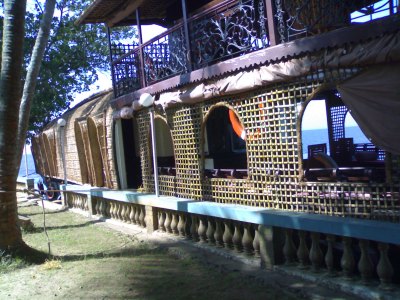
- The houseboat waiting for us near the cottage
Rajeshattan told us that Kumarakom was practically unknown till Henry Baker purchased the land from the erstwhile Raja of Travancore to build himself a grand home.
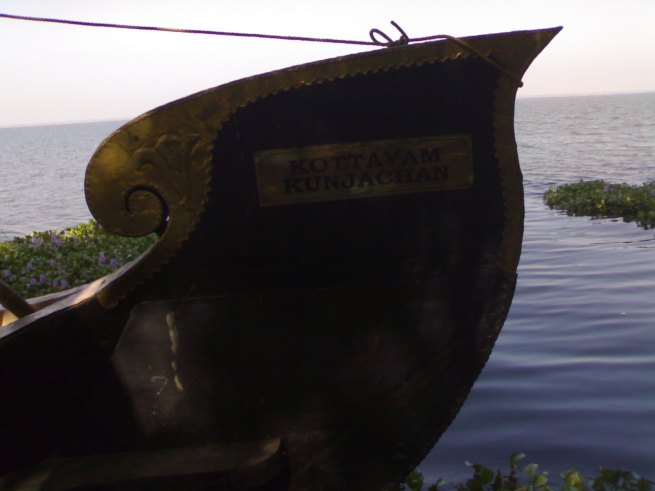
- Kottayam Kunjachan, named after a Malayalam flick
When they left India, Taj hotels stepped in to turn it into a fancy resort, changing the fortunes of the once quiet fishing hamlet. But today, it is a maze of modern resorts and heritage homes-cum-hotels spilling over the island banks.
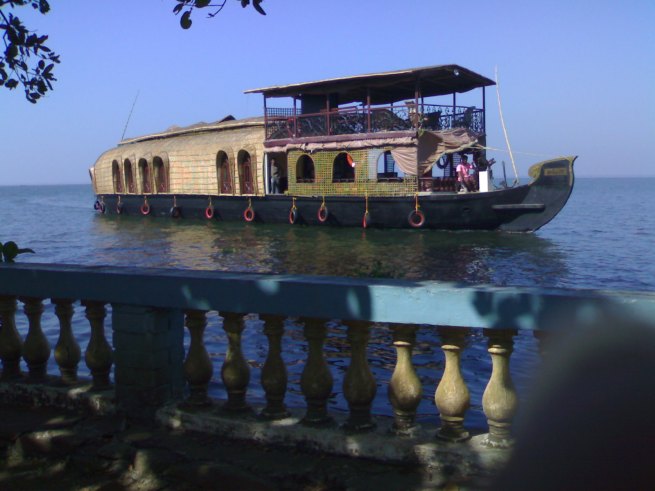
- Our houseboat coming near the cottage
The houseboat came near the cottage around 9.30 am and round 10.30 am, we embarked on a voyage of dreams in our exquisitely built houseboat. Traditionally, houseboat was called Kettuvallam, which means a boat made by tying together pieces of wood. Unbelievable as it may sound, not a single nail is used in the making of a Kettuvallam. Jack wood planks are joined together with coir rope and then coated with black resin made from boiled cashewnut shell oil, which acts as a protective coating. The roof is made of bamboo poles and palm leaves. A houseboat will be about 60 to 70 feet in length and a width of around 15 feet in the middle.
Our houseboat had well furnished and bath attached three bedrooms, sun bath-deck, lounge-cum-dining room and a kitchen. The boat had modern facilities like air condition, electric lights, fans, European style bathrooms and showers in all the three rooms.
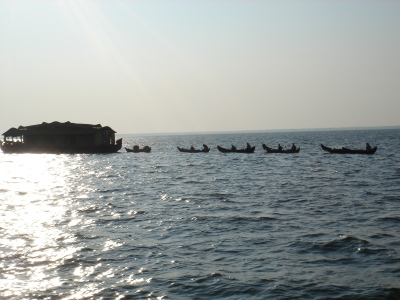
The boat looked like a mini-palace gliding along the vast green expanse of backwaters, the most exciting spectacle of the world. The simple joys of life amidst the delicate embrace of mists, was enhanced by the pleasant harmony of singing birds. Green stretches of paddy fields surrounded the rustic charm of tiny islands fringed with long rows of swaying coconut trees, as time seemed to stand still while we drifted along.
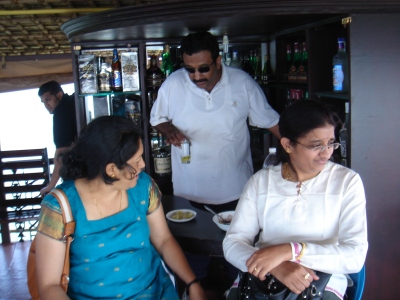
- Rajeshattan, Viji and me on the upper deck
The boat was very spacious and had lot of moving space. The view of the lake from the Sundeck (upper deck) was most spectacular.
Music, dance and jokes by Anglo-Indian friends made the journey more interesting and lively (??!!).

Two experienced boatmen navigated us through the tranquil stretches of the backwaters.
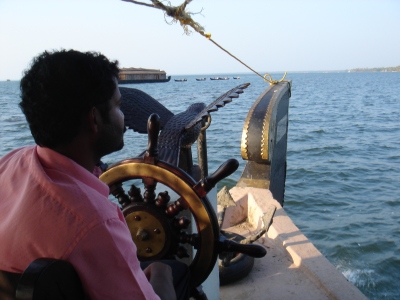
- steering the boat
All enjoyed the meals — lunch (avial, thoran, white rice, taravu, fish curry and pappadam), evening snacks (palampuri, I might be spelling it wrong, as Malayalis pronounce it with a nasal sound!), and dinner (rice, sambar, chapati, upperi and pappadam), breakfast (Idli and sambar). Rajeshattan had informed the cook that we need white rice ad not Kerala boiled rice. The food was served on time and we found the quantity to be adequate.
Vij and others, being sea food lovers enjoyed fish delicacies, as the fresh catch from the backwaters went directly from the waters to the kitchen for frying!
What more, the boat stopped near a toddy shop in an island and everybody enjoyed the drink while children kept themselves busy catching small fish in the lake.
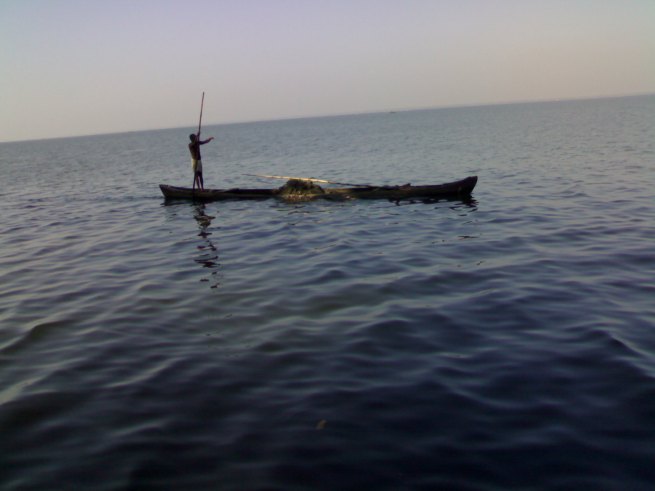
- A fisherman transporting sea muscles in his canoe
Fishermen not only catch fish in the Vembanad Lake but also small muscles, one of the dietary staples of backwater dwellers, that grow in the bottom of the lake. Fishermen take shells generated by muscles and sell it to factories.

Factories mix the shells with carbon, bake in fire till they turn white and hose with water. The chemical reaction turns them into calcium hydroxide powder.
Lying down on the bed and seeing the sprawling backwaters from the bedroom window made it a perfect holiday!
They docked the boat in the evening and it was already getting dark and my plan of going on a canoe cruise through narrow backwater channels went for a toss. Vij didn’t miss a chance to steer the houseboat when it was anchored!
They docked the boat in the evening and it was already getting dark and my plan of going on a canoe cruise through narrow backwater channels went for a toss. Vij didn’t miss a chance to steer the houseboat when it was anchored!
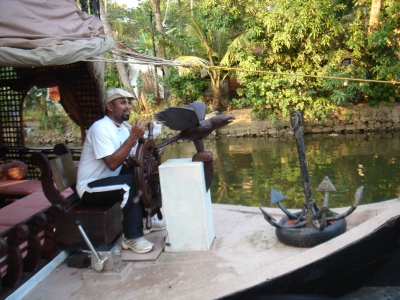
- Vij steering the boat
Eldho and his wife Sheela joined us in the evening to spend night on the houseboat. It was time to bid adieu to others, and one group went to Munnar and the other to a religious visit.
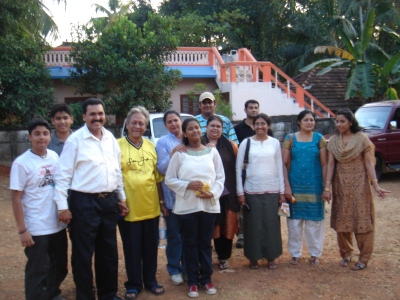
- Anglo-Indian group
We went to a small church overlooking the lake and sat on the compound of it and had a quick chat. The chat revolved around Christian beliefs and miracles.
The three men had their own time, pulling each other’s legs and we three women shared our thoughts. Eldho’s wife explained us about the working condition in Thuraif, about people, shopping and other related things.
In the meanwhile, we decided to watch a movie and caught few scenes from Mammooty’s latest flick, where his mother’s role was played by Usha Utthappa. While we were busy watching the film, Rajeshattan was busy swimming in the backwaters. He shouted from there that the water was not deep and if he stands it is coming to his shoulder level. Some parts in the lake are not deep and are shallow and fishermen take shells from such places.
During Onam festival, the lake becomes alive with boat races.
The Kerala Backwaters is a chain of brackish lagoons and lakes lying parallel to the Arabian Sea coast known as the Malabar coast. The network includes five large lakes, including Ashtamudi Kayal and Vembanad Kayal, linked by 1,500 km of canals, both man-made and natural, fed by 38 rivers, and extending virtually the entire length of the state.
Backwaters were formed by the action of waves and shore currents creating low barrier islands across the mouths of many rivers flowing down from the Western Ghats. Vembanad Lake is the largest of the lakes, covering an area of 200 sq km. It borders Alappuzha (Alleppey), Kottayam, and Ernakulam districts. The port of Kochi is located at the lake’s outlet to the Arabian Sea.
Backwaters were formed by the action of waves and shore currents creating low barrier islands across the mouths of many rivers flowing down from the Western Ghats. Vembanad Lake is the largest of the lakes, covering an area of 200 sq km. It borders Alappuzha (Alleppey), Kottayam, and Ernakulam districts. The port of Kochi is located at the lake’s outlet to the Arabian Sea.
On Tuesday morning we bid adieu to our houseboat. We visited the house of Rajeshattan to meet his mother before leaving for Kochi.
Vij and I were eager to meet see Suhana, his close friend Amar’s daughter. It had been so long since we met Amar and his wife Deepa. Eldho dropped us to Amar’s house around 2.30-3 pm.

Sunday, 2 February 2014
Wed Duniya
My latest is Wed Duniya -- an article on different types of weddings across the world -- in today's Kannada Prabha newspaper. Here's the link:


Thursday, 12 December 2013
Book review: Rajinikanth: The Definitive Biography
My latest is a book review of Rajinikanth: The Definitive Biography by Naman Ramachandran. Here's the link.


Monday, 9 December 2013
Book Review: Karma gone bad?
Karma Gone Bad by Jenny Feldon
The world comes crumbling down when a New Yorker is forced to leave the country to settle down in the land of Karma, India. Blogger Jenny Feldon chronicles her not so-easy two-year journey in her memoir Karma Gone Bad: How I Learned to Love Mangos, Bollywood and Water Buffalo (November 5, 2013).

The
memoir opens with the much pampered princess packing her designer
dresses, shoes and sling bags, as her husband Jay is transferred to
India on a two-year contract. She dreams of making friends with
glamorous expats, seeing lengths and breadths of India, practicing yoga
at the land of yoga. However, it doesn’t take much time for the newly
married 27-year-old Jenny to realize that the country she had imagined,
read and watched in movies was far from reality.
The moment she arrives in Hyderabad, which she calls ‘Bad, to emphasize her bad
experiences in the capital city of southern state Andhra Pradesh, she
feels stuck. She not only misses her beauty sessions in New York, but
also Starbucks, latest fashion trends, friends and colleagues who
supported her back home. Adding to the woes, her husband Jay falls sick
within two days of their arrival and she suffers food poisoning several
times, unable to manage with the “spicy” food.
She
finds mistakes and flaws in everybody and everything. She feels lonely
in a country which is one of the most densely populated nations in the
world and feels like losing her identity, as people address her “Madam”
and not Jenny. “Here, I was no one. A parasitic extension of my husband,
a hanger-on in the world of corporate transplants,” she laments and
blames India even for that. She fails to become “the best Indian
housewife”.
 |
| Jenny Feldon |
She
sees how life in India cannot become “a travelogue”, full of
photographs and anecdotes about her exotic new life. Unable to cope with
situations – in fact, Jenny’s little white Maltese, Tucker, copes
better than her – she abruptly leaves her husband and India within six
months. Jay, who arrives in the U.S. for Thanksgiving, discusses divorce
and she sees her mistake. She returns to India, but with a change in
the attitude and outlook.
She
realizes what the universe had been trying to tell her all along: India
didn’t need to change. Instead it is she who needs to change and
promptly does it. She stops blaming India, keeps her unrealistic
expectations to the side and accepts the country as it is: “With my new
plan in place to embrace all (or at least some) things Indian, Bollywood
didn’t seem like a bad place to start.” She
enjoys the remaining days of her stay in India, making friends with
people, visiting local market, cooking and eating Indian food. Her visit
to Taj Mahal in Agra, her interest in learning Hindi and practicing
yoga brings the circle of karma to the full. At last, she successfully finds beauty in the chaos in the land of karma.
Readers
– if not all, at least in India – will hate the narrator for the first
three-fourth of the book. Her never ending childish tantrums, complaints
and insecurities are spread all over the first 75% of the book. One
wonders why and how can she complain so much – whether it is for not
getting a latte, or for “brown people” staring at her, or for people not
standing in the queue like Americans, or fearing for the safety of her
dog!
Though
she makes an effort to enjoy her stay by embracing the Indian culture
and befriending Indians in the last quarter of the book, her initial
complaints are too strong to forget and remain in the back of mind. She
looks dismissing the Indian culture, not because India is poor or less
than any other country, but because it is not like other western
countries and the people are not like Americans!
This
sets an example for those who would like to know what happens if a
person with preconceived notion goes to live in a foreign country. There
are several references to India as a “third world”, which is quite
surprising given the fact that it is one of the competing economies and
has been outsourcing its talent across the world, mainly to the U.S.,
over the past several years.
The
memoir has some instances where readers wonder at the (poor) general
knowledge of the author who keeps wondering often at small things. When
she wonders, “Shouldn’t there be light? Buildings? No city I’d ever seen
looked so dark from the sky,” we feel like showing her the satellite
image of India on Diwali night released by NASA last year.
When
driver Venkat Reddy proudly tells her that he has brought a “foreign
car”, Hyundai, to take them, it sounds as exaggerated as when she
exclaims that the steering wheel on the right-hand side “made the car
seem cartoonish” as if she were “on a ride at Disneyland”! We feel like
reminding her that not just India, there are other 74 other countries,
including the United Kingdom, which have the steering wheel on the
right-hand side and drive on the left side of the road.
What
more, she sees a buffalo on the street and confuses it with a cow! We
can’t blame her for not watching National Geographic or Discovery or
Animal Planet, because later at some point of time she mentions that she
has seen buffaloes in zoos. She offends Indian readers when she wants
the “puja” (prayer) room for her Maltese.
The
woman who lived in the US by Zagat and not by Lonely Planet, suffers
food poisoning time and again, she buys expired imported canned food and
depends on takeaway pizzas, but dares not to cook with whatever is
available; she doesn’t wash the clothes for the first six weeks because
the house does not have a washing machine, she doesn’t even get a
faintest idea of buying a washing machine; she can’t drink coffee
because she can’t get a latte and she doesn’t think of purchasing a
coffeemaker either; she worries about charcoal pressed dresses, but not
think of buying a iron and press her clothes; she worries about her
manicure, but never tries to do it by herself; she looks for a yoga
studio, but never tries practicing at home.
Her
woes never end and she fails to open her eyes even when an Australian
tourist tells her to learn the language to know the place and the
people, as “the words come only when you teach yourself new ways to
think about them”. Instead of sympathizing with the author, Indian
readers get annoyed at her tantrums.
Things
become easy when she gets the real meaning of “When in Rome, do as the
Romans do!” After all, her “life in India was a big burnt, mishappen
cookie – delicious in spite of its imperfections”. Maybe she could have
narrated more on the issues like buffaloes, mangoes, Bollywood,
electricity, rainfall, traffic and others after her “enlightenment”.
Note: Read the original review in Kannada published in Khushi, Kannada Prabha on Dec. 08, 2013, here...
Subscribe to:
Posts (Atom)